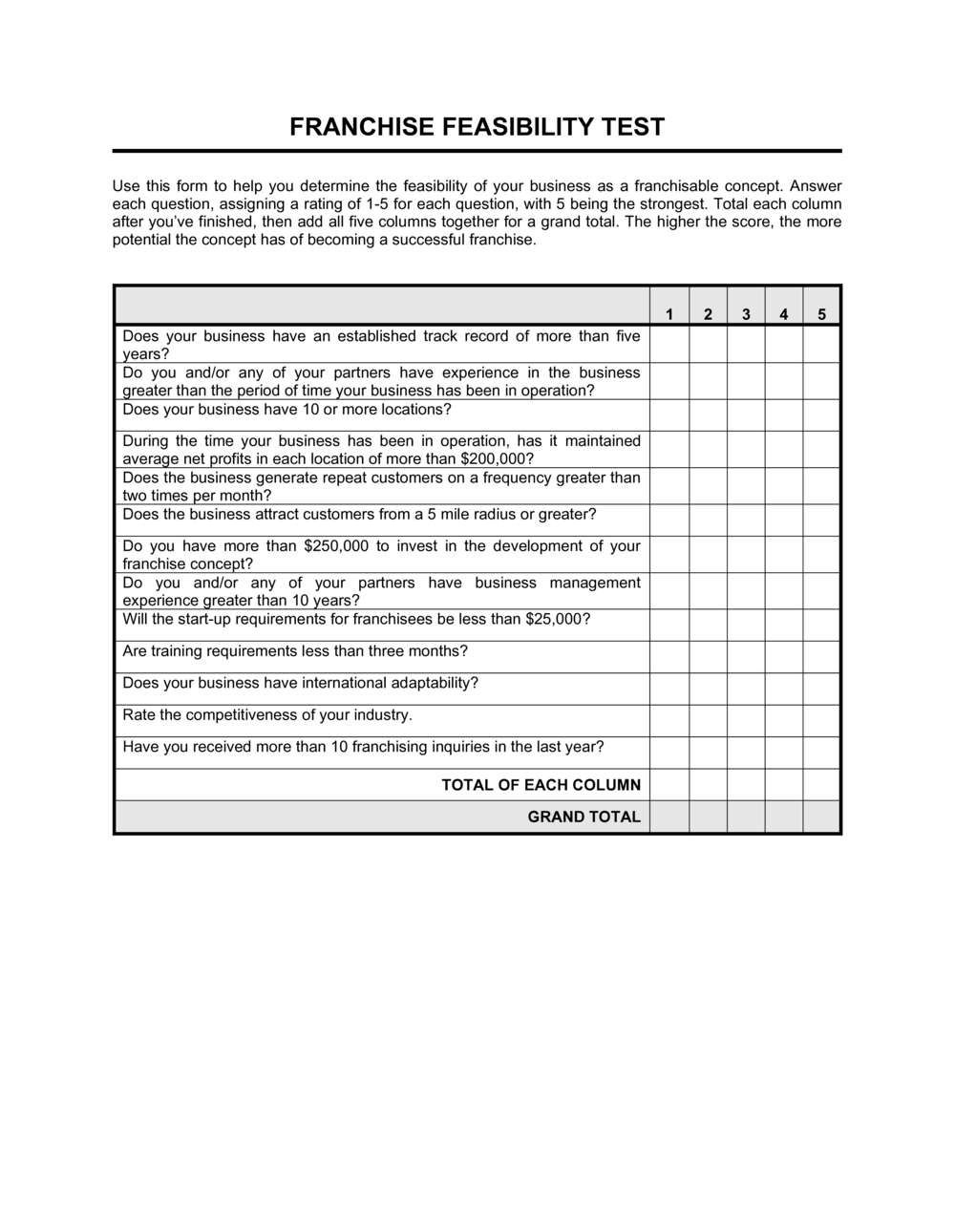
Test Franchise Feasibility Template

Free Word download • Edit online • Save & share with Drive • Export to PDF

1 page20–30 min to fillDifficulty: StandardSignature requiredLegal review recommended
Learn more ↓
FreeTest Franchise Feasibility Template

At a glance

What it is
A Test Franchise Feasibility document is a binding legal agreement used to evaluate whether a franchise concept, territory, or operator is viable before committing to a full franchise relationship. This free Word download gives franchisors and prospective franchisees a structured framework — covering territory rights, financial obligations, performance benchmarks, and exit conditions — that can be edited online and exported as PDF for execution.
When you need it
Use it when a franchisor wants to pilot a new territory or assess a prospective franchisee's operational capability before granting a long-term franchise agreement. It is also used when a prospective franchisee needs a formal, time-limited evaluation period to test the franchise model before committing capital.
What's inside
Territory definition and exclusivity terms, test period duration and performance benchmarks, financial obligations including fees and royalties, disclosure and confidentiality requirements, IP usage rights during the test period, termination and exit conditions, and conversion terms if the test period is successfully completed.

What is a Test Franchise Feasibility Document?

A Test Franchise Feasibility document is a binding legal agreement that creates a structured, time-limited evaluation period during which a franchisor and a prospective franchisee assess whether a full franchise relationship is commercially and operationally viable. It grants the franchisee limited rights to operate under the franchise system — including use of the brand, trademarks, and operational know-how — while imposing fee obligations, performance benchmarks, and compliance standards that mirror those of a full franchise agreement. Unlike a casual pilot or informal trial, a properly executed test franchise feasibility agreement is enforceable, includes IP protections and confidentiality obligations, and converts automatically into a full franchise agreement if the franchisee meets the agreed benchmarks.

Why You Need This Document

Without a formal test franchise feasibility agreement, a franchisor who allows a prospective franchisee to operate under the brand — even informally or on a handshake basis — risks creating an implied ongoing franchise relationship with no enforceable performance standards, no clean exit mechanism, and no protection for its trade secrets or trademarks. In US franchise registration states and in Canadian provinces with disclosure legislation, an undocumented test arrangement that involves a fee can trigger mandatory FDD delivery obligations and waiting periods, exposing the franchisor to rescission claims worth the full franchise fee plus damages. For the prospective franchisee, an unsigned arrangement provides no territorial protection, no defined conversion right, and no recourse if the franchisor grants a competing franchise during the test period. This template establishes clear obligations for both parties from day one, protects the brand during the evaluation, and creates a legally sound pathway to conversion — without committing either party to a long-term relationship before fit is confirmed.

Which variant fits your situation?

If your situation is…Use this template
Granting a full, long-term franchise relationship after a successful test periodFranchise Agreement
Protecting confidential franchise system information shared during evaluationNon-Disclosure Agreement (NDA)
Documenting the financial obligations of a franchisee over the full termFranchise Disclosure Document
Establishing a master franchise arrangement for a regional or national territoryMaster Franchise Agreement
Licensing brand and IP rights without a full franchise relationshipLicense Agreement
Evaluating a new business concept before franchising it at allFeasibility Study Report
Formalizing a short-term pilot of a single franchise locationLetter of Intent (Franchise)

Common mistakes to avoid

❌ Vague territory description

Why it matters: Phrases like 'the greater metro area' have no fixed legal boundary. A competitor franchisee operating 2 miles away can claim they are outside the territory, triggering costly litigation.

Fix: Define territory using ZIP codes, county names, or a radius from a specific street address, and attach a labeled map as a signed schedule.

❌ No default outcome at test period expiry

Why it matters: If the agreement is silent on what happens when the test period ends without formal action from either party, a court may find an implied ongoing franchise relationship — exposing the franchisor to full franchise obligations.

Fix: Include an explicit clause stating that the test arrangement expires automatically at the end date unless both parties execute a written conversion or extension before that date.

❌ Performance benchmarks that are unmeasurable or subjective

Why it matters: Benchmarks like 'satisfactory performance' or 'meeting brand standards' give the franchisor unlimited discretion to deny conversion and expose the agreement to a bad-faith claim.

Fix: Express every benchmark as a number: minimum dollar revenue, minimum audit score percentage, or minimum compliance inspection rating — with the source data and measurement method stated.

❌ No confidentiality survival clause

Why it matters: Without a survival clause, the franchisee's confidentiality obligation may end the moment the test period does — leaving the franchisor's trade secrets, pricing, and system details completely unprotected.

Fix: Include a clause expressly stating that confidentiality obligations survive termination or expiry for a defined period — typically 3 to 5 years.

❌ Signing after the franchisee has already begun operating

Why it matters: In common-law jurisdictions, restrictive covenants — non-compete, IP assignment, confidentiality — signed after the relationship has begun may be unenforceable without fresh consideration.

Fix: Execute all documents before the franchisee uses any mark, system knowledge, or operational process belonging to the franchisor.

❌ Omitting a debranding deadline on termination

Why it matters: A franchisee who continues displaying the franchisor's marks after termination creates consumer confusion, dilutes brand equity, and can expose the franchisor to third-party trademark claims.

Fix: State a specific deadline — typically 5 to 10 business days after termination — by which the franchisee must remove all signage, uniforms, and branded materials.

The 10 key clauses, explained

Parties, Recitals, and Purpose

In plain language: Identifies the franchisor and franchisee as legal entities, states the purpose of the test arrangement, and confirms that no full franchise rights are granted until the test period is successfully completed.

Sample language
This Test Franchise Feasibility Agreement is entered into on [DATE] between [FRANCHISOR LEGAL NAME], a [STATE/COUNTRY] [ENTITY TYPE] ('Franchisor'), and [FRANCHISEE LEGAL NAME], a [STATE/COUNTRY] [ENTITY TYPE] ('Franchisee'). The parties wish to evaluate the feasibility of a franchise relationship in the territory described herein, subject to the terms below.

Common mistake: Using a trade name instead of the registered legal entity name for either party — if a dispute arises, enforcing obligations against the correct legal entity becomes significantly harder.

Test Period, Duration, and Renewal

In plain language: Sets the start and end date of the evaluation period, conditions under which it may be extended, and what happens automatically if neither party acts at expiry.

Sample language
The Test Period shall commence on [START DATE] and expire on [END DATE], unless earlier terminated. The parties may extend the Test Period by mutual written consent for up to [X] additional months. Absent written notice from either party at least [30] days before expiry, the Test Period shall expire without conversion.

Common mistake: Failing to specify what happens at expiry by default — if the document is silent, a franchisee who continues operating after the end date may claim an implied ongoing agreement.

Territory Definition and Exclusivity

In plain language: Defines the geographic area where the franchisee may operate during the test period and whether the franchisor is restricted from granting competing rights in that area.

Sample language
Franchisee is granted a non-exclusive / exclusive right to operate the Franchise System within the territory defined as [GEOGRAPHIC DESCRIPTION — e.g., ZIP codes, county boundaries, or radius from address] ('Territory'). Franchisor [shall / shall not] grant additional franchise rights within the Territory during the Test Period.

Common mistake: Granting territorial exclusivity without a population or revenue floor condition. A large exclusive territory with no performance floor locks out the franchisor regardless of how poorly the test is performing.

Financial Obligations — Fees and Royalties

In plain language: States the initial test fee, ongoing royalty percentage, marketing fund contribution, and any minimum revenue commitment required during the test period.

Sample language
Franchisee shall pay Franchisor an initial Test Fee of $[AMOUNT] on execution. Franchisee shall pay a weekly royalty of [X]% of Gross Sales and a marketing fund contribution of [Y]% of Gross Sales, due every [FRIDAY / 15th of each month].

Common mistake: Defining 'Gross Sales' inconsistently with the full franchise agreement you intend to use later — a mismatch creates a royalty calculation dispute at conversion.

Performance Benchmarks and Compliance Standards

In plain language: Sets the specific, measurable targets the franchisee must hit to pass the test period and qualify for conversion to a full franchise agreement.

Sample language
To qualify for conversion, Franchisee must: (a) achieve minimum Gross Sales of $[AMOUNT] per month for at least [X] consecutive months; (b) achieve a customer satisfaction score of at least [X]% on Franchisor's standard audit; and (c) pass [X] unannounced compliance inspections with a score of at least [Y]%.

Common mistake: Setting benchmarks so high that no test franchisee can realistically meet them, or so low they provide no meaningful evaluation. Benchmarks should reflect the bottom quartile of the existing franchise system's performance.

IP License and Use of Brand

In plain language: Grants the franchisee a limited, non-transferable license to use the franchisor's trademarks, trade dress, and systems during the test period only — and strictly within the defined territory.

Sample language
Franchisor grants Franchisee a limited, non-exclusive, non-transferable license to use the Marks and System solely within the Territory during the Test Period, in strict accordance with Franchisor's brand standards as set out in the Operations Manual. This license terminates automatically upon expiry or earlier termination of this Agreement.

Common mistake: Omitting a brand-standards compliance obligation on the IP license. A franchisee who misuses the trademark during the test period can damage brand equity and third-party trademark rights without an enforceable remedy.

Confidentiality and Non-Disclosure

In plain language: Prohibits both parties from disclosing the other's confidential information — system details, financials, customer data — during and after the test period.

Sample language
Each party agrees to hold in strict confidence all Confidential Information received from the other party and not to use or disclose it except as necessary to perform obligations under this Agreement. Confidentiality obligations survive termination of this Agreement for a period of [X] years.

Common mistake: No survival clause on confidentiality — once the test period ends, the franchisee retains full knowledge of the franchise system's trade secrets unless the obligation explicitly continues post-termination.

Termination for Cause and Without Cause

In plain language: States the grounds for immediate termination (material breach, insolvency, fraud) and the notice period required for termination without cause, including any compensation due.

Sample language
Franchisor may terminate this Agreement immediately upon written notice if Franchisee: (a) fails to cure a material breach within [10] business days of written notice; (b) becomes insolvent or files for bankruptcy; or (c) commits fraud or criminal conduct affecting the Franchise System. Either party may terminate without cause on [30] days' written notice.

Common mistake: Including only termination for cause with no without-cause mechanism — this can trap both parties in a deteriorating test relationship with no clean exit.

Post-Termination Obligations and Non-Compete

In plain language: Sets what the franchisee must do upon exit — debranding, return of materials, final royalty settlement — and the scope of any post-termination non-compete restriction.

Sample language
Upon termination or expiry, Franchisee shall immediately: (a) cease using all Marks and Confidential Information; (b) return all Operations Manuals and proprietary materials; and (c) pay all outstanding fees within [10] business days. Franchisee shall not operate a Competing Business within the Territory for [12] months following termination.

Common mistake: No debranding deadline — franchisees who continue displaying the franchisor's marks after termination create consumer confusion and potential liability under trademark law.

Conversion to Full Franchise Agreement

In plain language: Sets out the conditions, process, and timeline for converting a successful test period into a binding long-term franchise agreement — including whether a new franchise fee is payable at conversion.

Sample language
If Franchisee satisfies all Performance Benchmarks and is not in breach of this Agreement at expiry, Franchisor shall, within [30] days of expiry, offer Franchisee a standard Franchise Agreement for the Territory. The initial Test Fee [shall / shall not] be credited against the franchise fee payable under the full Franchise Agreement.

Common mistake: Not specifying whether the test fee is credited at conversion — omitting this creates a fee dispute at the moment of greatest goodwill between the parties.

How to fill it out

  1. 1

    Enter the legal entity names for both parties

    Use each party's full registered corporate or LLC name — not a brand or operating name. Confirm entity type (corporation, LLC, partnership) and jurisdiction of formation for both franchisor and franchisee.

    💡 Cross-reference the franchisor's FDD or registration filing to confirm the exact registered entity name before execution.

  2. 2

    Define the territory with a precise geographic description

    Avoid vague language like 'the greater [CITY] area.' Use ZIP codes, county boundaries, a defined radius from a street address, or a map exhibit attached as Schedule A. State explicitly whether exclusivity applies.

    💡 Attach a labeled map as Schedule A and have both parties initial it — territorial disputes are the most common source of franchise litigation.

  3. 3

    Set the test period start date, end date, and extension mechanics

    Enter a specific calendar start date and a firm end date — typically 3 to 12 months out. Include a mutual written-consent extension clause and specify the default outcome if no action is taken at expiry.

    💡 A 6-month test period is the practical minimum for evaluating seasonal businesses; a 12-month test captures a full seasonal cycle.

  4. 4

    Specify all financial obligations with exact figures

    Enter the initial test fee, royalty percentage, and marketing fund contribution. Define 'Gross Sales' using the same language you plan to use in the full franchise agreement to avoid conversion disputes.

    💡 State the currency explicitly, especially for cross-border arrangements — USD and CAD are routinely confused without an explicit currency code.

  5. 5

    Set measurable performance benchmarks

    Translate your conversion criteria into specific, quantified benchmarks: minimum monthly revenue, compliance audit scores, and customer satisfaction thresholds. Reference the metric, the minimum threshold, and the measurement period.

    💡 Base benchmarks on the bottom quartile of your existing franchise system — this filters out genuinely unsuitable operators without setting an impossible bar.

  6. 6

    Complete the IP license and brand-standards reference

    Confirm the marks being licensed, reference the Operations Manual by version or date, and state that the license is non-transferable and territory-limited. Include a clause requiring the franchisee to notify the franchisor of any unauthorized third-party use of the marks.

    💡 Attach a Schedule B listing all licensed trademarks with their registration numbers to prevent scope disputes.

  7. 7

    Draft the termination and post-termination obligations

    Set the notice period for without-cause termination and the cure period for breach. List all post-termination obligations — debranding, return of materials, final fee payment — and specify the non-compete duration and geographic scope.

    💡 A 10-business-day cure period for financial defaults is standard; operational breaches affecting brand quality or safety may warrant immediate termination rights.

  8. 8

    Sign before the franchisee begins any operations under the system

    Both parties must execute the agreement before the franchisee uses any of the franchisor's marks, systems, or confidential information. Execution after the franchisee has already begun operating may void restrictive covenants and create an implied license.

    💡 Use a timestamped eSign solution and store the fully executed copy in a shared document repository accessible to both parties.

Frequently asked questions

What is a test franchise feasibility agreement?

A test franchise feasibility agreement is a binding legal document that establishes a time-limited evaluation period during which a franchisor and prospective franchisee assess whether a full franchise relationship is viable. It grants the franchisee limited rights to operate under the franchise system — including use of the brand and operational know-how — in exchange for fees and compliance with performance benchmarks, without committing either party to a long-term franchise agreement. If the franchisee meets the benchmarks, the agreement typically includes a conversion right to a full franchise agreement.

How is a test franchise feasibility agreement different from a full franchise agreement?

A full franchise agreement grants long-term, comprehensive rights to operate a franchise location — typically 5 to 20 years — with a substantial upfront franchise fee. A test franchise feasibility agreement is shorter (3 to 12 months), involves a smaller initial fee, and conditions conversion to a full agreement on the franchisee meeting specific performance benchmarks. The test arrangement protects both parties from a premature long-term commitment before operational compatibility is confirmed.

Is a test franchise feasibility agreement legally binding?

Yes. Despite its evaluative purpose, a properly executed test franchise feasibility agreement is generally enforceable as a binding contract in most jurisdictions when it includes offer, acceptance, and consideration. Obligations including confidentiality, royalty payments, IP usage restrictions, and post-termination non-competes are all enforceable during and after the test period, provided the agreement is signed before the franchisee begins operating under the system.

What performance benchmarks should a test franchise feasibility agreement include?

Benchmarks should be specific and measurable: minimum monthly gross revenue (e.g., $25,000 per month for at least 4 consecutive months), compliance audit scores (e.g., a minimum of 80% on unannounced inspections), and customer satisfaction scores if the system uses them. Subjective standards like "satisfactory performance" should be avoided — they give unlimited discretion to the franchisor and expose the agreement to bad-faith claims if conversion is denied.

Does the test fee paid during the evaluation period apply toward the full franchise fee?

This depends entirely on what the agreement says. Some franchisors credit the test fee in full against the franchise fee payable at conversion; others treat it as a separate, non-refundable evaluation fee. The agreement should state explicitly whether a credit applies — omitting this creates a fee dispute at conversion, precisely when both parties want to be focused on finalizing the long-term relationship.

Do I need to comply with franchise disclosure laws during a test arrangement?

In the United States, FTC Franchise Rule disclosure requirements typically apply whenever a franchisee pays a fee and operates under a common marketing plan — conditions that a test arrangement may satisfy. Several states impose additional pre-sale disclosure requirements with waiting periods that apply regardless of how the arrangement is labeled. Franchisors should obtain legal advice before structuring a test arrangement in any US state with franchise registration requirements, including California, Illinois, Maryland, and New York.

Can a franchisor terminate a test franchise feasibility agreement early?

Yes, if the agreement includes appropriate termination rights. Most test franchise agreements allow the franchisor to terminate immediately for material breach — such as failure to pay royalties, unauthorized brand use, or insolvency — and to terminate without cause on a defined notice period (typically 30 days). Without-cause termination is important because it allows the franchisor to exit a test that is technically compliant but commercially unsuitable, without exposing the agreement to an implied-permanent-relationship claim.

What happens to the franchisee's obligations after the test period ends?

Post-termination obligations survive the end of the test period regardless of the reason for exit. These typically include immediate debranding and removal of all signage and branded materials, return of the confidential operations manual and all proprietary materials, payment of all outstanding royalties and fees within a defined deadline, and compliance with any non-compete restriction for the duration stated in the agreement. Confidentiality obligations typically survive for 3 to 5 years after exit.

Is a test franchise feasibility agreement required by law?

No law specifically requires this form of document — it is a contractually negotiated tool that both parties choose to use rather than jumping directly to a full franchise agreement. However, once a franchisor decides to structure a test arrangement, documenting it with a binding agreement is strongly advisable. An informal trial period with no written terms creates ambiguity about IP ownership, fee obligations, and post-termination restrictions that courts may resolve against the franchisor.

How this compares to alternatives

vs Franchise Agreement

A full franchise agreement grants long-term operating rights — typically 5 to 20 years — with a substantial upfront fee and no exit optionality without breach or default. A test franchise feasibility agreement is a short-term, conditional evaluation with a clean expiry mechanism. Use the test document first to confirm operational and financial fit before committing either party to the full long-term agreement.

vs Letter of Intent (Franchise)

A letter of intent records non-binding terms in principle — interest in a franchise relationship, a proposed territory, and indicative financials. It does not grant IP usage rights, impose royalty obligations, or set enforceable performance benchmarks. A test franchise feasibility agreement is fully binding and includes all operational and financial obligations for the duration of the test period.

vs Master Franchise Agreement

A master franchise agreement grants rights to sub-franchise an entire region or country — a major, long-term commitment. A test franchise feasibility agreement is used to evaluate whether a single operator is suitable for a single territory before granting any sub-franchising rights. Franchisors expanding internationally often use a test document before executing a master arrangement.

vs License Agreement

A license agreement grants rights to use IP without the broader operational framework — training, systems, compliance standards, and brand obligations — that characterize a franchise relationship. A test franchise feasibility agreement includes an IP license as one component, but also imposes the operational, financial, and performance obligations that define a franchise. Using a license agreement to avoid franchise disclosure laws is a regulated practice in most jurisdictions.

Industry-specific considerations

Food and Beverage

Test periods assess kitchen compliance, health inspection results, and average transaction value — all of which vary significantly before a franchisee reaches operating maturity.

Retail

Inventory management compliance, visual merchandising standards, and same-store sales trajectory are the critical benchmarks evaluated during a retail franchise test period.

Professional Services

Licensing and credential requirements for the franchisee's principals must be confirmed before conversion, as regulatory non-compliance can void the full franchise agreement in many states.

Fitness and Wellness

Member acquisition rate and retention after the first 90 days are the primary conversion benchmarks, alongside brand presentation and trainer certification compliance.

Technology and SaaS

Software-enabled franchise systems use test periods to evaluate franchisee adoption of proprietary platforms, data reporting compliance, and customer onboarding metrics.

Home Services

Insurance coverage verification, technician certification, and customer satisfaction scores from the first 50 jobs are standard feasibility benchmarks in this sector.

Jurisdictional notes

United States

The FTC Franchise Rule requires franchisors to provide a Franchise Disclosure Document (FDD) at least 14 calendar days before any fee is paid or agreement signed — conditions that many test arrangements satisfy. Fifteen states (including California, Illinois, Maryland, Minnesota, New York, and Washington) have independent franchise registration laws with additional waiting periods and filing requirements. Structuring a test arrangement to avoid FDD disclosure is a common compliance error with significant civil and criminal exposure.

Canada

Five Canadian provinces — Alberta, British Columbia, Manitoba, Ontario, and Prince Edward Island — have franchise disclosure legislation that requires a compliant disclosure document to be delivered at least 14 days before a prospective franchisee signs any agreement or pays any fee. A test franchise feasibility agreement that involves a fee and a marketing plan almost certainly triggers provincial disclosure obligations. Quebec does not currently have franchise-specific legislation but general civil law principles apply.

United Kingdom

The UK has no statutory franchise disclosure regime, but the British Franchise Association (BFA) Code of Ethics establishes industry standards that most institutional lenders and prospective franchisees expect franchisors to follow. Test arrangements must comply with general contract law, IP licensing rules, and Competition and Markets Authority guidelines on exclusivity clauses. Post-Brexit, EU block exemptions no longer apply automatically and individual assessment under UK competition law is required for territorial restrictions.

European Union

The EU has no harmonized franchise disclosure regulation, but several member states — including France, Italy, Spain, and Belgium — have national franchise laws requiring pre-sale disclosure with mandatory waiting periods of 20 to 30 days. Territorial exclusivity clauses in franchise agreements are assessed under the EU Vertical Agreements Block Exemption Regulation (VABER), which permits exclusivity only below a 30% market share threshold. GDPR obligations apply to any customer or franchisee data shared during the test period.

Template vs lawyer — what fits your deal?

PathBest forCostTime
Use the templateEstablished franchisors running a domestic single-territory pilot with an experienced franchisee candidateFree30–60 minutes to customize and execute
Template + legal reviewFirst-time franchisors, multi-territory pilots, or any test arrangement in a US franchise registration state$500–$1,500 for a franchise attorney review3–7 business days
Custom draftedInternational test arrangements, master franchise pilots, regulated industries (healthcare, financial services), or test periods with complex equity or conversion provisions$2,500–$8,000+2–4 weeks

Glossary

Test Period
A defined, time-limited window — typically 3 to 12 months — during which the franchise concept or franchisee is evaluated against agreed performance benchmarks before a full franchise agreement is executed.
Territorial Exclusivity
A contractual right preventing the franchisor from granting another franchise within a defined geographic area during the test period.
Franchise Disclosure Document (FDD)
A legally mandated pre-sale disclosure document in the US that provides prospective franchisees with 23 categories of material information about the franchisor and the franchise system.
Royalty Fee
A recurring payment — typically a percentage of gross sales — paid by the franchisee to the franchisor in exchange for the right to operate under the franchise system.
Performance Benchmark
A measurable operational or financial target the franchisee must meet during the test period, such as minimum weekly revenue, customer satisfaction scores, or compliance audit results.
Conversion Right
A contractual option allowing either party to convert the test arrangement into a full, long-term franchise agreement upon successful completion of the test period.
Confidential Operations Manual
A franchisor's proprietary document detailing the systems, processes, and standards franchisees must follow — shared during the test period under strict confidentiality obligations.
Intellectual Property (IP) License
A limited grant of rights allowing the franchisee to use the franchisor's trademarks, trade dress, and know-how for the duration of the test period only.
Termination for Cause
The franchisor's right to end the test arrangement immediately — without notice or compensation — upon documented material breach by the franchisee.
Non-Compete Obligation
A post-termination restriction preventing a franchisee who exits the test arrangement from operating a competing business within the defined territory for a specified period.
Material Breach
A failure by one party that is significant enough to undermine the purpose of the agreement and entitle the other party to terminate or seek damages.
Master Franchise
An arrangement in which a single operator is granted the right to sub-franchise within a defined region or country, acting as a local franchisor on behalf of the parent brand.

Part of your Business Operating System

This document is one of 3,000+ business & legal templates included in Business in a Box.

  • Fill-in-the-blanks — ready in minutes
  • 100% customizable Word document
  • Compatible with all office suites
  • Export to PDF and share electronically

Create your document in 3 simple steps.

From template to signed document — all inside one Business Operating System.
1
Download or open template

Access over 3,000+ business and legal templates for any business task, project or initiative.

2
Edit and fill in the blanks with AI

Customize your ready-made business document template and save it in the cloud.

3
Save, Share, Send, Sign

Share your files and folders with your team. Create a space of seamless collaboration.

Save time, save money, and create top-quality documents.

★★★★★

"Fantastic value! I'm not sure how I'd do without it. It's worth its weight in gold and paid back for itself many times."

Managing Director · Mall Farm
Robert Whalley
Managing Director, Mall Farm Proprietary Limited
★★★★★

"I have been using Business in a Box for years. It has been the most useful source of templates I have encountered. I recommend it to anyone."

Business Owner · 4+ years
Dr Michael John Freestone
Business Owner
★★★★★

"It has been a life saver so many times I have lost count. Business in a Box has saved me so much time and as you know, time is money."

Owner · Upstate Web
David G. Moore Jr.
Owner, Upstate Web

Run your business with a system — not scattered tools

Stop downloading documents. Start operating with clarity. Business in a Box gives you the Business Operating System used by over 250,000 companies worldwide to structure, run, and grow their business.

Free Forever Plan · No credit card required