Subordination and Cession of Priority Leased Equipment Template

Free Word download • Edit online • Save & share with Drive • Export to PDF

1 page20–30 min to fillDifficulty: StandardSignature requiredLegal review recommended
Learn more ↓
FreeSubordination and Cession of Priority Leased Equipment Template

At a glance

What it is
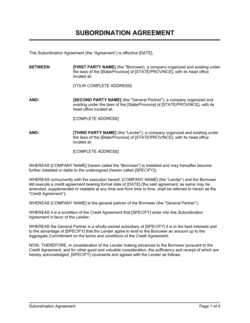
A Subordination and Cession of Priority for Leased Equipment is a legally binding agreement in which one secured party — typically a lessor or equipment financier — agrees to subordinate its priority interest in specific leased equipment to another secured creditor, such as a senior lender. This free Word download gives you a structured starting point you can edit online and export as PDF for execution by all relevant parties.
When you need it
Use it when a lessee's senior lender requires that existing equipment lease interests be ranked below the lender's security interest as a condition of extending credit or refinancing. It is also triggered when multiple creditors have competing claims over the same leased assets and the parties need to establish a clear, documented priority order.
What's inside
The agreement covers identification of the parties and the equipment, the subordination declaration and ranking of interests, cession of priority rights, conditions precedent to the subordination taking effect, representations and warranties by each party, governing law, and execution blocks for all signatories.

What is a Subordination and Cession of Priority for Leased Equipment?

A Subordination and Cession of Priority for Leased Equipment is a legally binding agreement in which a lessor or junior creditor formally reorders its priority ranking in specific leased equipment relative to a senior lender. The subordinating party — typically the equipment owner or financing party — agrees that its interest ranks below the senior lender's security interest, and cedes its higher priority position to that lender so the lender effectively steps into first place for enforcement purposes. The agreement does not extinguish the lessor's underlying ownership or lease rights; it reorders those rights in a documented priority waterfall that all parties acknowledge and are bound by.

Why You Need This Document

Without a properly executed subordination and cession of priority, a senior lender has no assurance that its security interest in leased equipment will survive a priority challenge from the lessor — especially in insolvency, where competing creditors assert every available claim. Most institutional lenders list this agreement as a condition precedent to funding: the credit facility simply does not close until all prior interests are subordinated and documented. For the lessee, the absence of this document can stall a financing for weeks while creditors argue over ranking, delay an SBA or bank loan approval, or expose the business to competing enforcement actions if it later defaults. For the lessor, failing to document an agreed subordination creates ambiguity that can result in a court-ordered ranking the lessor never intended. This template gives all three parties — lessor, lender, and lessee — a clear, enforceable record of the agreed priority structure, reducing enforcement disputes and protecting each party's legitimate interests within that structure.

Which variant fits your situation?

If your situation is…Use this template
Senior lender requires all lease interests subordinated before extending creditSubordination and Cession of Priority Leased Equipment
Landlord must subordinate property interest to a mortgage lenderSubordination, Non-Disturbance and Attornment Agreement (SNDA)
Multiple lenders need to agree on priority order for a single assetIntercreditor Agreement
Lessee needs to confirm lease survives lender enforcement actionNon-Disturbance Agreement
Lender takes a blanket security interest over all business assets including leased equipmentGeneral Security Agreement
Equipment financier and operating lessor need to allocate residual value rightsEquipment Lease Agreement
Secured party needs to formally release its registered priority interestRelease and Discharge of Security Interest

Common mistakes to avoid

❌ Failing to identify all registered interest holders

Why it matters: A secured party not named in or bound by the subordination retains its original priority ranking, potentially sitting ahead of the senior lender despite the agreement. The subordination achieves nothing as against that party.

Fix: Run a full UCC, PPSA, or applicable personal property registry search before drafting. Require every party with a registered interest in the equipment to execute the agreement or provide a separate release.

❌ Using generic equipment descriptions without a Schedule A

Why it matters: An ambiguous description — 'all leased equipment on premises' — creates disputes about whether a specific high-value asset is covered. Courts have declined to enforce subordinations where the collateral could not be identified with certainty.

Fix: Attach a Schedule A listing every piece of equipment by make, model, serial number, and location. Update the schedule if additional equipment is added to the lease during the credit facility term.

❌ Omitting consideration for the cession of priority

Why it matters: A gratuitous promise to cede priority — with no benefit flowing to the ceding party — is at risk of being set aside as unenforceable in common-law jurisdictions, particularly if the subordinating party later faces financial difficulty.

Fix: Include express consideration — a fee, a reduction in interest rate, a covenant from the lender, or even a nominal stated amount — and recite it in the agreement. Adequacy of consideration is rarely reviewed; existence is mandatory.

❌ Signing after the lender has already registered its security interest

Why it matters: Priority under Article 9 (UCC) and equivalent PPSA regimes is generally determined by the order of registration, not by the date of the agreement. A post-registration subordination may not retroactively alter a priority ranking that has already been established by filing dates.

Fix: Coordinate execution and registration so the subordination agreement is signed before — or simultaneously with — the lender's security registration. Document the sequence carefully.

❌ No notice period for the lessor before enforcement

Why it matters: If the senior lender repossesses or sells equipment without notifying the lessor, the lessor loses the opportunity to cure the lessee's default, protect its residual interest, or retrieve its property through appropriate legal channels.

Fix: Include a clause requiring the lender to give the lessor written notice of default and a minimum cure period — typically 10–30 days — before exercising any enforcement remedy against the equipment.

❌ Selecting a governing law that differs from the equipment's location

Why it matters: Priority over tangible personal property — including leased equipment — is determined by the law of the jurisdiction where the property is situated, not where the contract was signed or the parties are incorporated. A mismatched governing-law clause can make the priority ranking unenforceable in the jurisdiction that matters.

Fix: Always align the governing law clause with the state, province, or country where the equipment is physically located. If equipment is in multiple locations, consider a multi-schedule approach with jurisdiction-specific governing law for each group.

The 10 key clauses, explained

Recitals and identification of parties

In plain language: Names each party to the agreement — the subordinating party (lessor or junior creditor), the benefiting party (senior lender), and the lessee — and recites the background facts that give rise to the need for subordination.

Sample language
WHEREAS [LESSOR NAME] ('Lessor') holds a lease interest in the equipment described in Schedule A ('Equipment') pursuant to the Equipment Lease dated [DATE]; and WHEREAS [LENDER NAME] ('Senior Lender') has agreed to extend credit to [LESSEE NAME] ('Lessee') subject to the subordination of Lessor's interest as set out herein.

Common mistake: Failing to name every party that holds any registered or unregistered interest in the equipment. An unnamed party is not bound by the subordination and can later assert priority, defeating the entire purpose of the agreement.

Description and identification of leased equipment

In plain language: Precisely identifies the specific equipment subject to the subordination — make, model, serial number, and any registration or asset identification numbers — so there is no dispute about what is covered.

Sample language
The Equipment subject to this Agreement is described in Schedule A and includes: [MAKE AND MODEL], Serial No. [SERIAL NUMBER], Asset ID [ASSET ID], currently located at [ADDRESS/LOCATION].

Common mistake: Using a generic description such as 'all leased equipment' without a Schedule A. Ambiguous identification creates disputes about whether a specific asset is covered and may render the subordination unenforceable as to that asset.

Subordination declaration

In plain language: The operative clause in which the subordinating party formally agrees that its interest in the equipment ranks below the senior lender's security interest, in the priority order stated.

Sample language
[LESSOR NAME] hereby subordinates its lease interest, ownership claim, and any security interest it holds in the Equipment to the security interest of [LENDER NAME] arising under the [SECURITY AGREEMENT / GENERAL SECURITY AGREEMENT] dated [DATE], such that [LENDER NAME]'s interest shall rank in priority to the Lessor's interest in all respects.

Common mistake: Limiting the subordination to 'lien claims' only while leaving ownership rights unsaid. In a true lease, the lessor owns the equipment — if ownership is not expressly addressed, the senior lender may have a junior claim despite the subordination clause.

Cession of priority

In plain language: The formal cession by which the subordinating party transfers its higher-ranking priority position to the senior lender, so the lender steps into first position even if it registered later.

Sample language
[LESSOR NAME] hereby cedes, transfers, and assigns to [LENDER NAME] all priority rights it holds or may hold in the Equipment, such that [LENDER NAME] shall be deemed to have first-ranking priority in the Equipment from the date of this Agreement.

Common mistake: Confusing a cession of priority with an assignment of the lease itself. The cession transfers the priority position only — the lessor retains its substantive rights under the lease; only the ranking changes.

Conditions precedent

In plain language: Lists the conditions that must be satisfied before the subordination and cession take effect — typically execution by all parties, payment of consideration, and confirmation of the senior lender's security registration.

Sample language
This Agreement shall become effective only upon: (a) execution by all parties hereto; (b) registration by [LENDER NAME] of a financing statement in respect of the Equipment in [JURISDICTION]; and (c) payment by [LENDER NAME] to [LESSOR NAME] of the sum of $[AMOUNT] as consideration for the cession of priority.

Common mistake: Omitting a consideration clause. In common-law jurisdictions, a cession of priority without consideration may be challenged as a gratuitous promise and found unenforceable. Even a nominal amount — $1.00 — satisfies the requirement.

Representations and warranties

In plain language: Each party confirms key facts: the lessor warrants it holds valid title or a perfected interest in the equipment; the lender warrants its security agreement is validly executed; the lessee confirms no other undisclosed encumbrances exist.

Sample language
Lessor represents and warrants that: (a) it holds valid legal title to the Equipment free of undisclosed encumbrances; (b) the Equipment Lease is in full force and effect; and (c) no other person has been granted a security interest or priority over the Equipment except as disclosed herein.

Common mistake: Lessee not providing any warranties. The lessee is the party best positioned to know about undisclosed encumbrances — omitting lessee representations leaves the senior lender exposed to hidden claims.

Non-disturbance and quiet enjoyment

In plain language: Protects the lessee's right to continue using the equipment undisturbed during the lease term even if the senior lender enforces its security interest — so the lessee is not evicted from possession simply because the lender exercised its rights.

Sample language
So long as Lessee is not in default under the Equipment Lease, [LENDER NAME] agrees that it shall not disturb Lessee's possession or use of the Equipment, and that any enforcement action taken by [LENDER NAME] shall be subject to the Lessee's continuing rights under the Equipment Lease.

Common mistake: Including non-disturbance without an attornment clause. Without attornment, if the lender takes possession of the equipment, the lessee has no obligation to recognize the lender as the new lessor — undermining the lender's security value in the asset.

Enforcement and remedies upon default

In plain language: States what each party may do if the lessee defaults — how the senior lender may enforce its security interest, what notice (if any) must be given to the lessor, and whether the lessor has a right to cure the lessee's default.

Sample language
Upon the occurrence of a default under the [CREDIT AGREEMENT], [LENDER NAME] may enforce its security interest in the Equipment by [repossession / sale / appointment of receiver] upon [X] days' prior written notice to Lessor. Lessor shall have the right, but not the obligation, to cure any monetary default by Lessee within [X] days of such notice.

Common mistake: No notice requirement for the lessor before enforcement. A senior lender that seizes equipment without notifying the lessor may face tortious interference claims and, in some jurisdictions, statutory liability for failing to give reasonable notice to interested parties.

Governing law and jurisdiction

In plain language: Specifies which jurisdiction's laws govern the agreement and which courts or arbitral bodies have jurisdiction to resolve disputes — critical given that priority rules for personal property vary significantly by state and country.

Sample language
This Agreement shall be governed by and construed in accordance with the laws of [STATE / PROVINCE / COUNTRY]. The parties irrevocably submit to the exclusive jurisdiction of the courts of [JURISDICTION] for resolution of any dispute arising under this Agreement.

Common mistake: Choosing a governing law that differs from the jurisdiction where the equipment is physically located. Priority over personal property — including leased equipment — is generally governed by the law of the jurisdiction where the collateral is situated, regardless of what the contract says.

Execution and counterparts

In plain language: Confirms that the agreement may be signed in separate counterparts (including electronically), each of which constitutes an original, and that the agreement is binding upon execution by all required parties.

Sample language
This Agreement may be executed in any number of counterparts, each of which shall be deemed an original and all of which together shall constitute one and the same agreement. Electronic signatures shall be deemed valid and binding to the same extent as original ink signatures.

Common mistake: Not requiring all secured parties with a registered interest to execute the agreement. A subordination signed only by the primary lessor does not bind a co-lessor or guarantor who holds an independent registered interest in the same equipment.

How to fill it out

  1. 1

    Identify all parties and their roles

    List the full legal names of the lessor, the senior lender, and the lessee in the parties clause. Confirm each party's registered entity name matches any existing security registrations or financing statements.

    💡 Run a UCC, PPSA, or Companies House search before drafting to identify all registered interests — this prevents surprises during execution.

  2. 2

    Prepare Schedule A with precise equipment details

    Document each piece of equipment covered by the subordination: make, model, serial number, asset ID, and current location. Attach this as Schedule A and cross-reference it in the main body.

    💡 Serial numbers and asset IDs are the only reliable way to identify equipment unambiguously — descriptions like 'two forklifts' will create disputes at enforcement.

  3. 3

    Draft the subordination and cession clauses

    State the exact priority ranking — for example, that the lessor's interest will rank second after the senior lender's — and confirm whether the cession transfers only priority or also any enforcement rights.

    💡 Specify whether the subordination is limited to the current credit facility or extends to any future advances under the same credit agreement. Lenders typically require the latter.

  4. 4

    Define conditions precedent to effectiveness

    List every condition that must be satisfied before the agreement takes effect — execution, lender registration, any required board approvals, and payment of consideration.

    💡 Include a drop-dead date by which conditions must be satisfied. An open-ended conditions clause can leave the agreement in limbo indefinitely.

  5. 5

    Include representations and warranties for each party

    Have each party confirm the key facts relevant to their position: the lessor's title, the lender's registered security, and the lessee's disclosure of all known encumbrances.

    💡 Ask the lessee to provide a certificate of no-default under the existing lease at the time of signing — this protects the lender from inheriting a defaulted lease.

  6. 6

    Draft the non-disturbance and attornment provisions

    Confirm the lessee's right to quiet enjoyment continues after the subordination, and include an attornment clause so the lessee will recognize the lender — or any transferee — as the new lessor if the lender enforces.

    💡 Pair the attornment clause with a lender obligation to assume the lease obligations if it takes possession — otherwise the lessee may refuse to attorn.

  7. 7

    Set the governing law to match equipment location

    Select the jurisdiction where the equipment is physically located as the governing law. If equipment spans multiple jurisdictions, consider a multi-jurisdiction schedule or separate agreements per location.

    💡 In the US, Article 9 of the UCC governs priority for most equipment; in Canada, the applicable PPSA is determined by where the equipment is situated at the time of perfection.

  8. 8

    Execute before the lender registers its security interest

    Ensure all parties sign the agreement before the senior lender files its financing statement or registration. The execution date establishes the point from which the cession of priority is effective.

    💡 File a copy of the executed agreement in your legal records management system and confirm it is cross-referenced in the credit facility's conditions-precedent checklist.

Frequently asked questions

What is a subordination and cession of priority for leased equipment?

A subordination and cession of priority for leased equipment is a legal agreement in which a lessor or junior creditor formally agrees that its interest in specific equipment ranks below a senior lender's security interest, and cedes its higher-priority position to that lender. It is used in equipment financing transactions where a lender requires clear first-ranking security over assets that are already subject to an existing lease or encumbrance. The agreement protects the lender's enforcement rights and establishes a documented priority order among all parties with an interest in the equipment.

When is this agreement required?

It is most commonly required when a company seeks new financing or refinancing and the prospective lender insists that all prior interests in the equipment — including operating and finance leases — be subordinated to its security position as a condition of funding. It is also used in multi-lender facilities where competing creditors must agree on a priority waterfall, and in insolvency or restructuring contexts where the ranking of creditors needs to be formally documented before assets are distributed or realized.

What is the difference between subordination and a cession of priority?

Subordination is the broader concept — the act of agreeing that one interest ranks below another. A cession of priority is the specific mechanism by which the higher-ranking party transfers its priority position to the benefiting party, so the benefiting party effectively steps into first place even if it registered later. In practice, well-drafted agreements do both: the subordinating party agrees its interest is junior, and it also formally cedes its priority ranking so there is no ambiguity about the resulting order.

Does subordinating a lease interest affect the lessee's right to use the equipment?

Not by itself — the subordination governs priority between creditors, not the lessee's operational rights. However, lenders commonly require a non-disturbance clause in the same agreement to explicitly protect the lessee's right to continue using the equipment undisturbed, provided the lessee is not in default under the lease. Without a non-disturbance clause, a lender that enforces its security could potentially recover the equipment in a way that disrupts the lessee's operations, depending on the applicable jurisdiction.

Is this agreement enforceable without consideration?

In most common-law jurisdictions — including the US, Canada, and the UK — a promise without consideration is generally unenforceable as a contract. A lessor that agrees to cede priority without receiving any benefit in return may be able to challenge the agreement later, especially in financial distress. Best practice is to include express consideration: a fee from the lender, a covenant, or even a nominal stated sum. Civil law jurisdictions, including Quebec and much of the EU, have different requirements, so always confirm the applicable rule for the governing law.

How does this agreement interact with UCC Article 9 or PPSA filings?

Under Article 9 of the UCC and equivalent PPSA regimes, priority between security interests in personal property — including leased equipment — is generally determined by the order in which financing statements are filed in the public registry. A subordination agreement alters this statutory default by contractual agreement: the first-filing party agrees to step back. The agreement is binding between the contracting parties but must be properly executed and ideally cross-referenced in any registry filings to be effective against third parties and in insolvency proceedings.

Do all parties with a security interest in the equipment need to sign?

Yes — only parties that sign the subordination agreement are bound by it. A secured party that holds a registered interest in the equipment but is not named in or party to the agreement retains its original priority position. Before executing, conduct a comprehensive registry search and ensure every party with a registered or known unregistered interest either signs the agreement or provides a separate release or confirmation of ranking.

What happens to the subordination if the lessee defaults under the equipment lease?

The subordination itself remains in effect regardless of lease default — it governs priority between creditors, not the validity of the lease. However, a default under the lease typically triggers the lessor's right to terminate and repossess, and the enforcement clause in the subordination agreement determines what notice the lessor must give the senior lender and what cure rights the lender or lessee has before repossession proceeds. Without clear default and enforcement mechanics in the subordination agreement, the parties may end up in competing enforcement actions over the same equipment.

Does this agreement need to be notarized?

Notarization is not typically required for a subordination and cession of priority agreement to be enforceable in the US, UK, or most Canadian provinces. However, some civil law jurisdictions — including Quebec and certain EU member states — may require notarial authentication for agreements that affect registered real or personal property rights. Review the formal execution requirements of the governing jurisdiction before signing, and consider having the agreement witnessed even where not strictly required to strengthen its evidentiary standing.

How this compares to alternatives

vs Intercreditor Agreement

An intercreditor agreement governs the rights and obligations of multiple lenders with competing claims across a borrower's entire asset base — covering enforcement standstills, payment waterfalls, and voting rights. A subordination and cession of priority is narrower: it typically addresses one category of asset (leased equipment) and one specific priority reordering between a lessor and a senior lender, without the broader lender-to-lender mechanics of a full intercreditor arrangement. Use a full intercreditor agreement when there are two or more active secured lenders with overlapping collateral pools.

vs Equipment Lease Agreement

An equipment lease agreement establishes the legal relationship between lessor and lessee — ownership, rental payments, maintenance, and return conditions. A subordination and cession of priority does not alter those lease terms; it governs the ranking of the lessor's interest relative to a third-party lender. Both documents are typically required simultaneously when a lessee is financing operations with leased equipment and a credit facility secured against those assets.

vs General Security Agreement

A general security agreement (or security agreement under Article 9 UCC) creates a security interest in favor of a lender over a borrower's personal property, including equipment. It establishes the lender's claim but does not, on its own, resolve priority conflicts with a pre-existing lessor's interest. The subordination and cession of priority is the document that resolves that conflict by reordering the interests after both the lease and the security agreement are in place.

vs Release and Discharge of Security Interest

A release and discharge extinguishes a security interest entirely — the secured party gives up all claims to the collateral. A subordination and cession of priority does not extinguish the lessor's interest; it merely changes its ranking relative to the senior lender. The lessor retains its ownership or lease interest and its rights against the lessee; it simply agrees to rank behind the lender for priority purposes. Use a release only when the lessor is prepared to surrender all claims, not merely to step back in the priority order.

Industry-specific considerations

Manufacturing

Production equipment — CNC machines, presses, and conveyor systems — is frequently leased and cross-secured by working-capital lenders, making subordination agreements a standard closing requirement.

Transportation and Logistics

Fleet vehicles, trailers, and material-handling equipment carry multiple competing interests from fleet lessors and asset-backed lenders, requiring documented priority rankings for each asset.

Healthcare

Diagnostic imaging and surgical equipment is routinely leased by hospitals and clinics, and hospital lenders require subordination of equipment lease interests as a condition of credit facility funding.

Construction

Heavy machinery and specialized equipment leases in construction projects often sit alongside project finance facilities, where the priority of the equipment lessor relative to the project lender must be formally resolved.

Jurisdictional notes

United States

Priority over personal property — including leased equipment — is governed by Article 9 of the Uniform Commercial Code (UCC) in all 50 states. Priority is generally determined by the order of UCC-1 financing statement filings. A subordination agreement alters this statutory default by contract. True leases (where the lessor retains meaningful residual value risk) are treated differently from security-interest-disguised-as-leases under UCC §1-203 — counsel should confirm the characterization before drafting. California and New York impose additional requirements on certain commercial lending transactions.

Canada

Personal property security in Canada is governed by provincial PPSA legislation (Ontario, BC, Alberta, and others), which closely mirrors Article 9 of the UCC. Priority is determined by registration order in the applicable provincial PPSA registry. Quebec is a civil law jurisdiction: security over moveable property (including equipment) is governed by the Civil Code of Quebec under hypothec rules rather than PPSA, and subordination mechanics differ materially. Any equipment located in Quebec requires advice from Quebec-licensed counsel.

United Kingdom

Security interests over equipment in England and Wales are governed by the Companies Act 2006 (for registered charges) and common law. Fixed charges over specific equipment and floating charges over equipment classes must be registered at Companies House within 21 days to be effective against third parties. Post-Brexit, cross-border recognition of security interests between the UK and EU member states requires separate analysis. Scotland operates under a distinct Scots law regime with different formalities for fixed and floating security.

European Union

There is no unified EU personal property security law — priority rules are determined by the domestic law of each member state. Germany uses the Sicherungsübereignung (security transfer of title) model; France applies the nantissement de matériel rules under the Code civil; Spain and Italy have their own pledge and hypothec frameworks. The EU Financial Collateral Arrangements Directive provides some harmonization for financial instruments but does not cover tangible equipment. GDPR is not directly relevant to this document type.

Template vs lawyer — what fits your deal?

PathBest forCostTime
Use the templateStandard equipment lease subordinations in a single jurisdiction where all parties are cooperative and the credit facility terms are straightforwardFree30–60 minutes to complete
Template + legal reviewMulti-asset subordinations, cross-border equipment locations, or transactions where any party is unfamiliar with the priority framework$500–$1,500 for a one-hour review by a secured-transactions or asset-finance lawyer2–5 business days
Custom draftedLarge credit facilities with multiple lessors, multi-jurisdiction collateral, insolvency-proximate transactions, or situations where the priority structure is contested$2,500–$8,000+ depending on complexity and number of parties1–3 weeks

Glossary

Subordination
The contractual act of one creditor agreeing that its claim or security interest ranks below another creditor's interest in the same asset or pool of assets.
Cession of Priority
A formal transfer or relinquishment of one party's priority ranking in favor of another, so the receiving party steps into the higher-ranking position.
Security Interest
A creditor's legal right in a debtor's property that serves as collateral for a debt or obligation, giving the creditor priority access to that property on default.
Lessor
The party that owns equipment and grants the right to use it to a lessee under a lease agreement, typically retaining a security or ownership interest in the asset.
Senior Lender
A creditor whose claim is ranked first in priority — meaning it is repaid before any junior or subordinated creditors in the event of default or insolvency.
Perfection
The process by which a secured party makes its security interest enforceable against third parties, typically by filing a financing statement or registering the interest in a public registry.
Intercreditor Agreement
A multi-party agreement between two or more creditors that sets out the relative priority of their respective security interests and governs enforcement rights.
Conditions Precedent
Specific requirements that must be satisfied before a party's obligation under an agreement becomes effective — failure to satisfy them suspends or voids the obligation.
Floating Charge
A security interest that attaches to a class of assets that changes over time — such as inventory or equipment — and crystallizes into a fixed charge on a specified trigger event.
UCC-1 Financing Statement
A form filed under the Uniform Commercial Code to publicly perfect a secured party's interest in personal property, including leased equipment, in the United States.
PPSA
Personal Property Security Act — Canadian provincial legislation governing the creation, perfection, and priority of security interests in personal property, including leased equipment.

Part of your Business Operating System

This document is one of 3,000+ business & legal templates included in Business in a Box.

  • Fill-in-the-blanks — ready in minutes
  • 100% customizable Word document
  • Compatible with all office suites
  • Export to PDF and share electronically

Create your document in 3 simple steps.

From template to signed document — all inside one Business Operating System.
1
Download or open template

Access over 3,000+ business and legal templates for any business task, project or initiative.

2
Edit and fill in the blanks with AI

Customize your ready-made business document template and save it in the cloud.

3
Save, Share, Send, Sign

Share your files and folders with your team. Create a space of seamless collaboration.

Save time, save money, and create top-quality documents.

★★★★★

"Fantastic value! I'm not sure how I'd do without it. It's worth its weight in gold and paid back for itself many times."

Managing Director · Mall Farm
Robert Whalley
Managing Director, Mall Farm Proprietary Limited
★★★★★

"I have been using Business in a Box for years. It has been the most useful source of templates I have encountered. I recommend it to anyone."

Business Owner · 4+ years
Dr Michael John Freestone
Business Owner
★★★★★

"It has been a life saver so many times I have lost count. Business in a Box has saved me so much time and as you know, time is money."

Owner · Upstate Web
David G. Moore Jr.
Owner, Upstate Web

Run your business with a system — not scattered tools

Stop downloading documents. Start operating with clarity. Business in a Box gives you the Business Operating System used by over 250,000 companies worldwide to structure, run, and grow their business.

Free Forever Plan · No credit card required