Worksheet_Business Insurance Planning

Free download • Use as a template • Print or share

1 page20–30 min to useDifficulty: StandardSignature requiredLegal review recommended
Learn more ↓
FreeWorksheet_Business Insurance Planning Template

At a glance

What it is
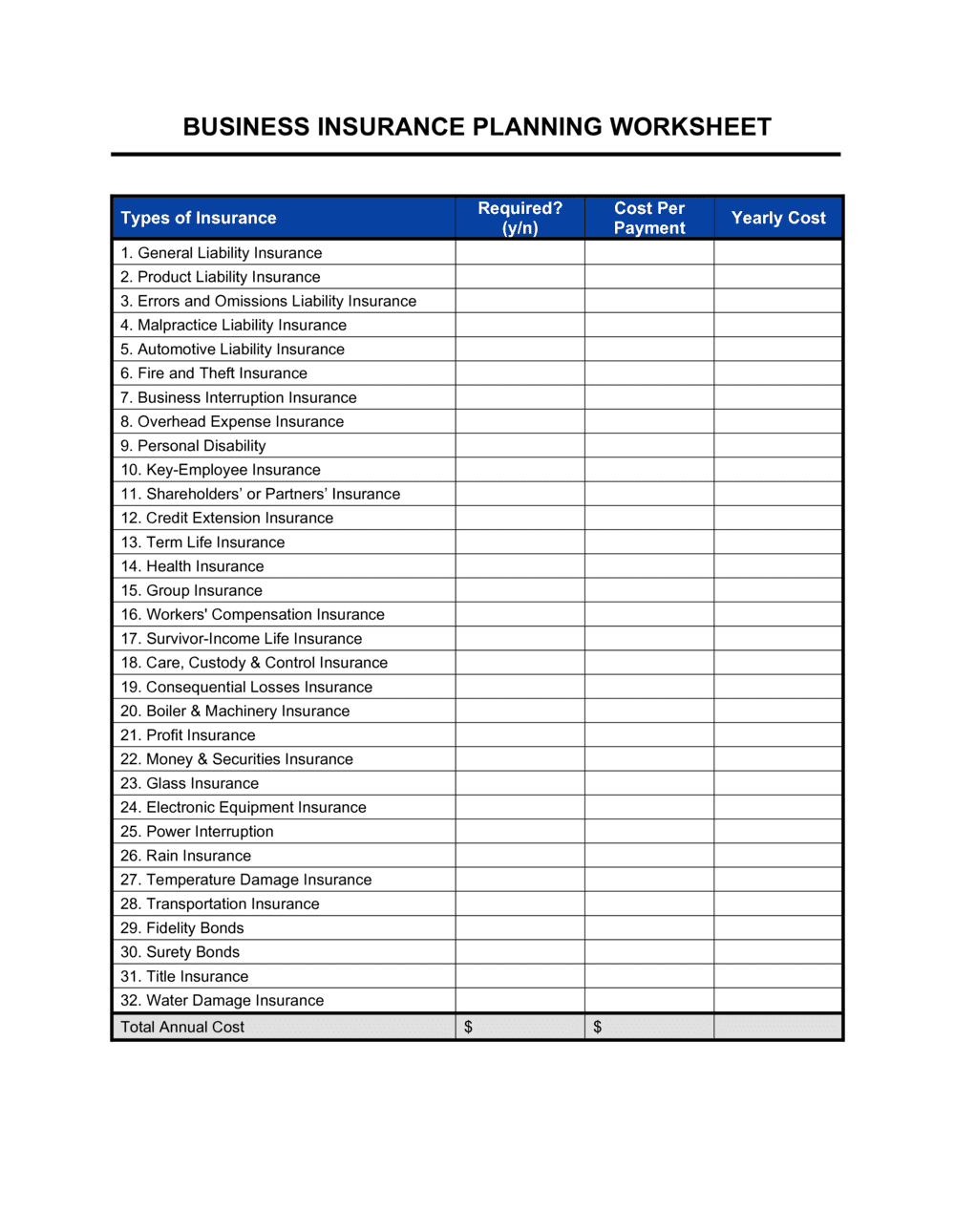
A Business Insurance Planning Worksheet is a structured document that helps business owners systematically identify, evaluate, and record their insurance coverage needs across every operational risk area. This free Word download walks you through each coverage category — from general liability to cyber liability — so you can assess gaps, compare policy options, and document binding decisions in a single reference file you can share with brokers, lenders, or legal counsel.
When you need it
Use it when launching a new business, renewing existing policies, onboarding a new insurance broker, or responding to a lender or contract requirement that specifies minimum coverage levels. It is also the right starting point after a major business change — new location, added employees, expanded product lines — that may have altered your risk profile.
What's inside
Business profile and risk summary, inventory of required and optional coverage types, current policy details with carrier and premium data, coverage gap analysis, liability limit assessment, renewal schedule, and a sign-off section for broker confirmation and owner acknowledgment.

What is a Business Insurance Planning Worksheet?

A Business Insurance Planning Worksheet is a structured document that guides business owners through a systematic review of their commercial insurance needs — mapping every operational risk area to a coverage type, recording active policy details, and identifying gaps between current coverage and actual exposure. Unlike a simple checklist, this worksheet functions as a binding planning record: when completed and signed by both the business owner and a licensed broker, it creates a dated, documented foundation for coverage decisions that can be referenced in disputes, regulatory inquiries, or lender audits. This free Word download covers the full scope of commercial lines — from general liability and workers' compensation to cyber liability and business interruption — in a single organized file you can edit online and export as PDF.

Why You Need This Document

Businesses that manage insurance reactively — renewing policies on autopilot without a structured review — consistently carry coverage that no longer matches their actual risk profile. A business that has grown from three employees to thirty, added e-commerce, or signed a major client contract may now be legally required to carry coverage types it never obtained, or to maintain limits twice what its current policies provide. The financial consequences of discovering a gap after a loss are severe: uninsured claims, contract defaults triggered by certificate failures, and regulatory penalties for non-compliance with mandatory coverage laws. Beyond loss events, inadequate insurance documentation creates friction in every capital raise, lease negotiation, and enterprise client onboarding process that requires a certificate of insurance. This worksheet closes that gap by making insurance planning a deliberate, documented, and reviewable process — and this template gives you the structure to complete that process in a single working session with your broker.

Which variant fits your situation?

If your situation is…Use this template
Launching a new business and identifying coverage from scratchBusiness Insurance Planning Worksheet (Startup)
Renewing all policies at the end of the coverage yearInsurance Renewal Checklist
Documenting a single specific policy — e.g., general liabilityCertificate of Insurance Template
Evaluating risk exposure across a multi-location enterpriseEnterprise Risk Assessment Worksheet
Managing claims history and open claims by policyInsurance Claims Log
Planning property and casualty coverage for a physical storefrontCommercial Property Insurance Checklist
Assessing cyber and data breach coverage for a tech businessCyber Risk Insurance Assessment

Common mistakes to avoid

❌ Completing the worksheet once and never updating it

Why it matters: A business that adds employees, new locations, or a product line acquires new exposures not reflected in the original analysis. An outdated worksheet creates a false sense of adequate coverage.

Fix: Set a calendar trigger to revisit the worksheet at every policy renewal and whenever a material business change occurs — revenue growth of 25%, headcount crossing a statutory threshold, or a new client contract with specific requirements.

❌ Recording policy limits from the invoice rather than the declarations page

Why it matters: Premium invoices do not show per-occurrence or aggregate limits. Errors in recorded limits mean the gap analysis is built on wrong data, and coverage shortfalls go undetected until a claim is filed.

Fix: Retrieve the current declarations page directly from the carrier portal or broker for each policy before completing the policy register section.

❌ Issuing a certificate of insurance before confirming additional insured endorsement

Why it matters: A certificate that names a party as additional insured when they are not actually endorsed onto the policy is a material misrepresentation. The party has no real coverage, and the business faces potential fraud liability.

Fix: Confirm the endorsement with your broker in writing before issuing any certificate of insurance. Most carriers can add an additional insured within 24–48 hours.

❌ Omitting professional liability coverage for service-based businesses

Why it matters: General liability does not cover claims that advice, a deliverable, or a professional service caused a client financial harm. Service businesses operating without E&O coverage face uncapped personal exposure for these claims.

Fix: Identify every business activity that could give rise to a professional negligence claim and confirm that a professional liability or E&O policy covers it explicitly — including any technology services, staffing, or consulting revenue streams.

❌ Skipping the broker sign-off because it feels administrative

Why it matters: An unsigned, unreviewed worksheet provides no evidentiary protection if an insurer, regulator, or counterparty questions whether the business exercised reasonable care in managing its insurance program.

Fix: Treat the broker signature as a professional confirmation of the analysis, not a formality. A signed worksheet is a dated record that the business took deliberate steps to identify and address its coverage obligations.

❌ Ignoring contractual insurance requirements embedded in client or vendor agreements

Why it matters: Client master service agreements frequently require $2M–$5M in general liability, specific cyber liability limits, and additional insured status. Failing to meet these terms is a breach of contract, not just an insurance gap.

Fix: Review every active client and vendor contract for insurance clauses before completing the required coverage inventory. Treat contractual minimums as hard floors — not suggestions — when assessing adequacy.

The 9 key clauses, explained

Business Profile and Risk Summary

In plain language: Identifies the legal name, entity type, industry classification, number of employees, annual revenue, and primary locations of the business — the foundation for every coverage recommendation.

Sample language
Business Legal Name: [BUSINESS NAME] | Entity Type: [LLC / Corporation / Partnership] | Industry: [NAICS CODE AND DESCRIPTION] | Employees: [NUMBER] | Annual Revenue: $[AMOUNT] | Primary Location: [ADDRESS]

Common mistake: Using a trade name instead of the registered legal entity name. Policies issued to the wrong name can be voided or create coverage gaps when a claim is filed under the correct legal entity.

Required Coverage Inventory

In plain language: Lists every coverage type legally required for the business — workers' compensation, commercial auto, professional liability for licensed trades — with the applicable statutory or contractual source of the requirement.

Sample language
Coverage Type: [WORKERS' COMPENSATION] | Required By: [STATE LAW / CLIENT CONTRACT / LEASE AGREEMENT] | Minimum Limit Required: $[AMOUNT] | Deadline for Compliance: [DATE]

Common mistake: Treating workers' compensation as optional for businesses with fewer than five employees. Thresholds vary by state and industry — some jurisdictions require coverage from the first employee or even for sole proprietors in certain trades.

Current Policy Register

In plain language: Documents each active policy — carrier name, policy number, coverage type, limit, deductible, premium, and expiration date — in a single reference table.

Sample language
Carrier: [CARRIER NAME] | Policy No.: [NUMBER] | Coverage: [TYPE] | Per-Occurrence Limit: $[AMOUNT] | Aggregate Limit: $[AMOUNT] | Deductible: $[AMOUNT] | Premium: $[AMOUNT/YEAR] | Expiry: [DATE]

Common mistake: Recording only the premium and expiration date without noting per-occurrence and aggregate limits. When a claim exceeds the per-occurrence limit, the business discovers the gap too late to remedy it.

Coverage Gap Analysis

In plain language: Compares required and recommended coverage types against current active policies to identify exposures that are uninsured or underinsured.

Sample language
Coverage Type: [CYBER LIABILITY] | Required: [YES / NO] | Currently Covered: [YES / NO] | Gap: [UNINSURED / UNDERINSURED BY $AMOUNT] | Recommended Action: [OBTAIN POLICY / INCREASE LIMIT BY $AMOUNT]

Common mistake: Completing the gap analysis once at business launch and never updating it. A business that adds e-commerce, remote workers, or a new product line acquires new exposures that the original analysis did not capture.

Liability Limit Assessment

In plain language: Evaluates whether current per-occurrence and aggregate limits are adequate given the business's revenue, client contract requirements, and industry risk profile.

Sample language
Current General Liability Limit: $[AMOUNT] per occurrence / $[AMOUNT] aggregate | Client Contract Minimum Requirement: $[AMOUNT] | Recommended Limit Based on Revenue: $[AMOUNT] | Gap: $[AMOUNT] | Action: [INCREASE LIMIT / ADD UMBRELLA POLICY]

Common mistake: Setting liability limits based on premium cost rather than actual exposure. A $1M general liability policy may satisfy a contract requirement but is insufficient if a single injury claim against a business with $5M in revenue could exceed that amount.

Key Exclusions and Endorsements Review

In plain language: Identifies significant exclusions in each policy that may leave the business exposed, and notes any endorsements added to close those gaps.

Sample language
Policy: [GENERAL LIABILITY] | Key Exclusion: [PROFESSIONAL SERVICES EXCLUSION] | Impact: [ADVICE-RELATED CLAIMS NOT COVERED] | Endorsement Added: [NONE / PROFESSIONAL LIABILITY ENDORSEMENT] | Action Required: [OBTAIN SEPARATE E&O POLICY]

Common mistake: Ignoring exclusion language because policies appear comprehensive on the declarations page. A general liability policy that excludes professional services leaves a consultant or agency with no coverage for its core business activity.

Additional Insured and Certificate Requirements

In plain language: Records all third parties — clients, landlords, lenders, general contractors — who must be named as additional insureds, and tracks whether certificates of insurance have been issued and accepted.

Sample language
Additional Insured: [PARTY NAME] | Relationship: [CLIENT / LANDLORD / LENDER] | Required Coverage: [TYPE AND LIMIT] | Certificate Issued: [YES / NO / DATE] | Certificate Accepted: [YES / NO / PENDING]

Common mistake: Issuing a certificate of insurance without actually adding the party as an additional insured on the underlying policy. A certificate that misrepresents coverage exposes the business to fraud claims and leaves the third party unprotected.

Renewal Schedule and Review Triggers

In plain language: Lists upcoming policy renewal dates and documents the business events or thresholds — revenue growth, headcount increase, new locations — that should trigger an out-of-cycle insurance review.

Sample language
Policy: [TYPE] | Renewal Date: [DATE] | Review Lead Time: [60 / 90 DAYS BEFORE EXPIRY] | Review Triggers: [REVENUE EXCEEDS $[AMOUNT] / HEADCOUNT EXCEEDS [NUMBER] / NEW LOCATION ADDED]

Common mistake: Waiting until the renewal notice arrives to begin the review process. Switching carriers or adding coverage typically requires 30–60 days for underwriting — starting late forces renewing with the existing carrier on whatever terms they offer.

Broker and Owner Sign-Off

In plain language: Records the broker's confirmation that the worksheet accurately reflects current coverage and identified gaps, and the owner's acknowledgment that they have reviewed the analysis and accepted or deferred each recommendation.

Sample language
Broker Name: [BROKER FULL NAME] | License No.: [NUMBER] | Brokerage: [FIRM NAME] | Signature: ___________ | Date: [DATE] | Owner/Officer: [NAME] | Title: [TITLE] | Signature: ___________ | Date: [DATE]

Common mistake: Leaving the sign-off section blank after completing the analysis. An unsigned worksheet has no evidentiary value if a coverage dispute or regulatory inquiry arises later — the signature creates a dated record of informed decision-making.

How to fill it out

  1. 1

    Complete the business profile section

    Enter the registered legal name, entity type, NAICS industry code, number of full-time and part-time employees, annual revenue, and all operating locations. This data drives every coverage recommendation that follows.

    💡 Pull the legal name and entity type directly from your state or provincial registration — not from your website or marketing materials.

  2. 2

    Identify all legally required coverages

    Research the mandatory insurance requirements for your industry and jurisdiction — workers' compensation thresholds, commercial auto for company vehicles, professional liability for licensed trades. Record the statutory or contractual source for each requirement.

    💡 Check your client contracts and commercial lease for insurance requirements — these often exceed statutory minimums and are just as binding.

  3. 3

    Enter all current active policies in the policy register

    Collect the declarations page for every active policy and transfer the carrier name, policy number, coverage type, per-occurrence limit, aggregate limit, deductible, annual premium, and expiration date into the register table.

    💡 If you cannot locate a declarations page for a policy, request a current one from your broker before completing this step — never fill in limits from memory.

  4. 4

    Run the coverage gap analysis

    Compare the required and recommended coverage inventory against your active policy register. For each coverage type, mark whether it is covered, uncovered, or underinsured, and note the dollar gap where applicable.

    💡 Pay particular attention to cyber liability, employment practices liability, and directors and officers coverage — these are frequently missing from small business portfolios and increasingly required by client contracts.

  5. 5

    Assess liability limits against actual exposure

    For each policy, compare the current per-occurrence and aggregate limits against your largest active client contract requirement and a conservative estimate of your maximum single-event loss. Flag any policy where the current limit falls short.

    💡 An umbrella policy costing $500–$1,500 per year can increase your effective general liability limit from $1M to $5M — often the most cost-efficient gap closure available.

  6. 6

    Review key exclusions for each policy

    Read the exclusions section of each declarations page or policy summary. Record any exclusion that covers a material part of your business activity, and note whether an endorsement or separate policy is available to close it.

    💡 Ask your broker specifically about the professional services exclusion in general liability, the intentional acts exclusion in E&O, and the war/terrorism exclusion in property policies — these are the three most commonly overlooked gaps.

  7. 7

    Record additional insured requirements and issue certificates

    List every party requiring additional insured status — from client MSAs, lease agreements, and lender covenants. Confirm each is actually endorsed onto the relevant policy, then request and deliver certificates of insurance.

    💡 Set a calendar reminder 30 days before any certificate expires to renew it proactively — a lapsed certificate can trigger a contract default even if the underlying policy is still active.

  8. 8

    Obtain broker and owner signatures

    Have your licensed insurance broker review the completed worksheet, confirm its accuracy, and sign the broker sign-off section. The business owner or an authorized officer then signs the owner acknowledgment to create a dated record of the review.

    💡 Store the signed worksheet with your policy binder and share a copy with your CFO or board — it serves as documented evidence of a deliberate, informed insurance review.

Frequently asked questions

What is a business insurance planning worksheet?

A business insurance planning worksheet is a structured document that guides a business owner through a systematic assessment of their insurance needs — identifying required and recommended coverage types, documenting current policies, and flagging gaps between what the business has and what it needs. It serves as both an internal risk management tool and a communication document to share with a broker, lender, or legal counsel.

Is a business insurance planning worksheet legally required?

No law requires a business to complete an insurance planning worksheet. However, certain coverage types — workers' compensation, commercial auto, and professional liability in licensed trades — are legally mandated in most jurisdictions. The worksheet is the mechanism for identifying and documenting compliance with those mandates, and it creates a dated record of due diligence that can be valuable in regulatory inquiries or disputes.

What types of insurance should a small business have?

Most small businesses need at minimum: general liability, commercial property (or a bundled BOP), workers' compensation if they have employees, and commercial auto if company vehicles are used. Service businesses should add professional liability or E&O coverage. Any business storing customer data should carry cyber liability insurance. Specific industries — construction, healthcare, financial services — have additional mandatory or contractually required coverage types.

How often should I update my business insurance planning worksheet?

At minimum, review and update the worksheet at every annual policy renewal. You should also trigger an out-of-cycle review whenever a material business change occurs: adding employees past a statutory workers' compensation threshold, opening a new location, launching a new product or service line, signing a client contract with specific insurance requirements, or crossing a revenue threshold that increases your liability exposure.

What is the difference between a BOP and separate general liability and property policies?

A Business Owner's Policy (BOP) bundles general liability and commercial property coverage at a combined premium typically lower than purchasing each separately. It is designed for small to medium businesses with standard risk profiles. Larger businesses, or those in high-risk industries like construction or manufacturing, often need separate policies with customized limits and endorsements that a BOP cannot accommodate. The worksheet helps you determine which structure fits your current risk profile.

Do I need a lawyer to complete a business insurance planning worksheet?

A lawyer is not required to complete the worksheet itself. However, legal review is recommended before finalizing decisions on liability limits if you operate in a regulated industry, before signing a client contract with specific insurance requirements, or if your business faces unusual risks — product liability, environmental exposure, or professional malpractice. A broker handles the insurance placement; a lawyer reviews the contractual obligations that drive your coverage requirements.

What happens if my coverage gaps are identified but not corrected?

An identified, documented gap that is not corrected creates a worse legal position than an undocumented gap. If a loss occurs in an uninsured area and the worksheet shows the gap was known and accepted, the business owner faces the full financial exposure personally — and courts in some jurisdictions have found that knowing acceptance of a material risk can pierce corporate liability protections. Act on gaps within 30–60 days of identification or formally document the business reason for deferral.

What is an additional insured and why does it matter?

An additional insured is a third party named on your policy who receives coverage protections alongside you as the named insured. Clients, landlords, and lenders routinely require additional insured status as a condition of doing business — it means their interests are protected if a claim arises from your operations. Failing to add a required additional insured is a breach of contract. The worksheet tracks all outstanding additional insured obligations and whether certificates have been issued and accepted.

Can I share this worksheet directly with my insurance broker?

Yes — the worksheet is designed for exactly that purpose. A completed business profile and gap analysis gives your broker the information they need to obtain accurate quotes, recommend endorsements, and confirm that coverage meets your contractual obligations. Sharing it before your renewal meeting typically reduces the time needed for the broker's own needs assessment and produces more accurate proposals.

How this compares to alternatives

vs Certificate of Insurance

A certificate of insurance is a one-page summary of an active policy issued to a third party — it confirms coverage exists but does not plan or analyze it. The business insurance planning worksheet is the upstream document that determines what coverage to obtain and at what limits. You complete the worksheet first; you issue the certificate after coverage is confirmed.

vs Risk Assessment Template

A risk assessment identifies and scores operational, financial, and strategic risks across the business. A business insurance planning worksheet focuses specifically on converting those risks into insurance coverage decisions — matching each exposure to a policy type, limit, and carrier. Both documents are complementary: the risk assessment identifies what can go wrong; the worksheet determines how it is insured.

vs Business Continuity Plan

A business continuity plan outlines how the business will operate during and after a disruptive event — the procedures, resources, and recovery steps. A business insurance planning worksheet determines what financial protection covers those events. The two documents work together: the continuity plan defines the response; the insurance worksheet ensures the financial recovery is funded.

vs Employee Benefits Plan Template

An employee benefits plan documents health, dental, vision, and retirement benefits offered to employees as part of the compensation package. A business insurance planning worksheet covers commercial lines — liability, property, workers' compensation — that protect the business itself. Workers' compensation appears in the insurance worksheet; employee health benefits are a separate planning exercise.

Industry-specific considerations

Construction and Contracting

General contractors must document general liability, builders risk, workers' compensation, and commercial auto coverage — and track additional insured requirements from every project owner and subcontract.

Professional Services

Consultants, accountants, and attorneys require E&O or professional liability coverage not included in a standard BOP, and must track client MSA requirements for minimum limits and additional insured endorsements.

Healthcare and Medical Practices

Medical malpractice, HIPAA cyber liability, and employment practices liability are all separately required — and each has distinct documentation and renewal obligations that the worksheet tracks in parallel.

Retail and E-commerce

Product liability coverage, commercial property for physical inventory, and cyber liability for stored customer payment data are the three coverage categories most commonly under-documented in retail insurance programs.

Technology and SaaS

Cyber liability, technology E&O, and directors and officers coverage are essential for SaaS businesses — client contracts typically require $1M–$5M in cyber liability as a condition of accessing customer data or infrastructure.

Manufacturing

Product liability, commercial property with equipment breakdown coverage, and workers' compensation for a high-injury-risk workforce all require distinct limit assessments and endorsements that a single BOP cannot address.

Jurisdictional notes

United States

Workers' compensation is governed at the state level — thresholds range from one employee in most states to five in Alabama and South Carolina. Texas is the only state where workers' comp is not mandatory for private employers. Professional liability requirements apply to licensed trades in every state. The FTC and state attorneys general increasingly scrutinize inadequate cyber liability coverage for businesses storing consumer data.

Canada

Workers' compensation is provincially administered — all provinces require coverage, but employer registration thresholds, premium rates, and benefit structures vary. Quebec operates its own CNESST system with distinct requirements. Professional liability is mandatory for many licensed professions under provincial regulatory bodies. Commercial general liability limits of $2M per occurrence are the de facto standard required by most commercial leases and client contracts across Canada.

United Kingdom

Employers' liability insurance is compulsory under the Employers' Liability (Compulsory Insurance) Act 1969 for any business with at least one employee — the minimum limit is £5M, though £10M is standard. Public liability insurance is not legally required but is effectively mandatory for any business with client-facing premises or activities. Professional indemnity is compulsory for solicitors, accountants, architects, and several other regulated professions under their respective regulatory frameworks.

European Union

Insurance requirements vary significantly by member state — Germany, France, and the Netherlands impose sector-specific mandatory coverage obligations. GDPR creates a de facto cyber liability requirement for any business processing EU personal data, as breach notification costs, regulatory fines of up to 4% of global annual turnover, and third-party claims require dedicated coverage. Many EU jurisdictions require professional liability for regulated services including legal, financial, medical, and engineering activities.

Template vs lawyer — what fits your deal?

PathBest forCostTime
Use the templateSmall business owners and startups conducting an initial or annual insurance review with their brokerFree2–4 hours to complete with declarations pages in hand
Template + legal reviewBusinesses with client contracts specifying minimum limits, regulated industries, or coverage gaps exceeding $1M in exposure$300–$800 for a one-hour attorney review of coverage obligations and contractual requirements1–3 days
Custom draftedEnterprise operations, multi-jurisdiction businesses, or industries with complex regulatory insurance mandates — healthcare, financial services, construction$1,500–$5,000 for a risk management consultant or attorney-led coverage audit2–4 weeks

Glossary

General Liability Insurance
Coverage that protects a business against third-party claims for bodily injury, property damage, and personal injury occurring in connection with business operations.
Business Owner's Policy (BOP)
A bundled insurance product combining general liability and commercial property coverage, typically offered at a lower combined premium than purchasing each separately.
Errors and Omissions (E&O) Insurance
Professional liability coverage that protects service businesses and consultants against claims that negligent advice or a work product failure caused a client financial harm.
Workers' Compensation Insurance
Mandatory coverage in most jurisdictions that pays medical expenses and lost wages for employees injured on the job, and limits the employer's civil liability for workplace injuries.
Umbrella Policy
Excess liability coverage that activates once the limits of an underlying policy — typically general liability or auto — are exhausted, providing an additional layer of protection.
Declarations Page
The summary page of an insurance policy stating the named insured, policy period, coverage types, limits, deductibles, and premium — the quickest reference for coverage confirmation.
Coverage Limit
The maximum dollar amount an insurer will pay for a covered claim under a specific policy, expressed per occurrence and in aggregate for the policy period.
Deductible
The amount the insured must pay out of pocket before the insurance policy begins covering a claim — higher deductibles typically produce lower premiums.
Additional Insured
A third party — such as a client, landlord, or lender — added to a policy to receive coverage protections alongside the named insured, often required by contract.
Cyber Liability Insurance
Coverage that pays costs arising from data breaches, ransomware attacks, and network security failures, including notification expenses, regulatory fines, and third-party claims.
Business Interruption Insurance
Coverage that replaces lost revenue and pays fixed operating expenses when a covered event — fire, flood, or equipment failure — forces a temporary shutdown.
Indemnification Clause
A contractual provision in which one party agrees to compensate the other for specified losses or liabilities — often the basis for an insurance requirement in a client or vendor contract.

Part of your Business Operating System

This document is one of 3,000+ business & legal templates included in Business in a Box.

  • Fill-in-the-blanks — ready in minutes
  • 100% customizable Word document
  • Compatible with all office suites
  • Export to PDF and share electronically

Create your document in 3 simple steps.

From template to signed document — all inside one Business Operating System.
1
Download or open template

Access over 3,000+ business and legal templates for any business task, project or initiative.

2
Edit and fill in the blanks with AI

Customize your ready-made business document template and save it in the cloud.

3
Save, Share, Send, Sign

Share your files and folders with your team. Create a space of seamless collaboration.

Save time, save money, and create top-quality documents.

★★★★★

"Fantastic value! I'm not sure how I'd do without it. It's worth its weight in gold and paid back for itself many times."

Managing Director · Mall Farm
Robert Whalley
Managing Director, Mall Farm Proprietary Limited
★★★★★

"I have been using Business in a Box for years. It has been the most useful source of templates I have encountered. I recommend it to anyone."

Business Owner · 4+ years
Dr Michael John Freestone
Business Owner
★★★★★

"It has been a life saver so many times I have lost count. Business in a Box has saved me so much time and as you know, time is money."

Owner · Upstate Web
David G. Moore Jr.
Owner, Upstate Web

Run your business with a system — not scattered tools

Stop downloading documents. Start operating with clarity. Business in a Box gives you the Business Operating System used by over 250,000 companies worldwide to structure, run, and grow their business.

Free Forever Plan · No credit card required