How To Decide Which Debt To Pay Off First

Word (DOC/DOCX)•2 pages•20–25 min to fill•Difficulty: Standard
Learn more ↓

The full editable document opens in Business in a Box.

At a glance

What it is
A debt prioritization plan is a structured Word document that helps business owners and finance managers inventory all outstanding debts, rank them by cost and risk, and build a sequenced repayment strategy. This Word template walks you through every step — from listing balances and interest rates to selecting an elimination method — so you can edit online and export as PDF to share with your accountant, CFO, or board.
When you need it
Use it when your business is carrying multiple loans, lines of credit, or vendor payables simultaneously and you need to decide where to direct surplus cash first. It is especially useful after a cash-flow crunch, a refinancing event, or the start of a new fiscal year when you are resetting financial priorities.
What's inside
A complete debt inventory table, interest-rate and minimum-payment analysis, risk classification by debt type, a method-selection guide comparing the avalanche and snowball approaches, a month-by-month repayment schedule, and a cash-flow impact summary showing how each payoff milestone frees up operating capital.

Which variant fits your situation?

If your situation is…Use this template
Carrying multiple high-interest debts with similar balancesDebt Avalanche Repayment Plan
Needing quick psychological wins to stay motivated through a long payoffDebt Snowball Repayment Plan
Restructuring all business debts into a single repayment scheduleDebt Consolidation Plan
Presenting a debt reduction strategy to a bank or lenderDebt Management Plan
Tracking monthly progress against a fixed payoff timelineDebt Repayment Tracker
Analyzing whether to pay debt early or invest surplus cash insteadDebt vs. Investment Analysis Worksheet
Planning cash flow around multiple loan maturity datesCash Flow Forecast Template

What is a Debt Prioritization Plan?

A debt prioritization plan is a structured operational document that helps business owners and finance teams inventory every outstanding obligation, rank each debt by cost and risk, and build a sequenced repayment schedule that directs surplus cash where it produces the greatest financial benefit. Rather than making ad hoc payment decisions each month, a written plan applies a consistent method — typically the avalanche (highest APR first), snowball (smallest balance first), or a risk-adjusted hybrid — and projects the month-by-month balance reductions and payoff milestones that result. The plan also quantifies the total interest saved compared to making minimum payments only, giving decision-makers a concrete figure to present to accountants, boards, or lenders.

Why You Need This Document

Without a written debt prioritization plan, surplus cash rarely finds its most valuable destination. Business owners pay whichever invoice feels most urgent rather than whichever debt is most expensive, and freed minimum payments from eliminated debts disappear into operating spending instead of compounding the payoff chain. The financial cost is concrete: a business carrying $150,000 in mixed-rate debt that makes minimum payments only will often pay $30,000–$60,000 more in interest than one following a structured avalanche schedule. Beyond interest savings, a documented plan protects against default on secured obligations — defaulting on a collateralized loan can trigger asset repossession within 60–90 days, a risk that pure interest-rate ranking ignores. This template gives you the structure to rank debts correctly, model the repayment timeline, and hold your business accountable to a specific debt-free date.

Common mistakes to avoid

❌ Ignoring secured and tax debts in favor of highest-APR ranking

Why it matters: A defaulted secured loan can trigger asset repossession within 60–90 days; unpaid payroll taxes accumulate IRS penalties at 15% per year plus personal liability. The financial cost of default far exceeds the interest-savings calculation.

Fix: Always resolve any debt in default or near-default, any IRS or state tax obligation, and any secured debt close to its covenant threshold before applying avalanche or snowball logic to the remainder.

❌ Paying off a loan early without checking the prepayment penalty

Why it matters: A 3–5% prepayment fee on a $200,000 balance equals $6,000–$10,000 — potentially eliminating a year's worth of interest savings from early payoff.

Fix: Pull the prepayment clause from every loan agreement before building the schedule and calculate net savings after the penalty. If the penalty makes early payoff uneconomical, redirect surplus cash to a higher-cost unconstrained debt.

❌ Building the repayment schedule on peak-month cash flow

Why it matters: A surplus that exists only in your three best revenue months creates a schedule you cannot sustain, leading to missed payments and a broken plan by Q2.

Fix: Base the monthly surplus figure on your lowest-revenue month of the past 12 months, then treat any additional cash as an optional accelerator rather than a plan requirement.

❌ Failing to redirect freed minimum payments to the next target debt

Why it matters: When a debt is eliminated, the freed monthly payment rarely finds its way to the next target without a formal rule — it disperses into operating costs, and the compounding payoff acceleration is lost.

Fix: Write a specific reallocation rule into the plan: 'Upon payoff of [DEBT A], its $[X] monthly payment is immediately redirected to [DEBT B].' Set a calendar reminder for the month the payoff occurs.

❌ Comparing debt APR to gross investment return when deciding whether to pay vs. invest

Why it matters: A 12% projected return on a marketing campaign is not risk-free and is often gross, not net. Comparing it to a 10% APR debt payoff — which is a guaranteed after-tax return — understates the value of debt elimination.

Fix: Adjust the investment return for risk and tax before comparing it to the debt's APR. Use the after-tax, risk-adjusted expected return as the comparison figure.

❌ Treating the plan as a one-time exercise rather than a living document

Why it matters: Refinancing events, new credit lines, revenue changes, and unexpected expenses all shift the optimal sequencing. A plan built in January and not reviewed until December is working from stale assumptions by March.

Fix: Schedule a 30-minute quarterly review to update all balances, confirm the target debt, and recalculate the debt-free date. Treat the review as a fixed calendar commitment, not an optional task.

The 9 key sections, explained

Debt inventory table

Interest cost analysis

Debt risk classification

Prepayment penalty review

Repayment method selection

Month-by-month repayment schedule

Cash flow freed milestone tracker

Debt vs. investment trade-off analysis

Summary and accountability dashboard

How to fill it out

  1. 1

    List every debt in the inventory table

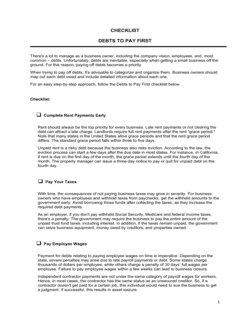
    Pull statements for every outstanding obligation — term loans, lines of credit, equipment financing, business credit cards, SBA loans, owner advances, and significant vendor payables. Enter the current balance, APR, monthly minimum, and maturity date for each.

    💡 Include debts with $0 interest (e.g., 0% promotional financing) — they still carry maturity dates that affect your cash flow planning.

  2. 2

    Calculate total interest remaining at minimum payments

    For each debt, use an amortization formula or online calculator to project the total interest you will pay if you make only minimum payments through maturity. This number is the baseline you are trying to beat.

    💡 The gap between your minimum-payment total and your optimized-plan total is your biggest motivational lever — make it visible at the top of the document.

  3. 3

    Classify each debt by risk level

    Tag each debt as secured, unsecured, tax, or vendor. Note the specific collateral at risk for secured debts and the default timeline — how quickly the lender can act if you miss a payment.

    💡 Prioritize any debt where default triggers an IRS lien, asset repossession, or personal guarantee call-in, regardless of its interest rate.

  4. 4

    Check every loan agreement for prepayment penalties

    Review each loan contract's prepayment clause. Calculate the penalty dollar amount and determine the net savings after the penalty if you pay early. Flag any debt where the penalty eliminates the benefit of early payoff.

    💡 Some SBA 7(a) loans carry prepayment penalties only in the first three years — confirm whether your loan is still in that window before accelerating payments.

  5. 5

    Select your repayment method

    Choose avalanche (highest APR first), snowball (smallest balance first), or a hybrid that addresses any high-risk secured or tax debts first before applying either method to the remainder. Document your rationale so the plan can be explained to stakeholders.

    💡 If two debts have APRs within 1–2 percentage points of each other, choose the smaller balance — the interest difference is marginal and the faster payoff accelerates the cash-freed cascade.

  6. 6

    Build the month-by-month payment schedule

    Set your total monthly debt payment budget — minimums on all debts plus your surplus directed at the target debt. Map out each month until the target debt hits zero, then redirect that payment to the next debt in sequence.

    💡 Model a 15–20% cash-flow buffer month so that a single slow revenue month does not force you to break the schedule.

  7. 7

    Fill in the cash-flow freed milestone tracker

    Each time a debt is eliminated, record the monthly payment freed and explicitly state where it goes next. Treat the freed payment as a committed reallocation, not discretionary cash.

    💡 Set a calendar reminder the month a debt is paid off to consciously redirect the freed payment before it gets absorbed into operating spending.

  8. 8

    Complete the summary dashboard and review quarterly

    Populate the one-page summary with your starting totals, projected interest savings, and debt-free date. Schedule a quarterly review to update balances, adjust for any prepayments or refinancing, and confirm the timeline is on track.

    💡 A plan reviewed quarterly closes the gap between projection and reality by an average of 20–30% compared to plans reviewed only annually.

Frequently asked questions

How do I decide which debt to pay off first?

Start by listing every debt with its current balance, APR, monthly minimum payment, and type (secured, unsecured, or tax). Prioritize any debt in default or backed by critical collateral first, regardless of interest rate. Then apply either the avalanche method — directing surplus cash to the highest-APR debt — or the snowball method — targeting the smallest balance first. For most businesses, the avalanche method produces the greatest total interest savings, but the right choice depends on your cash flow stability and the spread of rates across your debts.

What is the debt avalanche method?

The debt avalanche directs all surplus payment capacity to the debt with the highest annual percentage rate while paying minimums on everything else. Once the highest-rate debt is eliminated, the freed payment rolls into the next-highest-rate debt. This method minimizes total interest paid over the life of the repayment plan and is the mathematically optimal strategy when interest rates vary significantly across debts.

What is the debt snowball method?

The debt snowball targets the smallest outstanding balance first, regardless of interest rate, generating a completed payoff quickly. The freed payment then cascades to the next-smallest balance. The method is psychologically motivating and works well when business owners need early wins to sustain commitment to a long repayment plan. The trade-off is paying more total interest compared to the avalanche method when high-rate debts also carry large balances.

Should I pay off business debt or invest surplus cash in the business?

Paying off a 20% APR credit card is a guaranteed 20% after-tax return — compare that to the risk-adjusted, after-tax expected return of any investment before deciding. As a general rule, paying down debt with an APR above 8–10% is preferable to reinvestment unless the investment has a documented, high-confidence return that clearly exceeds that threshold. For debts below 5–6%, the case for reinvestment is stronger, particularly if the business can deploy capital at a materially higher return.

Does it ever make sense to pay a low-interest debt before a high-interest one?

Yes, in three situations. First, if a low-interest secured loan is close to covenant default and you risk losing the underlying asset. Second, if a low-interest debt is personally guaranteed and your personal financial exposure is significant. Third, if the psychological relief of eliminating a specific obligation — such as a loan from a family member — has real business value in reducing distraction or relationship strain.

How do prepayment penalties affect my payoff strategy?

A prepayment penalty can make early payoff of a specific loan uneconomical. Calculate the net savings — total interest avoided minus the penalty fee — before directing surplus cash there. If the penalty eliminates the savings, redirect that cash to a debt with no prepayment restriction and revisit the penalized loan once you are past the penalty window, which is typically the first three years for SBA loans.

How often should I update my debt payoff plan?

Review and update the plan quarterly at a minimum. Refinancing events, new credit lines, revenue changes, and early payoffs all shift the optimal sequencing. An annual review leaves the plan operating on stale assumptions for up to 11 months. Set a recurring calendar appointment for a 30-minute balance update and timeline recalculation at the start of each quarter.

What debts should always be paid first regardless of interest rate?

Payroll taxes, sales tax remittances, and other government obligations should always come first — the IRS and state agencies can assess personal liability on business owners and impose liens that block future financing. After tax debts, prioritize any secured loan where default could trigger repossession of assets critical to operations. Only after those obligations are current should you apply avalanche or snowball logic to remaining debts.

Can this plan be used for personal debt as well as business debt?

The framework applies equally to personal debt — the inventory table, interest analysis, method selection, and repayment schedule work the same way whether the debts are business loans or personal mortgages, student loans, and credit cards. However, the risk classification differs: personal secured debts (mortgages, auto loans) and tax obligations take the same priority role that business secured and payroll tax debts do in the business version of the plan.

What is a realistic timeline to pay off business debt?

Timeline depends on total debt load, monthly surplus, and interest rates. A business with $50,000 in mixed debt and a $3,000 monthly surplus above minimums can realistically eliminate all debt in 18–24 months using the avalanche method. A $300,000 debt load with a $5,000 surplus may take 5–7 years. The plan's value is making the timeline explicit and showing how each payoff milestone accelerates the next — not just estimating a final date.

How this compares to alternatives

vs Cash flow forecast

A cash flow forecast projects total cash in and out over a future period — it shows whether you will have enough cash to meet all obligations but does not tell you which debt to prioritize with surplus cash. A debt prioritization plan sits one level deeper, taking the surplus the cash flow forecast identifies and directing it optimally. Use the cash flow forecast to confirm you have a surplus before building the repayment schedule.

vs Debt consolidation plan

A debt consolidation plan restructures multiple debts into a single new loan at a lower blended rate — it changes the debt structure rather than the repayment sequence. A prioritization plan works with your existing debts as they are. Use consolidation when you can secure a materially lower rate; use the prioritization plan when refinancing is not available or when the consolidation savings are insufficient to justify the transaction costs.

vs Budget template

A budget allocates total revenue across all spending categories including debt service. A debt prioritization plan zooms into the debt service line and optimizes how that allocation is distributed across individual obligations. Build the budget first to confirm the total debt payment envelope, then use the prioritization plan to direct that envelope.

vs Financial projections template

Financial projections model revenue, expenses, and cash position over a 12-month or multi-year horizon. A debt prioritization plan is a tactical execution document derived from those projections — it takes the cash position the financial model projects and converts it into a specific monthly payment schedule. The two documents should be built in tandem, with the projections validating the surplus assumptions in the repayment plan.

Industry-specific considerations

Retail and e-commerce

Inventory financing, merchant cash advances, and seasonal credit lines create multiple simultaneous obligations with widely varying rates — sequencing them around peak and off-peak cash flow is critical.

Construction and trades

Equipment loans, subcontractor payables, and draw-based project financing create staggered maturity dates that require a rolling repayment schedule aligned to project completion milestones.

Professional services

Firms often carry a mix of a business line of credit, SBA loans from expansion, and software financing — the plan helps prioritize high-rate unsecured lines while protecting the secured credit facility used for payroll float.

Food and beverage

Restaurant and food-service operators frequently carry high-rate merchant cash advances alongside equipment leases and supplier payables — avalanche prioritization of the MCA can save tens of thousands in fees over a 12-month payoff.

Healthcare

Medical practices carrying equipment financing, practice acquisition loans, and malpractice insurance premium financing need risk-based prioritization that accounts for lender covenants tied to patient revenue thresholds.

Manufacturing

Capital-intensive operations with secured equipment loans, revolving credit facilities, and supplier terms require a sequencing approach that protects collateralized assets while systematically reducing the highest-cost unsecured obligations.

Template vs pro — what fits your needs?

PathBest forCostTime
Use the templateSmall business owners and founders managing fewer than eight debts with clear balances and ratesIncluded with Business in a Box2–4 hours to complete
Template + professional reviewBusinesses with complex debt structures, secured loans near covenant limits, or significant tax obligations$150–$500 for a one-hour accountant or financial advisor review1–3 days
Custom draftedBusinesses in workout negotiations with lenders, facing insolvency risk, or preparing a debt restructuring proposal for creditors$1,000–$5,000+ for a CPA or turnaround consultant engagement1–3 weeks

Glossary

Debt Avalanche
A repayment strategy that directs all surplus cash to the highest-interest-rate debt first, minimizing total interest paid over time.
Debt Snowball
A repayment strategy that targets the smallest balance first regardless of interest rate, generating early payoff wins to maintain momentum.
Annual Percentage Rate (APR)
The yearly cost of borrowing expressed as a percentage, including interest and fees — the primary metric for comparing debt costs.
Minimum Payment
The lowest amount a lender requires each billing cycle to keep the account in good standing; paying only the minimum extends repayment and maximizes interest paid.
Amortization
The process of spreading loan payments over time so that each payment covers a portion of principal and interest, with the interest share declining as the balance falls.
Secured Debt
Debt backed by a specific asset — such as a building or equipment — that a lender can seize if the borrower defaults.
Unsecured Debt
Debt with no collateral attached, such as a business credit card or a signature line of credit; typically carries a higher interest rate to compensate the lender for greater risk.
Cash Flow Freed
The monthly cash released when a debt is fully paid off, equal to the minimum payment that was previously obligated — available to redeploy toward the next target debt.
Prepayment Penalty
A fee charged by some lenders when a borrower pays off a loan earlier than the agreed schedule, reducing the lender's expected interest income.
Debt-to-Income Ratio (DTI)
Total monthly debt payments divided by gross monthly revenue — a key metric lenders use to assess repayment capacity and creditworthiness.

Part of your Business Operating System

This document is one of 3,000+ business & legal templates included in Business in a Box.

  • Fill-in-the-blanks — ready in minutes
  • 100% customizable Word document
  • Compatible with all office suites
  • Export to PDF and share electronically

Browse related collections

Create your document in 3 simple steps.

From template to signed document — all inside one Business Operating System.

1
Download or open template

Access over 3,000+ business and legal templates for any business task, project or initiative.

2
Edit and fill in the blanks with AI

Customize your ready-made business document template and save it in the cloud.

3
Share with your team

Share your files and folders with your team. Create a space of seamless collaboration.

Save time, save money, and create top-quality documents.

★★★★★

"Fantastic value! I'm not sure how I'd do without it. It's worth its weight in gold and paid back for itself many times."

Managing Director · Mall Farm
Robert Whalley
Managing Director, Mall Farm Proprietary Limited
★★★★★

"I have been using Business in a Box for years. It has been the most useful source of templates I have encountered. I recommend it to anyone."

Business Owner · 4+ years
Dr Michael John Freestone
Business Owner
★★★★★

"It has been a life saver so many times I have lost count. Business in a Box has saved me so much time and as you know, time is money."

Owner · Upstate Web
David G. Moore Jr.
Owner, Upstate Web

Run your business with a system — not scattered tools

Stop downloading documents. Start operating with clarity. Business in a Box gives you the Business Operating System used by over 250,000 companies worldwide to structure, run, and grow their business.

Start free · No credit card required