Employment At Will Policy Template

Free Word download β€’ Edit online β€’ Save & share with Drive β€’ Export to PDF

1 pageβ€’15–25 min to fillβ€’Difficulty: Standard
Learn more ↓
FreeEmployment At Will Policy Template

At a glance

What it is
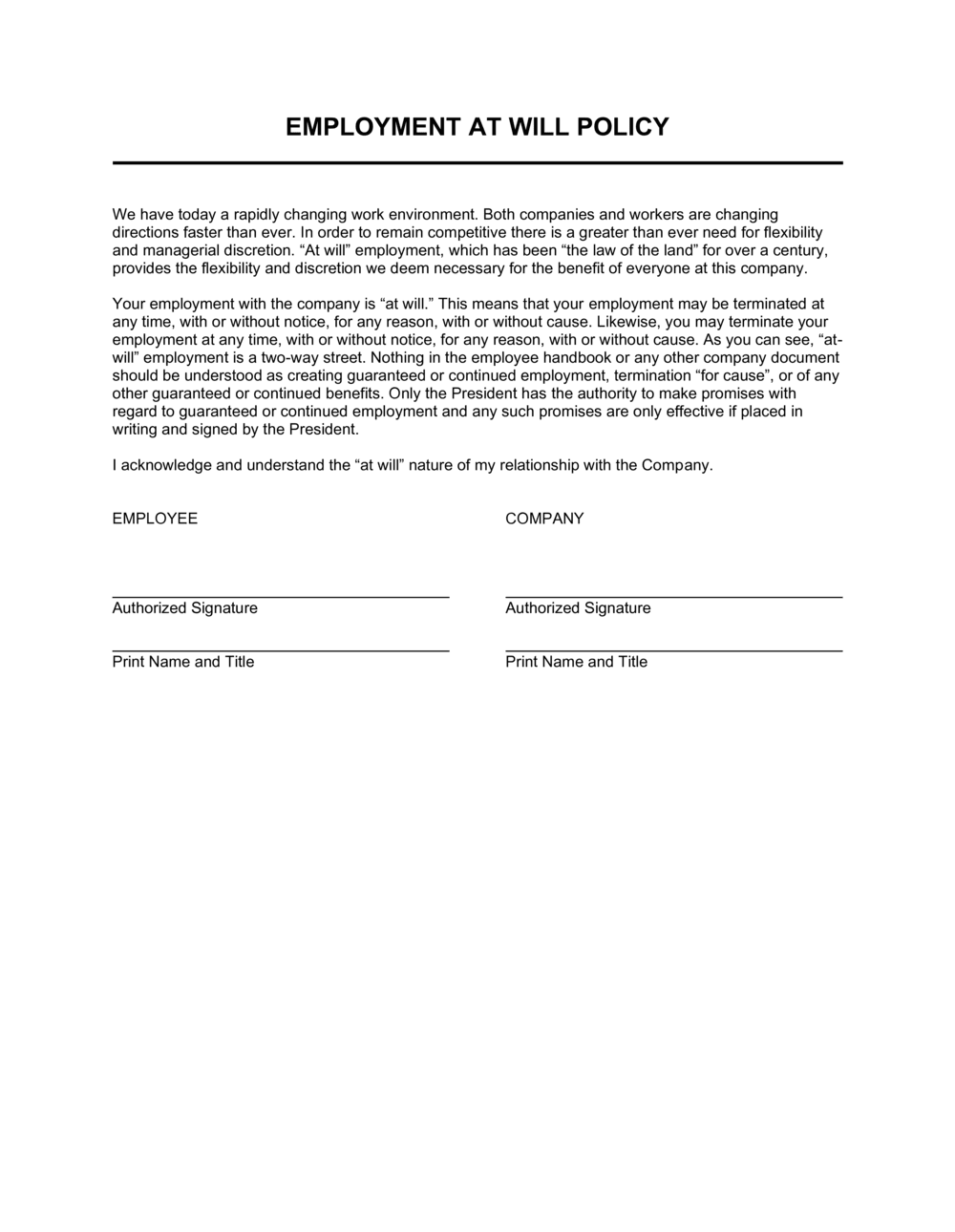
An Employment At Will Policy is a written statement included in an employee handbook or issued as a standalone HR document that formally communicates the at-will nature of the employment relationship. This free Word download gives you a ready-to-edit template covering the core at-will declaration, exceptions and limitations, and an employee acknowledgment section β€” exportable as PDF for distribution and file retention.
When you need it
Use it when onboarding new employees, updating your employee handbook, or any time you need to formally document that employment is not guaranteed for a fixed term and may be ended by either party at any time for any lawful reason.
What's inside
A plain-language at-will declaration, an explanation of what the policy does and does not restrict, a list of conduct and statutory exceptions, and an employee acknowledgment block confirming the individual has read and understood the terms.

What is an Employment At Will Policy?

An Employment At Will Policy is a formal HR document that communicates to every employee β€” in plain, unambiguous language β€” that their employment has no guaranteed term and may be ended by either party at any time, for any lawful reason, or for no reason at all. It also identifies the legal exceptions that limit that right, specifies who has authority to modify the relationship, and includes a signed acknowledgment confirming the employee received and understood the statement. Unlike a full employment contract, the at-will policy is a unilateral employer declaration rather than a bilateral agreement, and it is most commonly distributed as part of the onboarding packet or embedded near the front of the employee handbook.

Why You Need This Document

Without a written at-will policy, a terminated employee's attorney has significant room to argue that verbal assurances, performance reviews, or handbook language created an implied contract β€” and that your dismissal breached it. Courts in numerous states have sided with employees on exactly these grounds, awarding back pay and damages that dwarf the cost of getting the paperwork right at the start. A properly drafted and signed at-will policy closes the implied-contract gap, puts every employee on notice of the employment relationship's nature before any dispute arises, and gives managers a clear framework for what they can and cannot say about job security. This template gives you the core declaration, the exceptions language, and the acknowledgment block you need β€” ready to customize, distribute, and file in under 30 minutes.

Which variant fits your situation?

If your situation is…Use this template
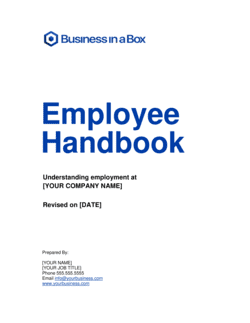
Embedding at-will language inside a full employee handbookEmployee Handbook
Creating a binding employment agreement that references at-will statusEmployment Contract (At-Will)
Issuing a standalone acknowledgment form for signature and filingEmployee Acknowledgment Form
Covering remote employees across multiple US statesRemote Work Employment Agreement
Documenting a probationary period alongside at-will termsProbationary Employment Contract
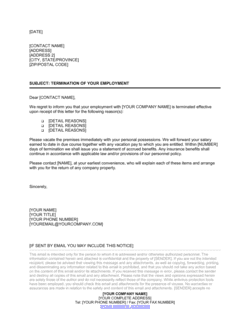
Terminating an at-will employee with a formal written recordEmployee Dismissal Letter
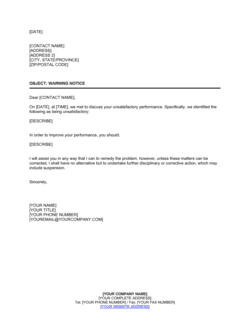
Documenting the reason for a for-cause terminationEmployee Warning Notice

Common mistakes to avoid

❌ Using mandatory progressive discipline language

Why it matters: If the policy describes a required sequence of warnings before termination, courts in many states treat it as a contractual procedure. Skipping a step then exposes the company to breach-of-implied-contract claims.

Fix: Describe progressive discipline as a practice the company 'may' use at its discretion, not a procedure it 'will' follow, and pair it with an explicit reservation of at-will rights.

❌ Failing to collect signed acknowledgments

Why it matters: Without a signed copy, a terminated employee can credibly claim they never received or understood the at-will policy, removing your primary defense in a wrongful termination dispute.

Fix: Build acknowledgment collection into the first-day onboarding checklist and use e-signature software so there is a timestamped record for every employee.

❌ Applying the policy to non-US employees

Why it matters: At-will employment is a US-specific doctrine. Issuing this policy to employees in Canada, the UK, or the EU gives them a false picture of their rights and may undermine their actual statutory protections.

Fix: Scope the policy explicitly to US employees and create jurisdiction-appropriate employment agreements or policies for workers in other countries.

❌ Allowing managers to make verbal job-security promises

Why it matters: A supervisor telling an employee 'don't worry, your job is safe' or 'we never fire people without cause here' can override a written at-will policy through promissory estoppel in some states.

Fix: Train all managers on the at-will policy, instruct them never to make verbal guarantees of employment, and include a clause stating that only a named executive's written signature can modify at-will status.

❌ Omitting the public policy and anti-retaliation exceptions

Why it matters: A policy that implies the employer can fire anyone for any reason at all overstates the legal position. When a firing falls into a protected category, the policy's silence on exceptions becomes evidence of bad intent.

Fix: Include a clear exceptions section acknowledging all major federal and applicable state anti-discrimination and anti-retaliation statutes by name.

❌ Never updating the policy after legal changes

Why it matters: Employment law changes frequently β€” new state non-compete bans, expanded protected classes, or updated NLRB guidance can make a years-old at-will policy legally inaccurate.

Fix: Schedule an annual review of the policy against current federal and state employment law, and update it β€” with a fresh acknowledgment cycle β€” whenever a material change occurs.

The 8 key sections, explained

Policy purpose and scope

At-will declaration

Limitations and exceptions

What does not alter at-will status

Handbook and policy disclaimer

Termination procedures (informational)

Employee rights and non-retaliation statement

Employee acknowledgment and signature block

How to fill it out

  1. 1

    Insert your company name and effective date

    Replace every instance of [COMPANY NAME] with your registered business name and enter the date the policy takes effect. Consistency across all instances matters for legal clarity.

    πŸ’‘ Use your full legal entity name, not a trade name or DBA, so the policy aligns with your employment agreements and payroll records.

  2. 2

    Confirm the geographic scope

    Identify which employees and locations the policy covers. If your business operates only in the US, state that explicitly. If you have employees in Canada or overseas, create separate policies for those jurisdictions.

    πŸ’‘ Do not apply a US at-will policy to Canadian or UK employees β€” it is unenforceable and creates false expectations about their actual termination rights.

  3. 3

    Review and adapt the exceptions section

    Check the federal and state statutes listed in the limitations section against the states where you have employees. Add any state-specific exceptions β€” for example, California, Montana, or New York have notable restrictions on at-will employment.

    πŸ’‘ Montana is the only US state that restricts at-will termination after a probationary period β€” if you have Montana employees, add a specific carve-out.

  4. 4

    Designate the authority to modify the policy

    Name the specific title β€” typically CEO, President, or CHRO β€” whose written signature is required to modify or override the at-will relationship. Do not leave this blank or use a generic title.

    πŸ’‘ The more specific this designation, the more protection it provides. 'Any officer' is weaker than 'the President and CEO of [COMPANY NAME].'

  5. 5

    Audit handbook language for implied contract risk

    Read your employee handbook section by section and flag any language that implies guaranteed employment, mandatory procedures, or specific termination steps. Replace or add disclaimers to each instance.

    πŸ’‘ Search for phrases like 'will be', 'guaranteed', 'required steps', and 'must follow' β€” these are the most common sources of implied contract claims.

  6. 6

    Distribute the policy and collect signed acknowledgments

    Include the policy in new-hire onboarding packets and have each employee sign and date the acknowledgment block. File the signed copy in the employee's personnel file.

    πŸ’‘ For remote employees, use an e-signature tool to collect and timestamp acknowledgments β€” paper copies get lost and undated signatures are nearly useless in a dispute.

  7. 7

    Re-issue the policy when it is updated

    Whenever you revise the at-will policy or employee handbook, re-issue the updated version and collect a fresh signed acknowledgment from all current employees.

    πŸ’‘ Date-stamp every version of the policy so you can demonstrate which version was in effect at the time of any particular employment action.

Frequently asked questions

What is an employment at will policy?

An employment at will policy is a written HR document that formally communicates to employees that their employment has no fixed term and may be ended by either the employer or the employee at any time, for any lawful reason, or for no reason at all. It also typically outlines the legal exceptions to at-will status and includes an acknowledgment block for the employee to sign. The policy is most commonly included in an employee handbook or distributed as a standalone onboarding document.

What are the exceptions to at-will employment?

The three main common-law exceptions are the public policy exception (you cannot fire someone for exercising a legal right, like filing a workers' comp claim), the implied contract exception (handbook language or verbal promises creating an expectation of job security), and the good faith and fair dealing exception (recognized in a minority of states). Federal and state anti-discrimination statutes add a separate layer of protection regardless of at-will status.

Do I need a signed acknowledgment from every employee?

Yes β€” a signed acknowledgment is the most important risk-management element of an at-will policy. Without it, a terminated employee can claim they never received or understood the policy. Courts have sided with employees on this basis. Collect a signed copy at onboarding and re-collect signatures whenever the policy is materially updated.

Can an employee handbook create an implied employment contract?

Yes, in many states. Courts have found that handbook language promising job security, describing mandatory termination procedures, or using words like 'permanent employees' or 'you will receive progressive discipline' creates an implied contract that limits at-will rights. A strong at-will policy with a clear disclaimer β€” stating the handbook is not a contract β€” reduces but does not eliminate this risk.

Does an at-will policy mean I can fire someone for any reason?

No. At-will means you can terminate without a specific stated reason, but the reason cannot be an unlawful one. Dismissals based on race, sex, religion, national origin, age, disability, pregnancy, or other protected characteristics violate federal and state anti-discrimination law regardless of at-will status. Firing an employee for filing a complaint, taking FMLA leave, or serving on jury duty is also unlawful.

Should an at-will policy be in the employee handbook or a separate document?

Ideally both β€” include the at-will declaration prominently near the front of the employee handbook and issue it as a standalone document that employees sign separately at onboarding. Embedding it only in a lengthy handbook means employees may not read or register it. A separate signed acknowledgment creates a clear record that the policy was communicated and understood.

Does an at-will policy eliminate the need for an employment contract?

For most hourly and salaried employees, a well-drafted at-will policy in an employee handbook provides sufficient legal footing. However, senior employees, executives, and employees with access to sensitive IP or key customer relationships should still sign a formal employment contract that includes confidentiality, IP assignment, and non-solicit clauses β€” which a standalone at-will policy does not cover.

How often should I update the at-will policy?

Review the policy at least once per year and any time a significant change in federal or state employment law occurs. Material changes β€” such as the addition of a new protected class or a new state restriction on non-competes β€” may require immediate updates. Each revision should be re-issued to all current employees with a new signed acknowledgment.

How this compares to alternatives

vs Employment Contract (At-Will)

An employment contract is a bilateral agreement signed by both employer and employee that sets out compensation, duties, IP assignment, confidentiality, and termination in binding detail. An at-will policy is a unilateral employer statement of the employment relationship's nature. Use the policy for the general workforce and an employment contract for senior hires where restrictive covenants are needed.

vs Employee Handbook

An employee handbook is a comprehensive reference covering all workplace policies β€” conduct, benefits, leave, safety, and more. The at-will policy is a single section within that handbook, or a standalone document issued alongside it. For small teams, a standalone at-will policy is faster to deploy; for any team of ten or more, embedding it in a full handbook is best practice.

vs Employee Dismissal Letter

An employee dismissal letter documents a specific termination event β€” the date, reason (if given), and logistics such as final pay and return of property. The at-will policy establishes the legal framework that makes that termination permissible. The policy comes first at onboarding; the dismissal letter is issued at the moment of separation.

vs Employee Warning Notice

An employee warning notice documents a specific performance or conduct issue as part of a progressive discipline process. An at-will policy should explicitly state that issuing warnings does not create a contractual obligation to continue doing so. Without that language, a history of warnings can imply that the employer must follow the same process before every future termination.

Industry-specific considerations

Technology / SaaS

Fast-growing headcount and frequent restructuring make a clearly documented at-will policy essential for managing layoffs and role eliminations without triggering implied-contract claims.

Retail and Hospitality

High employee turnover and seasonal hiring mean at-will acknowledgments must be collected efficiently at scale, typically through digital onboarding workflows.

Professional Services

Client-facing employees often receive informal performance assurances from managers; a strong at-will policy and manager training reduce implied-contract exposure in this sector.

Healthcare

Credentialing requirements and licensing conditions mean termination decisions are already constrained; the at-will policy must be carefully worded to coexist with peer review and disciplinary procedures.

Manufacturing

Unionized workforces operate under collective bargaining agreements, not at-will terms; the policy should explicitly exclude union employees and apply only to non-represented staff.

Nonprofit Organizations

Grant-funded positions may carry implicit duration expectations tied to funding cycles; the at-will policy should address how funding-dependent roles are handled without creating implied fixed terms.

Template vs pro β€” what fits your needs?

PathBest forCostTime
Use the templateSmall businesses and startups deploying a standard at-will policy for US-based employeesFree15–30 minutes to customize and distribute
Template + professional reviewCompanies with employees in multiple states, or those revising a handbook with legacy implied-contract language$200–$500 for an HR consultant or employment attorney review2–5 business days
Custom draftedEmployers with unionized workforces, employees in Montana or other restrictive states, or multi-jurisdiction operations including Canada or the EU$500–$2,000+ for custom legal drafting1–2 weeks

Glossary

At-Will Employment
An employment relationship with no fixed term, where either the employer or the employee may end the relationship at any time for any lawful reason, or for no reason at all.
Wrongful Termination
A dismissal that violates a specific legal protection β€” such as anti-discrimination law, a retaliation statute, or a public policy exception β€” regardless of the at-will doctrine.
Implied Contract Exception
A court-recognized limitation on at-will employment where handbook language, verbal promises, or past practice create an expectation of continued employment.
Public Policy Exception
A common-law rule in most US states that prohibits terminating an employee for exercising a legal right, such as filing a workers' compensation claim or serving on jury duty.
Good Faith and Fair Dealing Exception
Recognized in a minority of US states, this exception prohibits dismissals motivated purely by bad faith β€” for example, firing an employee just before a sales commission vests.
Employee Acknowledgment
A signed statement confirming that the employee has received, read, and understood a specific policy or document β€” used to demonstrate notice was given.
For-Cause Termination
A dismissal based on specific documented grounds such as misconduct, policy violation, or poor performance, as opposed to a no-reason at-will separation.
Promissory Estoppel
A legal theory under which an employee can hold an employer to a verbal promise of job security if the employee reasonably relied on that promise to their detriment.
WARN Act
The federal Worker Adjustment and Retraining Notification Act, which requires employers with 100 or more employees to provide 60 days' notice before mass layoffs or plant closings.
Constructive Discharge
When working conditions are made so intolerable β€” deliberately or through severe negligence β€” that a reasonable employee is effectively forced to resign.

Part of your Business Operating System

This document is one of 3,000+ business & legal templates included in Business in a Box.

  • Fill-in-the-blanks β€” ready in minutes
  • 100% customizable Word document
  • Compatible with all office suites
  • Export to PDF and share electronically

Create your document in 3 simple steps.

From template to signed document β€” all inside one Business Operating System.
1
Download or open template

Access over 3,000+ business and legal templates for any business task, project or initiative.

2
Edit and fill in the blanks with AI

Customize your ready-made business document template and save it in the cloud.

3
Save, Share, Send, Sign

Share your files and folders with your team. Create a space of seamless collaboration.

Save time, save money, and create top-quality documents.

β˜…β˜…β˜…β˜…β˜…

"Fantastic value! I'm not sure how I'd do without it. It's worth its weight in gold and paid back for itself many times."

Managing Director Β· Mall Farm
Robert Whalley
Managing Director, Mall Farm Proprietary Limited
β˜…β˜…β˜…β˜…β˜…

"I have been using Business in a Box for years. It has been the most useful source of templates I have encountered. I recommend it to anyone."

Business Owner Β· 4+ years
Dr Michael John Freestone
Business Owner
β˜…β˜…β˜…β˜…β˜…

"It has been a life saver so many times I have lost count. Business in a Box has saved me so much time and as you know, time is money."

Owner Β· Upstate Web
David G. Moore Jr.
Owner, Upstate Web

Run your business with a system β€” not scattered tools

Stop downloading documents. Start operating with clarity. Business in a Box gives you the Business Operating System used by over 250,000 companies worldwide to structure, run, and grow their business.

Free Forever PlanΒ Β·Β No credit card required