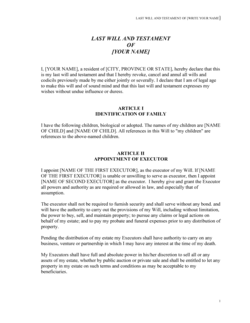
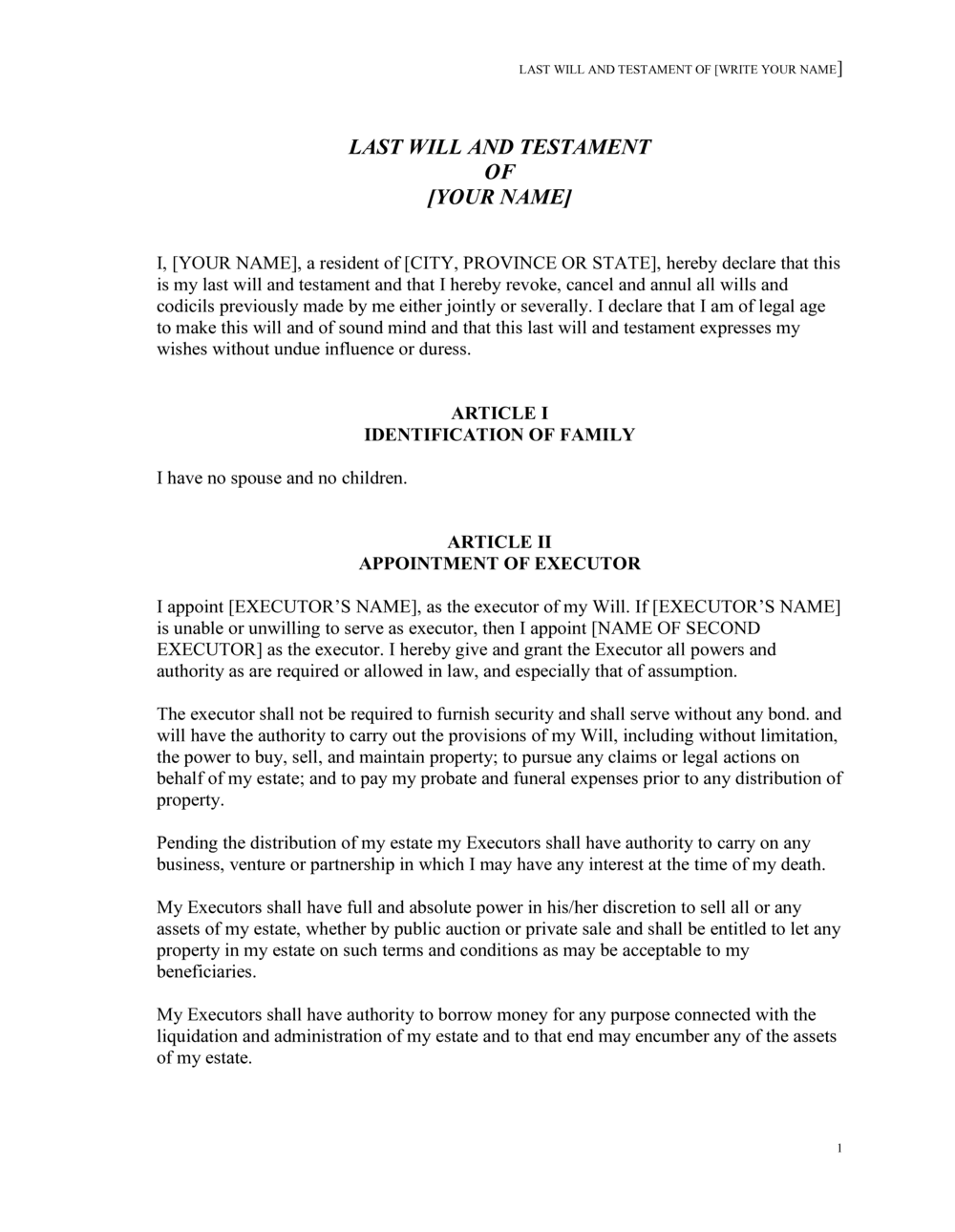
Last Will and Testament - Single with No Children Template

Free Word download β€’ Edit online β€’ Save & share with Drive β€’ Export to PDF

4 pagesβ€’25–35 min to fillβ€’Difficulty: Complexβ€’Signature requiredβ€’Legal review recommended
Learn more ↓
FreeLast Will and Testament - Single with No Children Template

At a glance

What it is
A Last Will and Testament for a single person with no children is a legally binding document that records how you want your assets distributed after death, who you appoint to carry out those instructions, and any specific bequests to individuals, charities, or organizations. This free Word download gives you a structured, attorney-reviewable starting point you can edit online and export as PDF to execute with witnesses before storing with your estate documents.
When you need it
Use it whenever you want to control who inherits your property, accounts, and personal belongings rather than leaving that decision to your state or province's intestacy laws. It becomes especially important when you own real estate, hold investment or retirement accounts, run a business, or have strong preferences about which friends, relatives, or charities should benefit from your estate.
What's inside
Testator identification and revocation of prior wills, executor appointment and powers, specific bequests of named assets, residuary estate distribution, beneficiary designations with alternates, debts and funeral expense instructions, digital asset provisions, and the signature and witness attestation block required for valid execution.

What is a Last Will and Testament (Single, No Children)?

A Last Will and Testament is a legally binding testamentary document in which a person β€” the testator β€” records their instructions for distributing their property and assets after death, appoints an executor to carry out those instructions, and may specify preferences for funeral arrangements and the handling of digital accounts. This template is designed specifically for single adults with no minor or dependent children: a streamlined but complete document covering all essential clauses without the guardianship provisions, spousal election rights, or trust-for-minors language that complicate wills for parents and married individuals. Available as a free Word download, it provides a structured, attorney-reviewable starting point you can complete in under an hour and execute with two witnesses.

Why You Need This Document

Without a valid will, your estate passes by intestacy β€” meaning a court applies your jurisdiction's default inheritance hierarchy, which for a single person with no children typically means assets flow to your parents, then your siblings, regardless of your actual relationships or wishes. A long-term partner, a close friend, or a favored charity receives nothing. Beyond controlling who inherits, a signed will names the executor you trust to manage the process, specifies how debts and expenses are paid before distribution, and provides explicit authority over digital assets β€” cryptocurrency, online accounts, and domain names β€” that intestacy rules were never designed to address. The absence of a will also means a higher-friction, longer, and costlier probate process as courts fill in every gap your silence creates. This template closes those gaps at the cost of one careful hour and, where your estate warrants it, a single attorney review session.

Which variant fits your situation?

If your situation is…Use this template
Single adult with no children and straightforward asset listLast Will and Testament β€” Single, No Children
Married couple wanting mirror wills with mutual inheritanceLast Will and Testament β€” Married Couple
Single parent needing to appoint a guardian for minor childrenLast Will and Testament β€” Single With Children
Person wanting to transfer assets outside probate through a trustRevocable Living Trust Agreement
Person needing to name a healthcare decision-maker while aliveHealthcare Power of Attorney
Person wanting to delegate financial decisions if incapacitatedDurable Power of Attorney
Person specifying end-of-life medical preferencesLiving Will / Advance Healthcare Directive

Common mistakes to avoid

❌ Using a beneficiary or executor as a witness

Why it matters: Most jurisdictions disqualify bequests to a witness-beneficiary or void the entire will. An executor who witnesses the will can create a conflict that jeopardizes their authority to administer the estate.

Fix: Choose two independent adults who receive nothing under the will and have no role in administering the estate. Colleagues, neighbors, and friends work well.

❌ Failing to name alternate beneficiaries

Why it matters: If a named beneficiary predeceases the testator and no alternate is listed, that share of the estate falls into intestacy β€” passing by statute to heirs you may not have chosen.

Fix: Name at least one alternate for every beneficiary, including the residuary estate. Add a final charitable alternate as a last resort.

❌ Describing assets too vaguely

Why it matters: Descriptions like 'my savings account' or 'my car' are ambiguous when the testator holds multiple accounts or vehicles. Executors and courts must interpret the intent, and disputes among beneficiaries are common.

Fix: Include account numbers, institution names, property legal descriptions, and vehicle identification numbers so each asset can be identified without ambiguity.

❌ Storing credentials or account passwords inside the will

Why it matters: Wills become public record when admitted to probate. Any passwords or PINs included in the document are accessible to anyone who searches the court file.

Fix: Reference a separate, secure document for credentials. Store it in a password manager or sealed physical envelope and tell your executor its location separately.

❌ Never updating the will after major life changes

Why it matters: A will that names an ex-partner as beneficiary, a deceased person as executor, or references assets you no longer own creates confusion, legal contests, and unintended distributions.

Fix: Review your will after any major life event β€” a significant asset acquisition, a change in relationships, the death of a named party, or a move to a new jurisdiction β€” and execute a codicil or new will as needed.

❌ Executing the will without meeting the jurisdiction's formality requirements

Why it matters: A will signed by only one witness, or notarized but not witnessed, may be entirely invalid under the law of the testator's domicile β€” meaning the estate passes by intestacy as if no will existed.

Fix: Confirm the execution requirements for your specific state or province before signing. Most common-law jurisdictions require two adult witnesses; Louisiana requires a notary and specific formalities.

The 10 key clauses, explained

Testator identification and revocation of prior wills

In plain language: States your full legal name, residential address, and a declaration that you are of sound mind and legal age, and expressly revokes all prior wills and codicils.

Sample language
I, [FULL LEGAL NAME], of [CITY, STATE/PROVINCE], being of legal age and sound mind, hereby make this my Last Will and Testament and revoke all prior wills and codicils previously made by me.

Common mistake: Using a nickname or shortened name instead of the exact legal name matching government ID β€” this creates identity disputes during probate and can delay estate administration for months.

Executor appointment and powers

In plain language: Names the person or institution responsible for administering the estate, grants them authority to act without court supervision where permitted, and names an alternate executor if the primary cannot serve.

Sample language
I appoint [EXECUTOR FULL NAME] of [CITY, STATE/PROVINCE] as Executor of this Will. If [EXECUTOR FULL NAME] is unable or unwilling to serve, I appoint [ALTERNATE EXECUTOR FULL NAME] as successor Executor. I grant my Executor full authority to administer my estate without bond or court supervision to the extent permitted by law.

Common mistake: Naming only one executor with no alternate. If the sole executor predeceases the testator or declines the role, the court appoints an administrator β€” a process that adds cost and delays distribution.

Payment of debts and expenses

In plain language: Directs the executor to pay valid debts, funeral costs, and estate administration expenses from the estate before distributing assets to beneficiaries.

Sample language
I direct my Executor to pay all of my legally enforceable debts, funeral and burial expenses, and the costs of administering this estate as soon as practicable after my death.

Common mistake: Omitting this clause and making specific bequests without accounting for debts β€” beneficiaries may receive assets only to have the executor claw them back to satisfy creditors.

Specific bequests

In plain language: Lists named assets β€” real estate, vehicles, bank accounts, jewelry, or personal property β€” and identifies exactly who receives each item.

Sample language
I give and bequeath my [DESCRIPTION OF ASSET] located at [ADDRESS / DESCRIPTION] to [BENEFICIARY FULL NAME] of [CITY, STATE/PROVINCE], absolutely and forever. If [BENEFICIARY FULL NAME] does not survive me by [30] days, this bequest shall lapse and fall into the residue of my estate.

Common mistake: Describing assets too vaguely β€” 'my car' or 'my bank account' when you own multiple vehicles or hold accounts at several institutions. Ambiguous descriptions require executor interpretation, invite disputes, and can require a court ruling.

Residuary estate distribution

In plain language: Disposes of everything not covered by specific bequests β€” the bulk of most estates β€” by naming one or more beneficiaries and their respective shares, with alternates.

Sample language
I give all the rest, residue, and remainder of my estate, both real and personal, wherever situated, to [PRIMARY BENEFICIARY FULL NAME] in equal shares. If [PRIMARY BENEFICIARY FULL NAME] does not survive me, I give the residue to [ALTERNATE BENEFICIARY FULL NAME].

Common mistake: Failing to name a final alternate for the residuary estate. If all named beneficiaries predecease the testator and no alternate is listed, the residue passes by intestacy β€” undoing the entire purpose of having a will.

Alternate and lapse provisions

In plain language: States what happens to a bequest if a named beneficiary dies before the testator β€” whether the gift lapses into residue, passes per stirpes, or goes to a named substitute.

Sample language
If any beneficiary named in this Will predeceases me and no alternate is named, the share that would have passed to that beneficiary shall fall into the residue of my estate and be distributed accordingly.

Common mistake: Omitting survival periods entirely. Without a survivorship clause (typically 30 days), an estate could pass to a beneficiary who dies days later β€” triggering a second probate for the same assets.

Digital assets and online accounts

In plain language: Grants the executor authority to access, manage, and distribute digital assets β€” including social media accounts, cryptocurrency wallets, domain names, and cloud storage β€” and references a separate password/access document.

Sample language
I grant my Executor full authority to access, manage, transfer, and close my digital assets and online accounts, including but not limited to [PLATFORM / WALLET TYPES]. Access credentials are recorded in a separate document stored at [LOCATION].

Common mistake: Including passwords and login credentials directly in the will. Wills become public record during probate β€” any credentials written in the document are exposed to anyone who searches the court file.

Funeral and disposition of remains

In plain language: States your preferences for burial, cremation, memorial services, or organ donation, and directs the executor to carry them out to the extent practicable.

Sample language
I direct that my remains be [BURIED / CREMATED / DONATED TO SCIENCE] and that my funeral and memorial arrangements reflect my preference for [DESCRIPTION]. These are my wishes; I recognize my Executor has final legal authority to carry them out.

Common mistake: Writing funeral instructions only in the will. Wills are often not read until days after death β€” after funeral decisions have already been made. Communicate these wishes to your executor directly and in a separate letter as well.

No-contest clause

In plain language: Provides that any beneficiary who challenges the validity of the will in court forfeits their inheritance, discouraging litigation over the estate.

Sample language
If any beneficiary under this Will contests its validity or any of its provisions, that beneficiary shall receive nothing from my estate, and their share shall be distributed as if they had predeceased me.

Common mistake: Including a no-contest clause in a state or province where it is not enforced. Several US states and some Canadian provinces either refuse to enforce them or significantly limit their effect β€” include one only after confirming it is valid in the governing jurisdiction.

Signature and witness attestation

In plain language: The testator's dated signature block and the attestation language signed by at least two witnesses confirming they observed the execution and that the testator appeared of sound mind.

Sample language
Signed by [TESTATOR FULL NAME] on [DATE] in the presence of the undersigned witnesses. We, the witnesses, declare that the Testator signed this Will freely and voluntarily and appeared to be of legal age, sound mind, and under no undue influence.

Common mistake: Having a beneficiary or the executor serve as a witness. Most jurisdictions disqualify or void bequests to a witness-beneficiary β€” and in some states the entire will is voided. Use two independent witnesses who receive nothing under the will.

How to fill it out

  1. 1

    Enter your full legal name and address

    Use the exact name appearing on your government-issued ID β€” driver's license or passport. Include your current residential address and the date of execution. This establishes identity for probate and prevents challenges.

    πŸ’‘ If you have changed your name (by marriage, divorce, or legal order), use the name on your most current legal ID and note the former name in parentheses.

  2. 2

    Name your executor and an alternate

    Choose a trusted adult who lives in or near your jurisdiction, is organized, and is willing to take on the role. Confirm with them before naming them. Name a second person as alternate in case the first is unable or unwilling to serve.

    πŸ’‘ Institutional executors (banks and trust companies) are available if you have no suitable individual β€” they charge a fee of roughly 1–4% of the estate value but provide professional, conflict-free administration.

  3. 3

    List specific bequests with precise asset descriptions

    For each item you want to leave to a named person or charity, describe the asset with enough specificity to identify it uniquely β€” include account numbers, property addresses, vehicle VINs, or serial numbers where relevant.

    πŸ’‘ For personal property of moderate or low value, consider a personal property memorandum β€” a separate list you can update without re-executing the will β€” if your jurisdiction recognizes them.

  4. 4

    Designate residuary beneficiaries and alternates

    Name at least one primary residuary beneficiary and one alternate. If you want to split the residue among several people, state each person's percentage share. Percentages must total 100%.

    πŸ’‘ Name a final 'catch-all' charity as the last alternate β€” if every named human beneficiary predeceases you, the residue goes to a cause you care about rather than to the state.

  5. 5

    Add digital asset provisions and reference a password document

    List the categories of digital assets you hold (cryptocurrency, brokerage accounts, domain names, cloud storage) and grant your executor explicit authority to access them. Do not include passwords in the will itself.

    πŸ’‘ Store credentials in a password manager or sealed envelope and tell your executor its location β€” review and update this document annually.

  6. 6

    State your funeral and disposition preferences

    Indicate whether you want burial, cremation, or donation of your remains, and note any preferences for memorial services. Keep it brief β€” detailed planning belongs in a separate letter to your executor.

    πŸ’‘ Email or hand-deliver a copy of your funeral preferences to your executor now. Wills are routinely found days after burial decisions have been finalized.

  7. 7

    Execute with two independent witnesses

    Sign and date the will in the presence of two adult witnesses who are not beneficiaries and not named as executor. Both witnesses must sign the attestation clause in your presence and in each other's presence.

    πŸ’‘ In the US, adding a self-proving affidavit notarized at the time of signing allows the will to be admitted to probate without the witnesses having to testify β€” a significant practical convenience.

  8. 8

    Store the original and tell your executor where it is

    Store the original signed will in a fireproof location β€” a home safe, a bank safe-deposit box, or with your attorney. Give your executor a copy and tell them the exact location of the original.

    πŸ’‘ Do not store the original in a safe-deposit box without ensuring someone has access after your death β€” banks typically seal boxes upon notification of death, and a court order may be required to retrieve the will.

Frequently asked questions

What is a last will and testament?

A last will and testament is a legally binding document in which a person (the testator) records their instructions for distributing their assets after death, appoints an executor to carry out those instructions, and may specify funeral preferences and other personal directives. Without a valid will, a person's estate is distributed according to the intestacy laws of their jurisdiction β€” which may produce results very different from what they would have chosen.

Who should use a will designed for a single person with no children?

This template is suited for any unmarried adult without minor or dependent children who wants to direct their estate to parents, siblings, friends, partners, or charities rather than relying on intestacy defaults. It is also appropriate for recently divorced individuals, widowed persons with no surviving children, and anyone whose family situation has changed such that a prior will no longer reflects their wishes.

What happens if I die without a will?

Dying without a valid will (intestate) means your estate is distributed by a court-appointed administrator according to your jurisdiction's statutory inheritance hierarchy β€” typically starting with a spouse, then children, then parents, then siblings. For a single person with no children, assets typically pass first to parents and then to siblings. Friends, unmarried partners, and charities receive nothing under intestacy regardless of your actual wishes.

Do I need a lawyer to make a last will and testament?

A template is often sufficient for straightforward estates β€” modest assets, clear beneficiaries, and a single jurisdiction. Legal review is strongly recommended if your estate includes real estate in more than one jurisdiction, a business interest, significant investment or retirement accounts, potential creditor claims, or if you anticipate a challenge from a family member. The cost of a one-hour attorney review ($150–$400) is small relative to the cost of a contested probate.

How many witnesses does a will require?

Most common-law jurisdictions β€” including US states, Canadian provinces, England, Wales, and Australia β€” require two adult witnesses who are not beneficiaries under the will. Scotland requires one witness. Louisiana requires a notary and two witnesses under its civil-law system. The EU varies significantly by member state, from one witness (Italy) to two (Germany) to notarization (France for certain will types). Always confirm the requirements for the jurisdiction where you are domiciled at the time of signing.

Does a will need to be notarized to be valid?

In most US states and Canadian provinces, notarization is not required for a will to be valid β€” two witness signatures are sufficient. However, adding a self-proving affidavit notarized at the time of signing allows the will to be admitted to probate without the witnesses having to appear and testify, which is a practical convenience. Some US states accept holographic (entirely handwritten and signed) wills without witnesses. In France and several other civil-law jurisdictions, a notarized will is the standard form.

Can I leave assets to a charity in my will?

Yes. You can name any registered nonprofit or charitable organization as a beneficiary of a specific bequest or a percentage of the residuary estate. Include the charity's full legal name and registration number (EIN in the US, charity registration number in the UK and Canada) to ensure the executor can identify and transfer to the correct organization. Many jurisdictions provide an estate tax charitable deduction for qualifying bequests.

What is a self-proving will?

A self-proving will includes a notarized affidavit signed by the testator and witnesses at the time of execution, swearing that all formalities were observed. When this affidavit is attached, the probate court can accept the will without requiring the witnesses to appear and testify β€” which is especially valuable if witnesses are elderly, moved away, or deceased by the time probate opens. Most US states recognize self-proving wills; availability varies in other jurisdictions.

How often should I update my will?

Review your will whenever you experience a significant life event: acquiring or selling major assets, moving to a different state or country, a change in relationships (new partner, estrangement), the death of a named executor or beneficiary, or a substantial change in the value of your estate. As a baseline, reviewing it every three to five years is reasonable. Minor updates can be made with a codicil; major changes typically warrant executing a new will and revoking the prior one.

How this compares to alternatives

vs Revocable Living Trust

A revocable living trust transfers assets to a trustee during the testator's lifetime, allowing those assets to pass to beneficiaries outside probate after death. A will takes effect only at death and passes through probate. For a single person with no children, a will is simpler and cheaper to create; a trust is worth the added cost primarily when the estate includes real estate in multiple states or when avoiding the public probate record is a priority.

vs Durable Power of Attorney

A durable power of attorney grants a named agent authority to manage your finances and property while you are alive but incapacitated. A last will and testament takes effect only after death and has no authority over decisions made during incapacity. Both documents are needed for comprehensive estate planning β€” the will does not substitute for a power of attorney.

vs Living Will / Advance Healthcare Directive

A living will records your preferences for end-of-life medical treatment β€” resuscitation, life support, pain management β€” and takes effect during incapacity, not after death. A last will and testament addresses asset distribution after death and has no bearing on medical decisions. Single adults with no children particularly need both, as there is no default next-of-kin automatically authorized to make healthcare decisions.

vs Letter of Instruction

A letter of instruction is an informal, non-binding document that guides your executor through practical details β€” account locations, digital credentials, funeral preferences, and personal wishes not covered by the will. It is not a legal document and cannot distribute assets or create obligations. Use it alongside your will, not instead of it, and update it freely without the formalities required to amend the will itself.

Industry-specific considerations

Professional services

Lawyers, accountants, and consultants often hold professional-practice interests, client receivables, and partnership stakes that require explicit bequest or wind-down instructions.

Technology / SaaS

Founders and engineers may hold cryptocurrency, unvested equity, IP rights, and valuable domain names that need explicit digital asset and intellectual property clauses.

Real estate

Property owners benefit from precise legal descriptions of each parcel and explicit executor authority to sell, transfer, or lease real property without additional court orders.

Creative and media

Authors, musicians, and designers may hold copyright royalties, publishing contracts, and licensing agreements that require a designated beneficiary and instructions for ongoing management.

Jurisdictional notes

United States

Most US states require two adult witnesses who are not beneficiaries; Louisiana requires a notary and two witnesses under its civil-law system. Adding a self-proving affidavit at signing simplifies probate admission. Several states β€” including California, Florida, and Texas β€” recognize holographic (handwritten) wills without witnesses, but a typed, witnessed will is the safer standard. Non-compete and community-property rules vary by state and can affect which assets pass through the will.

Canada

Each province sets its own Wills Act requirements. Most require two adult witnesses who are not beneficiaries; British Columbia permits a single witness under its Wills, Estates and Succession Act. Quebec operates under civil law and requires a notarial will or a holographic will β€” the common-law witnessed form is not valid there. Probate (Certificate of Appointment of Estate Trustee in Ontario) is required to transfer most titled assets and involves provincial fees based on estate value.

United Kingdom

The Wills Act 1837 (England and Wales) requires the testator's signature in the presence of two witnesses who then sign in the testator's presence. Scotland requires only one witness under the Requirements of Writing (Scotland) Act 1995. Witnesses must be at least 18 years old and must not be beneficiaries or spouses of beneficiaries. The UK has no inheritance tax threshold for estates below Β£325,000 (as of 2025), but larger estates may benefit from charitable bequests that reduce the taxable estate to below the nil-rate band.

European Union

EU Succession Regulation No. 650/2012 allows EU residents to elect the law of their nationality to govern their estate rather than the law of their habitual residence β€” a clause to that effect should be included for expats. Execution formalities vary widely: Germany and Austria require notarization or a handwritten holographic will; France requires a notarial will for full legal effect or a handwritten holographic will; Italy requires one witness or a holographic will. GDPR considerations apply to personal data held in digital assets passed under the will.

Template vs lawyer β€” what fits your deal?

PathBest forCostTime
Use the templateSingle adults with straightforward estates β€” modest savings, one jurisdiction, clear beneficiaries, no anticipated challengesFree30–60 minutes
Template + legal reviewAnyone with real estate, business interests, significant investments, or a move to a new jurisdiction$150–$400 for a one-hour attorney review1–3 days
Custom draftedComplex estates with multi-jurisdictional property, business succession, anticipated creditor claims, or contested family dynamics$500–$2,500+1–3 weeks

Glossary

Testator
The person who creates and signs the will β€” in this template, the single adult with no children whose estate is being planned.
Executor
The person or institution named in the will to administer the estate β€” collecting assets, paying debts, and distributing what remains to beneficiaries.
Beneficiary
Any individual, organization, or charity designated to receive a specific asset or share of the estate under the will.
Bequest
A specific gift of a named asset β€” such as a vehicle, piece of jewelry, or sum of money β€” to a named beneficiary.
Residuary Estate
Everything left over after specific bequests have been distributed and debts and expenses have been paid β€” the 'catch-all' portion of the estate.
Intestacy
The legal condition of dying without a valid will, leaving asset distribution to be determined by the jurisdiction's statutory inheritance rules.
Probate
The court-supervised process of authenticating a will, appointing the executor, paying debts, and distributing assets to beneficiaries.
Letters Testamentary
A court-issued document authorizing the executor to act on behalf of the estate β€” required by banks, brokerages, and property registries.
Attestation Clause
The section of the will signed by witnesses confirming they observed the testator sign and that the testator appeared to be of sound mind.
Per Stirpes
A distribution method meaning a deceased beneficiary's share passes proportionally to that beneficiary's own descendants rather than lapsing.
Codicil
A formal amendment to an existing will that modifies specific provisions without revoking the entire document.
Digital Assets
Online accounts, cryptocurrency holdings, domain names, and digital files that form part of the estate and require specific access and disposition instructions.

Part of your Business Operating System

This document is one of 3,000+ business & legal templates included in Business in a Box.

  • Fill-in-the-blanks β€” ready in minutes
  • 100% customizable Word document
  • Compatible with all office suites
  • Export to PDF and share electronically

Create your document in 3 simple steps.

From template to signed document β€” all inside one Business Operating System.
1
Download or open template

Access over 3,000+ business and legal templates for any business task, project or initiative.

2
Edit and fill in the blanks with AI

Customize your ready-made business document template and save it in the cloud.

3
Save, Share, Send, Sign

Share your files and folders with your team. Create a space of seamless collaboration.

Save time, save money, and create top-quality documents.

β˜…β˜…β˜…β˜…β˜…

"Fantastic value! I'm not sure how I'd do without it. It's worth its weight in gold and paid back for itself many times."

Managing Director Β· Mall Farm
Robert Whalley
Managing Director, Mall Farm Proprietary Limited
β˜…β˜…β˜…β˜…β˜…

"I have been using Business in a Box for years. It has been the most useful source of templates I have encountered. I recommend it to anyone."

Business Owner Β· 4+ years
Dr Michael John Freestone
Business Owner
β˜…β˜…β˜…β˜…β˜…

"It has been a life saver so many times I have lost count. Business in a Box has saved me so much time and as you know, time is money."

Owner Β· Upstate Web
David G. Moore Jr.
Owner, Upstate Web

Run your business with a system β€” not scattered tools

Stop downloading documents. Start operating with clarity. Business in a Box gives you the Business Operating System used by over 250,000 companies worldwide to structure, run, and grow their business.

Free Forever PlanΒ Β·Β No credit card required