Employee Newsletter Template

Free Word download β€’ Edit online β€’ Save & share with Drive β€’ Export to PDF

4 pagesβ€’20–30 min to fillβ€’Difficulty: Standardβ€’Signature requiredβ€’Legal review recommended
Learn more ↓
FreeEmployee Newsletter Template

At a glance

What it is
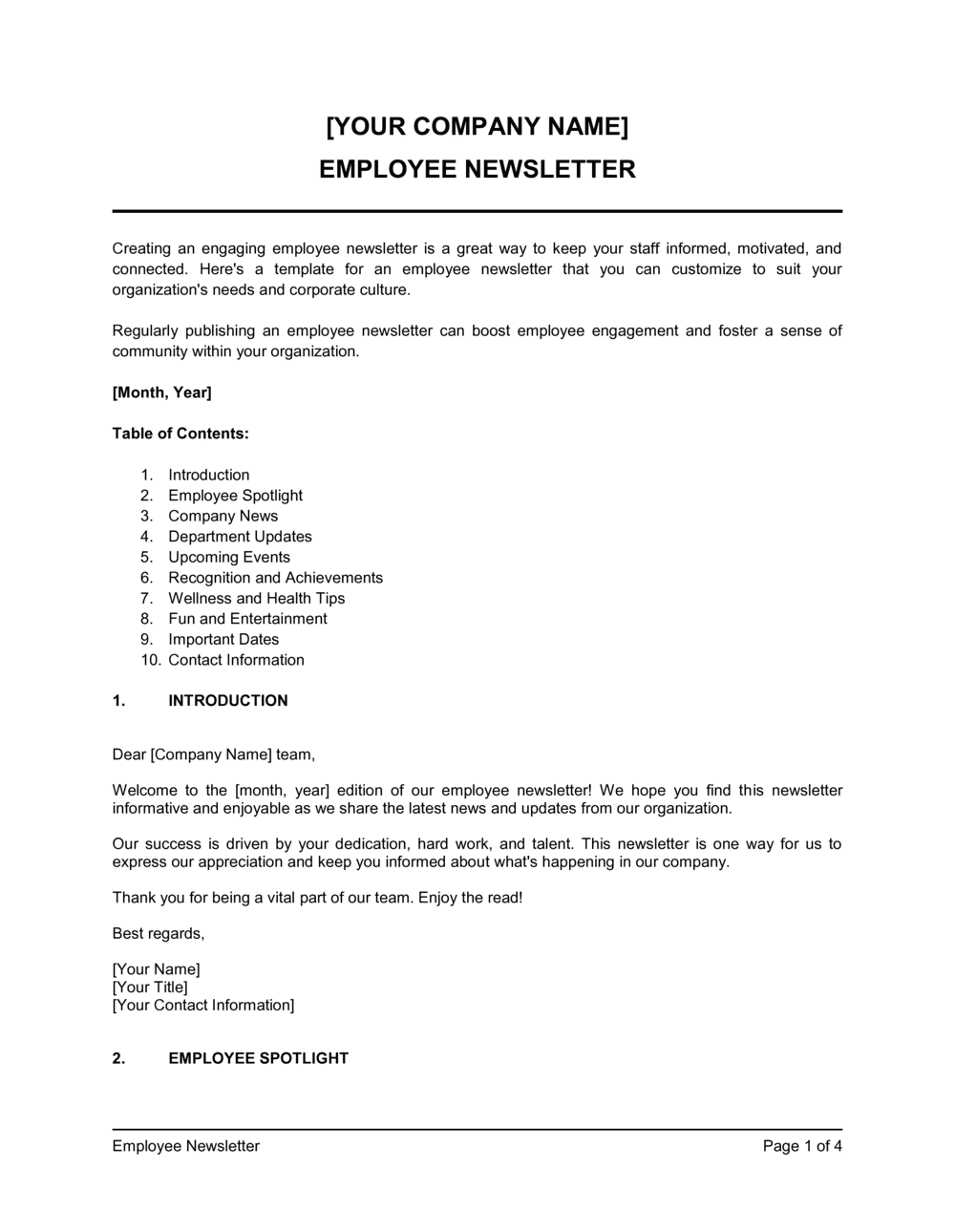
An Employee Newsletter is a formal internal communication document that employers distribute to staff on a regular cadence β€” weekly, bi-weekly, or monthly β€” to share company updates, HR announcements, policy changes, team achievements, and operational news. This free Word download gives you a professionally structured, editable template you can customize with your branding, update for each issue, and distribute by email or print.
When you need it
Use it whenever your organization needs a consistent, documented channel for communicating policy updates, benefit changes, compliance notices, organizational announcements, or cultural messaging to all employees at once. It becomes especially important when changes carry legal or compliance weight β€” such as policy amendments, benefits enrollment deadlines, or workplace safety updates β€” where a dated, distributed record matters.
What's inside
A masthead with issue date and distribution scope, an editorial message from leadership, HR and policy announcement sections, operational and project updates, compliance notices, team recognition, and an events calendar. Each section is structured so content can be swapped issue to issue without redesigning the layout.

What is an Employee Newsletter?

An Employee Newsletter is a recurring internal communication document that an organization distributes to its workforce β€” typically monthly or bi-weekly β€” to share company updates, HR announcements, policy changes, compliance notices, team recognition, and upcoming events in a single, structured publication. Unlike a standalone memo or one-off announcement email, the newsletter functions as a consistent, branded communication channel that employees learn to anticipate and reference. When it carries policy amendments, statutory disclosures, or benefits changes, it also functions as a dated, distributable record demonstrating that required information was formally communicated to staff.

Why You Need This Document

Without a structured, consistently formatted employee newsletter, organizations distribute policy changes through informal emails, Slack messages, and verbal announcements β€” none of which create a retrievable, dated record of what was communicated and to whom. When an employee later disputes that they received notice of a disciplinary policy change, a benefits deadline, or a revised remote-work procedure, an undated email thread is a weak evidentiary foundation. A formal newsletter with a sequential issue number, a dated masthead, a clearly labeled compliance section, and an acknowledgment record for high-stakes issues closes that gap. Beyond compliance, the newsletter reduces the fragmentation of internal communications that forces employees to check multiple channels, filter inboxes, and piece together organizational context from incomplete signals. This template gives you the structure to produce a professional, legally defensible issue in two to four hours β€” without designing the document from scratch each month.

Which variant fits your situation?

If your situation is…Use this template
Regular all-staff update covering company news and cultureEmployee Newsletter (Monthly)
Announcing a specific policy change or HR update onlyPolicy Update Memo
Communicating a major organizational change such as a restructure or acquisitionBusiness Announcement Letter
Notifying employees of a new or amended workplace safety procedureSafety Memo
Welcoming a new hire or announcing a promotionNew Employee Announcement
Summarizing a town hall or all-hands meeting for staff who missed itMeeting Minutes
Delivering a CEO or executive message to the full organizationCompany Memo (Executive)

Common mistakes to avoid

❌ No issue date or sequential numbering

Why it matters: Without a dated, numbered record, you cannot demonstrate that a specific policy notice or compliance disclosure was distributed on a particular date. This gap is routinely exploited in employment disputes and regulatory audits.

Fix: Add a masthead to every issue containing the company name, newsletter title, issue number, and publication date. Maintain a master log of all issues distributed.

❌ Embedding compliance notices inside general content

Why it matters: Burying a statutory disclosure or policy change inside a culture update section means employees can credibly claim they missed it β€” and regulators may agree the notice was insufficiently prominent.

Fix: Create a dedicated, clearly labeled compliance or policy section that appears in a consistent position in every issue. Use bold headings and effective dates to make mandatory content visually distinct.

❌ Publishing employee personal details without consent

Why it matters: Including home cities, health milestones, or family news without written consent violates GDPR in the EU and UK, PIPEDA in Canada, and may trigger state privacy claims in the US, in addition to damaging employee trust.

Fix: Obtain written or digital opt-in consent during onboarding for inclusion in company communications. Review consent records before each issue and remove individuals who have withdrawn consent.

❌ Distributing a policy-change issue without an acknowledgment record

Why it matters: An employee who later claims they were unaware of a policy change β€” disciplinary procedure, remote-work rules, or a benefits amendment β€” is much harder to manage without documented proof of receipt.

Fix: For any issue containing a policy amendment or statutory notice, append an acknowledgment block and track signed returns. Use email read receipts or a digital platform confirmation for distributed teams.

❌ Failing to archive issues with their distribution records

Why it matters: Without a retrievable archive, you cannot produce the evidence needed during an employment tribunal, a regulatory inspection, or an internal investigation that a specific communication was sent.

Fix: Save the final PDF of every issue alongside the distribution log β€” recipient list, send date, delivery confirmation β€” in a secure HR records folder. Retain for the jurisdiction-applicable period, typically three to seven years.

❌ Using inconsistent or outdated contact details in the resources section

Why it matters: A broken link to the benefits portal or an outdated HR email address in a compliance-heavy issue effectively prevents employees from acting on mandatory notices β€” and shifts liability back to the employer.

Fix: Assign one person to verify every contact, link, and portal URL in the resources section before each issue is finalized. Build this into the production checklist as a non-optional step.

The 9 key clauses, explained

Masthead and issue identification

In plain language: Identifies the newsletter by name, issue number, publication date, and the issuing entity β€” creating the audit record that anchors any compliance-related content inside.

Sample language
[COMPANY NAME] Employee Newsletter | Issue [NUMBER] | [MONTH YEAR] | Published by [DEPARTMENT / HR TEAM NAME]

Common mistake: Omitting the issue number and date. Without both, you cannot demonstrate to a regulator or in a dispute that a specific policy notice was distributed on a specific date.

Leadership message

In plain language: A brief statement from the CEO, president, or department head that sets the tone for the issue, reinforces company values, and signals priority topics.

Sample language
A message from [NAME], [TITLE]: 'This month we [ACHIEVEMENT / INITIATIVE]. As we move into [PERIOD], our focus is [PRIORITY]. Thank you for [SPECIFIC CONTRIBUTION].'

Common mistake: Writing a generic motivational message with no operational connection to the rest of the newsletter. The leadership message should reference at least one specific announcement in the issue.

HR and policy announcements

In plain language: The section carrying new or amended policies, benefits changes, leave entitlements, or compliance-required notices, each with an effective date and a reference to where employees can find the full policy.

Sample language
Effective [DATE], [POLICY NAME] has been updated. Key changes: [SUMMARY]. The full policy is available at [LOCATION / LINK]. Questions? Contact [HR CONTACT NAME] at [EMAIL].

Common mistake: Summarizing a policy change without stating the effective date or where to find the full document. Employees who act on an incomplete summary and the employer who relied on the newsletter to satisfy notice obligations are both exposed.

Compliance and legal notices

In plain language: Formally documented notices that the organization is required to communicate to employees by statute or regulation β€” such as open-enrollment deadlines, OSHA posting obligations, or statutory leave rights.

Sample language
Annual Benefits Open Enrollment runs [START DATE] to [END DATE]. Employees who do not make elections by [DEADLINE] will be defaulted to [DEFAULT PLAN]. For details, see [PLAN DOCUMENT LOCATION].

Common mistake: Burying compliance notices inside general news content. Regulatory notices must stand apart β€” use a clearly labeled section so the record shows they were prominently communicated.

Operational and project updates

In plain language: Department-level or company-wide updates on active projects, process changes, system rollouts, or facility news that affect daily work.

Sample language
[PROJECT NAME] is on track for [MILESTONE] in [MONTH]. Starting [DATE], [PROCESS CHANGE] will apply to [AFFECTED TEAM / LOCATION]. Contact [NAME] with questions.

Common mistake: Including project updates without naming who owns the change or who employees should contact. Anonymous announcements generate follow-up questions that clog HR inboxes.

Employee recognition and team news

In plain language: A standing section spotlighting individual achievements, work anniversaries, promotions, new hires, and team milestones β€” with employee consent for any personal details shared.

Sample language
Congratulations to [EMPLOYEE NAME] ([DEPARTMENT]) on [ACHIEVEMENT]. Welcome to [NEW HIRE NAME], joining as [TITLE] in [DEPARTMENT] on [START DATE].

Common mistake: Publishing personal details β€” home location, health milestones, family news β€” without written employee consent. In GDPR-regulated jurisdictions this is a data protection violation, not just a courtesy issue.

Events and important dates

In plain language: A calendar of upcoming internal events, training sessions, compliance deadlines, and public holidays relevant to the workforce in the issue's coverage period.

Sample language
[DATE]: [EVENT NAME] β€” [LOCATION / LINK]. [DATE]: [DEADLINE NAME] β€” action required by [TIME]. [DATE]: [TRAINING SESSION] β€” registration at [LINK].

Common mistake: Listing dates without specifying whether attendance is mandatory or voluntary. For legally required training β€” harassment prevention, safety certifications β€” mandatory status must be stated explicitly.

Resources and contact directory

In plain language: A consistent reference block listing HR contacts, employee assistance programs, IT helpdesk, and links to the employee handbook, benefits portal, and any updated policies.

Sample language
HR inquiries: [HR EMAIL] | Benefits questions: [BENEFITS PORTAL LINK] | EAP: [PROVIDER NAME] β€” [PHONE / LINK] | IT support: [IT EMAIL / TICKET LINK]

Common mistake: Updating contact names but not email addresses, or linking to an internal page that has moved. A broken resource link in a compliance-required communication creates the same problem as no link at all.

Acknowledgment and receipt confirmation

In plain language: A signature or click-through acknowledgment block used when the newsletter carries policy changes, compliance notices, or other content where documented receipt is legally advisable.

Sample language
I, [EMPLOYEE NAME], acknowledge receipt of the [COMPANY NAME] Employee Newsletter, Issue [NUMBER], dated [DATE], and confirm I have read the policy updates described herein. Signature: _______________ Date: _______________

Common mistake: Including an acknowledgment block in every issue regardless of content. Routine acknowledgments dilute their significance. Reserve them for issues containing mandatory policy notices or statutory disclosures.

How to fill it out

  1. 1

    Set the masthead and issue metadata

    Enter your company name, newsletter name, sequential issue number, and publication date. Confirm the distribution scope β€” all staff, a specific site, or a defined department β€” and record it in the masthead or header.

    πŸ’‘ Maintain a master issue log in a shared folder so you can produce a complete distribution record quickly if an employee disputes whether they received a specific policy notice.

  2. 2

    Draft the leadership message with a specific hook

    Write 100–200 words from the relevant executive. Reference at least one concrete development β€” a business result, a strategic milestone, or a cultural initiative β€” rather than a generic greeting.

    πŸ’‘ A leadership message that previews the newsletter's most important announcement doubles as a navigation aid for busy employees skimming on mobile.

  3. 3

    Populate HR and policy announcements with effective dates

    For each policy change or HR notice, state the effective date, summarize the change in two to three sentences, and link to the full policy document. Confirm the legal department or a senior HR professional has reviewed the language before distribution.

    πŸ’‘ If a policy change has different rollout dates by location or employment type, create a table rather than a paragraph β€” ambiguity in effective dates is the leading cause of policy compliance disputes.

  4. 4

    Isolate compliance and statutory notices in their own section

    Move any content required by law β€” OSHA updates, benefits enrollment windows, pay equity disclosures, statutory leave notices β€” into a clearly labeled compliance section. Do not embed them in general news.

    πŸ’‘ Date-stamp and archive a PDF copy of every issue containing a compliance notice. If you use an email platform, export the delivery report showing recipient, date, and time.

  5. 5

    Collect and verify operational updates from department leads

    Send a brief template to department heads one week before publication asking for active project updates, process changes, and staffing news. Edit for consistency and confirm that a named contact is identified for each item.

    πŸ’‘ A one-paragraph update with a named owner and a clear next step is always more useful than a detailed status report with no call to action.

  6. 6

    Obtain employee consent before publishing personal recognition

    Before naming an employee in the recognition section β€” especially for personal milestones like work anniversaries or promotions β€” confirm their preference in writing. In GDPR jurisdictions this is a data-handling obligation.

    πŸ’‘ A standing opt-in question in your onboarding paperwork ('May we include your name and role milestones in company communications?') eliminates the need for individual consent requests each issue.

  7. 7

    Add the acknowledgment block for compliance-heavy issues

    When the issue contains mandatory policy notices or statutory disclosures, add the acknowledgment block at the end and distribute with a signed-return deadline of five to seven business days. Track responses.

    πŸ’‘ Use a digital signature tool or an email-receipt survey for remote or distributed workforces β€” chasing physical signatures across multiple sites creates administrative overhead without improving the evidentiary record.

  8. 8

    Archive each issue with its delivery record

    Save the final distributed version as a PDF with the issue date in the filename. Store it alongside the delivery or distribution log in a location accessible to HR and legal for at least the duration of applicable records-retention requirements in your jurisdiction.

    πŸ’‘ In most jurisdictions, employment records β€” including policy communications β€” must be retained for three to seven years. Set a calendar reminder to confirm retention periods annually as regulations change.

Frequently asked questions

What is an employee newsletter?

An employee newsletter is a regularly distributed internal communication document that consolidates company updates, HR announcements, policy changes, team news, and compliance notices into a single publication sent to all staff or a defined employee group. It serves both as a cultural engagement tool and β€” when it carries policy or statutory content β€” as a documented record of what information was communicated, to whom, and on what date.

Why does an employee newsletter need a formal template?

A consistent template ensures every issue contains the structural elements that protect the organization legally: a dated masthead, a clearly labeled compliance section, an acknowledgment block for policy-change issues, and a resources directory. Without structure, individual issues may omit critical elements, creating gaps in the organization's communication and compliance records. A template also reduces production time and maintains brand consistency across issues and authors.

Do employees need to sign an employee newsletter?

Not for routine issues. However, when a newsletter contains mandatory policy changes, statutory disclosures, or amendments to employment terms β€” such as a revised remote-work policy or updated disciplinary procedure β€” an acknowledgment signature or digital confirmation is strongly advisable. This creates a dated record demonstrating that the employee received and noted the change, which is material evidence in any subsequent dispute about whether notice was given.

How often should an employee newsletter be distributed?

Monthly is the most common cadence for general-purpose employee newsletters. Organizations with high operational change β€” such as construction sites, healthcare providers, or fast-scaling startups β€” may publish bi-weekly. Quarterly issues are typical for smaller organizations with low policy-change volume. The cadence should be set in an editorial calendar and adhered to consistently; irregular distribution reduces readership and undermines the newsletter's role as a reliable communication channel.

What are the GDPR implications of publishing employee names in a newsletter?

Under GDPR, employee names and associated personal details β€” department, role, location, personal milestones β€” constitute personal data. Publishing them in a company newsletter requires a lawful basis, typically explicit consent. Employees must be able to withdraw consent without penalty. In practice, this means obtaining written opt-in consent during onboarding and maintaining a consent record. Failing to do so can result in a subject-access or erasure request and, in serious cases, a supervisory authority complaint.

How long should employee newsletters be retained?

In most jurisdictions, employment communications β€” including those that document policy notices or statutory disclosures β€” should be retained for the same period as employment records generally: three to seven years depending on jurisdiction and the nature of the content. Issues containing compliance notices or signed acknowledgments should be retained for the full applicable period even after the employee's departure. Store them as dated PDFs alongside distribution logs in a secure HR records system.

Can a small business use an employee newsletter template without HR expertise?

Yes β€” the template handles structure, section order, and placeholder language, so the author's job is filling in accurate content rather than designing the document from scratch. For routine issues covering company news and team updates, no HR expertise is required beyond basic accuracy. For issues carrying policy changes, benefit amendments, or statutory notices, a brief review by an HR professional or employment lawyer before distribution is worthwhile and typically takes less than an hour.

What is the difference between an employee newsletter and an employee handbook?

An employee handbook is a comprehensive reference document covering all company policies, benefits, and procedures in a single authoritative source β€” issued once and updated periodically. An employee newsletter is a time-specific communication issued on a regular cadence to announce current events, changes, and updates. The handbook is the authoritative policy record; the newsletter is the communication channel that tells employees when and how the handbook has changed.

How this compares to alternatives

vs Company Memo

A company memo is a single-subject, point-in-time communication β€” typically one to two pages β€” addressed to a specific audience about a specific decision or announcement. An employee newsletter is a recurring, multi-topic publication that consolidates several announcements into one distribution. Use a memo for urgent, standalone notices that cannot wait for the next newsletter cycle; use the newsletter for regular updates, culture content, and lower-urgency policy changes.

vs Employee Handbook

An employee handbook is the authoritative, comprehensive reference for all company policies, benefits, and workplace conduct standards β€” issued once and revised periodically. An employee newsletter is a regular communication that announces changes to what is in the handbook, not a replacement for it. The two documents work together: the handbook holds the policy; the newsletter tells employees when it changed.

vs Business Announcement Letter

A business announcement letter is a formal, signed communication about a single significant event β€” a merger, an acquisition, a leadership change, or an office relocation. It is issued as needed, not on a schedule, and typically carries the tone of an official corporate statement. An employee newsletter is a routine publication covering a range of topics; major announcements may be covered in the newsletter but often warrant a standalone letter as well.

vs Meeting Minutes

Meeting minutes record the decisions, action items, and discussions from a specific meeting β€” they are a verbatim or near-verbatim record for participants and absent stakeholders. An employee newsletter synthesizes operational updates and announcements into a readable publication for the broader workforce. Minutes are a historical record of what was decided; the newsletter is a communication tool for what employees need to know and do.

Industry-specific considerations

Healthcare

Compliance notices for HIPAA training deadlines, credentialing renewals, infection-control procedure updates, and mandatory reporting changes require a dated distribution record that a structured newsletter provides.

Manufacturing

OSHA safety procedure updates, shift-schedule changes, equipment certification deadlines, and union-agreement amendments must be documented as communicated, making the newsletter's issue-date and acknowledgment record operationally essential.

Professional Services

Client confidentiality reminders, professional development enrollment windows, billing-rate changes, and remote-work policy updates are the most common high-stakes items requiring structured distribution and a record of receipt.

Retail / Hospitality

High employee turnover makes a consistent newsletter critical for communicating tip-pooling rules, scheduling-system changes, seasonal staffing policies, and benefits eligibility thresholds to a workforce that changes rapidly.

Technology / SaaS

Remote and distributed teams rely on the newsletter as a primary cultural touchpoint; GDPR consent management for employee data, stock-vesting reminders, and IT security policy updates are the content categories with the greatest compliance weight.

Financial Services

Regulatory training deadlines, FINRA or FCA-mandated disclosures, conflicts-of-interest policy updates, and whistleblower procedure reminders must be communicated formally and archived, making a structured newsletter with acknowledgment records a compliance necessity.

Jurisdictional notes

United States

No federal law mandates a specific format for employee newsletters, but notices of ERISA-covered benefits changes, OSHA hazard communications, and FMLA policy updates distributed via newsletter should be dated and retained. Several states β€” including California, New York, and Illinois β€” require written notice of wage and hour policy changes within a defined period; a newsletter can satisfy this if it is dated, distributed to affected employees, and archived with a delivery record.

Canada

PIPEDA and provincial privacy legislation β€” including Quebec's Law 25 β€” treat employee names, roles, and personal milestones as personal information requiring a lawful basis for publication. Consent obtained during onboarding is the most practical basis. In Ontario and BC, employers must provide written notice of policy changes affecting employment terms; a dated, distributed newsletter with an acknowledgment record can satisfy this requirement. French-language publication is mandatory for Quebec-regulated employers.

United Kingdom

UK GDPR requires a lawful basis for processing employee personal data in any published communication. For newsletters, explicit consent is the most appropriate basis for personal recognition content. Newsletters carrying changes to employment terms β€” working hours, leave policy, pay structures β€” should include a written acknowledgment mechanism, as employment contract variations require documented employee agreement. ICO guidance recommends retaining employee communication records for the duration of employment plus six years.

European Union

GDPR Article 6 requires a specific lawful basis for including any employee personal data in a newsletter; consent is the standard basis and must be freely given, specific, and withdrawable. Data minimization principles apply β€” publish only the information necessary for the stated purpose. Works councils in Germany, France, Spain, and other member states may have consultation rights before significant policy changes are communicated to employees, even via newsletter. Retention periods for employment communications vary by member state but typically range from three to ten years.

Template vs lawyer β€” what fits your deal?

PathBest forCostTime
Use the templateRoutine monthly issues covering company news, team updates, and low-stakes HR announcementsFree2–4 hours per issue
Template + legal reviewIssues carrying policy amendments, benefits changes, or statutory compliance notices$150–$400 for a one-hour HR or employment-law review1–2 days including review turnaround
Custom draftedLarge organizations with multi-jurisdiction workforces, collective agreements, or heavily regulated industries requiring bespoke compliance language$500–$2,000+ per issue cycle for legal drafting and review3–5 business days

Glossary

Masthead
The header block of a newsletter that identifies the publication name, issue number, date, and issuing organization.
Distribution List
The defined group of recipients β€” all employees, a specific department, or a site location β€” to whom a particular issue is sent.
Issue Date
The official date a newsletter is released, which serves as the reference point for any time-sensitive notices or deadlines mentioned inside it.
Policy Announcement
A formal notice within the newsletter advising employees of a new, amended, or rescinded workplace policy, often with an effective date.
Compliance Notice
A section documenting that employees were informed of a legally required communication β€” such as a benefits enrollment window, OSHA update, or statutory leave entitlement β€” on a specific date.
Acknowledgment Clause
A statement, sometimes paired with a signature line, confirming that employees have received and read the newsletter, used when the content carries legal or contractual weight.
Effective Date
The date a policy change or new procedure announced in the newsletter comes into force, distinct from the newsletter's own issue date.
Editorial Calendar
A planned schedule of newsletter topics and issue dates, used to ensure time-sensitive content β€” such as open-enrollment reminders β€” reaches employees with adequate lead time.
Read Receipt
A digital or physical confirmation that a recipient opened or received the newsletter, used to document delivery when the content has legal or compliance significance.
Standing Section
A recurring column or block that appears in every issue β€” such as a safety tip, recognition spotlight, or leadership message β€” providing structural consistency across editions.

Part of your Business Operating System

This document is one of 3,000+ business & legal templates included in Business in a Box.

  • Fill-in-the-blanks β€” ready in minutes
  • 100% customizable Word document
  • Compatible with all office suites
  • Export to PDF and share electronically

Create your document in 3 simple steps.

From template to signed document β€” all inside one Business Operating System.
1
Download or open template

Access over 3,000+ business and legal templates for any business task, project or initiative.

2
Edit and fill in the blanks with AI

Customize your ready-made business document template and save it in the cloud.

3
Save, Share, Send, Sign

Share your files and folders with your team. Create a space of seamless collaboration.

Save time, save money, and create top-quality documents.

β˜…β˜…β˜…β˜…β˜…

"Fantastic value! I'm not sure how I'd do without it. It's worth its weight in gold and paid back for itself many times."

Managing Director Β· Mall Farm
Robert Whalley
Managing Director, Mall Farm Proprietary Limited
β˜…β˜…β˜…β˜…β˜…

"I have been using Business in a Box for years. It has been the most useful source of templates I have encountered. I recommend it to anyone."

Business Owner Β· 4+ years
Dr Michael John Freestone
Business Owner
β˜…β˜…β˜…β˜…β˜…

"It has been a life saver so many times I have lost count. Business in a Box has saved me so much time and as you know, time is money."

Owner Β· Upstate Web
David G. Moore Jr.
Owner, Upstate Web

Run your business with a system β€” not scattered tools

Stop downloading documents. Start operating with clarity. Business in a Box gives you the Business Operating System used by over 250,000 companies worldwide to structure, run, and grow their business.

Start freeΒ Β·Β No credit card required