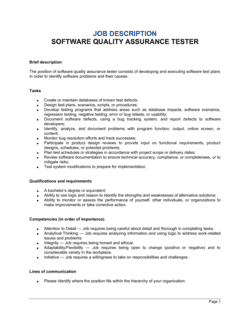
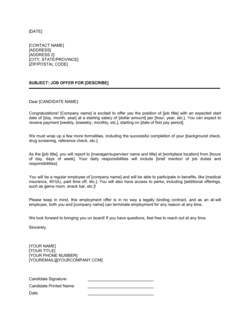
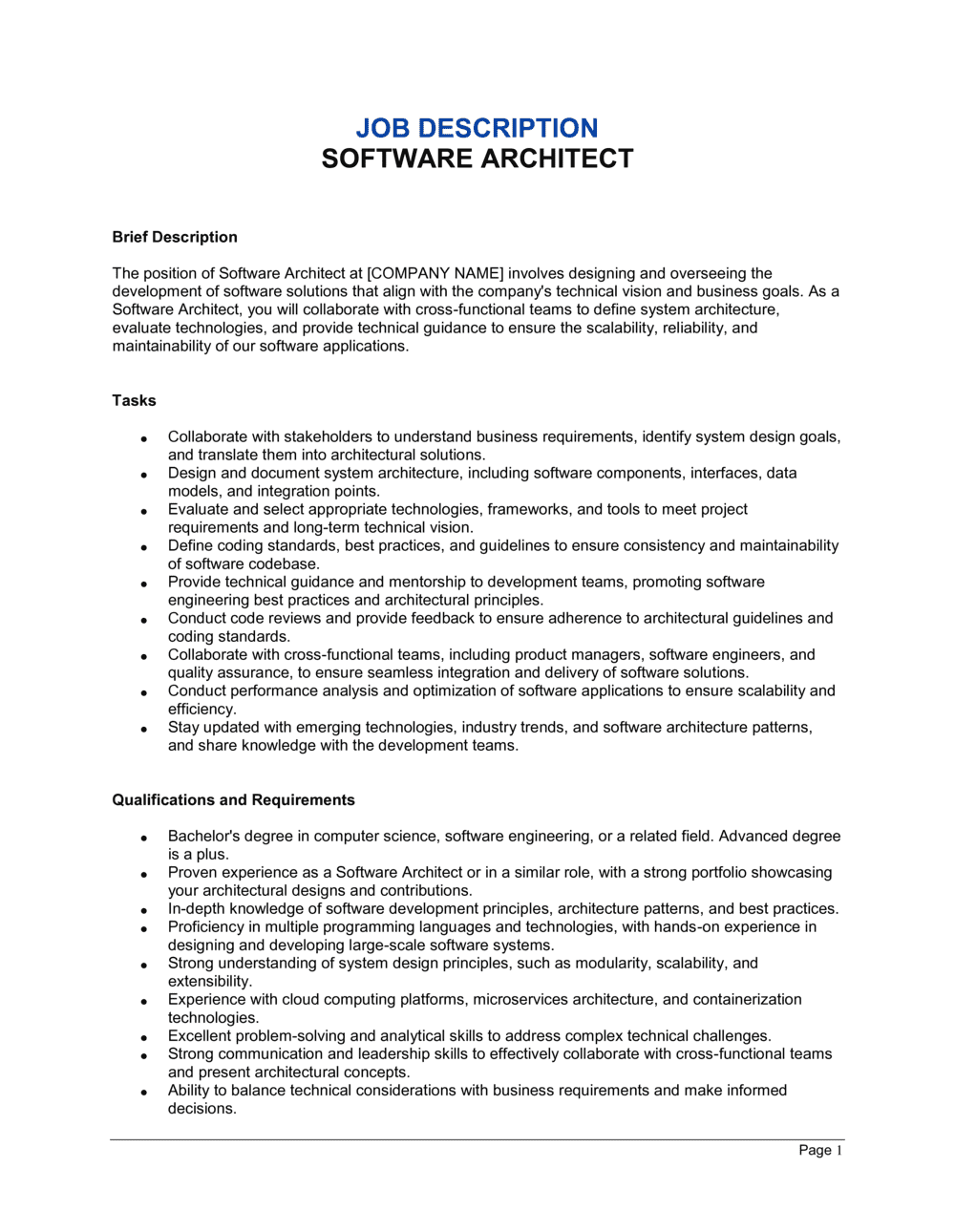
Software Architect Job Description Template

Free Word download • Edit online • Save & share with Drive • Export to PDF

2 pages20–30 min to fillDifficulty: StandardSignature requiredLegal review recommended
Learn more ↓
FreeSoftware Architect Job Description Template

At a glance

What it is
A Software Architect Job Description is a formal document that defines the scope, responsibilities, technical requirements, reporting structure, and performance expectations for a software architect role. This free Word download gives you a structured, recruiter-ready template you can edit online and export as PDF to post on job boards, attach to offer letters, or incorporate directly into employment contracts.
When you need it
Use it when opening a new software architect position, restructuring an existing technology team, or formalizing an incumbent's role to support performance reviews and compensation benchmarking.
What's inside
Role summary, key responsibilities, required and preferred qualifications, technical stack requirements, reporting structure, compensation and benefits overview, work arrangement details, and equal opportunity language. Each section includes placeholder guidance so hiring managers can tailor the document in under 30 minutes.

What is a Software Architect Job Description?

A Software Architect Job Description is a formal document that defines the responsibilities, qualifications, technical requirements, reporting structure, compensation range, and performance expectations for a software architect position. Unlike a brief job posting, a fully developed job description functions as a binding scope-of-work reference — one that can be incorporated into an employment contract, attached to an offer letter, and cited in performance reviews. It establishes mutual understanding between employer and candidate about what the role actually requires before the first day of work.

Why You Need This Document

Hiring a software architect without a precisely written job description creates compounding problems from day one. Without documented responsibilities and performance expectations, disagreements about role scope surface in the first performance cycle — often with no paper trail to resolve them. Vague or legally non-compliant postings in US states, Canadian provinces, and EU member states with pay transparency requirements expose the company to regulatory fines and reduced candidate response rates. Qualification lists that blend required and preferred criteria shrink the qualified applicant pool and increase time-to-fill for an already hard-to-source role. This template gives you a recruiter-ready, legally considered starting point that covers every critical clause — from technical stack disclosure to EEO language — so your next software architect hire starts from a foundation of clearly agreed expectations.

Which variant fits your situation?

If your situation is…Use this template
Hiring an architect focused on cloud infrastructure and scalabilityCloud Architect Job Description
Engaging an architect to design integrations across enterprise systemsEnterprise Architect Job Description
Hiring for client-facing technical pre-sales and scoping workSolutions Architect Job Description
Filling a hands-on coding and design leadership role in a product teamPrincipal Software Engineer Job Description
Hiring a technical leader specifically for security-focused architectureSecurity Architect Job Description
Engaging an architect on a contract or freelance basis rather than full-timeIndependent Contractor Agreement
Formalizing the agreed role terms before issuing an employment contractJob Offer Letter

Common mistakes to avoid

❌ Combining required and preferred qualifications in one list

Why it matters: Candidates treat every item as mandatory. Hiding a 'nice to have' certification in a required list shrinks the qualified applicant pool unnecessarily and can introduce indirect discrimination exposure.

Fix: Create two distinct sections — 'Required Qualifications' and 'Preferred Qualifications' — and audit each item before publishing to confirm it truly belongs where it is placed.

❌ Omitting the salary range on public job postings

Why it matters: Pay transparency laws in Colorado (EPEWA), New York City, California, Washington, and EU member states require salary ranges on job postings. Non-compliance results in regulatory fines and disqualification from state contracting in some jurisdictions.

Fix: Confirm pay transparency requirements for every jurisdiction where the role will be posted, then add an approved compensation band to the template before going live.

❌ Setting unrealistic or contradictory responsibilities

Why it matters: Listing hands-on coding (20+ hours/week) alongside full enterprise architecture governance signals that the hiring manager has not thought through the actual role — experienced architects recognize this and move on.

Fix: Have the direct manager map out a realistic weekly time allocation across the listed responsibilities before finalizing the document. Trim or split the role if any single responsibility exceeds 40% of available time.

❌ Using an outdated or generic equal opportunity statement

Why it matters: An EEO statement that omits sexual orientation, gender identity, or other classes protected under recent legislation creates legal exposure in jurisdictions where those classes are explicitly covered.

Fix: Review your EEO statement annually against current federal, state or provincial, and local protected-class lists, and update the template before each posting cycle.

The 10 key clauses, explained

Role title and reporting structure

In plain language: States the official job title, the level of seniority (e.g., Staff, Principal, Distinguished), and who the architect reports to directly.

Sample language
Title: Software Architect (Principal Level) | Reports to: [VP OF ENGINEERING / CTO] | Department: [ENGINEERING / TECHNOLOGY] | Location: [CITY, STATE / REMOTE]

Common mistake: Using a generic title like 'Architect' without a seniority qualifier — this creates ambiguity during compensation benchmarking and makes the posting harder to surface in job-board searches.

Role summary

In plain language: A 3–5 sentence overview of why the role exists, what problem it solves, and how it fits within the broader engineering organization.

Sample language
[COMPANY NAME] is seeking a Software Architect to lead the design and evolution of our [PLATFORM / PRODUCT NAME] platform. In this role, you will define architectural standards, guide cross-functional engineering teams, and drive the technical roadmap for a system serving [X] users and processing [Y] transactions per day.

Common mistake: Writing a role summary that simply repeats the job title in sentence form — 'You will be responsible for software architecture.' Specificity about scale, technology context, and organizational scope attracts qualified candidates and deters mismatches.

Key responsibilities

In plain language: An itemized list of the architect's core duties — design ownership, technical governance, mentorship, documentation, and cross-team collaboration.

Sample language
Design and document end-to-end architecture for [SYSTEM/PLATFORM]; define and enforce coding standards and architectural patterns; conduct architecture reviews and approve significant design changes; mentor senior engineers; partner with product management to translate business requirements into technical solutions.

Common mistake: Listing responsibilities at such a high level of abstraction (e.g., 'drive technical excellence') that the actual scope of work is unclear, making performance management and role boundaries impossible to enforce.

Required qualifications

In plain language: The minimum education, years of experience, and technical competencies a candidate must have to be considered — stated as non-negotiable.

Sample language
Bachelor's degree in Computer Science, Engineering, or a related field (or equivalent practical experience); [X]+ years of software development experience including [Y]+ years in an architecture or technical leadership role; demonstrated experience designing distributed systems at scale.

Common mistake: Setting a degree requirement as mandatory when the role genuinely only requires demonstrated technical competence — this can expose the employer to indirect discrimination claims in jurisdictions with protected characteristics tied to educational access.

Preferred qualifications

In plain language: Desirable but not mandatory skills, certifications, and experiences that differentiate strong candidates — stated as 'nice to have.'

Sample language
AWS Solutions Architect or Google Cloud Professional certification; experience with TOGAF or similar enterprise architecture frameworks; familiarity with [SPECIFIC DOMAIN, e.g., fintech regulatory environments or HIPAA-compliant system design]; prior experience in a high-growth startup environment.

Common mistake: Mixing required and preferred qualifications in a single list — candidates self-select out when they see one dealbreaker-sounding item in what was intended as a preferred list, reducing the qualified applicant pool.

Technical stack and environment

In plain language: Specifies the languages, frameworks, cloud platforms, and tools the architect will work with or govern, so candidates can self-assess fit.

Sample language
Primary stack: [LANGUAGE, e.g., Java / Python / Go]; cloud platform: [AWS / GCP / Azure]; data layer: [PostgreSQL / Kafka / Redis]; CI/CD: [GitHub Actions / Jenkins]; container orchestration: [Kubernetes / ECS].

Common mistake: Omitting the tech stack entirely or stating 'various technologies' — architects evaluate roles against their existing expertise and quickly move past postings that don't disclose the environment.

Compensation, benefits, and work arrangement

In plain language: States the salary range or band, bonus eligibility, equity participation, benefits summary, and work model (on-site, hybrid, or fully remote) so candidates can make an informed decision.

Sample language
Base salary: $[MIN]–$[MAX] USD annually, depending on experience; annual performance bonus up to [X]%; equity: [stock options / RSUs] per the Company's equity plan; benefits include [HEALTH / DENTAL / VISION / 401(K)]; work model: [REMOTE / HYBRID — X days per week on-site in CITY].

Common mistake: Omitting salary ranges entirely — several US states and the EU now require pay transparency in job postings, and failure to comply results in regulatory fines and reduced candidate response rates.

Performance expectations and success metrics

In plain language: Defines what 'good' looks like in the role — what the architect is expected to deliver in the first 30, 60, or 90 days and on an ongoing basis.

Sample language
Within 30 days: complete architecture audit of [SYSTEM]; within 90 days: deliver a written architectural roadmap for [QUARTER/YEAR]; ongoing: maintain system availability of [X]% SLA, reduce time-to-architecture-decision for new projects to under [Y] business days.

Common mistake: Leaving performance expectations out of the job description entirely — this makes the first performance review a negotiation over what the role was supposed to accomplish rather than a structured assessment.

Equal opportunity and accommodation statement

In plain language: A legally required affirmation that the employer does not discriminate on protected characteristics and will provide reasonable accommodations to applicants who need them.

Sample language
[COMPANY NAME] is an equal opportunity employer. We do not discriminate on the basis of race, color, religion, sex, national origin, age, disability, veteran status, sexual orientation, gender identity, or any other characteristic protected by applicable law. Applicants requiring reasonable accommodation should contact [HR EMAIL / PHONE].

Common mistake: Using a generic boilerplate statement that omits protected classes added by recent legislation (e.g., sexual orientation and gender identity under post-Bostock federal interpretation in the US) — creating legal exposure in jurisdictions where those classes are explicitly protected.

Acknowledgment and signature block

In plain language: A section where the hiring manager or HR representative and, upon offer acceptance, the candidate acknowledge that the job description reflects the agreed scope of the role.

Sample language
I have reviewed and understand the responsibilities and requirements described in this job description. | Hiring Manager: [NAME / TITLE / DATE] | Employee / Candidate: [NAME / DATE]

Common mistake: Treating the job description as a one-way broadcast rather than a mutually acknowledged scope document — without acknowledgment, employees can later claim they were never informed of specific responsibilities when performance issues arise.

How to fill it out

  1. 1

    Define the seniority level and reporting line

    Decide whether the role is Staff, Principal, or Distinguished level based on the scope of systems the architect will own. Confirm the direct reporting manager and add their title to the reporting structure field.

    💡 Aligning the seniority label to a published engineering career ladder — even a simple one — makes compensation benchmarking and future promotions much easier to defend.

  2. 2

    Write the role summary with specific context

    Describe the platform or product the architect will own, the scale of the system (users, transactions, data volume), and the team structure they will work within. This is the single most read section after the title.

    💡 Include one or two concrete data points about system scale — 'serving 2 million active users' or 'processing 50,000 events per second' — to attract candidates with the right experience level.

  3. 3

    List responsibilities in order of time investment

    Sequence duties from highest to lowest expected time allocation — design and documentation first, mentorship and process work later. Aim for 6–10 discrete responsibilities with action verbs.

    💡 Avoid listing more than ten responsibilities. Beyond ten, the role reads as two jobs compressed into one headcount, which signals poor organizational design to experienced candidates.

  4. 4

    Separate required from preferred qualifications

    Place only true dealbreakers in the required section — experience years, specific system-design skills, and any legally mandated credentials. Move certifications and domain knowledge to preferred.

    💡 Research shows that candidates — especially underrepresented groups — apply only when they meet 100% of requirements. Keeping required qualifications tight increases application volume and diversity.

  5. 5

    Specify the technical stack explicitly

    List every primary language, framework, cloud platform, and toolchain the architect will govern or work within. If the stack is evolving, note that explicitly.

    💡 Group the stack by layer — application, data, infrastructure, observability — so candidates can quickly scan for fit rather than parsing a flat list.

  6. 6

    Add a salary range and work arrangement

    Enter the approved compensation band, bonus eligibility, and whether the role is remote, hybrid, or on-site. Include the office location if hybrid or on-site.

    💡 Check Colorado, New York, California, Washington, and EU member state requirements before publishing — pay transparency laws in these jurisdictions require a salary range on every public job posting.

  7. 7

    Define 30-60-90 day success metrics

    Add at least three concrete deliverables or outcomes expected in the first 90 days — an architecture audit, a documented technical roadmap, or a specific SLA target achieved.

    💡 Frame metrics as outcomes, not activities. 'Deliver a written microservices migration roadmap by Day 90' is enforceable; 'learn the codebase' is not.

  8. 8

    Obtain hiring manager sign-off before posting

    Route the completed job description to the direct manager and HR for review. Collect signatures in the acknowledgment block to create a record of agreed scope before the requisition opens.

    💡 Storing the signed version alongside the eventual employment contract creates a clean paper trail if a future performance dispute involves disagreement about role scope.

Frequently asked questions

What is a software architect job description?

A software architect job description is a formal document that defines the responsibilities, qualifications, technical requirements, reporting structure, and performance expectations for a software architect role. It serves as both a recruiting tool — used to attract and screen candidates — and a binding scope-of-work reference once a hire is made. A well-written job description reduces disputes about role boundaries and supports structured performance reviews.

What does a software architect actually do?

A software architect designs the high-level structure of software systems, selects technologies, defines engineering standards, and guides development teams through implementation. Day-to-day responsibilities typically include producing architecture decision records, conducting design reviews, mentoring senior engineers, partnering with product management on technical feasibility, and maintaining system quality attributes like scalability, reliability, and security. The balance between design work and hands-on coding varies by company size and team maturity.

What qualifications should a software architect job description require?

Most software architect roles require 8–12 years of software development experience, including 3–5 years in a technical leadership or architecture capacity. Strong candidates demonstrate experience designing distributed systems, leading cross-functional technical decisions, and documenting architecture at a level that non-engineering stakeholders can review. Certifications such as AWS Solutions Architect or TOGAF are commonly listed as preferred rather than required, except in regulated industries or enterprise environments where they may be mandatory.

Is a job description a legally binding document?

A job description is not a standalone employment contract, but once acknowledged and signed by both parties, it can be incorporated by reference into an employment agreement and carry contractual weight regarding role scope and responsibilities. Courts in the US, Canada, and the UK have cited job descriptions in disputes over constructive dismissal, duty of care, and reasonable accommodation obligations. Treating it as a binding scope document from the outset — with signatures — reduces ambiguity in performance management and termination proceedings.

Should a software architect job description include a salary range?

Yes, in a growing number of jurisdictions it is legally required. Colorado, New York City, California, Washington, Illinois, and EU member states under the Pay Transparency Directive all mandate salary ranges on public job postings. Beyond compliance, postings with salary ranges attract 30–40% more qualified applicants on average and reduce time spent screening candidates whose expectations are misaligned with the approved band.

What is the difference between a software architect and a solutions architect?

A software architect typically focuses on the internal design of a product or platform — system components, data flows, code structure, and engineering standards. A solutions architect is usually client-facing, working with prospective customers to design how an organization's products or cloud services will integrate with the customer's environment. Both require strong system design skills, but solutions architects spend significantly more time in pre-sales, scoping, and stakeholder communication.

How specific should the technical stack section be?

Specific enough that a qualified candidate can self-assess fit in under two minutes. List the primary programming language, cloud platform, data layer technologies, CI/CD toolchain, and any domain-specific compliance environments (e.g., HIPAA, PCI-DSS). If the stack is actively evolving, state that explicitly — senior architects often find greenfield or modernization contexts more attractive than maintaining a legacy system, and honesty about the environment saves screening time on both sides.

Do I need a lawyer to write a software architect job description?

For most standard domestic hires, a high-quality template reviewed by an HR professional is sufficient. Legal review is recommended when the role involves access to sensitive IP or trade secrets that will be referenced in a linked confidentiality agreement, when the position spans multiple jurisdictions with different pay transparency or anti-discrimination requirements, or when the job description will be incorporated by reference into an executive employment contract.

How often should a software architect job description be updated?

Review the job description whenever the technology stack changes significantly, when the role's reporting structure shifts, before each new hiring cycle, and at least annually as part of a compensation benchmarking exercise. An outdated job description used in a performance review — one that lists technologies the team abandoned two years ago or omits responsibilities the role now carries — creates credibility problems and potential legal exposure if the employee contests the review.

How this compares to alternatives

vs Software Engineer Job Description

A software engineer job description focuses on individual contribution — writing, testing, and deploying code within defined technical boundaries. A software architect job description covers system-wide design authority, cross-team technical governance, and strategic technology decisions. Architects typically hold no direct reports but exercise significant influence over engineering direction and standards.

vs CTO Job Description

A CTO job description covers executive leadership — technology strategy, board-level communication, budget ownership, and team building across the entire engineering organization. A software architect job description focuses on technical design and engineering standards within a specific product, platform, or domain. The CTO owns the 'what and why' of technology investment; the architect owns the 'how' at the systems level.

vs Independent Contractor Agreement

A job description defines the scope of a permanent or fixed-term employment role. An independent contractor agreement governs a self-employed engagement with a defined deliverable, no employment entitlements, and different IP and tax treatment. If the architect will be engaged as a contractor rather than an employee, pair a contractor-specific scope of work with an independent contractor agreement rather than an employment job description.

vs Employment Contract

A job description defines what the role involves; an employment contract creates the binding legal relationship — covering compensation, IP assignment, confidentiality, non-compete, termination, and severance. The job description is typically incorporated by reference into the employment contract as a schedule. Both documents are needed; neither replaces the other.

Industry-specific considerations

SaaS / Technology

Emphasis on distributed systems design, API governance, cloud-native architecture patterns, and cross-team technical standards in fast-moving product environments.

Financial Services / Fintech

Regulatory compliance requirements (PCI-DSS, SOX, GDPR), low-latency transaction processing, and audit-trail architecture are standard additional requirements.

Healthcare / MedTech

HIPAA-compliant system design, HL7/FHIR integration standards, FDA software validation requirements, and data residency constraints shape the technical qualifications section.

Enterprise / Professional Services

TOGAF certification, enterprise integration patterns, legacy system modernization experience, and stakeholder communication skills at C-suite level are commonly required.

Jurisdictional notes

United States

Pay transparency laws in Colorado, New York City, California, Washington, and Illinois require salary ranges on public job postings — verify requirements for each state where the role will be advertised. EEO statements must reflect current federal protected classes including sexual orientation and gender identity under post-Bostock EEOC guidance. Degree requirements should be audited for adverse impact risk under Title VII if they screen out protected groups disproportionately.

Canada

British Columbia and Prince Edward Island require pay transparency in job postings as of 2023–2024; other provinces are actively legislating similar requirements. The Canadian Human Rights Act and provincial human rights codes prohibit discriminatory qualification requirements. In Quebec, job postings for roles primarily performed in the province must be available in French under the Charter of the French Language.

United Kingdom

Job descriptions must avoid language or requirements that could constitute indirect discrimination under the Equality Act 2010, including age-related experience thresholds and degree requirements that disadvantage protected groups. While pay transparency is not yet legally mandated in job postings, large employers (250+ employees) must publish gender pay gap reports annually. IR35 considerations apply if the architect role is initially filled by a contractor through a personal service company.

European Union

The EU Pay Transparency Directive (2023/970) requires employers to provide salary range information to job applicants upon request and, in most member states, proactively in the job posting itself — full transposition deadline is June 2026. GDPR applies to any personal data collected during the application process. Member states including France, Germany, and the Netherlands impose additional anti-discrimination requirements on job postings that go beyond the EU baseline.

Template vs lawyer — what fits your deal?

PathBest forCostTime
Use the templateStandard domestic software architect hires at a single location with an existing HR functionFree30–60 minutes
Template + legal reviewMulti-state or cross-border postings, roles with access to sensitive IP, or positions linked to an executive employment agreement$200–$500 for an employment lawyer or HR consultant review1–3 days
Custom draftedEnterprise hires in regulated industries (fintech, healthcare), international postings, or roles where the job description will be a primary exhibit in an employment contract$800–$2,500+1–2 weeks

Glossary

Software Architect
A senior technical leader who designs high-level software structures, selects technologies, and establishes engineering standards across a product or platform.
Technical Stack
The specific combination of programming languages, frameworks, databases, and infrastructure tools a software system is built on.
System Design
The process of defining the components, interfaces, and data flows of a software system to meet functional and non-functional requirements.
Non-Functional Requirements
System qualities such as performance, scalability, reliability, and security that constrain how a system behaves, as opposed to what it does.
Architecture Decision Record (ADR)
A short document capturing a significant technical decision — the context, the options considered, and the rationale for the choice made.
Technical Debt
The accumulated cost of shortcuts or suboptimal design decisions made earlier in a project, which must eventually be addressed to maintain system health.
Microservices
An architectural pattern where an application is structured as a collection of small, independently deployable services each responsible for a discrete function.
TOGAF
The Open Group Architecture Framework — a widely recognized methodology and certification standard for enterprise architecture practice.
SDLC (Software Development Life Cycle)
The structured process a development team follows from requirements gathering through deployment and maintenance of a software system.
SLA (Service Level Agreement)
A formal commitment defining the expected performance, availability, and response-time standards for a system or service.
On-Call Responsibilities
A defined obligation for a technical employee to be reachable and able to respond to critical system incidents outside standard working hours.

Part of your Business Operating System

This document is one of 3,000+ business & legal templates included in Business in a Box.

  • Fill-in-the-blanks — ready in minutes
  • 100% customizable Word document
  • Compatible with all office suites
  • Export to PDF and share electronically

Create your document in 3 simple steps.

From template to signed document — all inside one Business Operating System.
1
Download or open template

Access over 3,000+ business and legal templates for any business task, project or initiative.

2
Edit and fill in the blanks with AI

Customize your ready-made business document template and save it in the cloud.

3
Save, Share, Send, Sign

Share your files and folders with your team. Create a space of seamless collaboration.

Save time, save money, and create top-quality documents.

★★★★★

"Fantastic value! I'm not sure how I'd do without it. It's worth its weight in gold and paid back for itself many times."

Managing Director · Mall Farm
Robert Whalley
Managing Director, Mall Farm Proprietary Limited
★★★★★

"I have been using Business in a Box for years. It has been the most useful source of templates I have encountered. I recommend it to anyone."

Business Owner · 4+ years
Dr Michael John Freestone
Business Owner
★★★★★

"It has been a life saver so many times I have lost count. Business in a Box has saved me so much time and as you know, time is money."

Owner · Upstate Web
David G. Moore Jr.
Owner, Upstate Web

Run your business with a system — not scattered tools

Stop downloading documents. Start operating with clarity. Business in a Box gives you the Business Operating System used by over 250,000 companies worldwide to structure, run, and grow their business.

Free Forever Plan · No credit card required