Director of Software Development Job Description Template

Free Word download • Edit online • Save & share with Drive • Export to PDF

2 pages20–30 min to fillDifficulty: StandardSignature requiredLegal review recommended
Learn more ↓
FreeDirector of Software Development Job Description Template

At a glance

What it is
A Director of Software Development Job Description is a formal document that defines the scope, responsibilities, reporting structure, required qualifications, and compensation framework for a senior technical leadership role. This free Word download gives you a structured, legally defensible starting point you can edit online and export as PDF to attach to an employment contract or post to job boards.
When you need it
Use it when creating a new Director of Software Development position, replacing an incumbent, or formalizing an informal role that has grown beyond its original scope. It is also required when attaching a role definition to an employment contract or when HR needs a documented basis for performance management.
What's inside
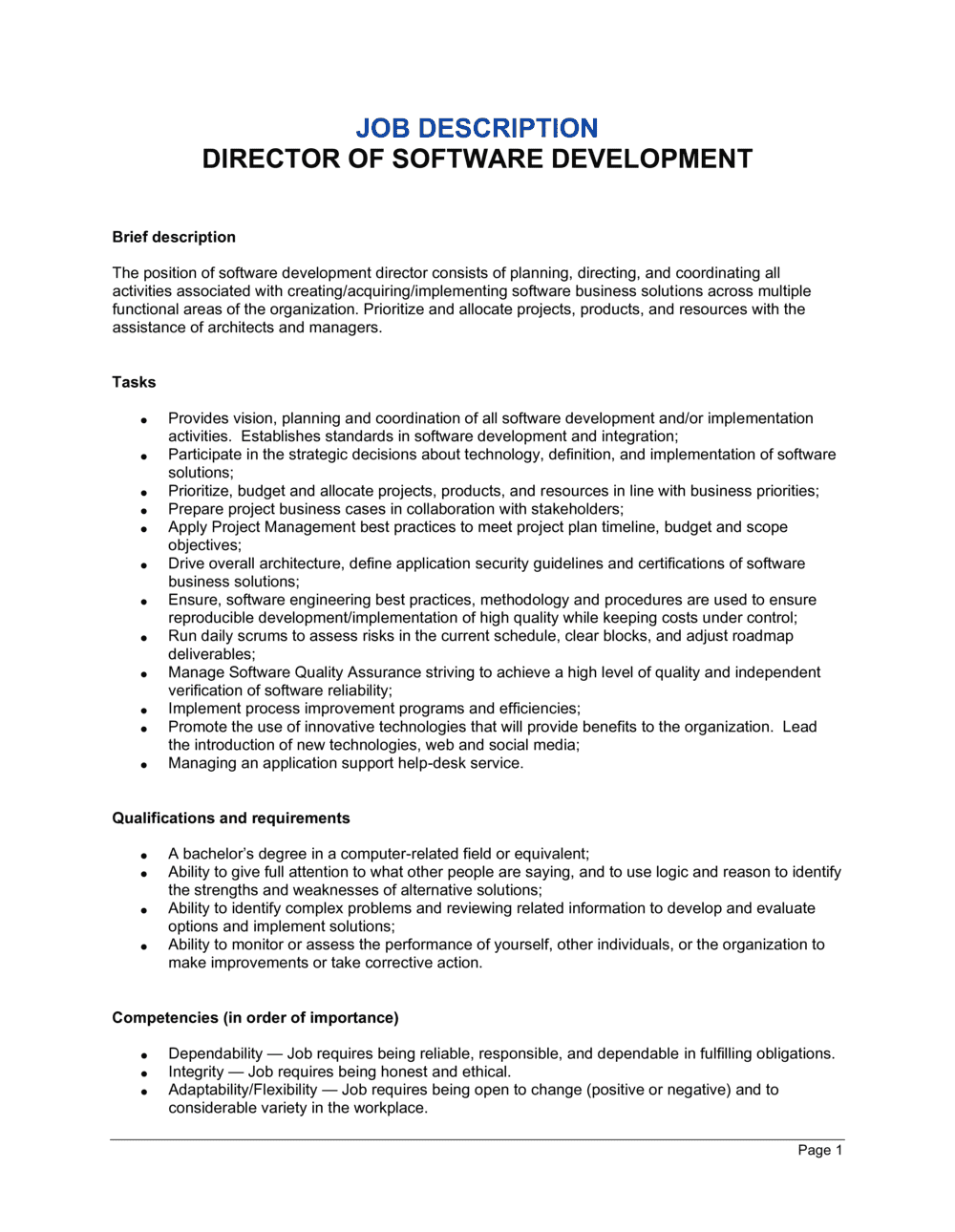
Role summary and reporting structure, a detailed list of core duties and team-leadership responsibilities, required and preferred qualifications, technical competency expectations, performance metrics, compensation and benefits framework, and equal opportunity language.

What is a Director of Software Development Job Description?

A Director of Software Development Job Description is a formal document that defines the full scope of a senior engineering leadership role — including reporting structure, core duties, required and preferred qualifications, technical competencies, performance expectations, compensation framework, and equal opportunity commitments. It functions both as a hiring tool that attracts and screens qualified candidates and as a legal document that, when attached to an employment contract, establishes the documented basis for performance management, role classification, and compensation decisions. Unlike a generic job posting, a properly structured job description is specific enough to withstand legal scrutiny under employment discrimination law and FLSA classification requirements.

Why You Need This Document

Hiring a Director of Software Development without a well-drafted job description creates compounding risk across the employment lifecycle. At the hiring stage, a vague or legally non-compliant posting attracts mismatched applicants, exposes the company to discrimination complaints, and — in California, Colorado, New York, and a growing list of other jurisdictions — violates mandatory salary disclosure laws. After the hire, a job description attached as Schedule A to the employment contract becomes the documented baseline for performance reviews, scope disputes, and terminations for underperformance. Without it, the company has no objective written standard to point to when managing out an underperforming director, significantly increasing wrongful termination risk. This template gives you a complete, jurisdiction-aware starting point that covers every required section, flags the legal obligations specific to your hiring location, and is formatted to attach directly to an executive employment contract.

Which variant fits your situation?

If your situation is…Use this template
Hiring a director to lead a single product engineering teamDirector of Software Development Job Description
Filling a broader technology leadership role covering infrastructure and securityChief Technology Officer Job Description
Defining a hands-on engineering manager below director levelSoftware Engineering Manager Job Description
Hiring a VP to oversee multiple director-level engineering teamsVP of Engineering Job Description
Recruiting a technical architect without people-management responsibilitiesPrincipal Software Engineer Job Description
Formalizing the role in writing ahead of an employment contractEmployment Contract (Executive)
Documenting the role for a contract or interim director engagementIndependent Contractor Agreement

Common mistakes to avoid

❌ Conflating director and senior IC responsibilities

Why it matters: A job description that lists 40% hands-on coding duties alongside full team leadership and budget accountability creates role ambiguity, drives mismatched applications, and sets an impossible performance standard.

Fix: Decide the split between people leadership and technical contribution before drafting, and make it explicit — e.g., '80% leadership and strategy, 20% hands-on technical review and architecture.'

❌ Posting a salary range that does not reflect actual intent

Why it matters: In California, Colorado, New York, and several other jurisdictions, salary ranges must be published and must be in good faith. A range of $100K–$300K for a role with a real target of $180K violates disclosure laws and damages candidate trust.

Fix: Use the actual approved pay band for the role, confirmed with finance and HR, before posting. If the band is wide, explain the factors that determine placement within it.

❌ Omitting performance expectations and KPIs

Why it matters: Without documented success metrics, the company cannot demonstrate that a termination for underperformance was based on objective, pre-communicated standards — increasing wrongful dismissal risk.

Fix: Include at minimum a 90-day milestone, a Year 1 delivery target, and one measurable team-health metric such as attrition or engineering satisfaction score.

❌ Using a title that differs from the employment contract

Why it matters: A mismatch between the job description title and the employment contract title creates legal ambiguity about which document governs the role's scope, compensation classification, and notice entitlements.

Fix: Confirm the official title in HR and legal systems before finalizing the job description, and use exactly that title in all hiring documents including the offer letter, contract, and onboarding records.

❌ Listing unnecessary degree requirements

Why it matters: Requiring a four-year CS degree for a director role without examining whether it is genuinely necessary can constitute indirect discrimination under the ADA, the UK Equality Act, and EU employment directives — particularly if the requirement disproportionately excludes protected groups.

Fix: Replace absolute degree requirements with 'degree or equivalent practical experience' unless the role genuinely cannot be performed without a credential — then document why.

❌ Skipping the EEO and accommodation statement or leaving placeholder text

Why it matters: Publishing a job description without a valid EEO statement exposes the company to discrimination complaints and, in the US, can jeopardize federal contractor status under OFCCP requirements.

Fix: Always include a completed, jurisdiction-appropriate EEO and accommodation statement with real HR contact information before posting or attaching to a contract.

The 10 key clauses, explained

Role title and organizational positioning

In plain language: States the official job title, the department the role sits within, the person or title it reports to, and the number and type of direct reports.

Sample language
Title: Director of Software Development | Department: Engineering | Reports to: [CTO / VP of Engineering] | Direct Reports: [NUMBER] Software Engineering Managers and/or Senior Engineers

Common mistake: Using a working title different from the one in the employment contract. Mismatches create classification ambiguity, complicate payroll records, and can affect FLSA exempt-status determinations.

Role summary and purpose

In plain language: A 3–5 sentence paragraph explaining why this role exists, what it is accountable for at a high level, and how it contributes to the company's technology and business objectives.

Sample language
The Director of Software Development is responsible for leading [COMPANY NAME]'s software engineering organization, delivering scalable products that support [BUSINESS OBJECTIVE]. This role partners with Product, Design, and Data teams to translate strategy into shipped software, while building and retaining an engineering team of [X] engineers.

Common mistake: Writing a summary so generic it could apply to any technology role. A vague summary attracts unqualified applicants and undermines the document's use as a performance management baseline.

Core duties and responsibilities

In plain language: An itemized list of the primary functions the director is accountable for — team leadership, architecture decisions, delivery management, cross-functional collaboration, and budget ownership.

Sample language
Lead, mentor, and grow a team of [X] engineers across [NUMBER] squads. Own the engineering roadmap and ensure quarterly delivery against OKRs. Establish and enforce coding standards, code review processes, and CI/CD practices. Partner with the Product team to define technical requirements and scope estimates.

Common mistake: Listing duties without distinguishing essential functions from preferred activities. Under the ADA and equivalent UK/EU legislation, only essential functions can be used to assess whether a candidate with a disability can perform the role.

Required qualifications

In plain language: The minimum education, years of experience, and technical skills the candidate must have — the non-negotiable baseline used to screen applications.

Sample language
Bachelor's degree in Computer Science, Software Engineering, or a related field (or equivalent practical experience). [8+] years of software development experience, including [3+] years in an engineering leadership role. Proven experience with [PROGRAMMING LANGUAGE / PLATFORM] in a production environment.

Common mistake: Setting degree requirements that are not genuinely necessary for the role. Several jurisdictions, including the UK under the Equality Act 2010, treat unjustified credential requirements as potential indirect discrimination barriers.

Preferred qualifications

In plain language: Additional skills or credentials that would make a candidate stronger but are not mandatory — used to differentiate finalists rather than screen applicants out.

Sample language
Master's degree in Computer Science or MBA preferred. Experience scaling engineering teams from [X] to [Y] engineers. Familiarity with [CLOUD PLATFORM — AWS / GCP / Azure] and infrastructure-as-code tooling. Prior experience in a [INDUSTRY — fintech / healthtech / SaaS] environment.

Common mistake: Treating preferred qualifications as requirements during screening, effectively raising the bar beyond what is documented and exposing the company to disparate-impact claims.

Technical competencies and tools

In plain language: Specifies the programming languages, frameworks, development methodologies, and platforms the director is expected to be proficient in or able to evaluate.

Sample language
Proficiency in [LANGUAGE(S) — e.g., Python, Java, TypeScript]. Experience leading teams using Agile / Scrum / SAFe. Familiarity with microservices architecture, RESTful APIs, and cloud-native deployment. Working knowledge of security-by-design principles and DevSecOps practices.

Common mistake: Over-specifying a laundry list of 20+ technologies. It narrows the candidate pool unnecessarily and signals that the hiring team conflates a director role — which is primarily strategic and leadership-oriented — with a senior individual-contributor role.

Performance expectations and KPIs

In plain language: Defines how success will be measured in the first 90 days, Year 1, and on an ongoing basis — covering delivery metrics, team health indicators, and cross-functional goals.

Sample language
Within 90 days: complete a technical audit and present findings to the CTO. Year 1: achieve [X]% on-time delivery against the engineering roadmap; reduce critical production incidents by [Y]%; maintain engineering attrition below [Z]%.

Common mistake: Omitting performance expectations from the job description entirely. Without documented standards, performance-improvement plans and terminations for underperformance are harder to defend legally.

Compensation, benefits, and employment type

In plain language: States the salary range, bonus eligibility, equity structure, benefits, FLSA classification, and whether the role is full-time permanent or fixed-term.

Sample language
Base salary: $[MINIMUM]–$[MAXIMUM] depending on experience. Annual discretionary bonus of up to [X]% of base. Equity: [RSU / option] grant of [AMOUNT] vesting over [4 years with 1-year cliff]. Benefits: [STANDARD BENEFITS PACKAGE]. Classification: Full-time, Exempt.

Common mistake: Publishing a salary range so wide — e.g., $120K–$300K — that it provides no real information. Increasingly, jurisdictions including California, New York, and Colorado mandate that posted salary ranges be in good faith and reasonably reflect the actual intended pay band.

Work location and travel requirements

In plain language: Specifies whether the role is on-site, hybrid, or remote, the expected office schedule for hybrid roles, and any travel requirements as a percentage of time.

Sample language
Location: [CITY, STATE] — Hybrid (3 days/week in office) or Remote (US-based). Travel: up to [15]% for team off-sites, customer meetings, and engineering conferences.

Common mistake: Leaving work location vague in the job description when it is specified in the employment contract. Discrepancies between the two documents create offer-stage disputes and, post-hire, exposure for constructive dismissal claims if remote work is later restricted.

Equal opportunity and accommodation statement

In plain language: A standard clause affirming that the company does not discriminate on protected characteristics and will provide reasonable accommodation to qualified applicants with disabilities.

Sample language
[COMPANY NAME] is an equal opportunity employer. We do not discriminate on the basis of race, color, religion, sex, national origin, age, disability, or any other protected characteristic. Qualified applicants requiring accommodation should contact [HR EMAIL / PHONE].

Common mistake: Copying a generic EEO statement without updating the contact information or reviewing it for jurisdiction-specific required language. Canada, the UK, and the EU each have distinct protected characteristics and mandatory phrasing requirements.

How to fill it out

  1. 1

    Define the organizational context before writing

    Clarify the reporting line (who this person reports to), the team size they will manage, and the business problems this hire is meant to solve. These decisions shape every other section of the document.

    💡 Get sign-off from the hiring manager and the CHRO on the reporting structure before drafting — changing it after posting requires reposting and delays the search.

  2. 2

    Write the role summary with a specific business outcome

    Describe what the director will own, what teams they lead, and what a successful first year looks like in one business-outcome sentence. Avoid generic 'responsible for all software development' language.

    💡 Anchor the summary to a concrete challenge — 'scale the platform from 500K to 5M users' is more compelling and accurate than 'lead engineering.'

  3. 3

    Separate essential duties from preferred activities

    Mark each duty as essential (required to perform the role) or marginal (nice to have). This distinction is legally significant for ADA compliance in the US and equivalent legislation in other jurisdictions.

    💡 If you cannot explain why a duty is essential if challenged by a candidate with a disability, it likely belongs in the preferred section.

  4. 4

    Set required qualifications only as high as the role genuinely demands

    Review each required qualification and ask whether a candidate without it could still perform all essential functions. Remove requirements that are not genuinely necessary — they reduce the qualified pool and create legal risk.

    💡 Replace 'must have a CS degree' with 'CS degree or equivalent practical experience' unless a degree is a genuine operational requirement.

  5. 5

    Specify technical tools with context, not just a list

    For each technology listed, note whether the director needs to be a practitioner, an evaluator, or simply aware of it. A director who needs to evaluate a team's Python code does not need to be a production Python engineer.

    💡 Limit the technical tools section to eight or fewer technologies — any more signals the job is written for a senior IC, not a director.

  6. 6

    Add a salary range that reflects the actual pay band

    Enter the real minimum and maximum for this role in this market. In California, Colorado, New York, Washington, and several other jurisdictions, posting a salary range is legally required and must be in good faith.

    💡 If you are unwilling to post the range publicly, include it in the internal version attached to the employment contract and review applicable state or provincial disclosure laws before removing it from the public posting.

  7. 7

    Review and update the EEO and accommodation statement

    Replace the placeholder contact information with real HR contact details and verify the statement covers all protected characteristics required in the applicable jurisdiction.

    💡 In Canada, the statement must reference the Canadian Human Rights Act or applicable provincial human rights code. In the UK, reference the Equality Act 2010. In the EU, tailor to the member state's implementing legislation.

  8. 8

    Attach the finalized description to the employment contract before signing

    The job description should be incorporated as Schedule A to the employment contract so the employee acknowledges the full scope of duties at signing.

    💡 Have the employee initial Schedule A separately at signing to confirm they reviewed the role scope — this strengthens the employer's position in any future performance or scope dispute.

Frequently asked questions

What does a Director of Software Development do?

A Director of Software Development leads an organization's engineering teams, owns the software delivery roadmap, and is accountable for team performance, technical standards, and cross-functional collaboration with Product, Design, and Data. Unlike a VP of Engineering, the role typically operates at the team and program level rather than the organizational strategy level, and may retain some hands-on technical involvement depending on company size.

What qualifications should a Director of Software Development have?

Most employers require at least eight years of software development experience, including three or more years in an engineering leadership role, and a bachelor's degree in computer science or a related field — or equivalent practical experience. Strong candidates also demonstrate proficiency in Agile methodologies, experience managing teams of ten or more engineers, and a track record of delivering complex software projects on time and within budget.

How is a Director of Software Development different from a VP of Engineering?

A Director of Software Development typically leads one or more engineering teams with a focus on delivery execution, technical standards, and team development. A VP of Engineering operates at the organizational level — setting multi-year engineering strategy, managing multiple directors, owning engineering culture across the company, and representing technology at the executive leadership table. The director role is more hands-on with day-to-day engineering management; the VP role is more strategic and cross-functional.

Should a job description be attached to an employment contract?

Yes. Incorporating the job description as Schedule A to the employment contract makes the documented duties legally part of the agreement, giving both parties a clear reference point for performance management and scope disputes. The employee should initial the schedule separately at signing to confirm they reviewed and accepted the full role scope. Without this attachment, the employment contract alone may be insufficiently specific about duties and accountability.

Do I need to post a salary range in a Director of Software Development job description?

Salary range disclosure is legally required for public job postings in California, Colorado, New York, Washington, and several other US states, as well as in the UK and across EU member states under the EU Pay Transparency Directive (effective from 2026). Even where not required, director-level roles benefit from published ranges because senior candidates routinely filter out postings without compensation data. The range must reflect the actual approved pay band, not an artificially wide placeholder.

Is a Director of Software Development classified as exempt under the FLSA?

In most cases, yes. A Director of Software Development typically qualifies as exempt under the FLSA's executive and professional exemptions — the role involves managing two or more employees, has authority over hiring and performance decisions, and commands a salary well above the minimum exempt threshold (currently $684 per week federally, with higher thresholds in some states). Misclassifying the role as non-exempt triggers overtime liability, so confirm the exemption tests are met before finalizing the compensation section.

What performance metrics should be included in the job description?

Director-level job descriptions should include at least three measurable expectations: a 90-day onboarding milestone (such as completing a technical audit), a Year 1 delivery target (such as on-time roadmap completion rate), and an ongoing team-health metric (such as engineering attrition below a defined threshold or quarterly engineering satisfaction scores above a target). These documented standards form the baseline for performance reviews and, if necessary, performance-improvement plans.

Can I use one job description across multiple jurisdictions?

A single base template can be used across jurisdictions, but it must be reviewed and localized before posting or attaching to a contract in each country. Key variations include salary disclosure requirements (US state laws, UK, EU), protected characteristics in the EEO statement (the EU adds age, religion, and sexual orientation under the Employment Equality Directive), degree requirement scrutiny (higher in the UK and EU), and language requirements (French in Quebec-regulated employers). A single generic posting risks non-compliance in at least one jurisdiction.

What is the difference between a job description and a job posting?

A job description is an internal operational and legal document defining the full scope of the role — duties, qualifications, performance standards, compensation, and classification. A job posting is the externally published version, typically abbreviated, written to attract candidates rather than document legal accountability. The job description should be completed first and used as the source of truth for the posting, the offer letter, and the employment contract.

How this compares to alternatives

vs VP of Engineering Job Description

A VP of Engineering job description covers organizational strategy, multi-team leadership, executive-level stakeholder management, and often direct board reporting. A Director of Software Development description focuses on delivery execution, team development, and technical standards at the program level. Use the director template for roles managing one to three teams; use the VP template for roles overseeing multiple directors or the entire engineering function.

vs Software Engineering Manager Job Description

An engineering manager job description emphasizes day-to-day people management of a single team, sprint-level delivery, and individual contributor coaching. A director-level description adds budget ownership, multi-team coordination, cross-functional strategy, and organizational design. The director role is one to two levels above an engineering manager in most mid-size to large organizations.

vs Employment Contract (Executive)

An employment contract is the binding legal agreement governing compensation, IP assignment, non-compete, confidentiality, and termination terms. A job description defines the operational scope of the role and is typically incorporated as Schedule A to the contract. Both documents are needed — the job description alone creates no enforceable obligations, and the contract alone is too thin to manage performance.

vs Independent Contractor Agreement

An independent contractor agreement engages a self-employed individual for defined deliverables without employment entitlements. A job description is used for employment relationships. If the director role involves setting hours, using company tools, and managing company employees, it almost certainly cannot be classified as independent contractor work — misclassification triggers back taxes, penalties, and benefit liability in every major jurisdiction.

Industry-specific considerations

SaaS / Technology

Emphasis on cloud-native architecture, CI/CD pipeline ownership, engineering velocity metrics, and cross-functional collaboration with Product and Design in a product-led growth model.

Financial Services / Fintech

Security-by-design and regulatory compliance requirements (PCI-DSS, SOC 2) are essential qualifications; the job description must reference relevant regulatory frameworks to attract appropriately credentialed candidates.

Healthcare / HealthTech

HIPAA technical safeguard accountability and experience with HL7/FHIR integration standards are typically required qualifications; FDA software validation experience is relevant for medical device software roles.

Manufacturing and Industrial

Integration of software systems with operational technology (OT) and IoT platforms is a differentiating qualification; the role often spans both enterprise software and embedded or edge systems.

Retail / E-commerce

Platform scalability during peak traffic periods, payment processing security, and experience with headless commerce or microservices architectures are the key technical competency differentiators.

Professional Services

The director role often includes direct client-facing responsibilities for technology delivery, making stakeholder communication and project governance qualifications as important as pure engineering leadership credentials.

Jurisdictional notes

United States

Salary range disclosure is legally required for public postings in California, Colorado, New York, Washington, Rhode Island, and several other states — and the range must be in good faith. The role almost always qualifies as FLSA-exempt under the executive and professional exemptions, but confirm salary meets the applicable state threshold, which can exceed the federal $684/week floor. Degree requirements should use 'or equivalent practical experience' language to reduce disparate-impact risk under EEOC guidance.

Canada

Pay transparency obligations are active in British Columbia and Prince Edward Island and under consideration in Ontario and Alberta — review the applicable provincial statute before posting. The EEO statement must reference the Canadian Human Rights Act for federally regulated employers, or the applicable provincial human rights code. In Quebec, job postings for provincially regulated employers must be available in French, and qualifications must not indirectly discriminate under the Quebec Charter of Human Rights and Freedoms.

United Kingdom

Under the Equality Act 2010, job descriptions must not contain requirements that indirectly discriminate on the basis of sex, race, disability, age, religion, or sexual orientation unless the requirement is a proportionate means of achieving a legitimate aim. The UK government's 2024 pay transparency consultation may introduce mandatory salary range disclosure for public postings — monitor GOV.UK for updates. Degree requirements that are not genuinely necessary carry particular scrutiny given socioeconomic diversity considerations in senior tech hiring.

European Union

The EU Pay Transparency Directive (2023/970/EU) requires member states to implement mandatory salary range disclosure for job postings by June 2026. The Employment Equality Directive (2000/78/EC) prohibits discrimination on grounds of religion, belief, disability, age, and sexual orientation — all of which must be reflected in the EEO statement. Member states vary in how they implement qualification and language requirements; France, Germany, and the Netherlands each have additional posting obligations for senior roles. Confirm local counsel review for any director-level hire in a specific member state.

Template vs lawyer — what fits your deal?

PathBest forCostTime
Use the templateHR teams and hiring managers creating a job description for a standard domestic director-level hireFree30–60 minutes
Template + legal reviewCross-border hires, roles in states or provinces with salary disclosure requirements, or companies with prior discrimination claims$200–$500 for an employment lawyer or HR compliance review1–3 days
Custom draftedDirector roles with equity compensation, regulated industries (fintech, healthtech), or organizations subject to OFCCP federal contractor obligations$500–$2,000+3–7 days

Glossary

Job Description
A formal written document that defines the duties, responsibilities, qualifications, and reporting structure for a specific role within an organization.
FLSA Exempt Status
A US classification under the Fair Labor Standards Act indicating the role is not entitled to overtime pay, based on salary level and job duties tests.
Reporting Structure
The organizational hierarchy showing who the role reports to and which positions report to it.
Essential Functions
The fundamental job duties a position exists to perform, as distinguished from marginal tasks — critical for ADA compliance in the US.
Bona Fide Occupational Qualification (BFOQ)
A characteristic that is genuinely necessary to perform a job effectively, and one of the few legally permissible bases for requiring a specific attribute in a job posting.
Equity Compensation
Non-cash compensation in the form of stock options or restricted stock units, commonly offered to director-level technology hires as part of a total compensation package.
IC (Individual Contributor) vs. People Manager
A distinction clarifying whether the role involves direct management of employees or focuses solely on technical execution without reporting staff.
At-Will Employment
Employment that either party may end at any time for any lawful reason without advance notice — the default in most US states and relevant to how the job description interacts with an employment contract.
Reasonable Accommodation
A modification to job duties, environment, or processes that allows a qualified person with a disability to perform the essential functions of the role, required under the ADA in the US and equivalent laws elsewhere.
KPI (Key Performance Indicator)
A measurable value used to evaluate how effectively an employee is achieving key business objectives — often included in director-level job descriptions to set performance expectations.

Part of your Business Operating System

This document is one of 3,000+ business & legal templates included in Business in a Box.

  • Fill-in-the-blanks — ready in minutes
  • 100% customizable Word document
  • Compatible with all office suites
  • Export to PDF and share electronically

Create your document in 3 simple steps.

From template to signed document — all inside one Business Operating System.
1
Download or open template

Access over 3,000+ business and legal templates for any business task, project or initiative.

2
Edit and fill in the blanks with AI

Customize your ready-made business document template and save it in the cloud.

3
Save, Share, Send, Sign

Share your files and folders with your team. Create a space of seamless collaboration.

Save time, save money, and create top-quality documents.

★★★★★

"Fantastic value! I'm not sure how I'd do without it. It's worth its weight in gold and paid back for itself many times."

Managing Director · Mall Farm
Robert Whalley
Managing Director, Mall Farm Proprietary Limited
★★★★★

"I have been using Business in a Box for years. It has been the most useful source of templates I have encountered. I recommend it to anyone."

Business Owner · 4+ years
Dr Michael John Freestone
Business Owner
★★★★★

"It has been a life saver so many times I have lost count. Business in a Box has saved me so much time and as you know, time is money."

Owner · Upstate Web
David G. Moore Jr.
Owner, Upstate Web

Run your business with a system — not scattered tools

Stop downloading documents. Start operating with clarity. Business in a Box gives you the Business Operating System used by over 250,000 companies worldwide to structure, run, and grow their business.

Free Forever Plan · No credit card required