Request for Refund of Duplicate Payment Template

Free Word download β€’ Edit online β€’ Save & share with Drive β€’ Export to PDF

1 pageβ€’15–25 min to fillβ€’Difficulty: Standard
Learn more ↓
FreeRequest for Refund of Duplicate Payment Template

At a glance

What it is
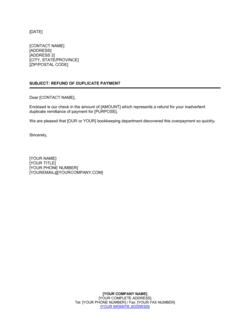
A Request for Refund of Duplicate Payment is a formal business letter sent by a payer to a vendor, supplier, or financial institution to document an inadvertent double payment and formally request the return of the excess funds. This free Word download provides a structured, professional starting point you can edit online and send within minutes.
When you need it
Use it as soon as you identify that the same invoice or transaction was processed twice β€” whether due to a data-entry error, a system glitch, or a miscommunication between departments. Acting quickly with a written record protects your recovery rights and creates a paper trail for your accounts-payable team.
What's inside
Payer and recipient details, reference numbers for both transactions, the exact duplicate amount being claimed, supporting documentation list, preferred refund method, a response deadline, and contact information for follow-up.

What is a Request for Refund of Duplicate Payment?

A Request for Refund of Duplicate Payment is a formal business letter sent by a payer to a vendor, supplier, or financial institution to document an accidental double payment and formally demand the return of the excess funds. It identifies both transactions by reference number and date, states the exact amount being claimed, attaches supporting bank evidence, and specifies how and by when the refund should be returned. The letter functions simultaneously as a recovery instrument and an auditable accounting record β€” giving both parties a clear paper trail for reconciliation, period-end close, and dispute resolution if the refund is not processed promptly.

Why You Need This Document

Without a written refund request, a duplicate payment is easily overlooked on the vendor's side β€” the extra funds are absorbed into their receivables, credited against a future invoice you didn't agree to, or simply not noticed until your next statement reconciliation. Verbal requests have no paper trail and give you nothing to escalate with if the vendor disputes the claim or stops responding. A properly drafted letter with transaction references and attached bank evidence compels faster action, satisfies your own accounts-payable audit requirements, and establishes the documented notice date you need if the matter escalates to a formal demand or bank chargeback. For finance teams, it also closes the control gap that allowed the duplicate payment in the first place β€” creating a record that the error was caught, reported, and resolved. This template gives you a professional, complete letter in under 15 minutes.

Which variant fits your situation?

If your situation is…Use this template
Duplicate payment made to a vendor or supplier by check or ACHRequest for Refund of Duplicate Payment
Overpayment on a single invoice (paid more than the invoiced amount)Request for Refund of Overpayment
Disputing an unauthorized or fraudulent charge with a bankBank Charge Dispute Letter
Vendor issued a credit note but has not applied itLetter Requesting Application of Credit Note
Payment made to the wrong vendor entirelyMisdirected Payment Recovery Letter
Customer double-charged on a retail or e-commerce transactionCustomer Refund Request Letter
Subscription or recurring billing processed twice in one periodDuplicate Subscription Charge Dispute Letter

Common mistakes to avoid

❌ Sending without supporting transaction evidence

Why it matters: A letter making a refund claim without attached proof β€” bank statements, payment confirmations β€” gives the vendor no way to verify the duplication and no obligation to act quickly.

Fix: Attach a bank statement excerpt showing both debits and a payment confirmation for each transaction before sending the initial letter.

❌ No refund deadline stated

Why it matters: Without a specified date, the vendor treats the request as low priority and it can sit unresolved for weeks while your period-end close approaches.

Fix: State a specific calendar date β€” 10 to 15 business days from the letter date β€” and request written acknowledgment within 5 business days.

❌ Addressing the letter to a generic department

Why it matters: Letters sent to 'Accounts Receivable' or 'Finance Department' without a name are routed slowly and can be reassigned multiple times before reaching someone with authority to process the refund.

Fix: Call the vendor before sending to confirm the name and direct email of the accounts-receivable or finance contact responsible for refund requests.

❌ Claiming the full payment amount rather than only the duplicate

Why it matters: Requesting both payments triggers a dispute review instead of a simple refund process β€” the vendor will investigate whether any valid payment is being contested, which delays everything.

Fix: State explicitly in the refund amount clause that the first payment is valid and only the second β€” duplicate β€” payment is being claimed.

The 9 key clauses, explained

Header: sender and recipient details

In plain language: Identifies the letter writer's business name, address, and contact information, and the full name and address of the vendor or institution being contacted.

Sample language
[YOUR COMPANY NAME] | [ADDRESS LINE 1] | [CITY, STATE, ZIP] | [DATE] | Attn: [RECIPIENT NAME / ACCOUNTS RECEIVABLE DEPARTMENT] | [VENDOR / INSTITUTION NAME] | [VENDOR ADDRESS]

Common mistake: Addressing the letter to a general department rather than a named contact. Letters without a named recipient are slower to route and easier to ignore.

Subject line

In plain language: A one-line summary that immediately identifies the purpose β€” duplicate payment β€” and references the invoice or transaction number so the recipient can pull records before reading further.

Sample language
Re: Request for Refund of Duplicate Payment β€” Invoice #[INVOICE NUMBER], Transaction Ref. #[TRANSACTION NUMBER]

Common mistake: Writing a vague subject like 'Payment Issue' instead of including the invoice number. The recipient's AP team will not search for the record without a reference to look up.

Opening statement

In plain language: States the purpose of the letter in plain terms β€” that a duplicate payment was made β€” and identifies the vendor relationship and the invoice in question.

Sample language
I am writing on behalf of [YOUR COMPANY NAME] to notify you that we inadvertently processed a duplicate payment for Invoice #[INVOICE NUMBER] dated [INVOICE DATE] in the amount of [AMOUNT].

Common mistake: Beginning with a lengthy apology or backstory instead of the key fact. State the duplicate payment in the first sentence so the recipient immediately understands what action is required.

Transaction details block

In plain language: Sets out both payments side by side β€” payment date, amount, method, and transaction reference β€” so the recipient can verify the duplication in their own records without ambiguity.

Sample language
First payment: [DATE], [AMOUNT], [METHOD β€” ACH / check / wire], Ref. #[TRANSACTION REF 1]. Second payment (duplicate): [DATE], [AMOUNT], [METHOD], Ref. #[TRANSACTION REF 2].

Common mistake: Describing the transactions in narrative prose rather than a structured list. A side-by-side format cuts verification time on the recipient's end and reduces back-and-forth.

Refund amount claimed

In plain language: States the exact dollar amount being requested for refund β€” equal to the duplicate payment β€” and confirms that only the excess payment is being claimed, not both.

Sample language
We respectfully request a refund of [DUPLICATE PAYMENT AMOUNT] ([AMOUNT IN WORDS]), representing the second payment processed in error. The original payment of [AMOUNT] on [DATE] is valid and is not subject to this claim.

Common mistake: Not specifying the currency, particularly in cross-border vendor relationships. Ambiguity over USD vs. CAD or EUR can delay or reduce the refund.

Supporting documentation list

In plain language: Lists the attachments included with the letter β€” bank statements, payment confirmations, remittance advices β€” that prove both payments were processed.

Sample language
Enclosed for your reference: (1) Bank statement excerpt showing both debits on [DATE 1] and [DATE 2]; (2) Payment confirmation for Transaction Ref. #[REF 1]; (3) Payment confirmation for Transaction Ref. #[REF 2]; (4) Copy of original Invoice #[INVOICE NUMBER].

Common mistake: Sending the letter without attachments and promising to follow up with documentation. Unsubstantiated claims are deprioritized; include proof in the initial communication.

Preferred refund method

In plain language: Specifies how and where the refund should be returned β€” bank account details for ACH, check payable to the company name, or a credit memo if preferred β€” reducing processing delay on the recipient's side.

Sample language
Please return the funds via ACH to: Bank: [BANK NAME] | Account Name: [ACCOUNT NAME] | Routing Number: [ROUTING NUMBER] | Account Number: [ACCOUNT NUMBER]. Alternatively, a check payable to [YOUR COMPANY NAME] is acceptable.

Common mistake: Not providing refund instructions at all and leaving the method to the vendor's discretion. This often results in a credit memo applied to future invoices rather than a cash refund.

Response deadline

In plain language: Requests a written acknowledgment and specifies the date by which the refund or a confirmed refund schedule should be received β€” typically 10–15 business days from the letter date.

Sample language
We ask that you acknowledge receipt of this request within [5] business days and process the refund no later than [DATE β€” typically 15 business days from letter date]. If you require additional documentation, please contact [NAME] at [EMAIL / PHONE].

Common mistake: Setting no deadline at all. Without a stated due date, the recipient has no urgency and the request will often sit unresolved until the payer follows up.

Closing and signature block

In plain language: Thanks the recipient for their prompt attention, provides a direct contact for questions, and closes with the authorized signatory's name, title, and company.

Sample language
Thank you for your prompt attention to this matter. Please do not hesitate to contact me directly at [PHONE] or [EMAIL] should you have any questions. Sincerely, [SIGNATORY NAME] | [TITLE] | [COMPANY NAME]

Common mistake: Closing with an aggressive or accusatory tone after a professional opening. A cooperative, matter-of-fact close preserves the vendor relationship and speeds resolution.

How to fill it out

  1. 1

    Gather both transaction records before drafting

    Pull the bank statement, payment confirmations, or EFT receipts for both payments. Note each transaction reference number, date, amount, and payment method.

    πŸ’‘ Screenshot or print the bank portal entries for both debits at this stage β€” you will attach them to the letter and they are the most persuasive evidence you have.

  2. 2

    Enter sender and recipient contact details

    Fill in your company's full legal name and mailing address at the top. Address the letter to a named individual in the vendor's accounts-receivable or finance department rather than a generic department title.

    πŸ’‘ A quick call to the vendor to confirm the correct AP contact name before sending reduces routing delays by 3–5 business days on average.

  3. 3

    Complete the subject line with both reference numbers

    Add the invoice number and at least one transaction reference number to the subject line so the recipient can pull the record before opening the body of the letter.

    πŸ’‘ If the vendor uses a PO number or vendor ID, include that too β€” the more identifiers you provide, the faster their team can verify the duplicate.

  4. 4

    Fill in the transaction details block

    Enter the date, amount, method, and reference number for each of the two payments in the structured table format. Confirm the amounts are identical and reference the same invoice.

    πŸ’‘ Double-check that the reference numbers you enter exactly match the numbers on the bank statement β€” a single digit error will slow verification.

  5. 5

    State the exact refund amount and currency

    Enter the dollar amount of the duplicate payment as both a figure and words (e.g., '$1,250.00 β€” One Thousand Two Hundred Fifty Dollars). Specify the currency if the vendor operates internationally.

    πŸ’‘ Confirm that the amount you claim matches exactly one of the two payments β€” not a rounded or estimated figure β€” to avoid disputes about the refund amount.

  6. 6

    Provide your preferred refund method with full banking details

    Enter your ACH routing and account number, or request a check and specify the exact payee name. Include a secondary option (check or credit memo) in case your primary method is not supported by the vendor.

    πŸ’‘ If you prefer a credit memo against future invoices rather than a cash refund, state that explicitly β€” it is often processed faster by the vendor's AP team.

  7. 7

    Set a response deadline and send with attachments

    Insert a specific date β€” 10 to 15 business days from the letter date β€” for the refund or confirmed schedule. Attach all supporting documents (bank statement excerpt, both payment confirmations, and the original invoice) before sending.

    πŸ’‘ Send via email with read receipt, or certified mail if the amount is above $5,000, so you have documented proof of delivery if escalation becomes necessary.

Frequently asked questions

What is a request for refund of duplicate payment?

A request for refund of duplicate payment is a formal letter sent by a payer to a vendor, supplier, or financial institution when the same invoice or obligation has been paid twice. It documents both transaction references, states the amount being claimed, and specifies how the recipient should return the funds. Having the request in writing creates a paper trail for both parties' accounting records.

How do I prove a duplicate payment was made?

The strongest evidence is a bank statement or payment portal screenshot showing two identical debits on or near the same date, combined with the payment confirmation or remittance advice for each transaction. Include the original invoice as well so the vendor can match all three documents β€” the invoice and both payments β€” without needing to contact you.

How long should I give the vendor to process a refund?

Ten to fifteen business days is the standard request window for a straightforward duplicate payment refund. Larger vendors with formal AP processes may need up to 30 days to route and approve the refund internally. Set a firm date in your letter and request written acknowledgment within five business days so you know the letter reached the right person.

Should I request a cash refund or a credit memo?

A cash refund β€” by ACH or check β€” is preferable when you need to restore your working capital or when the vendor relationship may end. A credit memo is faster to process on the vendor's side and works well for ongoing relationships where the credit will be applied against the next invoice. State your preference clearly in the letter; vendors default to whichever option is easiest for them otherwise.

Can I send this letter by email, or does it need to be mailed?

Email is appropriate for most duplicate payment refund requests and produces a timestamped delivery record. Use certified mail or courier for amounts above $5,000, for vendors you have had difficulty reaching, or when the situation may escalate to a formal dispute or legal claim. In either case, attach the supporting documents rather than promising to send them separately.

What if the vendor ignores my refund request?

Send a follow-up after the deadline passes, referencing the original letter by date and the outstanding amount. If a second request goes unanswered, escalate to a formal demand letter from your company's legal department or counsel, or initiate a chargeback through your bank if the payment was made by credit card or an eligible ACH method. Keeping dated copies of all correspondence is essential at this stage.

Does a duplicate payment refund request letter need to be signed?

A formal signature is not legally required for a refund request letter to be valid, but including the name and title of an authorized signatory β€” accounts payable manager, CFO, or business owner β€” adds credibility and signals that the request has internal approval. Most vendors process signed letters faster than unsigned ones because they can verify authority without a callback.

What information must I include in the letter?

At minimum: both parties' contact details, the invoice number, the reference numbers and dates of both payments, the exact refund amount and currency, the preferred refund method with banking details, a response deadline, and a list of attached supporting documents. Missing any of these will slow the vendor's verification process and delay the refund.

How this compares to alternatives

vs Demand letter

A demand letter is an escalation tool used after informal requests have failed β€” it typically carries legal weight and may precede litigation. A duplicate payment refund request is a cooperative, first-contact document that assumes good faith on the recipient's part. Use the refund request first; move to a demand letter only if the vendor fails to respond within the agreed timeframe.

vs Credit note

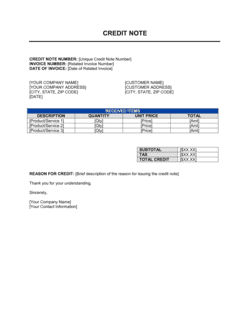
A credit note is issued by the vendor to reduce the amount a customer owes β€” it is the vendor's tool, not the payer's. A refund request letter is issued by the payer to initiate recovery of funds already disbursed. If the vendor offers a credit note in response to your letter, you can accept it as an alternative to a cash refund if the amount will be applied against a future invoice.

vs Bank dispute letter

A bank dispute letter is directed at your financial institution to initiate a chargeback or ACH return β€” it is used when direct contact with the vendor has failed or the charge was unauthorized. A duplicate payment refund request goes directly to the vendor and is the appropriate first step. Bank disputes can damage the vendor relationship and are subject to strict time limits, so they are a last resort.

vs Overpayment refund request

An overpayment refund request covers situations where a single payment exceeded the invoiced amount β€” for example, paying $1,500 on a $1,200 invoice. A duplicate payment refund request covers a separate, additional payment for the same invoice in full. The two documents reference different error types and include different transaction evidence.

Industry-specific considerations

Professional Services

Law firms, accounting practices, and consultancies frequently pay vendor invoices through multiple systems β€” billing software and a bank portal β€” creating duplicate ACH payments that require formal recovery letters.

Retail and E-commerce

High transaction volumes and automated payment runs increase the risk of duplicate supplier payments during peak seasons, making a standardized letter template essential for the AP team.

Construction and Trades

Progress billing and milestone payments to subcontractors are processed in batches, and duplicate payments commonly occur when paper checks and electronic transfers are used in parallel.

Healthcare

Medical practices and hospitals pay suppliers, labs, and equipment vendors through complex billing systems where duplicate payments arise from insurance reimbursements processed alongside direct payments.

Template vs pro β€” what fits your needs?

PathBest forCostTime
Use the templateAny business or individual recovering a duplicate payment from a vendor, supplier, or financial institutionFree10–15 minutes
Template + professional reviewDuplicate payments above $10,000, international vendors, or situations where the vendor is disputing the claim$100–$300 for a brief accountant or legal review1–2 business days
Custom draftedFormal legal demand where the vendor has refused to refund and the matter may proceed to collections or court$300–$800 for a lawyer-drafted demand letter2–5 business days

Glossary

Duplicate Payment
A payment made twice for the same obligation β€” same invoice number, same amount, and same payee β€” resulting in an unintended double disbursement.
Remittance Advice
A document sent with a payment that identifies which invoice or invoices the funds cover, used to match receipts on the recipient's side.
ACH Transfer
Automated Clearing House transfer β€” an electronic bank-to-bank payment processed through the US banking network, commonly used for vendor payments.
Transaction Reference Number
A unique identifier assigned by a bank or payment system to a specific transaction, used to locate and verify the payment in financial records.
Accounts Payable (AP)
The department or ledger entry representing money a business owes to its suppliers and vendors for goods and services already received.
Credit Memo
A document issued by a vendor reducing the amount owed by the customer β€” an alternative to a cash refund when the payer has an ongoing relationship with the vendor.
Reconciliation
The process of matching a company's internal payment records against bank statements or vendor statements to identify discrepancies such as duplicate payments.
Overpayment
Any payment that exceeds the amount legitimately owed, including duplicate payments, arithmetic errors, and payments made against already-credited invoices.
EFT (Electronic Funds Transfer)
A broad term for any transfer of money initiated electronically between bank accounts, including ACH, wire transfers, and online bill payments.
Aging Report
An accounts-payable or accounts-receivable report grouping transactions by age β€” used to identify duplicate or unresolved payments during reconciliation.

Part of your Business Operating System

This document is one of 3,000+ business & legal templates included in Business in a Box.

  • Fill-in-the-blanks β€” ready in minutes
  • 100% customizable Word document
  • Compatible with all office suites
  • Export to PDF and share electronically

Create your document in 3 simple steps.

From template to signed document β€” all inside one Business Operating System.
1
Download or open template

Access over 3,000+ business and legal templates for any business task, project or initiative.

2
Edit and fill in the blanks with AI

Customize your ready-made business document template and save it in the cloud.

3
Save, Share, Send, Sign

Share your files and folders with your team. Create a space of seamless collaboration.

Save time, save money, and create top-quality documents.

β˜…β˜…β˜…β˜…β˜…

"Fantastic value! I'm not sure how I'd do without it. It's worth its weight in gold and paid back for itself many times."

Managing Director Β· Mall Farm
Robert Whalley
Managing Director, Mall Farm Proprietary Limited
β˜…β˜…β˜…β˜…β˜…

"I have been using Business in a Box for years. It has been the most useful source of templates I have encountered. I recommend it to anyone."

Business Owner Β· 4+ years
Dr Michael John Freestone
Business Owner
β˜…β˜…β˜…β˜…β˜…

"It has been a life saver so many times I have lost count. Business in a Box has saved me so much time and as you know, time is money."

Owner Β· Upstate Web
David G. Moore Jr.
Owner, Upstate Web

Run your business with a system β€” not scattered tools

Stop downloading documents. Start operating with clarity. Business in a Box gives you the Business Operating System used by over 250,000 companies worldwide to structure, run, and grow their business.

Start freeΒ Β·Β No credit card required