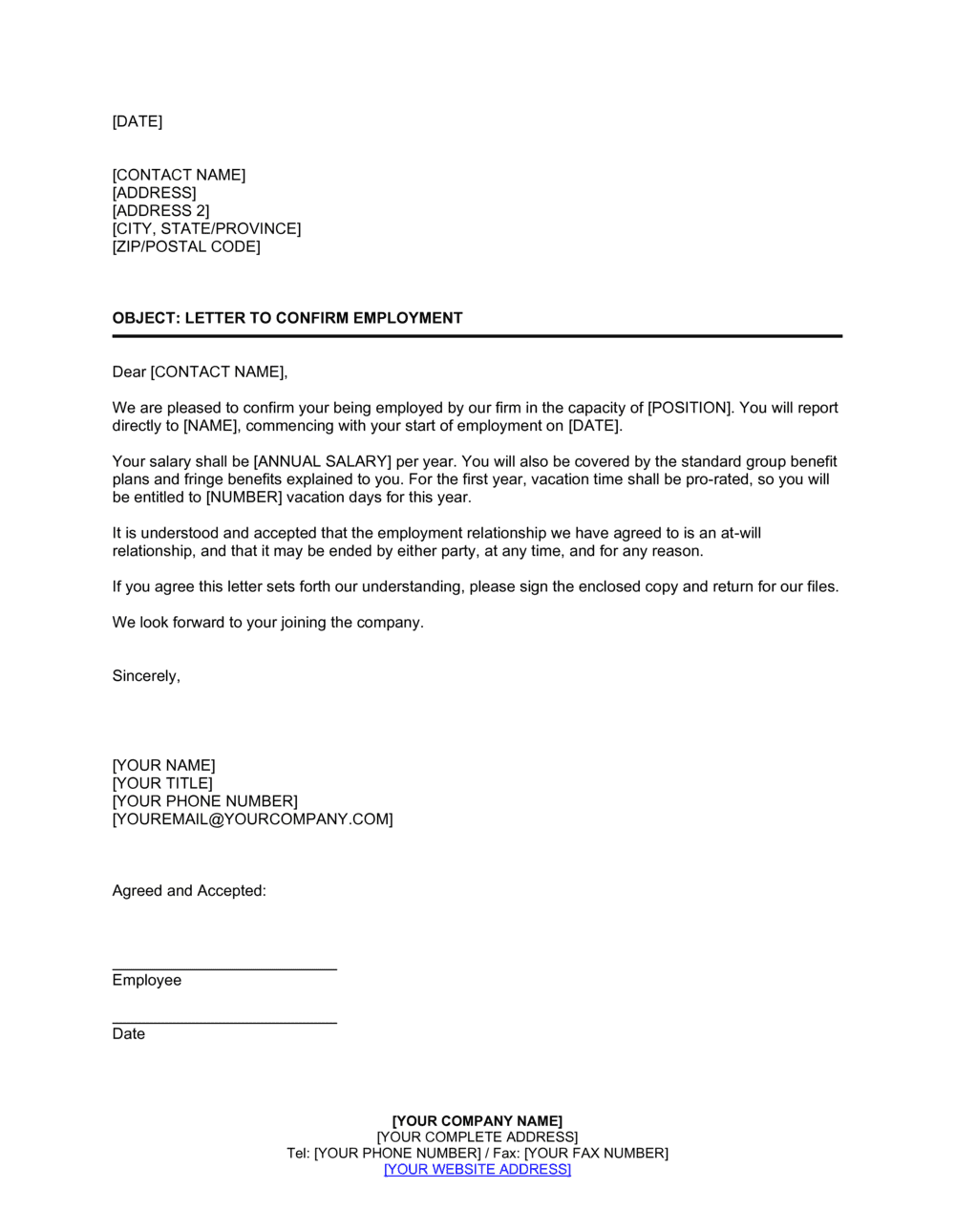
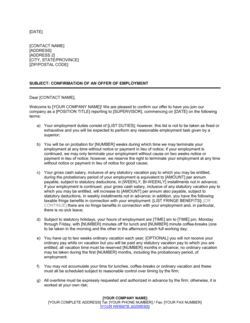
Letter Confirming Employment Template

Free Word download β€’ Edit online β€’ Save & share with Drive β€’ Export to PDF

1 pageβ€’15–20 min to fillβ€’Difficulty: Standard
Learn more ↓
FreeLetter Confirming Employment Template

At a glance

What it is
A Letter Confirming Employment is a formal document issued by an employer that verifies an employee's current role, salary, start date, and employment status. This free Word download lets you fill in the key details, print on company letterhead, and export as PDF β€” ready to submit to a visa office, bank, landlord, or background screening agency within minutes.
When you need it
Issue it whenever an employee needs third-party proof of their employment status β€” most commonly for mortgage or loan applications, rental agreements, immigration visa requests, or pre-employment background checks at a new employer.
What's inside
Company letterhead block, date and recipient details, employee name and job title, employment type and start date, annual salary or hourly rate, confirmation of current active status, and an authorized signatory block with contact details for follow-up queries.

What is a Letter Confirming Employment?

A Letter Confirming Employment is a formal document issued by an employer that verifies an employee's current job title, start date, employment type, and gross salary. It functions as official proof of employment status for third parties β€” banks, mortgage lenders, landlords, immigration authorities, and background check agencies β€” who need to confirm that a person is genuinely employed and earning a stated income before approving a loan, lease, or visa application. Unlike an employment reference letter, it contains no opinion or assessment; it is a statement of verifiable facts on company letterhead, signed by an authorized representative.

Why You Need This Document

Employees routinely need formal proof of their employment status, and an ad-hoc email from a manager rarely satisfies the requirements of a bank or visa office. Without a properly formatted confirmation letter on company letterhead β€” with gross salary, employment type, start date, and an authorized signature β€” mortgage applications stall, rental agreements fall through, and visa submissions get returned for missing documentation. For HR teams and business owners, handling these requests without a standard template leads to inconsistent letters that contradict payroll records or omit required fields, triggering follow-up calls and delays for both the employee and the third party. This template gives you a consistent, professional starting point that meets the expectations of financial institutions, immigration authorities, and landlords, so each request takes five minutes rather than an afternoon.

Which variant fits your situation?

If your situation is…Use this template
Employee needs proof of income for a mortgage applicationLetter Confirming Employment (with salary detail)
Employee is applying for a work visa or immigration statusEmployment Verification Letter for Immigration
Landlord requires proof of stable employment before signing a leaseLetter Confirming Employment (rental version)
New employer requests verification as part of a background checkEmployment Reference Letter
Employee is self-employed and needs proof of incomeSelf-Employment Verification Letter
Employee is on a fixed-term contract and needs status confirmedFixed-Term Employment Confirmation Letter
Employee needs a letter confirming a recent promotion or role changeEmployee Promotion Letter

Common mistakes to avoid

❌ Quoting net salary instead of gross

Why it matters: Banks and lenders use gross income to calculate debt-to-income ratios and maximum loan amounts. A net figure understates earnings and can result in the employee being offered a lower loan amount or rejected outright.

Fix: Always state the gross annual salary and label it explicitly as 'gross' β€” add the currency code to eliminate any ambiguity for international recipients.

❌ Issuing the letter too early

Why it matters: Most mortgage lenders and visa offices treat employment confirmation letters as valid for only 30 days. A letter dated six weeks before submission will be rejected and a new one requested, delaying the application.

Fix: Coordinate with the employee on their submission timeline and issue the letter no more than two to three weeks before they plan to submit it.

❌ Using an informal email format instead of company letterhead

Why it matters: A letter without a company logo, registered address, and official domain email looks unofficial and is routinely questioned or rejected by banks, landlords, and immigration authorities.

Fix: Print or export the letter on formal company letterhead with all contact details visible β€” if your company has a branded Word or PDF template, use it.

❌ Omitting the employment type classification

Why it matters: Lenders and landlords treat full-time permanent employees differently from fixed-term or probationary workers when assessing risk. Leaving out the classification forces a follow-up request and delays the process.

Fix: Explicitly state whether the employment is permanent, fixed-term, or probationary, and include the contract end date for fixed-term arrangements if the requesting party requires it.

The 8 key clauses, explained

Letterhead and date block

In plain language: Prints the employer's official company name, address, phone, and email at the top, followed by the date the letter is issued.

Sample language
[COMPANY NAME] | [ADDRESS LINE 1], [CITY], [STATE/PROVINCE] [ZIP/POSTAL CODE] | Tel: [PHONE] | [DATE]

Common mistake: Using a personal email address or generic Gmail domain instead of the company domain β€” third parties often reject letters that do not appear to come from an official business address.

Recipient details

In plain language: Addresses the letter to the specific organization or individual requesting verification, or uses a 'To Whom It May Concern' salutation when the recipient is unknown.

Sample language
To: [RECIPIENT NAME / ORGANIZATION] | Re: Employment Confirmation for [EMPLOYEE FULL NAME]

Common mistake: Leaving the recipient blank on the assumption it is acceptable to send a generic letter β€” some banks and visa offices require the letter to be addressed to them specifically.

Opening confirmation statement

In plain language: States clearly and directly that the named individual is currently employed by the company, establishing the core fact the letter is meant to confirm.

Sample language
This letter confirms that [EMPLOYEE FULL NAME] is currently employed by [COMPANY NAME] in the position of [JOB TITLE].

Common mistake: Opening with background about the company instead of immediately confirming employment β€” recipients scan for the confirmation statement and may miss it if buried.

Employment type and start date

In plain language: Specifies whether the employment is full-time, part-time, permanent, or fixed-term, and states the official start date on record.

Sample language
[EMPLOYEE FULL NAME] has been employed on a [full-time / part-time / fixed-term] basis since [START DATE].

Common mistake: Omitting the employment type β€” lenders and immigration officers treat full-time permanent employment differently from casual or fixed-term arrangements, and the omission triggers a follow-up request.

Salary or compensation details

In plain language: States the employee's current gross annual salary or hourly rate, which is the primary data point banks and landlords need to assess financial capacity.

Sample language
[EMPLOYEE FULL NAME]'s current gross annual salary is $[AMOUNT] ([CURRENCY]), payable [bi-weekly / monthly].

Common mistake: Quoting the net (take-home) figure instead of the gross salary β€” lenders base affordability calculations on gross income and will return the letter for correction.

Confirmation of current active status

In plain language: Explicitly states that the employee is in good standing and currently active, distinguishing this letter from a reference for a departed employee.

Sample language
[EMPLOYEE FULL NAME] remains an active member of our team in good standing as of the date of this letter.

Common mistake: Forgetting to include the 'as of the date of this letter' qualifier β€” without it, a letter written weeks before submission may be considered outdated by the recipient.

Invitation for follow-up queries

In plain language: Provides direct contact information for the signatory or HR department so the third party can verify the letter's authenticity or ask follow-up questions.

Sample language
Should you require any further information, please do not hesitate to contact the undersigned at [EMAIL] or [PHONE NUMBER].

Common mistake: Listing only a general company switchboard number β€” some banks and visa offices will attempt to call the signatory directly to authenticate the letter, and an unresponsive general line raises doubts.

Signatory block

In plain language: Closes the letter with the name, job title, and signature of the authorized person issuing the confirmation on behalf of the company.

Sample language
Yours sincerely, [SIGNATORY FULL NAME] | [JOB TITLE] | [COMPANY NAME]

Common mistake: Having a junior employee sign the letter when the requesting party specifically requires a director, officer, or HR manager signature β€” check the third party's requirements before issuing.

How to fill it out

  1. 1

    Add your company letterhead

    Insert your company's registered name, street address, phone number, and email address in the header block. If you have a branded letterhead template, paste the body text into it rather than building the header manually.

    πŸ’‘ Use your official company domain email in the letterhead β€” letters with generic email domains are frequently questioned by banks and immigration offices.

  2. 2

    Enter the date and recipient details

    Type today's date in the date field. If the requesting organization has provided specific addressing instructions β€” such as a branch name or visa officer reference number β€” include those in the recipient block.

    πŸ’‘ Issue the letter no more than 30 days before it will be submitted β€” most financial institutions and visa offices reject letters older than 30 days.

  3. 3

    Fill in the employee's full legal name and job title

    Use the employee's name exactly as it appears on their government ID or employment contract β€” middle names and spelling must match to avoid identity verification issues.

    πŸ’‘ Cross-check the name and title against your HR records before signing; discrepancies between the letter and payroll documents are a common cause of application delays.

  4. 4

    Confirm employment type and start date

    Select the correct employment classification β€” full-time permanent, part-time, or fixed-term β€” and enter the start date from payroll records. If the employee is still in a probationary period, decide whether to note it based on what the requesting party requires.

    πŸ’‘ If the letter is for a visa application, check whether the requesting authority needs the contract end date for fixed-term employees β€” omitting it on an immigration letter is a frequent rejection reason.

  5. 5

    State the gross annual salary

    Enter the employee's current gross annual salary and currency. If the employee is paid hourly, convert to an annualized figure (hourly rate Γ— standard hours per week Γ— 52) and note the hourly rate in parentheses.

    πŸ’‘ Confirm with the employee what figure they have quoted on their application β€” a mismatch between the letter and the application form will trigger a query.

  6. 6

    Name the authorized signatory and obtain their signature

    Enter the full name and job title of the person signing on behalf of the company. Have them sign before the letter is sent, not after β€” an unsigned or digitally watermarked letter is sometimes rejected by formal institutions.

    πŸ’‘ Check the third party's requirements upfront: some mortgage lenders specify that the signatory must be a director or HR manager, not an office administrator.

Frequently asked questions

What is a letter confirming employment?

A letter confirming employment is a formal document issued by an employer that verifies an employee's current job title, start date, employment type, and salary. It is used as official proof of employment status when an employee applies for a mortgage, rental property, visa, or undergoes a background check. It is a factual confirmation document, not a performance reference or character reference.

Who typically requests an employment confirmation letter?

Banks and mortgage lenders request it to verify income and employment stability before approving a loan. Landlords use it to confirm a prospective tenant can afford the rent. Immigration authorities require it as part of work visa or residency applications. Background check agencies may request it as part of a pre-employment screening process at a new employer.

Does a letter confirming employment need to be signed?

While no legal requirement mandates a signature in most jurisdictions, virtually all third parties β€” banks, visa offices, and landlords β€” require a handwritten or authorized digital signature from a named company representative. An unsigned letter is routinely rejected. The signatory should be identified by full name and job title beneath their signature.

What is the difference between an employment confirmation letter and an employment reference letter?

An employment confirmation letter states verifiable facts β€” job title, salary, start date, and employment status β€” without any qualitative assessment. An employment reference letter includes the writer's opinion of the employee's performance, skills, and character. Third parties requesting proof of income or employment status need the confirmation letter; prospective employers evaluating a candidate need the reference.

How long is an employment confirmation letter valid?

Most banks and immigration authorities treat employment confirmation letters as valid for 30 days from the date of issue. Some landlords accept letters up to 60 days old. To be safe, issue the letter no more than two to three weeks before the employee plans to submit it. If the letter expires before submission, a new one must be issued.

Can a small business owner or sole trader issue an employment confirmation letter?

Yes. A business does not need to be a large corporation to issue a valid employment confirmation letter. Small business owners and sole traders can issue the letter on business letterhead, signed in their capacity as owner or director. Some lenders may request supporting documents such as a business registration number or recent tax filings to corroborate the letter when the employer is a small or newly established entity.

Does the letter need to include the employee's salary?

It depends on the purpose. Mortgage and loan applications almost always require salary details β€” without them, the lender cannot assess affordability. Visa applications may or may not require salary figures depending on the immigration authority. Rental applications typically require salary confirmation. When in doubt, include the gross annual salary and currency β€” it is easier to redact than to reissue the letter.

Can I use this template for an employee on a fixed-term or probationary contract?

Yes. Simply note the employment type as fixed-term and include the contract end date in the relevant clause. For employees on probation, state the probationary period end date and whether conversion to permanent status is anticipated, if the requesting party asks for that level of detail. Some visa and mortgage applications treat fixed-term employment differently, so check the third party's specific requirements before issuing.

How this compares to alternatives

vs Employment Reference Letter

An employment reference letter includes qualitative assessments of the employee's performance, skills, and work ethic β€” it is used when a candidate applies for a new job and needs a recommendation. A letter confirming employment states only verifiable facts with no opinion or assessment. Third parties requesting proof of income need the confirmation letter; prospective employers evaluating a hire need the reference.

vs Offer Letter

An offer letter is issued before employment begins to confirm the terms of a new role β€” salary, start date, and title. A letter confirming employment is issued to a current employee to verify their existing status to a third party. The two documents serve opposite purposes in the employment timeline.

vs Employment Contract

An employment contract is a binding agreement governing the full terms of the working relationship, including IP, confidentiality, non-compete, and termination clauses. A confirmation letter is a short, factual summary of employment status issued on request. The contract is never shared with third parties like banks or landlords β€” the confirmation letter is.

vs Employee Promotion Letter

A promotion letter formally notifies an employee of a change in role, title, or compensation and becomes part of their HR record. A confirmation letter verifies the employee's current status to an external party. If an employee was recently promoted, the confirmation letter should reflect the new title and salary β€” ideally issued after the promotion letter has been signed.

Industry-specific considerations

Technology / SaaS

Remote and international workforces frequently require employment confirmation for cross-border visa applications and overseas rental agreements.

Financial Services

Regulated firms must ensure confirmation letters align with internal data governance policies before disclosing salary and role details to third parties.

Healthcare

Clinical staff on short fixed-term or locum contracts often need letters that specify contract end dates and renewal expectations for mortgage lenders.

Construction and Trades

Project-based employment and variable hours require annualized income calculations and clear employment-type classification to satisfy lender requirements.

Template vs pro β€” what fits your needs?

PathBest forCostTime
Use the templateHR managers, office managers, and business owners issuing standard employment confirmations for mortgages, rentals, or background checksFree5 minutes per letter
Template + professional reviewLetters for immigration visa applications or regulated financial institutions that have specific formatting requirements$0–$100 (HR advisor or immigration consultant check)30–60 minutes
Custom draftedHighly regulated industries or complex employment arrangements requiring legal sign-off before disclosure$150–$400 (employment lawyer review)1–2 days

Glossary

Employment Verification
The process of confirming that an individual is or was employed at a specific organization, typically at the request of a third party such as a bank or landlord.
Authorized Signatory
The person within the company β€” usually an HR manager, director, or officer β€” who has the authority to sign documents on the company's behalf.
Employment Status
A classification indicating whether the employee is full-time, part-time, casual, fixed-term, or permanent.
Company Letterhead
Pre-formatted stationery bearing the company's logo, registered name, address, and contact details, used to give official correspondence a formal appearance.
Gross Annual Salary
An employee's total yearly compensation before tax deductions, used by lenders and landlords to assess affordability.
Start Date
The official first day of employment as recorded in payroll and HR systems, which establishes length of service.
Probationary Period
A defined initial period of employment β€” typically 30 to 90 days β€” during which the employee's status may be conditional, a detail some third parties specifically ask to have confirmed.
Employment Reference
A separate document or statement attesting to the quality of an employee's work β€” distinct from an employment confirmation letter, which only verifies facts.
Third-Party Verifier
An external organization β€” bank, immigration authority, landlord, or background check agency β€” that requests confirmation of employment directly from the employer.

Part of your Business Operating System

This document is one of 3,000+ business & legal templates included in Business in a Box.

  • Fill-in-the-blanks β€” ready in minutes
  • 100% customizable Word document
  • Compatible with all office suites
  • Export to PDF and share electronically

Create your document in 3 simple steps.

From template to signed document β€” all inside one Business Operating System.
1
Download or open template

Access over 3,000+ business and legal templates for any business task, project or initiative.

2
Edit and fill in the blanks with AI

Customize your ready-made business document template and save it in the cloud.

3
Save, Share, Send, Sign

Share your files and folders with your team. Create a space of seamless collaboration.

Save time, save money, and create top-quality documents.

β˜…β˜…β˜…β˜…β˜…

"Fantastic value! I'm not sure how I'd do without it. It's worth its weight in gold and paid back for itself many times."

Managing Director Β· Mall Farm
Robert Whalley
Managing Director, Mall Farm Proprietary Limited
β˜…β˜…β˜…β˜…β˜…

"I have been using Business in a Box for years. It has been the most useful source of templates I have encountered. I recommend it to anyone."

Business Owner Β· 4+ years
Dr Michael John Freestone
Business Owner
β˜…β˜…β˜…β˜…β˜…

"It has been a life saver so many times I have lost count. Business in a Box has saved me so much time and as you know, time is money."

Owner Β· Upstate Web
David G. Moore Jr.
Owner, Upstate Web

Run your business with a system β€” not scattered tools

Stop downloading documents. Start operating with clarity. Business in a Box gives you the Business Operating System used by over 250,000 companies worldwide to structure, run, and grow their business.

Free Forever PlanΒ Β·Β No credit card required