Customer Letter for Departed Employee Template

Free Word download β€’ Edit online β€’ Save & share with Drive β€’ Export to PDF

1 pageβ€’15–20 min to fillβ€’Difficulty: Standard
Learn more ↓
FreeCustomer Letter for Departed Employee Template

At a glance

What it is
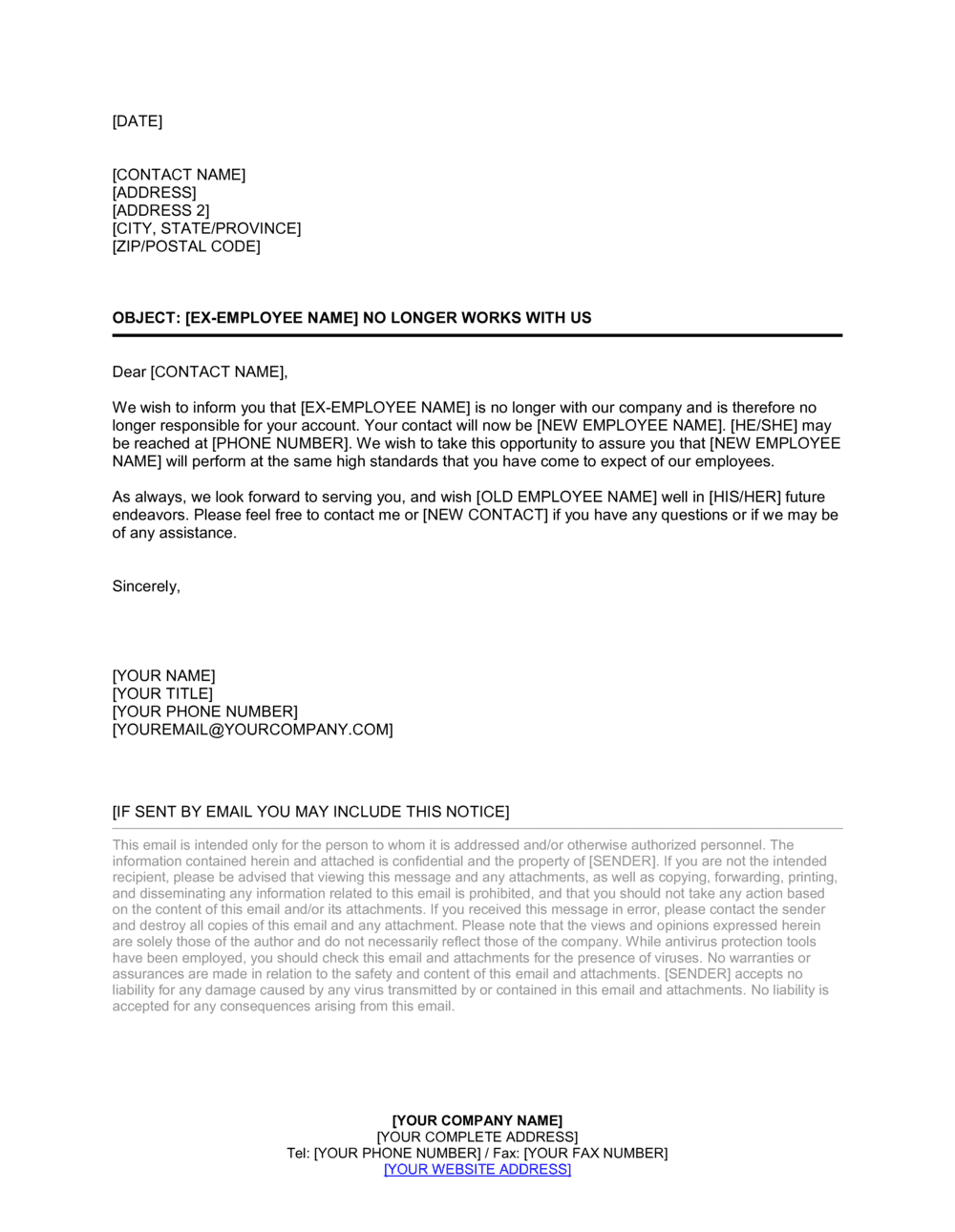
A Customer Letter for Departed Employee is a formal business letter sent to clients or customers to inform them that their dedicated account contact or sales representative has left the company. This free Word download lets you fill in the departing employee's name, the replacement's details, and your transition plan, then send it immediately by email or post.
When you need it
Use it as soon as an account-facing employee resigns or is terminated β€” ideally within 24 to 48 hours of the departure becoming official. Sending it promptly prevents customers from reaching out to a defunct contact and signals that the relationship is being actively managed.
What's inside
An opening acknowledgment of the staffing change, a warm introduction of the replacement contact with their credentials and role, a reaffirmation of service continuity, updated contact details, and a professional closing that invites customers to reach out with questions.

What is a Customer Letter for Departed Employee?

A Customer Letter for Departed Employee is a formal business letter sent by a company to its clients or customers when an account-facing employee β€” such as a sales representative, account manager, or customer success contact β€” leaves the organization. It serves three purposes in a single document: informing the customer of the change, introducing the replacement contact with enough background to establish credibility, and reaffirming that all existing agreements and service commitments remain unchanged. This free Word download gives you a complete, ready-to-send template that you can personalize with the relevant names, dates, and contact details in under 15 minutes.

Why You Need This Document

When an account-facing employee departs without a prompt, professional customer notification, the consequences are concrete and immediate. Customers discover the change through an out-of-office message or a bounced email, begin reaching out with no response, and interpret the silence as disorganization β€” or worse, as an opportunity to evaluate competing suppliers. In account-managed businesses, a single departing sales rep can take months of relationship equity with them if customers feel abandoned rather than handed off. This template gives you a structured way to get ahead of that risk within 48 hours of any departure, ensuring every customer receives a named replacement, a direct phone number and email, and an explicit assurance that their terms and service levels are not changing. For businesses with any material book of client relationships, building this letter into the offboarding checklist is one of the lowest-cost retention actions available.

Which variant fits your situation?

If your situation is…Use this template
A sales representative's entire client portfolio must be reassignedCustomer Letter for Departed Employee
The departure is amicable and you want to thank the employee publiclyFarewell Letter to Customers from Employee
An internal team member has changed roles but not left the companyChange of Account Manager Letter
A senior executive or key decision-maker has departedLetter Announcing Departure of Executive
Notifying staff internally about the departure rather than customersEmployee Departure Announcement
Formally documenting the employee's last day and obligations before departureEmployee Dismissal Letter

Common mistakes to avoid

❌ Delaying the letter by more than a week

Why it matters: Customers who discover the departure from an out-of-office message or a bounced email before receiving any communication from you feel blindsided β€” and begin evaluating alternatives.

Fix: Build this letter into your offboarding checklist so it is drafted and approved before the employee's last day and sent within 24 to 48 hours of the departure.
❌ Explaining the reason for departure

Why it matters: Mentioning termination, resignation details, or any conflict opens the company to reputational risk and can generate questions the sender is not prepared to answer.

Fix: State only that the employee has left the company and the effective date. No further detail is necessary or appropriate in a customer communication.

❌ Sending the letter from a no-reply email address

Why it matters: Customers who have questions or concerns cannot respond directly, which creates frustration and erodes the trust the letter is designed to protect.

Fix: Send from the replacement's email address or a monitored inbox, and ensure the replacement is prepared to respond to replies promptly.

❌ Omitting the service continuity clause

Why it matters: Without an explicit statement that agreements and service levels are unchanged, customers in the middle of active projects or contract renewals may put decisions on hold or initiate competitive reviews.

Fix: Include a direct, unambiguous sentence confirming that all terms, pricing, and commitments remain in effect, and reference the new contact as the person to confirm this.

The 8 key clauses, explained

Sender and date line

In plain language: Identifies the company sending the letter, the sender's name and title, and the date of issue.

Sample language
[SENDER NAME], [TITLE] | [COMPANY NAME] | [DATE]

Common mistake: Using a generic 'The Management' signature instead of a named sender β€” customers are less likely to trust or respond to an anonymous communication.

Customer address block

In plain language: States the recipient's name, title, company, and mailing or email address so the letter reaches the correct contact.

Sample language
[CUSTOMER FULL NAME] | [TITLE] | [COMPANY NAME] | [ADDRESS]

Common mistake: Sending the letter to a general inbox rather than the named decision-maker, which means it may be filtered or ignored before the right person sees it.

Opening acknowledgment of the departure

In plain language: Informs the customer directly and professionally that the named employee has left the company, without unnecessary detail about the circumstances.

Sample language
I am writing to let you know that [DEPARTED EMPLOYEE NAME], who has been your primary contact at [COMPANY NAME], has left the company as of [DEPARTURE DATE].

Common mistake: Providing reasons for the departure β€” whether voluntary or involuntary β€” which can create legal exposure or damage the company's professional image.

Introduction of the replacement contact

In plain language: Names the new account contact, gives a brief relevant background, and confirms that they are already up to speed on the customer's account.

Sample language
Going forward, [REPLACEMENT NAME] will be your dedicated point of contact. [REPLACEMENT NAME] brings [X] years of experience in [RELEVANT AREA] and is fully briefed on your account history and current projects.

Common mistake: Introducing the replacement without any context β€” customers are less likely to engage with a name they know nothing about.

Reaffirmation of service continuity

In plain language: Reassures the customer that existing agreements, pricing, service levels, and commitments remain unchanged.

Sample language
Please be assured that all existing agreements, service levels, and commitments between [COMPANY NAME] and [CUSTOMER COMPANY NAME] remain fully in effect. You can expect the same level of service you have come to rely on.

Common mistake: Omitting this clause entirely, leaving customers uncertain whether contracts or pricing may change β€” which can prompt them to explore competing suppliers.

Updated contact details

In plain language: Provides the replacement contact's direct phone number, email address, and any other relevant channel so customers can reach them immediately.

Sample language
You can reach [REPLACEMENT NAME] directly at [EMAIL ADDRESS] or [PHONE NUMBER]. [He/She/They] will be available during normal business hours, [HOURS], [TIME ZONE].

Common mistake: Listing only an email address and omitting a phone number for customers who prefer to speak directly, particularly for urgent account matters.

Offer to speak or meet

In plain language: Invites the customer to schedule an introductory call or meeting with the new contact to ensure a smooth transition.

Sample language
We would welcome the opportunity to schedule a brief introductory call between you and [REPLACEMENT NAME] at your convenience. Please reply to this letter or contact [REPLACEMENT NAME] directly to arrange a time.

Common mistake: Skipping this clause on the assumption the customer will reach out if they need to β€” proactively offering a meeting significantly reduces early churn risk.

Closing and sender signature

In plain language: A professional closing that thanks the customer for their continued relationship and is signed by a named, senior sender.

Sample language
Thank you for your continued trust in [COMPANY NAME]. We value your partnership and look forward to serving you. Sincerely, [SENDER NAME], [TITLE]

Common mistake: Closing with only a first name or a department name β€” a full name and title signals accountability and gives the customer a senior escalation path if needed.

How to fill it out

  1. 1

    Enter the sender's name and title

    Fill in the name and title of the person sending the letter β€” ideally the departing employee's direct manager or a senior leader familiar to the customer.

    πŸ’‘ The more senior the sender, the stronger the signal that the customer relationship is valued. Use the VP or Director level for high-value accounts.

  2. 2

    Address the letter to the correct contact

    Use the customer's full name, title, and company rather than a generic salutation. Pull this from your CRM to ensure accuracy.

    πŸ’‘ Check that the contact record is current β€” customers who have changed roles or companies will need a different communication entirely.

  3. 3

    Fill in the departed employee's name and last day

    State the employee's name and exact departure date factually. Do not include reasons for departure β€” keep it brief and neutral.

    πŸ’‘ If the departure was abrupt or contentious, draft and run the letter past your legal or HR team before sending, even if formal review is not required.

  4. 4

    Introduce the replacement contact with relevant background

    Add the replacement's full name, a one-sentence summary of their relevant experience, and a statement confirming they have been briefed on the account.

    πŸ’‘ One specific, relevant credential β€” 'five years managing accounts in the manufacturing sector' β€” builds more confidence than a generic 'highly experienced professional.'

  5. 5

    Insert the replacement's direct contact details

    Enter the replacement's direct email, phone number, and business hours including time zone. Confirm these details are active before sending.

    πŸ’‘ Set up an email forward from the departed employee's address to the replacement before the letter is sent β€” some customers will reply to the old address out of habit.

  6. 6

    Personalize the service continuity paragraph for high-value accounts

    For strategic accounts, reference specific agreements or projects by name to make the assurance concrete rather than generic.

    πŸ’‘ A letter that mentions the customer's actual project or contract number is perceived as significantly more attentive than a standard form letter.

  7. 7

    Sign and send within 48 hours of the departure

    Export the completed letter as PDF or send directly from Word. Email is appropriate for most accounts; post a physical copy for formal or long-standing client relationships.

    πŸ’‘ Follow up with a phone call to your top ten accounts within 24 hours of sending the letter β€” written notice alone is rarely sufficient for your most valuable relationships.

Frequently asked questions

When should I send a customer letter for a departed employee?

Send it within 24 to 48 hours of the employee's last day. The longer you wait, the higher the chance a customer will discover the departure through an out-of-office reply or a bounced email before they receive your communication. For high-value or strategically important accounts, a phone call from a senior leader should accompany the letter on the same day.

Should I explain why the employee left in the letter?

No. Whether the departure was a resignation, a termination, or a mutual separation, the letter should state only that the employee has left the company and the effective date. Providing reasons β€” particularly for involuntary departures β€” creates legal exposure, can embarrass the individual, and generates questions you are not positioned to answer in writing to a customer.

Who should sign the customer notification letter?

The letter should be signed by the departing employee's direct manager or a senior leader known to the customer. For strategic or enterprise accounts, having the VP of Sales or Customer Success sign the letter signals that the relationship is being taken seriously. Avoid using generic titles like 'The Management Team' as the signatory β€” customers want to know who to call if they have concerns.

What if there is no replacement contact ready to introduce?

If a permanent replacement has not yet been named, introduce an interim contact β€” a manager, team lead, or colleague β€” who will handle the account until a permanent contact is in place. Set a realistic timeline and follow up with a second letter introducing the permanent replacement as soon as they are assigned. Leaving customers with no named contact is the worst outcome.

Should I send the letter by email or by post?

Email is appropriate for most business customers and ensures the fastest delivery. For long-standing, formal, or high-value relationships β€” particularly in industries like legal, financial services, or construction β€” a physical letter on company letterhead carries additional weight. When in doubt, send both: an email for speed and a printed letter for formality.

Can I use the same letter for every customer the employee managed?

The template is designed to be personalized with each customer's name, company, and specific account details. For a large book of business, you can mail-merge the core letter using your CRM, but take the time to add one personalized sentence referencing the customer's specific project or account for your top accounts. Generic letters are better than silence, but personalized ones are meaningfully more effective at preventing churn.

Does this letter need to be reviewed by a lawyer?

In most cases, no. A factual, neutral notification letter does not create legal obligations or constitute a contract amendment. However, if the customer relationship is governed by a formal service agreement with specific notification requirements β€” such as a clause requiring written notice of account contact changes β€” review the contract terms and have your legal team confirm the letter satisfies them before sending.

How do I handle customers who are upset by the departure?

The letter itself will not resolve a customer who had a strong personal relationship with the departed employee. For these accounts, follow up the letter immediately with a phone call from the new contact and, if warranted, from a senior leader. Acknowledge the relationship the customer had, reinforce your commitment to their account, and give them an early win β€” such as a proactive account review or a resolved open issue.

How this compares to alternatives

vs Employee Dismissal Letter

An employee dismissal letter is an internal HR document sent to the employee being terminated, documenting the decision and the terms of separation. A customer letter for a departed employee is an external communication sent to clients to manage the relationship impact of that departure. The two documents serve entirely different audiences and should never be confused or combined.

vs Farewell Letter from Employee to Customers

A farewell letter is written in the departing employee's own voice and sent directly to clients to say goodbye, often sharing the employee's next steps. A customer notification letter is written by the company and focuses on continuity, the replacement contact, and reassurance. The farewell letter serves the employee's relationships; the notification letter protects the company's accounts.

vs Change of Account Manager Letter

A change of account manager letter is used when an existing employee is reassigned to a different role or territory β€” not when they leave. The tone and framing differ: reassignment letters can position the change as a positive development for the client, whereas departure letters must be more neutral and focus on the handover rather than the reason for the change.

vs General Business Announcement Letter

A general business announcement letter is a broad communication covering company news, new services, or organizational changes addressed to all customers at once. A customer letter for a departed employee is targeted to the specific accounts that individual managed and must be personalized by account to be effective. Using a general announcement letter for an employee departure produces a generic, impersonal communication that signals the company does not value individual relationships.

Industry-specific considerations

Professional Services

Client relationships are often built around a specific advisor or consultant, making prompt, senior-signed notification essential to preventing client loss when a practitioner departs.

Financial Services

Regulatory and fiduciary considerations may require timely written notification of relationship manager changes; client agreements often specify notification obligations.

Technology / SaaS

Customer success and account management turnover is common; a standardized departure letter integrated into offboarding reduces the revenue risk of rep-to-customer relationships.

Retail and Wholesale

Trade account buyers develop working relationships with sales reps around pricing agreements and order cadences; notification letters protect those terms from being renegotiated at departure.

Template vs pro β€” what fits your needs?

PathBest forCostTime
Use the templateAny business that needs to notify customers of a staff departure quickly and professionallyFree10–15 minutes per letter
Template + professional reviewRegulated industries or accounts governed by service agreements with specific notification clauses$0–$200 (legal or HR team review)1–2 hours
Custom draftedEnterprise accounts with contractual notification requirements or high legal sensitivity around the departure$300–$800 (external counsel or communications consultant)1–2 days

Glossary

Account Contact
The named employee at a company who serves as the primary point of communication for a given customer or client relationship.
Transition Period
A defined window of time during which the departing employee's responsibilities are handed off to their replacement, sometimes with overlap.
Warm Introduction
A personal introduction that frames a new contact in positive terms, providing background that helps the customer feel confident in the relationship.
Book of Business
The set of customer accounts and revenue relationships managed by a single sales representative or account manager.
Offboarding
The formal process of managing an employee's departure, including knowledge transfer, access revocation, and stakeholder communication.
Continuity of Service
The assurance that a customer's service levels, commitments, and terms will remain unchanged despite personnel changes.
CRM Handover
The process of transferring all customer notes, history, open deals, and contact records from a departing employee to their replacement in a customer relationship management system.
Point of Contact (POC)
The single person designated to handle inquiries, requests, and communication for a specific account or relationship.

Part of your Business Operating System

This document is one of 3,000+ business & legal templates included in Business in a Box.

  • Fill-in-the-blanks β€” ready in minutes
  • 100% customizable Word document
  • Compatible with all office suites
  • Export to PDF and share electronically

Create your document in 3 simple steps.

From template to signed document β€” all inside one Business Operating System.
1
Download or open template

Access over 3,000+ business and legal templates for any business task, project or initiative.

2
Edit and fill in the blanks with AI

Customize your ready-made business document template and save it in the cloud.

3
Save, Share, Send, Sign

Share your files and folders with your team. Create a space of seamless collaboration.

Save time, save money, and create top-quality documents.

β˜…β˜…β˜…β˜…β˜…

"Fantastic value! I'm not sure how I'd do without it. It's worth its weight in gold and paid back for itself many times."

Managing Director Β· Mall Farm
Robert Whalley
Managing Director, Mall Farm Proprietary Limited
β˜…β˜…β˜…β˜…β˜…

"I have been using Business in a Box for years. It has been the most useful source of templates I have encountered. I recommend it to anyone."

Business Owner Β· 4+ years
Dr Michael John Freestone
Business Owner
β˜…β˜…β˜…β˜…β˜…

"It has been a life saver so many times I have lost count. Business in a Box has saved me so much time and as you know, time is money."

Owner Β· Upstate Web
David G. Moore Jr.
Owner, Upstate Web

Run your business with a system β€” not scattered tools

Stop downloading documents. Start operating with clarity. Business in a Box gives you the Business Operating System used by over 250,000 companies worldwide to structure, run, and grow their business.

Start freeΒ Β·Β No credit card required