Complimentary Letter to Employee on Handling of Difficulty Template

Free Word download β€’ Edit online β€’ Save & share with Drive β€’ Export to PDF

1 pageβ€’15–20 min to fillβ€’Difficulty: Standard
Learn more ↓
FreeComplimentary Letter to Employee on Handling of Difficulty Template

At a glance

What it is
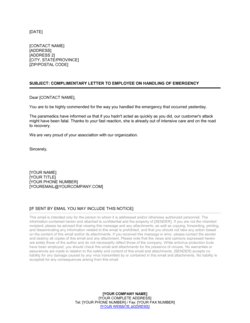
A Complimentary Letter to Employee on Handling of Difficulty is a formal written acknowledgment from a manager or employer recognizing an employee who navigated a challenging situation β€” a difficult client, an operational crisis, or a high-pressure deadline β€” with composure and effectiveness. This free Word download gives you a ready-to-edit letter you can personalize and send in minutes, or export as PDF for inclusion in an employee's personnel file.
When you need it
Use it after an employee resolves a crisis, de-escalates a tense client interaction, covers for an absent colleague under pressure, or otherwise demonstrates judgment and resilience beyond normal expectations. Sending it promptly β€” within a few days of the incident β€” maximizes its motivational impact.
What's inside
A professional salutation, a specific description of the difficult situation, a clear statement of the employee's commendable actions, an expression of appreciation, and a forward-looking closing that reinforces your confidence in the employee.

What is a Complimentary Letter to Employee on Handling of Difficulty?

A Complimentary Letter to Employee on Handling of Difficulty is a formal written acknowledgment from a manager or employer to an employee who navigated a specific challenging situation β€” a difficult client, an operational disruption, a staffing crisis, or a high-pressure deadline β€” with skill and composure. Unlike a general thank-you note, it names the specific incident, describes the employee's concrete actions, and connects those actions to a business outcome, creating a document that is both personally meaningful and professionally credible. It can be delivered directly to the employee, copied to HR for the personnel file, or both.

Why You Need This Document

Failing to formally recognize strong performance in difficult situations sends an unintended message: that going above and beyond is expected but not noticed. Employees who handle crises well and receive no acknowledgment are significantly more likely to disengage or leave β€” and the institutional knowledge they carry leaves with them. A written commendation letter creates a durable record that supports future promotion decisions, performance reviews, and reference requests, giving the recognition weight well beyond the moment it is received. This template gives you a professionally structured letter you can personalize and send in under ten minutes, ensuring the recognition arrives while it still matters.

Which variant fits your situation?

If your situation is…Use this template
Recognizing an employee for outstanding overall performance during the yearEmployee Commendation Letter
Formally thanking a team rather than a single individualTeam Appreciation Letter
Acknowledging exceptional customer service delivered by an employeeComplimentary Letter to Employee on Customer Service
Recommending the employee for a promotion after demonstrated leadershipEmployee Promotion Recommendation Letter
Writing a formal reference for a high-performing employee leaving the companyEmployee Reference Letter
Documenting positive feedback as part of a formal performance review cycleEmployee Performance Review

Common mistakes to avoid

❌ Generic praise with no behavioral specifics

Why it matters: Phrases like 'you did an excellent job' tell the employee nothing about what behavior to repeat. The letter loses its motivational and reinforcement value.

Fix: Name at least two to three specific actions the employee took during the difficulty β€” what they said, decided, or did β€” so the feedback is actionable.
❌ Sending the letter weeks after the incident

Why it matters: Recognition that arrives long after the event feels like an afterthought and loses the motivational impact of timely acknowledgment.

Fix: Aim to send the letter within three to five business days of the incident while the memory is fresh for both the employee and any colleagues who witnessed it.

❌ Omitting the business impact

Why it matters: Without connecting the employee's actions to an outcome β€” client retained, crisis resolved, team steadied β€” the letter reads as a courtesy rather than a meaningful acknowledgment.

Fix: Add one sentence linking the employee's actions to a concrete result, even if it is qualitative, such as 'your intervention prevented the situation from escalating to senior management.'

❌ Using a vague description of the difficulty

Why it matters: A letter that says 'during a recent challenge' provides no context for HR reviewers or future readers of the personnel file, reducing its value as a documented commendation.

Fix: Name the specific situation and date or timeframe so the letter is self-contained and intelligible to any reader without additional background.

The 8 key clauses, explained

Sender and date block

In plain language: Identifies who is sending the letter and when, establishing the formal context of the communication.

Sample language
[SENDER NAME] | [TITLE] | [COMPANY NAME] | [DATE]

Common mistake: Using a casual date format like '5/2/26' instead of 'May 2, 2026' β€” informal formatting undermines the professional tone of the letter.

Recipient and salutation

In plain language: Addresses the employee by name and uses a formal opening that sets a respectful, professional tone.

Sample language
Dear [EMPLOYEE FIRST NAME],

Common mistake: Opening with 'To Whom It May Concern' β€” this letter is personal and should always address the employee by name to have the intended motivational effect.

Opening statement of purpose

In plain language: States immediately that the letter is a formal commendation, so the employee understands the tone before reading further.

Sample language
I am writing to formally recognize and commend you for the exceptional manner in which you handled [BRIEF DESCRIPTION OF SITUATION] on [DATE OR TIMEFRAME].

Common mistake: Burying the compliment in the second or third paragraph β€” employees and HR reviewers should know within the first sentence that this is a positive letter.

Description of the difficult situation

In plain language: Provides enough context about the challenge so the letter makes sense to a third party reading it later β€” such as an HR reviewer or future employer.

Sample language
As you will recall, [COMPANY NAME] faced [DESCRIPTION OF DIFFICULTY β€” e.g., 'a significant service outage affecting our top-tier clients on [DATE]'], which placed considerable pressure on the [DEPARTMENT] team.

Common mistake: Being so vague that the description could apply to any employee. Specific situational details make the commendation credible and meaningful.

Description of the employee's specific actions

In plain language: Names the concrete steps the employee took to address the difficulty β€” this is the behavioral core of the letter and the section that drives future motivation.

Sample language
Rather than escalating the issue unnecessarily, you [SPECIFIC ACTION β€” e.g., 'contacted each affected client directly, communicated a transparent timeline for resolution, and coordinated with the technical team to restore service within four hours'].

Common mistake: Using generic phrases like 'you did a great job' without describing what the employee actually did β€” vague praise does not reinforce specific behavior.

Expression of appreciation and impact

In plain language: Connects the employee's actions to a concrete outcome β€” client retention, team stability, cost avoidance β€” so the employee understands the business significance of their contribution.

Sample language
Your calm and decisive approach prevented further client escalation and protected [COMPANY NAME]'s relationship with [CLIENT/ACCOUNT β€” optional]. This made a tangible difference to the team and to the company.

Common mistake: Stopping at 'thank you' without articulating the impact. Employees are more motivated when they understand how their actions contributed to a real outcome.

Forward-looking confidence statement

In plain language: Closes the substantive section with a statement that reinforces the manager's confidence in the employee going forward, turning the letter into a morale and retention tool.

Sample language
This kind of composure and professionalism is exactly what sets [EMPLOYEE NAME] apart, and I have every confidence you will continue to demonstrate this standard of excellence.

Common mistake: Ending the letter immediately after the compliment without a forward-looking statement β€” the confidence statement is what makes recognition feel career-affirming rather than transactional.

Formal closing and signature

In plain language: Closes the letter with a professional sign-off that includes the sender's name, title, and company to give the document authority and traceability.

Sample language
Sincerely, [SENDER NAME] | [TITLE] | [COMPANY NAME]

Common mistake: Using an overly casual closing like 'Cheers' or 'Best' in a formal letter intended for a personnel file β€” stick to 'Sincerely' or 'With appreciation'.

How to fill it out

  1. 1

    Fill in the sender block and date

    Enter your full name, job title, company name, and the date of writing at the top of the letter. Use the full written date format β€” 'May 2, 2026' β€” rather than a numeric shorthand.

    πŸ’‘ If the letter will be printed on company letterhead, the company name and address may already appear in the header β€” remove the duplicate from the sender block.

  2. 2

    Address the employee by name

    Use the employee's first name in the salutation for a warm but professional tone. If company culture is more formal, use 'Dear Mr./Ms. [LAST NAME]'.

    πŸ’‘ Check the employee's preferred name in your HR system β€” some employees go by a name different from what appears on official records.

  3. 3

    State the purpose of the letter in the opening sentence

    Clearly identify that you are writing to commend the employee, and reference the specific situation and date or timeframe in the first sentence so the context is immediately clear.

    πŸ’‘ One strong opening sentence beats a long preamble β€” get to the commendation within the first 20 words.

  4. 4

    Describe the difficulty with enough detail for a third party

    Briefly explain what the challenging situation was β€” a client complaint, an operational issue, a staffing gap β€” in enough detail that someone reading the letter in six months would understand the context.

    πŸ’‘ Keep this paragraph to two to three sentences. The situation is context, not the story β€” the employee's actions are the story.

  5. 5

    Name the specific actions the employee took

    List the concrete steps the employee took to address the difficulty. Use active verbs and be as specific as possible β€” 'contacted each client personally' beats 'handled communication.'

    πŸ’‘ If you weren't directly present, speak to colleagues who were before writing this section so the details are accurate.

  6. 6

    State the outcome and its business impact

    Connect the employee's actions to a result β€” client retained, service restored, team stabilized. Even a qualitative outcome ('prevented the situation from escalating') is more powerful than no outcome at all.

    πŸ’‘ If you have a quantifiable result β€” 'restored service within four hours' or 'resolved all three complaints on the same day' β€” include it.

  7. 7

    Close with a confidence statement and formal sign-off

    Add one sentence expressing confidence in the employee's continued performance, then close with 'Sincerely' or 'With appreciation' followed by your name and title.

    πŸ’‘ Send or present the letter within 72 hours of the incident while the details are fresh and the emotional impact of the recognition is highest.

Frequently asked questions

What is a complimentary letter to an employee on handling of difficulty?

It is a formal written communication from a manager or employer to an employee recognizing the skill, composure, or professionalism with which they navigated a specific challenging situation β€” such as a difficult client interaction, an operational crisis, or an unexpected staffing shortage. It serves both as a motivational tool and as a documented record of positive performance that can be placed in the employee's personnel file.

When should I send a complimentary letter to an employee?

Send it as soon as possible after the incident β€” ideally within three to five business days. Timely recognition reinforces the specific behavior you want to see repeated. Waiting more than two weeks significantly reduces the motivational impact and can make the gesture feel obligatory rather than genuine.

Does the letter need to be signed to be effective?

A signature is not legally required, but signing the letter adds formality and personal weight to the recognition. If the letter will be placed in the employee's personnel file or shared with senior leadership, a signed copy β€” printed or digitally signed β€” carries more authority than an unsigned document.

Should I copy HR or the employee's personnel file?

Yes, in most cases. Sending a copy to HR ensures the commendation is documented alongside any other performance records. This is particularly valuable if the employee is later considered for a promotion, a raise, or a reference request. Ask the employee's permission before copying anyone outside the direct management chain.

How is this different from a general employee appreciation letter?

A general appreciation letter acknowledges an employee's overall contribution β€” often at an annual review or work anniversary. A complimentary letter on handling of difficulty is event-specific: it ties the recognition to a particular incident and the concrete actions the employee took. That specificity makes it more credible, more motivating, and more useful as a personnel record.

Can I use this letter as part of a formal performance review?

Yes. Many managers attach incident-specific commendation letters as supporting evidence during annual or mid-year performance reviews. The letter provides concrete behavioral examples that strengthen ratings and help justify merit increases or promotions. It is more persuasive than a manager's verbal recollection alone.

How long should the letter be?

One page is the standard. A well-constructed letter needs four to six short paragraphs: an opening that states the purpose, a brief description of the situation, a paragraph on the employee's specific actions, a statement of impact and appreciation, and a forward-looking closing. Anything longer risks diluting the core message.

Is it appropriate to share the letter publicly with the team?

With the employee's consent, sharing a summary of the commendation with the broader team can reinforce positive behavior across the group and signal that management notices and values strong performance. However, sharing personnel documents without the employee's agreement is inadvisable and in some jurisdictions may implicate privacy obligations.

How this compares to alternatives

vs Complimentary letter to employee on customer service

A customer service commendation letter focuses specifically on how an employee served a customer β€” courtesy, responsiveness, and satisfaction. A handling-of-difficulty letter is broader, covering any challenging situation including internal crises, operational disruptions, or interpersonal conflict. Use the customer service variant when the trigger is a client interaction; use this letter when the challenge was operational or situational.

vs Employee performance review

A performance review is a structured evaluation of an employee's contributions across an entire review period, typically covering multiple competencies and goals. This letter is a single-incident commendation β€” specific, brief, and immediate. Both serve retention and development purposes, but the letter is more motivating in the moment while the review is more comprehensive for career planning.

vs Reference letter for employee

A reference letter is written for an employee who is leaving and addresses a future employer's questions about character and competence. A complimentary letter is written for a current employee and placed in their file or shared directly with them. The complimentary letter can later inform a reference letter, but the two serve entirely different audiences and moments.

vs Employee warning letter

An employee warning letter documents misconduct or underperformance and initiates a formal corrective process. A complimentary letter does the opposite β€” it formally documents exemplary conduct. Both belong in the personnel file to create a balanced and accurate record of the employee's performance history.

Industry-specific considerations

Professional Services

Recognizing consultants or account managers who de-escalated a client dispute or delivered under a compressed timeline without compromising quality.

Retail and Hospitality

Commending frontline staff who handled a difficult customer complaint, a product shortage, or a high-volume peak period with professionalism.

Healthcare

Acknowledging clinical or administrative staff who managed a critical patient situation, a staffing gap, or a regulatory inspection calmly and competently.

Technology and SaaS

Recognizing engineers or support staff who resolved a service outage, managed a security incident, or covered a critical on-call shift under significant pressure.

Template vs pro β€” what fits your needs?

PathBest forCostTime
Use the templateManagers and HR professionals sending a straightforward, single-incident commendation to any employeeFree5–10 minutes
Template + professional reviewLetters that will be placed in a formal personnel file or shared with senior leadership in a regulated industry$0–$100 (brief HR or legal review)30–60 minutes
Custom draftedComplex situations involving potential legal sensitivity β€” such as a crisis with regulatory implications β€” where the letter may be reviewed externally$200–$500 (HR consultant or employment lawyer)1–2 days

Glossary

Commendation
A formal written or verbal statement praising an employee's conduct or performance in a specific situation.
Personnel File
The official record maintained by an employer containing documents related to an employee's employment history, performance, and conduct.
Positive Reinforcement
A management practice of acknowledging and rewarding desirable behavior to increase the likelihood it will be repeated.
Situational Recognition
Recognition tied to a specific incident or event rather than general tenure or annual performance, which research shows is more motivating than delayed or generic praise.
Informal vs. Formal Recognition
Informal recognition is verbal or ad hoc; formal recognition is documented in writing and may be placed in the employee's personnel file.
Behavioral Specificity
The practice of naming the exact actions an employee took, rather than offering vague praise, so the employee understands precisely what conduct is being reinforced.
Escalation
The process of referring a problem or complaint to a higher authority when a resolution cannot be reached at the current level β€” a situation this letter type is often used to follow up after an employee successfully avoided.
Morale
The overall level of motivation, confidence, and satisfaction employees feel in their workplace, directly affected by how consistently management acknowledges strong performance.

Part of your Business Operating System

This document is one of 3,000+ business & legal templates included in Business in a Box.

  • Fill-in-the-blanks β€” ready in minutes
  • 100% customizable Word document
  • Compatible with all office suites
  • Export to PDF and share electronically

Create your document in 3 simple steps.

From template to signed document β€” all inside one Business Operating System.
1
Download or open template

Access over 3,000+ business and legal templates for any business task, project or initiative.

2
Edit and fill in the blanks with AI

Customize your ready-made business document template and save it in the cloud.

3
Save, Share, Send, Sign

Share your files and folders with your team. Create a space of seamless collaboration.

Save time, save money, and create top-quality documents.

β˜…β˜…β˜…β˜…β˜…

"Fantastic value! I'm not sure how I'd do without it. It's worth its weight in gold and paid back for itself many times."

Managing Director Β· Mall Farm
Robert Whalley
Managing Director, Mall Farm Proprietary Limited
β˜…β˜…β˜…β˜…β˜…

"I have been using Business in a Box for years. It has been the most useful source of templates I have encountered. I recommend it to anyone."

Business Owner Β· 4+ years
Dr Michael John Freestone
Business Owner
β˜…β˜…β˜…β˜…β˜…

"It has been a life saver so many times I have lost count. Business in a Box has saved me so much time and as you know, time is money."

Owner Β· Upstate Web
David G. Moore Jr.
Owner, Upstate Web

Run your business with a system β€” not scattered tools

Stop downloading documents. Start operating with clarity. Business in a Box gives you the Business Operating System used by over 250,000 companies worldwide to structure, run, and grow their business.

Free Forever PlanΒ Β·Β No credit card required