Complimentary Letter to Employee on Handling of Emergency Template

Free Word download β€’ Edit online β€’ Save & share with Drive β€’ Export to PDF

1 pageβ€’15–25 min to fillβ€’Difficulty: Standard
Learn more ↓
FreeComplimentary Letter to Employee on Handling of Emergency Template

At a glance

What it is
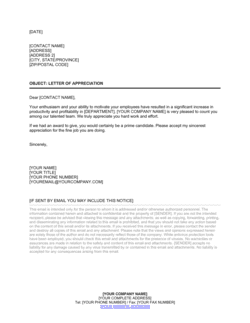
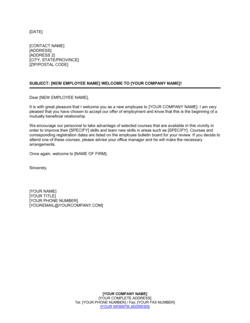
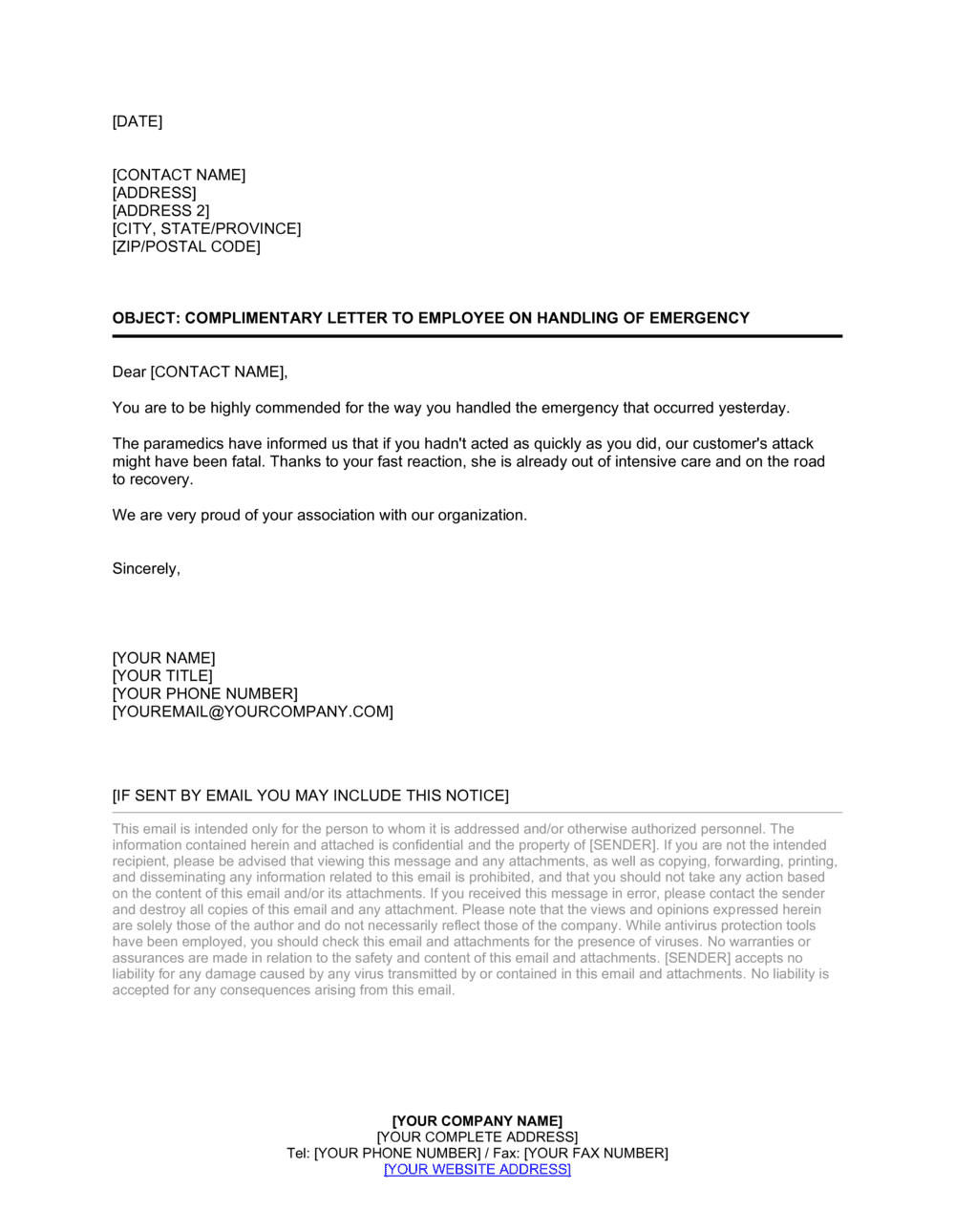
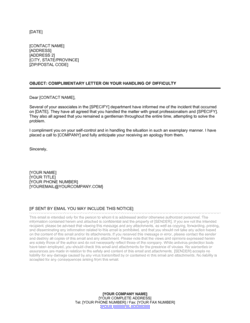
A Complimentary Letter to Employee on Handling of Emergency is a formal written acknowledgment from an employer or manager recognizing an employee's calm, effective, and professional conduct during an unexpected crisis or emergency situation. This free Word download gives you a structured template you can edit online and send β€” or place in the employee's personnel file β€” within minutes.
When you need it
Use it immediately after an employee demonstrates exceptional composure and skill during a workplace emergency β€” such as a medical incident, equipment failure, fire evacuation, security threat, or natural disaster. Prompt recognition, ideally within 48–72 hours of the event, carries the greatest motivational impact.
What's inside
A formal salutation, a description of the specific emergency and the employee's actions, an acknowledgment of the positive outcomes their response produced, a statement of the company's appreciation, and a forward-looking closing that reinforces confidence in the employee.

What is a Complimentary Letter to Employee on Handling of Emergency?

A Complimentary Letter to Employee on Handling of Emergency is a formal written commendation issued by an employer, manager, or HR department to recognize an employee who responded to an unexpected workplace crisis with composure, skill, and sound judgment. It describes the specific emergency, names the employee's concrete actions, and connects those actions to measurable positive outcomes β€” creating a permanent record of exemplary conduct. Unlike a casual verbal "thank you," this document carries organizational authority and belongs in the employee's personnel file as evidence of their character and capability under pressure.

Why You Need This Document

Failing to formally acknowledge exceptional employee conduct is a missed opportunity with real costs. Employees who receive no documented recognition after going above and beyond during a crisis are measurably more likely to disengage or leave β€” taking the institutional knowledge and calm-under-pressure experience you depend on with them. A timely, specific complimentary letter signals that the organization notices, values, and records exemplary behavior, reinforcing the exact conduct you want repeated. It also creates a factual record that strengthens performance reviews, supports promotion decisions, and provides credible third-party reference material. This template gives any manager the structure to produce a professional, personnel-file-ready commendation in under 15 minutes β€” so recognition happens when it matters most.

Which variant fits your situation?

If your situation is…Use this template
Recognizing an employee who assisted during a medical emergency on-siteComplimentary Letter to Employee on Handling of Emergency
Acknowledging outstanding overall job performance over a review periodEmployee Appreciation Letter
Formally commending an employee's leadership during a project crisisEmployee Commendation Letter
Recognizing a team, not an individual, for crisis responseTeam Recognition Letter
Nominating an employee for a formal internal award after the emergencyEmployee Award Nomination Letter
Confirming a salary increase or bonus tied to emergency performanceSalary Increase Letter

Common mistakes to avoid

❌ Delaying the letter beyond one week

Why it matters: Recognition loses motivational impact rapidly after the event. An employee who handled a crisis a month ago and receives no formal acknowledgment may feel overlooked, reducing the likelihood they will go above and beyond again.

Fix: Draft and send the letter within 48–72 hours of the emergency. If the situation is still being assessed, send a brief verbal acknowledgment immediately and follow up with the formal letter once facts are confirmed.
❌ Using vague, generic praise without specifics

Why it matters: Phrases like 'you did a great job' or 'we appreciate your efforts' carry no evidentiary weight in a personnel file and feel hollow to the recipient.

Fix: Name the emergency, the date, and at least two specific actions the employee took. If you were not present, gather the details from witnesses or the incident report before writing.

❌ Omitting the outcome or impact

Why it matters: Describing what the employee did without explaining what it achieved misses the point of recognition β€” that their actions made a tangible difference.

Fix: Add one sentence explicitly connecting the employee's response to a concrete positive result: safety preserved, losses minimized, or team confidence maintained.

❌ Failing to file a copy in the personnel record

Why it matters: A letter sent only by email can be lost or overlooked. Without a formal record, the commendation carries no weight during performance reviews, promotion decisions, or reference checks.

Fix: Print or save a PDF copy of the signed letter and add it to the employee's official personnel file on the same day it is sent.

The 9 key clauses, explained

Sender and recipient header

In plain language: Identifies the sender's name and title, the date, and the employee's full name and position β€” establishing the formal record.

Sample language
[YOUR NAME] | [YOUR TITLE] | [DATE] | To: [EMPLOYEE FULL NAME], [EMPLOYEE TITLE]

Common mistake: Using an informal email salutation instead of a full header. Without a complete header, the letter cannot be filed correctly in a personnel record.

Formal salutation

In plain language: Opens the letter respectfully using the employee's name, setting a professional but warm tone.

Sample language
Dear [EMPLOYEE FIRST NAME],

Common mistake: Writing 'Dear Employee' or 'To Whom It May Concern.' Impersonal salutations undermine the sincerity of the recognition.

Statement of purpose

In plain language: Opens the body by stating the letter's intent β€” to formally recognize the employee for their handling of a specific emergency.

Sample language
I am writing to formally commend you for your exceptional response to the [DESCRIBE EMERGENCY] that occurred on [DATE] at [LOCATION].

Common mistake: Burying the reason for the letter in the second or third paragraph. State the recognition immediately so the employee understands the letter's purpose from the first sentence.

Description of the emergency

In plain language: Provides a brief factual account of the emergency event β€” what happened, when, and where β€” so the letter is self-contained and meaningful out of context.

Sample language
On [DATE], [BRIEF DESCRIPTION OF EMERGENCY EVENT] arose unexpectedly, creating a situation that required immediate, decisive action to ensure the safety of [AFFECTED PARTIES].

Common mistake: Being so vague that the event is unrecognizable in the letter. Specific details make the commendation credible and meaningful when reviewed months or years later.

Description of the employee's specific actions

In plain language: Names the concrete steps the employee took during the emergency β€” the actions that distinguish their response as exceptional.

Sample language
Without hesitation, you [SPECIFIC ACTION 1], [SPECIFIC ACTION 2], and coordinated with [RELEVANT PARTIES] to [OUTCOME]. Your quick thinking and calm demeanor were critical to [RESULT].

Common mistake: Using generic praise like 'you handled it well' with no specifics. Vague commendations are less credible, carry less weight in future reviews, and mean less to the employee.

Acknowledgment of positive outcomes

In plain language: Connects the employee's actions to the tangible results β€” safety preserved, losses minimized, operations restored β€” reinforcing why their response mattered.

Sample language
As a direct result of your actions, [POSITIVE OUTCOME β€” e.g., all personnel were safely evacuated / damage to equipment was contained / normal operations resumed within [X] hours].

Common mistake: Skipping the outcome paragraph entirely. Linking actions to results demonstrates that the employer understood and valued the full impact of what the employee did.

Expression of appreciation

In plain language: Explicitly states the company's gratitude on behalf of the organization and, where applicable, fellow employees or customers who benefited.

Sample language
On behalf of [COMPANY NAME] and the entire [DEPARTMENT/TEAM], I want to express our sincere gratitude for your professionalism, composure, and dedication during an extremely challenging moment.

Common mistake: Writing only a personal 'thank you' without attributing appreciation to the organization. A personal note is valuable but the formal letter should carry organizational weight.

Forward-looking closing statement

In plain language: Closes the body by affirming the company's confidence in the employee and noting that the letter will be placed on file as a positive record.

Sample language
This letter will be placed in your personnel file as a formal record of your outstanding contribution. We are proud to have you as part of the [COMPANY NAME] team and look forward to your continued contributions.

Common mistake: Ending the letter abruptly after the appreciation without a forward-looking statement. A closing that reinforces the employee's value strengthens the motivational impact of the recognition.

Closing and signature

In plain language: Ends the letter with a professional valediction, the sender's handwritten or digital signature, printed name, and title.

Sample language
Sincerely, [SIGNATURE] | [YOUR FULL NAME] | [YOUR TITLE] | [COMPANY NAME]

Common mistake: Omitting the sender's title. Without a title, the letter's authority is unclear and it may carry less weight if reviewed by a third party such as a future employer.

How to fill it out

  1. 1

    Complete the sender and recipient header

    Enter your full name, title, and the date at the top, followed by the employee's full name and position. Use the date the letter is written, not the date of the emergency.

    πŸ’‘ If you plan to file this letter in the employee's personnel record, confirm you are using their legal name exactly as it appears in payroll records.

  2. 2

    Personalize the salutation

    Use the employee's first name for a warm but professional tone. If the workplace culture is more formal, use 'Mr.' or 'Ms.' followed by the last name.

    πŸ’‘ Match the salutation formality to the relationship β€” using a first name when you have always used it in conversation avoids an awkward shift in register.

  3. 3

    State the recognition purpose in the first sentence

    Write a clear opening sentence that identifies the letter as a formal commendation and names the emergency event and the date it occurred.

    πŸ’‘ Keep this sentence to one line β€” clarity in the opener sets the right tone for everything that follows.

  4. 4

    Describe the emergency in two to three sentences

    Provide enough factual context β€” what happened, when, and where β€” that the letter is understandable without background knowledge of the event.

    πŸ’‘ Cross-reference the incident report if one was filed to ensure factual accuracy before sending.

  5. 5

    List the employee's specific actions

    Write two to four concrete sentences describing exactly what the employee did during the emergency. Use active verbs: directed, coordinated, administered, contained, evacuated.

    πŸ’‘ Interview the employee or witnesses if you were not present β€” accurate specifics make the commendation far more meaningful than generic praise.

  6. 6

    Connect actions to outcomes

    Add one to two sentences linking the employee's response to measurable or observable results β€” injuries prevented, downtime reduced, or calm maintained among colleagues.

    πŸ’‘ Quantify where possible: 'operations resumed within two hours' is more compelling than 'operations were quickly restored.'

  7. 7

    Add the organizational appreciation and closing

    Express gratitude on behalf of the company and note that the letter will be filed in the employee's record. End with your professional closing and signature.

    πŸ’‘ Send a copy of the letter to the employee's direct manager if you are not their direct supervisor β€” it ensures the recognition is visible across the reporting chain.

Frequently asked questions

What is a complimentary letter to an employee on handling of an emergency?

It is a formal written commendation from an employer or manager to an employee who demonstrated exceptional skill, composure, or leadership during an unexpected emergency or crisis. It describes the event, names the employee's specific actions, and connects those actions to positive outcomes β€” creating a permanent record of exemplary conduct in the employee's personnel file.

When should I send a complimentary letter after an emergency?

Ideally within 48–72 hours of the event, once the immediate situation has been resolved and you have confirmed the key facts. Prompt recognition is significantly more motivating than delayed acknowledgment. If the full details are still being gathered, send a brief verbal or email acknowledgment immediately and follow up with the formal letter within the week.

Does the letter need to be signed to be valid?

A signature is not legally required for a complimentary letter, but it substantially increases the document's credibility and formality. A signed letter β€” even a digital signature β€” carries more weight in a personnel file and feels more meaningful to the recipient than an unsigned memo or email.

Should the letter be shared with anyone besides the employee?

Yes, in most cases. Sending a copy to the employee's direct manager (if you are not that person), the HR department, and the employee's personnel file ensures the recognition is visible across the organization. Some companies also share a summarized version in a team meeting or internal newsletter β€” with the employee's permission β€” to reinforce the behavior organizationally.

Can I use this letter for a team rather than an individual?

This template is designed for individual recognition, which carries more personal impact. For team recognition, adapt the salutation and action description to reference the group, or send individual letters to each team member involved. Individual letters sent to each person are more effective than a single group letter at reinforcing the specific behaviors you want to encourage.

How specific should the description of the emergency be?

Specific enough that the letter is self-contained and meaningful when read without background context β€” for example, during a performance review or reference check. Include the type of emergency, the date, the location, and the key actions taken. Avoid including confidential medical or personal information about third parties who were involved.

What tone is appropriate for this letter?

Formal, warm, and specific. The letter should feel like a genuine acknowledgment from a senior member of the organization, not a form letter. Avoid overly effusive language β€” three to four well-crafted paragraphs with concrete details are more effective than five paragraphs of generalities.

How this compares to alternatives

vs Employee Warning Letter

A warning letter documents unacceptable behavior and sets corrective expectations β€” it is a disciplinary record. A complimentary letter does the opposite: it formally records exemplary behavior and reinforces it. Both belong in the personnel file, but they serve entirely different purposes and should never be conflated.

vs Employee Performance Review

A performance review assesses an employee's overall contributions across a full review period, covering multiple competencies and goals. A complimentary letter responds to a single extraordinary event in real time. The letter should be referenced in the next performance review, but it is not a substitute for a structured evaluation.

vs Employee Appreciation Letter

An employee appreciation letter is a general expression of gratitude for consistent good work or tenure. A complimentary letter on handling of an emergency is event-specific β€” it documents a defined incident and the employee's response to it, making it more suitable for personnel file documentation and factual reference.

vs Incident Report

An incident report is a factual operational record of what happened during an emergency β€” who was involved, what occurred, and what actions were taken. A complimentary letter is a human-facing recognition document addressed to the employee. Both should be completed after a workplace emergency, but they serve different audiences and purposes.

Industry-specific considerations

Healthcare

Recognizing clinical or administrative staff who responded to a patient medical emergency or facility safety incident outside their standard duties.

Manufacturing

Commending workers who responded to equipment failure, chemical spill, or production-floor safety incident while minimizing injury and downtime.

Retail

Acknowledging staff who managed a customer medical emergency, security incident, or store evacuation while maintaining customer and colleague safety.

Professional Services

Recognizing an employee who managed a critical data breach, IT outage, or client-facing crisis with minimal disruption to operations or client relationships.

Template vs pro β€” what fits your needs?

PathBest forCostTime
Use the templateAny manager or HR professional issuing a standard commendation letter for a workplace emergency responseFree10–15 minutes
Template + professional reviewOrganizations in regulated industries where the letter may be referenced in a formal investigation or workers' compensation proceeding$100–$300 (HR advisor or employment counsel review)1–2 hours
Custom draftedHigh-stakes situations where the emergency involved injury, legal liability, or media attention$300–$800 (employment lawyer)1–2 days

Glossary

Commendation Letter
A formal written document from an employer recognizing an employee's exceptional conduct or achievement.
Personnel File
The employer's official record of an employee's employment history, including performance documents, disciplinary notices, and commendations.
Emergency Response
The actions an individual or team takes to address and manage the immediate consequences of an unexpected crisis or hazard.
Positive Reinforcement
A management technique that encourages desired behavior by formally acknowledging and rewarding it.
Exemplary Conduct
Behavior that exceeds normal expectations and serves as a model for others in the organization.
Incident Report
A formal record of an unexpected workplace event, documenting what happened, who was involved, and what actions were taken.
Employee Recognition
A deliberate organizational practice of acknowledging employee contributions, typically linked to improved engagement and retention.
Morale
The collective level of confidence, enthusiasm, and satisfaction among employees in a workplace.

Part of your Business Operating System

This document is one of 3,000+ business & legal templates included in Business in a Box.

  • Fill-in-the-blanks β€” ready in minutes
  • 100% customizable Word document
  • Compatible with all office suites
  • Export to PDF and share electronically

Create your document in 3 simple steps.

From template to signed document β€” all inside one Business Operating System.
1
Download or open template

Access over 3,000+ business and legal templates for any business task, project or initiative.

2
Edit and fill in the blanks with AI

Customize your ready-made business document template and save it in the cloud.

3
Save, Share, Send, Sign

Share your files and folders with your team. Create a space of seamless collaboration.

Save time, save money, and create top-quality documents.

β˜…β˜…β˜…β˜…β˜…

"Fantastic value! I'm not sure how I'd do without it. It's worth its weight in gold and paid back for itself many times."

Managing Director Β· Mall Farm
Robert Whalley
Managing Director, Mall Farm Proprietary Limited
β˜…β˜…β˜…β˜…β˜…

"I have been using Business in a Box for years. It has been the most useful source of templates I have encountered. I recommend it to anyone."

Business Owner Β· 4+ years
Dr Michael John Freestone
Business Owner
β˜…β˜…β˜…β˜…β˜…

"It has been a life saver so many times I have lost count. Business in a Box has saved me so much time and as you know, time is money."

Owner Β· Upstate Web
David G. Moore Jr.
Owner, Upstate Web

Run your business with a system β€” not scattered tools

Stop downloading documents. Start operating with clarity. Business in a Box gives you the Business Operating System used by over 250,000 companies worldwide to structure, run, and grow their business.

Free Forever PlanΒ Β·Β No credit card required