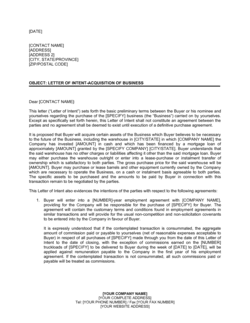
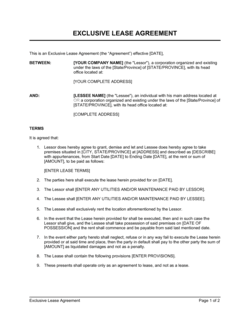
Offer to Purchase Real Estate Property Template

Free Word download β€’ Edit online β€’ Save & share with Drive β€’ Export to PDF

5 pagesβ€’20–30 min to fillβ€’Difficulty: Standard
Learn more ↓
FreeOffer to Purchase Real Estate Property Template

At a glance

What it is
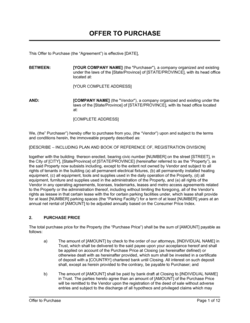
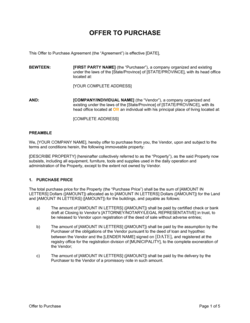
An Offer to Purchase Real Estate Property is a formal written letter a buyer submits to a seller to propose the terms under which they will purchase a specific property. This free Word download covers purchase price, deposit amount, financing contingency, conditions, closing date, and offer expiry β€” and becomes a binding agreement of purchase and sale if the seller accepts it as drafted.
When you need it
Use it when you have identified a property you want to buy and need to submit a formal, written offer to the seller or their agent. It is appropriate for residential, commercial, and investment property purchases at any price point.
What's inside
Property description and legal address, proposed purchase price and deposit schedule, financing contingency, conditions precedent (home inspection, title review), proposed closing date, inclusions and exclusions, and an offer expiry clause that protects the buyer's timeline.

What is an Offer to Purchase Real Estate Property?

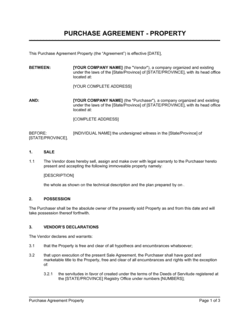
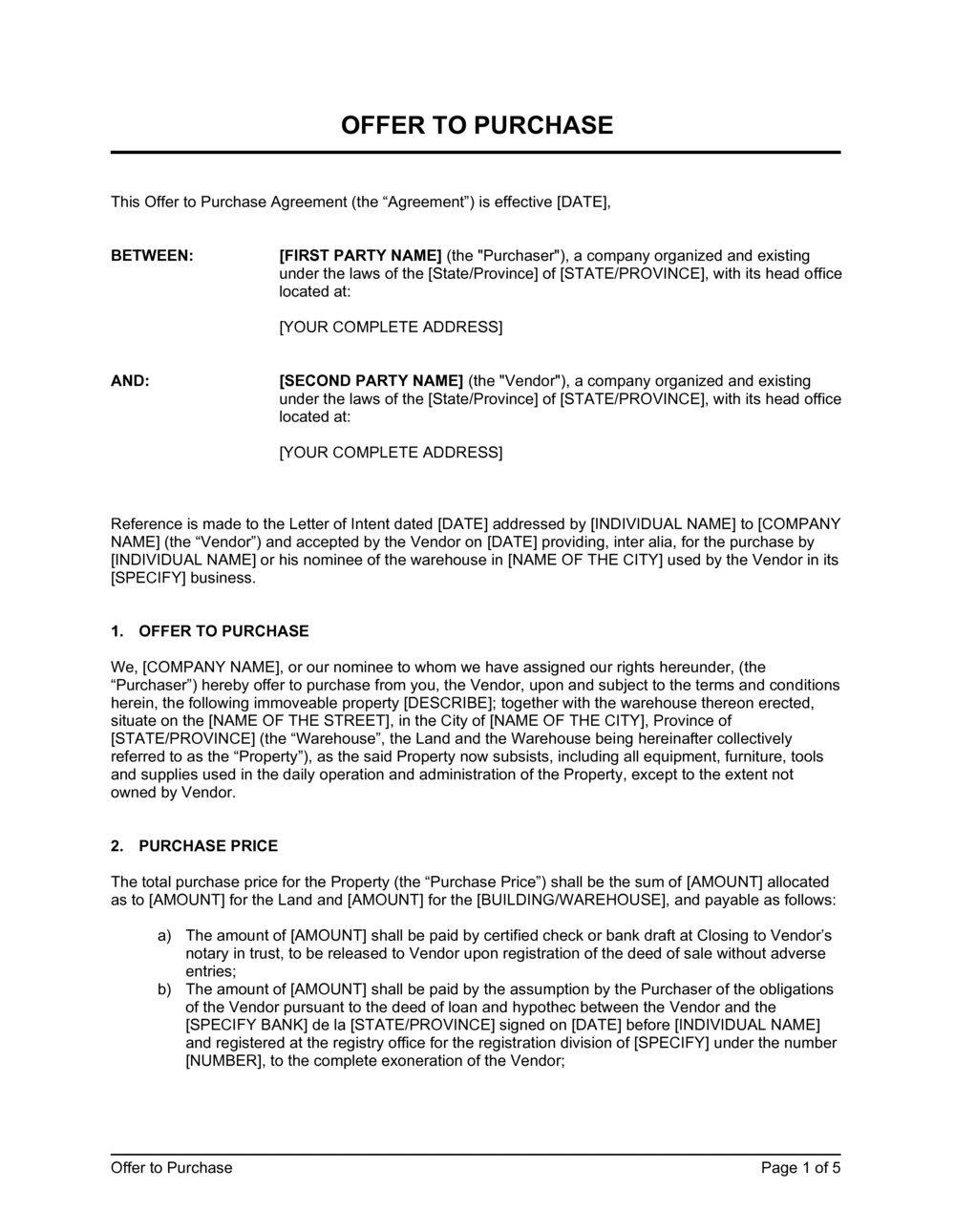
An Offer to Purchase Real Estate Property is a formal written document a buyer submits to a seller to propose the specific price and terms under which they will acquire a defined parcel of real property. It states the purchase price, deposit amount and trust holder, financing contingency, conditions precedent (such as a satisfactory home inspection), inclusions and exclusions, closing date, and the irrevocability window within which the seller must respond. Unlike an informal expression of interest, a properly drafted offer to purchase is designed so that seller acceptance without modification converts it directly into a binding agreement of purchase and sale β€” making every clause consequential before it is signed.

Why You Need This Document

Submitting a verbal or loosely worded offer exposes you to disputes on every material term: the seller claims the chandelier was never included, the closing date was never firm, or the financing condition had already expired. Without a written offer, you also have no mechanism to enforce the seller's acceptance or recover your deposit if the deal collapses. A clear, complete offer to purchase establishes the exact record both parties agreed to, protects your deposit through defined trust and refund provisions, and limits your liability through financing and inspection conditions that allow a clean exit if circumstances change. This template gives you the clause structure that real estate transactions require β€” formatted for immediate use, editable in Word, and ready to submit in under 30 minutes.

Which variant fits your situation?

If your situation is…Use this template
Purchasing a residential home or condoOffer to Purchase Real Estate Property
Buying vacant land or an undeveloped lotLand Purchase Offer Letter
Acquiring a commercial property for business useCommercial Real Estate Offer Letter
Formalizing terms after verbal agreement between private partiesReal Estate Purchase Agreement
Making a conditional offer pending sale of a current propertyConditional Offer to Purchase
Counter-offering a seller's price or termsReal Estate Counter Offer Letter
Withdrawing a previously submitted offer before acceptanceOffer Withdrawal Letter

Common mistakes to avoid

❌ Missing legal property description

Why it matters: An offer identified only by civic address can be challenged if the address is disputed, the lot has been subdivided, or the registry records differ from the street address. The offer may be unenforceable against the correct parcel.

Fix: Pull the legal description from the land registry or title deed and insert it verbatim alongside the civic address before submitting the offer.

❌ No financing contingency deadline

Why it matters: Without a specific date, the financing condition has no expiry β€” either party can argue the condition remains open indefinitely, blocking the transaction or trapping the buyer.

Fix: Set a specific calendar date for the financing condition that gives your lender at least 10–14 business days and falls well before the closing date.

❌ Omitting inclusions and relying on verbal assurances

Why it matters: Appliances, window coverings, and light fixtures that the seller described as 'staying' are legally theirs to remove unless the offer lists them explicitly. Post-closing disputes over inclusions are among the most common real estate complaints.

Fix: List every included item by description (make, model, or location) in the inclusions clause before submitting the offer.

❌ Setting an irrevocability period longer than 48 hours

Why it matters: A long irrevocability window allows the seller to use your written offer as leverage to solicit higher competing bids, leaving you exposed with no ability to withdraw or adjust your price.

Fix: Limit the irrevocability period to 24–48 hours. If the seller needs more time, they can request an extension β€” at that point you are negotiating, not waiting.

The 9 key clauses, explained

Property identification

In plain language: Identifies the property being purchased by its full civic address and legal description so there is no ambiguity about what is being sold.

Sample language
The Buyer hereby offers to purchase the property municipally known as [FULL ADDRESS], [CITY], [STATE/PROVINCE], [POSTAL CODE], legally described as [LEGAL DESCRIPTION] (the 'Property').

Common mistake: Using only the street address without the legal description. If the address is later disputed or contains a lot split, the offer cannot be matched to the correct parcel in land registry records.

Purchase price

In plain language: States the exact dollar amount the buyer is offering to pay, in figures and words, in the specified currency.

Sample language
The Buyer offers to purchase the Property for the sum of [PURCHASE PRICE IN WORDS] Dollars ($[PURCHASE PRICE IN FIGURES] [CURRENCY]).

Common mistake: Stating the price in figures only. Courts and registries have overturned transactions where a typo in figures conflicted with an unstated word amount β€” writing both prevents the ambiguity.

Deposit

In plain language: Specifies the deposit amount, when it is due, and who holds it in trust β€” typically the seller's agent or a lawyer β€” until closing.

Sample language
The Buyer shall deliver a deposit of $[DEPOSIT AMOUNT] by [METHOD] within [X] business days of acceptance, to be held in trust by [HOLDER] and applied to the purchase price on the closing date.

Common mistake: Omitting the trust holder's identity. Without a named trustee, a deposit dispute has no clear resolution mechanism and can delay or void the transaction.

Financing contingency

In plain language: Makes the offer conditional on the buyer obtaining mortgage financing on specific terms within a defined number of days β€” protects the buyer's deposit if financing falls through.

Sample language
This offer is conditional upon the Buyer arranging mortgage financing of not less than $[LOAN AMOUNT] at an interest rate not exceeding [X]% per annum, amortized over [X] years, on or before [DATE]. This condition is for the sole benefit of the Buyer.

Common mistake: Leaving the interest rate cap blank or too high. A vague financing contingency can be argued to be already satisfied, removing the buyer's ability to exit if their preferred lender declines.

Conditions precedent

In plain language: Lists any other conditions the buyer must satisfy β€” such as a satisfactory home inspection, review of a condominium status certificate, or sale of the buyer's existing property β€” along with their deadlines.

Sample language
This offer is further conditional upon the Buyer, at their own expense, obtaining a satisfactory home inspection report on or before [DATE]. If the condition is not satisfied, the Buyer may waive it in writing or this agreement shall be null and void.

Common mistake: Setting a condition deadline that falls after the closing date. When the condition timeline overlaps with or exceeds the closing date, the deal cannot close on schedule even if the condition is waived.

Inclusions and exclusions

In plain language: Lists specific fixtures, appliances, and chattels that are included in the purchase price or explicitly excluded from the sale.

Sample language
Included in the purchase price: [LIST OF INCLUSIONS β€” e.g., refrigerator, washer, dryer, window coverings]. Excluded from the purchase price: [LIST OF EXCLUSIONS β€” e.g., dining room chandelier, backyard playset].

Common mistake: Omitting the inclusions list entirely and assuming appliances are included. Sellers routinely remove items they consider personal property unless inclusions are stated in writing.

Closing date and possession

In plain language: Sets the exact date on which the transaction closes, the balance is paid, and the buyer takes physical possession of the property.

Sample language
This transaction shall be completed on [CLOSING DATE], at which time vacant possession of the Property shall be given to the Buyer unless otherwise agreed in writing.

Common mistake: Setting a closing date without accounting for lender processing times. Most mortgage lenders require at least 30 days from firm agreement to fund; a closing date set inside that window will default.

Irrevocability and offer expiry

In plain language: States the exact date and time by which the seller must accept the offer β€” after that time, the offer is void and the buyer is free to pursue other properties.

Sample language
This offer shall be irrevocable by the Buyer until [TIME] on [DATE], after which time, if not accepted, this offer shall be null and void and the deposit shall be returned without interest or deduction.

Common mistake: Setting an expiry window longer than 72 hours. A long irrevocability period lets the seller use the buyer's offer to shop for higher bids from competing buyers.

Governing law and notices

In plain language: Specifies the jurisdiction whose property laws govern the agreement and how formal notices between the parties must be delivered.

Sample language
This agreement shall be governed by the laws of [STATE/PROVINCE]. Notices shall be delivered in writing to the addresses set out herein, by email with read-receipt, personal delivery, or registered mail.

Common mistake: Omitting a notice clause entirely. Without it, a seller's verbal acceptance or a text message may be disputed as an insufficient response, leaving the acceptance status legally unclear.

How to fill it out

  1. 1

    Insert the full property description

    Enter the complete civic address and the legal description exactly as it appears on the current title deed or land registry record. Both are required to unambiguously identify the parcel.

    πŸ’‘ Request the legal description from the seller's agent or pull it from your county or provincial land registry online β€” do not rely on a tax assessment notice, which sometimes uses an abbreviated description.

  2. 2

    State the purchase price in figures and words

    Enter your offer amount numerically and spell it out in full words in the designated fields. Confirm the currency, particularly for cross-border purchases.

    πŸ’‘ Round numbers ($450,000 rather than $449,750) are easier to defend in a counter-offer negotiation and signal a straightforward buyer.

  3. 3

    Set the deposit amount and trustee

    Enter the deposit amount (typically 1–5% of the purchase price for residential property), the payment method, the number of business days after acceptance, and the full name of the trust holder.

    πŸ’‘ A higher deposit signals stronger buyer commitment and can tip a seller's decision in a competitive offer situation β€” but confirm you have the funds liquid before committing.

  4. 4

    Complete the financing contingency

    Enter the minimum loan amount, maximum interest rate, amortization period, and the date by which financing must be arranged. The date should give your lender at least 10–14 business days from the offer date.

    πŸ’‘ Get a pre-approval letter from your lender before submitting the offer β€” it lets you set a tighter financing condition deadline, which makes the offer more attractive to sellers.

  5. 5

    List all conditions with specific deadlines

    Add each condition (home inspection, status certificate, sale of existing property) on its own line with a firm calendar date for satisfaction or waiver.

    πŸ’‘ Book your home inspector before submitting the offer so you can set a realistic inspection deadline β€” inspectors in hot markets book 5–7 days out.

  6. 6

    Specify inclusions and exclusions

    Walk through the property mentally (or with your notes from the showing) and list every appliance and fixture you expect to be included. Add exclusions for anything the seller mentioned they were taking.

    πŸ’‘ When in doubt, include it. It is easier to remove an inclusion the seller objects to during negotiation than to add one they have already packed.

  7. 7

    Set the closing date and irrevocability expiry

    Choose a closing date at least 30–45 days from your expected firm agreement date to allow for lender funding. Set the irrevocability to 24–48 hours from the time of submission.

    πŸ’‘ Align your closing date with your current lease expiry or existing mortgage maturity where possible β€” avoids double-carrying costs.

Frequently asked questions

What is an offer to purchase real estate?

An offer to purchase real estate is a formal written document a buyer submits to a seller proposing the specific price and terms under which they will buy a property. It covers the purchase price, deposit, financing conditions, closing date, and offer expiry. When the seller accepts it without changes, it typically becomes a binding agreement of purchase and sale β€” making accurate drafting critical before submission.

Does an offer to purchase need to be in writing?

In virtually all jurisdictions, an agreement to purchase real property must be in writing to be legally enforceable β€” oral agreements to buy land are generally void under statutes of frauds that exist in every US state, Canadian province, and most common-law countries. A written, signed offer also protects the buyer by creating a clear record of the terms both parties agreed to.

What is the difference between an offer to purchase and a purchase agreement?

An offer to purchase is the buyer's proposal β€” it states what the buyer is willing to pay and under what conditions. A purchase agreement (or agreement of purchase and sale) is the binding contract formed when the seller accepts the offer as drafted. In many transactions, the offer to purchase template is drafted so that seller acceptance converts it automatically into the binding purchase agreement without a separate document.

How much deposit should I include in a real estate offer?

For residential properties, deposits typically run 1–5% of the purchase price in North America. A higher deposit signals stronger buyer intent and can be a decisive factor when a seller is weighing multiple offers. The deposit is held in trust and applied to the purchase price at closing β€” it is not an additional cost. Confirm you have the funds liquid and accessible before committing to a deposit amount in the offer.

What conditions should I include in a real estate offer?

The most common conditions are: financing (securing a mortgage on acceptable terms), home inspection (satisfactory report within a set number of days), title search (clear title with no liens or encumbrances), and β€” for condominiums β€” review of the status certificate or HOA documents. Each condition should have a specific calendar deadline and specify that it is for the buyer's sole benefit so only the buyer can waive it.

What happens if the seller does not respond before the offer expiry?

If the seller neither accepts, rejects, nor counters the offer before the irrevocability expiry time, the offer becomes null and void automatically. The buyer is released from any obligation and the deposit β€” if already paid β€” must be returned in full without deduction or interest. The buyer is then free to submit offers on other properties without restriction.

Can the seller change the terms of my offer?

Yes β€” a seller who wants to alter any term (price, closing date, inclusions, conditions) must issue a counter-offer, which voids the original offer and starts a new irrevocability period. At that point the buyer can accept, reject, or counter again. There is no binding agreement until both parties accept identical terms without modification.

Do I need a real estate agent to submit an offer to purchase?

No β€” buyers can submit offers directly to the seller in a for-sale-by-owner transaction. A well-structured template handles the essential terms. However, in competitive markets or complex transactions (commercial property, multi-unit, estate sales), a real estate lawyer or agent review of the offer before submission reduces the risk of enforceable errors. A lawyer review typically costs $300–$600 and is worthwhile for any purchase above $300,000.

How this compares to alternatives

vs Real Estate Purchase Agreement

A purchase agreement is the fully negotiated, binding contract executed after both parties have agreed on all terms. An offer to purchase is the buyer's opening proposal β€” it becomes the purchase agreement only when the seller accepts without changes. For simple transactions, a well-drafted offer to purchase serves both functions simultaneously.

vs Letter of Intent (Real Estate)

A letter of intent signals buyer interest and outlines high-level terms but is explicitly non-binding β€” it invites negotiation rather than creating an obligation. An offer to purchase is binding upon acceptance and sets specific, enforceable conditions. Use a letter of intent for commercial properties where due diligence precedes a formal offer; use an offer to purchase when you are ready to commit.

vs Counter Offer Letter

A counter offer is the seller's response when they want to change one or more terms of the buyer's original offer β€” price, closing date, or conditions. Issuing a counter offer voids the original offer and creates a new irrevocability period. The offer to purchase is the starting document; counter offers are the negotiation responses that follow.

vs Lease Agreement

A lease agreement grants the right to occupy a property for a defined term in exchange for rent β€” it transfers no ownership. An offer to purchase initiates the transfer of ownership. If a buyer is considering whether to buy or lease commercial space, the two documents represent fundamentally different legal and financial commitments.

Industry-specific considerations

Residential real estate

Home inspection and financing contingencies are standard; inclusions lists cover appliances, fixtures, and window coverings in detail.

Commercial real estate

Environmental assessment conditions, zoning confirmation, and longer due-diligence windows of 30–60 days are typical additions to the standard clause set.

Real estate investment

Investors often submit multiple offers simultaneously with short irrevocability windows, and frequently waive inspection conditions to move faster than owner-occupant buyers.

Construction and development

Offers on development sites include conditions for rezoning approval, site plan approval, and geotechnical assessment, with condition periods of 60–180 days.

Template vs pro β€” what fits your needs?

PathBest forCostTime
Use the templateBuyers in straightforward residential or private-party transactions with standard financing and inspection conditionsFree20–30 minutes
Template + professional reviewFirst-time buyers, competitive multi-offer situations, or purchases above $300,000$300–$600 (real estate lawyer review)1–2 business days
Custom draftedCommercial acquisitions, development land, multi-unit investment properties, or cross-border purchases$800–$2,500+3–7 business days

Glossary

Offer to Purchase
A written proposal from a buyer to a seller stating the price and terms under which the buyer is willing to buy a specific property.
Purchase Price
The total amount the buyer proposes to pay for the property, excluding closing costs, taxes, and other transactional fees.
Deposit (Earnest Money)
A sum paid by the buyer at offer acceptance to demonstrate serious intent β€” typically held in trust and applied to the purchase price at closing.
Financing Contingency
A condition that makes the offer binding only if the buyer secures mortgage financing at or below a specified interest rate and loan amount within a set number of days.
Condition Precedent
A requirement that must be satisfied before the purchase obligation becomes firm β€” common examples include a satisfactory home inspection and clear title.
Closing Date
The agreed calendar date on which ownership transfers, the balance of the purchase price is paid, and the buyer takes possession of the property.
Irrevocability Period
The window of time β€” typically 24 to 72 hours β€” during which the buyer cannot withdraw the offer and the seller must either accept, reject, or counter.
Inclusions and Exclusions
Specific fixtures, appliances, or chattels that are explicitly included in or excluded from the sale price β€” e.g., refrigerator included, dining room chandelier excluded.
Title Search
A review of public records to confirm the seller holds clear, unencumbered ownership of the property and that no liens or disputes exist against it.
Adjustment Date
The date used to calculate the pro-rated split of property taxes, utilities, and condo fees between buyer and seller at closing.

Part of your Business Operating System

This document is one of 3,000+ business & legal templates included in Business in a Box.

  • Fill-in-the-blanks β€” ready in minutes
  • 100% customizable Word document
  • Compatible with all office suites
  • Export to PDF and share electronically

Create your document in 3 simple steps.

From template to signed document β€” all inside one Business Operating System.
1
Download or open template

Access over 3,000+ business and legal templates for any business task, project or initiative.

2
Edit and fill in the blanks with AI

Customize your ready-made business document template and save it in the cloud.

3
Save, Share, Send, Sign

Share your files and folders with your team. Create a space of seamless collaboration.

Save time, save money, and create top-quality documents.

β˜…β˜…β˜…β˜…β˜…

"Fantastic value! I'm not sure how I'd do without it. It's worth its weight in gold and paid back for itself many times."

Managing Director Β· Mall Farm
Robert Whalley
Managing Director, Mall Farm Proprietary Limited
β˜…β˜…β˜…β˜…β˜…

"I have been using Business in a Box for years. It has been the most useful source of templates I have encountered. I recommend it to anyone."

Business Owner Β· 4+ years
Dr Michael John Freestone
Business Owner
β˜…β˜…β˜…β˜…β˜…

"It has been a life saver so many times I have lost count. Business in a Box has saved me so much time and as you know, time is money."

Owner Β· Upstate Web
David G. Moore Jr.
Owner, Upstate Web

Run your business with a system β€” not scattered tools

Stop downloading documents. Start operating with clarity. Business in a Box gives you the Business Operating System used by over 250,000 companies worldwide to structure, run, and grow their business.

Start freeΒ Β·Β No credit card required