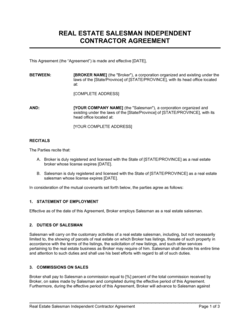
Real Estate Broker Job Description Template

Free Word download • Edit online • Save & share with Drive • Export to PDF

2 pages20–30 min to fillDifficulty: StandardSignature requiredLegal review recommended
Learn more ↓
FreeReal Estate Broker Job Description Template

At a glance

What it is
A Real Estate Broker Job Description is a formal document that defines the scope of a licensed broker's role within a brokerage, including duties, licensing and compliance requirements, commission structure, performance expectations, and reporting obligations. This free Word download gives you an editable, legally structured starting point you can tailor to your brokerage's specific needs and export as PDF for onboarding or employment purposes.
When you need it
Use it when hiring or onboarding a new licensed broker, formalizing an existing broker's role within your firm, or establishing written performance and compliance standards for all producing brokers on your team.
What's inside
Role identification, licensing and regulatory requirements, core duties and responsibilities, reporting structure, commission and compensation terms, performance expectations, confidentiality obligations, and termination conditions.

What is a Real Estate Broker Job Description?

A Real Estate Broker Job Description is a formal document that defines the scope, responsibilities, licensing requirements, compensation terms, and conduct standards of a licensed broker operating within a brokerage. Unlike a generic job posting, a signed broker job description creates enforceable obligations on both sides — establishing the commission split, production expectations, client confidentiality duties, non-solicitation restrictions, and termination procedures that govern the broker-brokerage relationship from day one. This free Word download gives managing brokers and brokerage owners a structured, legally grounded starting point they can customize and execute before the broker's first transaction.

Why You Need This Document

Operating without a signed broker job description exposes a brokerage to three specific and costly failure points. First, commission disputes: without a written split agreement, a departing broker can claim a verbal arrangement for a higher percentage — and courts frequently side with the broker when no written record exists. Second, in-escrow chaos: when a broker exits mid-transaction with no documented protocol, pending deals stall, clients lose representation, and the brokerage faces simultaneous claims from the client and the departing broker over who owns the file and the commission. Third, unenforceable non-solicitation: courts void clauses that are not tied to the broker's actual client relationships — meaning a poorly drafted or unsigned document provides zero protection when a broker leaves and calls your top clients the next morning. This template closes all three gaps in 20 minutes and provides the foundation for a legally sound broker-brokerage relationship from the first day of engagement.

Which variant fits your situation?

If your situation is…Use this template
Hiring a licensed associate broker who works under a managing brokerAssociate Real Estate Broker Job Description
Engaging a broker as an independent contractor rather than an employeeIndependent Contractor Agreement (Real Estate)
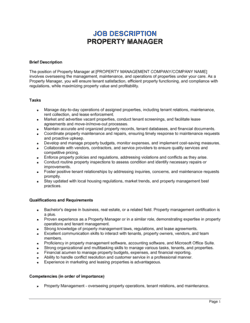
Defining a property manager's role within the brokerageProperty Manager Job Description
Hiring a real estate sales agent who does not hold a broker licenseReal Estate Sales Agent Job Description
Formalizing the managing broker's authority and oversight obligationsManaging Broker Employment Agreement
Documenting a dual-role broker who also handles leasingLeasing Agent Job Description
Creating a full employment contract to accompany the job descriptionEmployment Contract

Common mistakes to avoid

❌ Omitting license lapse as an immediate termination trigger

Why it matters: A broker whose license is suspended or revoked cannot legally represent clients. Every transaction they touch after lapse exposes the brokerage to regulatory sanctions and civil liability.

Fix: Add an explicit clause stating that license revocation, suspension, or lapse constitutes grounds for immediate termination without notice or severance, and require the broker to notify the brokerage within 24 hours of any license issue.

❌ Leaving commission split terms out of the job description

Why it matters: Commission disputes are the most litigated broker-brokerage issue. Without a written split agreement attached to or incorporated into the job description, the broker can claim a verbal agreement for a higher split.

Fix: State the exact commission split percentage, any production-based tiers, the payout timeline, and how splits are handled on deals that close after termination — all in the signed document.

❌ Using a trade name instead of the licensed legal entity

Why it matters: If the document names 'ABC Realty' but the licensed entity is 'ABC Realty LLC,' the job description may not be enforceable against the legal entity that holds the broker's license affiliation.

Fix: Verify the exact registered name with your state real estate commission and use that name verbatim in the parties section.

❌ No provision for in-escrow deals at termination

Why it matters: When a broker leaves mid-transaction, ownership of the file, client relationship, and earned commission becomes contested. Without a written protocol, deals fall through and the brokerage faces both client and broker claims simultaneously.

Fix: Include a clause specifying how commissions are split on pending transactions at the time of termination — for example, a pro-rated formula based on transaction stage — and who takes responsibility for seeing deals to close.

❌ Applying a one-size non-solicitation clause regardless of role

Why it matters: A non-solicitation clause covering every client in the brokerage's database is routinely found overbroad and unenforceable, voiding the protection entirely.

Fix: Limit non-solicitation to clients the broker personally represented or with whom the broker had direct contact during a defined lookback period — typically 24 months preceding separation.

❌ Not specifying who is responsible for E&O insurance

Why it matters: If both parties assume the other's policy applies and neither verifies, a claim against a broker with no active coverage leaves the brokerage as the only solvent defendant.

Fix: State explicitly whether coverage comes from the brokerage's master E&O policy or the broker's individual policy, confirm the limits in writing, and require an annual certificate of insurance.

The 10 key clauses, explained

Role Identification and Reporting Structure

In plain language: States the official job title, the brokerage entity employing or engaging the broker, and the person or role to whom the broker reports directly.

Sample language
Position Title: Licensed Real Estate Broker. Employer: [BROKERAGE LEGAL NAME], a [STATE] [ENTITY TYPE]. Reports to: [MANAGING BROKER NAME / TITLE]. Office Location: [OFFICE ADDRESS].

Common mistake: Listing the trade name instead of the brokerage's registered legal entity. If a licensing board audit or dispute arises, the document must match the licensed entity name on file.

Licensing and Regulatory Compliance Requirements

In plain language: Specifies the minimum license type required, the jurisdiction in which it must be active, continuing education obligations, and the broker's duty to maintain compliance with all applicable real estate laws.

Sample language
Broker shall hold an active [STATE] real estate broker license at all times during employment. Broker is responsible for completing [X] hours of continuing education per [PERIOD] as required by [STATE REAL ESTATE COMMISSION]. Broker shall comply with all applicable provisions of [STATE REAL ESTATE ACT] and NAR Code of Ethics.

Common mistake: Omitting continuing education obligations. A broker whose license lapses due to missed CE hours cannot legally transact — leaving the brokerage liable for any deals in progress.

Core Duties and Responsibilities

In plain language: Lists the broker's primary job functions — listing properties, representing buyers or sellers, negotiating transactions, drafting contracts, supervising agents, and maintaining client relationships.

Sample language
Broker's duties include: (a) listing residential and commercial properties on [MLS PLATFORM]; (b) representing buyers and sellers in purchase, sale, and lease transactions; (c) negotiating offers and counteroffers; (d) preparing and reviewing purchase agreements, listing agreements, and disclosure forms; (e) supervising and mentoring licensed sales agents as directed by [MANAGING BROKER].

Common mistake: Listing duties so narrowly that the broker cannot be directed to perform reasonable adjacent tasks — or so broadly that performance management becomes impossible because no specific expectation is set.

Commission Structure and Compensation

In plain language: Defines the commission split between broker and brokerage, any desk fees, bonus thresholds, and how and when commissions are paid out.

Sample language
Broker shall receive [X]% of the gross commission income on transactions closed by Broker. Commission payments shall be disbursed within [5] business days of brokerage receipt of funds. Desk fee of $[AMOUNT] per month is due on the [1st] of each month regardless of production.

Common mistake: Describing commission terms only in a verbal agreement or separate email rather than in the binding job description. Commission disputes are the leading source of broker-brokerage litigation.

Production Targets and Performance Expectations

In plain language: Sets measurable benchmarks for transaction volume or gross commission income the broker is expected to achieve, along with the review cadence and consequences for missing targets.

Sample language
Broker is expected to close a minimum of [X] transactions per [QUARTER / YEAR] or generate a minimum of $[AMOUNT] in gross commission income per [PERIOD]. Performance will be reviewed [QUARTERLY / ANNUALLY] by [MANAGING BROKER / HR].

Common mistake: Setting production targets without defining what happens if they are not met. Targets without stated consequences are unenforceable and create ambiguity at termination.

Client and Data Confidentiality

In plain language: Requires the broker to protect client personal information, transaction data, and brokerage proprietary information — including after the employment relationship ends.

Sample language
Broker shall not disclose or use any client personal information, transaction records, or Brokerage Confidential Information without prior written consent. This obligation survives termination of this Agreement for a period of [X] years.

Common mistake: Failing to define what constitutes 'Confidential Information.' Courts apply a reasonableness test — an overbroad definition can render the entire clause unenforceable.

Non-Solicitation of Clients and Agents

In plain language: Restricts a departing broker from soliciting the brokerage's clients or recruiting its agents for a defined period after leaving.

Sample language
For [12] months following separation, Broker shall not (a) solicit or accept business from any client with whom Broker had contact during the [24] months preceding separation, or (b) solicit, recruit, or induce any agent or employee of Brokerage to leave.

Common mistake: Using a client list sourced from the MLS — which is shared public infrastructure — as the basis for non-solicitation. Non-solicitation is most defensible when limited to clients the broker personally cultivated through brokerage resources.

Errors and Omissions Insurance Obligations

In plain language: Specifies whether the brokerage or broker is responsible for maintaining E&O coverage, the minimum coverage amount required, and the obligation to provide certificates of insurance.

Sample language
Broker shall maintain Errors and Omissions insurance with minimum coverage of $[AMOUNT] per occurrence and $[AMOUNT] aggregate. Broker shall provide Brokerage with a certificate of insurance within [10] days of hire and upon each renewal.

Common mistake: Assuming the brokerage's master E&O policy automatically covers all brokers. Many policies exclude independent contractors or brokers with prior claims — leaving gaps in coverage that expose both parties.

Termination, Notice, and License Portability

In plain language: States the notice period required for voluntary or employer-initiated termination, immediate-termination triggers (e.g., license revocation), and the process for transferring the broker's license to another firm.

Sample language
Either party may terminate this Agreement with [30] days' written notice. Brokerage may terminate immediately upon revocation, suspension, or lapse of Broker's license. Upon termination, Broker shall transfer license affiliation within [X] business days and return all Brokerage property and client files.

Common mistake: No provision for license portability on termination. Without it, pending transactions can stall for weeks while the broker and brokerage dispute file ownership and commission splits on deals in escrow.

Governing Law and Dispute Resolution

In plain language: Specifies which jurisdiction's real estate and employment laws govern the agreement and how disputes — including commission claims — are resolved.

Sample language
This Agreement is governed by the laws of [STATE / PROVINCE]. Any dispute arising under this Agreement shall be resolved by binding arbitration administered by [AAA / JAMS / REALTOR ASSOCIATION ARBITRATION PANEL] in [CITY], except claims for injunctive relief or license-related regulatory proceedings.

Common mistake: Choosing a governing law that differs from the state where the broker is licensed and practicing. Real estate licensing laws are jurisdiction-specific and cannot be contracted around.

How to fill it out

  1. 1

    Enter the brokerage's registered legal entity name

    Use the full legal name under which the brokerage holds its real estate license — not a trade name or DBA. Include the entity type (LLC, corporation, partnership) and the state of formation.

    💡 Cross-reference the name against your state real estate commission's license lookup to confirm an exact match.

  2. 2

    Specify the license type and jurisdiction requirements

    Identify the specific broker license category required — associate broker, managing broker, or designated broker — and list the jurisdiction's CE hour requirements and renewal cycle.

    💡 If the broker operates in multiple states, list each jurisdiction's license requirement separately. Multi-state broker compliance is a common audit trigger.

  3. 3

    Define the reporting structure clearly

    Name the managing broker or supervisor the position reports to, not just a job title. If the brokerage has multiple offices, specify which office this role is assigned to.

    💡 In states that require a designated broker, confirm that person's name and license number are on file with the real estate commission before executing the document.

  4. 4

    Detail the commission split and desk fee structure

    Enter the exact commission split percentage, the payment timeline after deal closing, any production-based split tiers, and the monthly desk fee amount if applicable. State the currency.

    💡 If the split changes based on annual production milestones, include a table showing each threshold and corresponding split — vague 'tiered commission' language creates disputes.

  5. 5

    Set specific production targets with consequences

    Enter the minimum transaction count or gross commission income target per quarter or year. State explicitly whether missing the target triggers a performance review, a commission split change, or grounds for termination.

    💡 Targets that are too aggressive drive broker turnover; targets that are too low have no practical effect. Benchmark against your market's average closed transactions per active broker.

  6. 6

    Tailor the non-solicitation scope to the broker's actual client contact

    Limit non-solicitation to clients the broker personally represented through brokerage resources, not all clients in the brokerage's CRM. Set a duration of 12 months for most roles.

    💡 In California, non-solicitation of clients in real estate has been challenged under the same framework as non-competes. Have California agreements reviewed by a real estate attorney.

  7. 7

    Confirm E&O coverage and attach a certificate

    Specify whether the brokerage's master policy or the broker's individual policy provides coverage, the minimum limits, and when proof of insurance must be delivered.

    💡 Request the insurer's declarations page, not just a certificate — declarations confirm the policy actually covers real estate brokerage activities and lists exclusions.

  8. 8

    Sign before the broker's first active transaction

    Both parties must execute the agreement before the broker represents any client under the brokerage's license. Post-transaction signature raises consideration problems and leaves the brokerage without enforceable confidentiality and non-solicitation terms on any deals already in progress.

    💡 Use Business in a Box eSign to timestamp execution and store the countersigned copy in BIB Drive alongside the broker's license certificate.

Frequently asked questions

What is a real estate broker job description?

A real estate broker job description is a formal document that defines the duties, licensing requirements, commission structure, performance expectations, and compliance obligations of a licensed broker working within a brokerage. It functions both as an operational guide for the broker and as a binding record of agreed terms — covering everything from daily responsibilities and reporting structure to non-solicitation restrictions and termination conditions.

What should a real estate broker job description include?

At minimum it should cover: the brokerage's legal entity name and the broker's job title, active license requirements and continuing education obligations, core duties (listing, buyer and seller representation, contract preparation, agent supervision), commission split and desk fee terms, production targets, client confidentiality obligations, non-solicitation restrictions, E&O insurance requirements, termination notice and license portability provisions, and governing law. Missing commission or termination terms are the most common sources of disputes.

Is a real estate broker job description legally binding?

When signed by both parties, a job description that includes compensation terms, confidentiality obligations, and termination provisions is generally treated as a binding contract in most jurisdictions. Courts have enforced commission split terms and non-solicitation clauses found in signed broker job descriptions. The document should be executed before the broker's first transaction to ensure all restrictive covenants have adequate consideration.

What is the difference between a real estate broker and a real estate agent?

A real estate agent holds a salesperson license and must work under the supervision of a licensed broker. A broker has completed additional education and licensing requirements that allow them to operate independently, open their own brokerage, and supervise agents. Job descriptions for these two roles differ significantly in scope of authority, supervision obligations, and licensing requirements — using the wrong template for the wrong role creates compliance gaps.

Can a real estate broker be classified as an independent contractor?

Yes — many brokerages engage brokers as independent contractors rather than employees, particularly when the broker sets their own schedule, pays their own expenses, and is compensated entirely on commission. In that case, a separate independent contractor agreement typically accompanies or replaces the job description. Misclassifying an employee broker as a contractor triggers back-tax liability and benefit claims; the IRS and most state labor agencies apply a multi-factor test to make the determination.

What commission split is standard for a real estate broker?

Commission splits vary widely by market, production volume, and brokerage model. Traditional brokerages typically start at a 50/50 or 60/40 (broker/brokerage) split for new brokers, escalating to 70/30 or 80/20 as production increases. High-production brokers at independent firms sometimes negotiate 90/10 splits with a desk fee. Flat-fee and 100%-commission models are increasingly common at virtual brokerages. Whatever structure is agreed, it must be documented in writing before the broker's first transaction.

What happens to pending transactions when a real estate broker leaves a brokerage?

Without a written protocol, in-escrow transactions become contested — both the broker and brokerage may claim the commission, and the client may be left without clear representation. A well-drafted job description includes a clause defining how commissions on pending deals are split at termination (typically based on transaction stage), who is responsible for seeing deals to close, and how client files are transferred. Some state real estate commissions also have rules governing file retention that override any contractual provision.

Do non-solicitation clauses in real estate broker agreements hold up in court?

Non-solicitation clauses are generally more enforceable than non-competes in real estate, but they must be narrowly tailored to be upheld. Courts regularly void clauses that restrict contact with all brokerage clients rather than just those the broker personally served. A restriction limited to clients the broker directly represented, lasting 12 months, is typically the outer limit of what courts will enforce. California applies especially strict scrutiny and requires careful drafting.

Does a real estate broker job description need to be reviewed by a lawyer?

For a straightforward associate broker hire at a single-office, single-state brokerage, a high-quality template is often sufficient. Legal review is advisable when hiring a managing or designated broker with supervisory authority, when the broker will operate across multiple jurisdictions, when significant E&O exposure exists, or when the commission structure includes equity, profit-sharing, or complex tiered arrangements. A 1–2 hour review by a real estate attorney typically costs $300–$600 and is worthwhile for senior hires.

How this compares to alternatives

vs Independent Contractor Agreement (Real Estate)

An independent contractor agreement governs the engagement of a broker as a self-employed professional rather than an employee — no benefits, no tax withholding, and the broker controls their own schedule. A job description assumes an employment relationship with supervision and set performance expectations. Misclassifying an employee broker as a contractor triggers back-tax and benefit liability; use the right template for the actual relationship.

vs Real Estate Agent Job Description

A real estate agent job description covers a salesperson who must work under broker supervision and cannot operate independently. A broker job description includes the additional authority, supervisory duties, and licensing requirements that distinguish a broker from an agent. Using an agent template for a broker hire leaves supervision obligations and compliance duties undocumented.

vs Employment Contract

An employment contract governs the full legal relationship between employer and employee — including IP assignment, severance, and detailed termination terms. A job description focuses on role scope, duties, and compensation, and is typically incorporated by reference into the employment contract. For senior broker hires, both documents should be executed together.

vs Property Manager Job Description

A property manager job description covers ongoing asset management — tenant relations, maintenance coordination, rent collection, and financial reporting — rather than transaction brokerage. Some brokers also perform property management duties, but the two roles carry different licensing requirements, liability exposures, and compensation structures that warrant separate documents.

Industry-specific considerations

Residential Real Estate

Buyer and seller representation, MLS compliance, open house obligations, and disclosure form requirements are central to the duties clause.

Commercial Real Estate

Lease negotiation, tenant representation, and complex deal structures require production targets expressed in dollar volume rather than transaction count.

Property Management

Brokers in property management roles carry dual responsibilities for leasing and asset oversight, requiring separate duty schedules and distinct commission and fee structures.

Real Estate Franchise Networks

Franchise systems often mandate standardized job descriptions that incorporate brand standards, franchisor code-of-conduct obligations, and approved commission split ranges.

Jurisdictional notes

United States

Real estate broker licensing is regulated at the state level — requirements vary significantly across the 50 states. Most states require a minimum number of hours as a licensed salesperson before qualifying for a broker license, and mandate continuing education for renewal. Non-solicitation clauses are generally enforceable if narrowly scoped, but California, Minnesota, and North Dakota apply strict scrutiny. Dual-agency rules differ by state; some require written consent, others prohibit it outright.

Canada

Real estate brokerage in Canada is provincially regulated. In Ontario, the Real Estate and Business Brokers Act (REBBA) governs broker conduct and mandates written agreements for broker-brokerage relationships. British Columbia's Real Estate Services Act requires brokers to be registered with the BC Financial Services Authority. Quebec requires all brokerage contracts to be in French for provincially regulated firms. Commission-split disputes are adjudicated by provincial real estate councils, not courts, in most provinces.

United Kingdom

The UK does not require a statutory license to act as an estate agent, but the Estate Agents Act 1979 and the Consumer Protection from Unfair Trading Regulations 2008 impose significant conduct obligations. Brokers who handle client funds must comply with anti-money laundering regulations under the Money Laundering, Terrorist Financing and Transfer of Funds Regulations 2017. Membership in a redress scheme (Property Ombudsman or Property Redress Scheme) is legally required. Non-solicitation clauses are enforceable if reasonable in scope and duration.

European Union

Real estate brokerage regulation varies substantially across EU member states — Germany, France, and the Netherlands each impose distinct licensing, registration, and conduct requirements. GDPR applies to all client data held by brokers and must be referenced in confidentiality provisions; data retention policies for client transaction records must comply with national GDPR implementation. Several member states require brokers to hold professional indemnity insurance as a condition of practice. Non-solicitation enforceability is generally recognized but must comply with national employment law.

Template vs lawyer — what fits your deal?

PathBest forCostTime
Use the templateSingle-office brokerages hiring associate brokers in a single US state or Canadian provinceFree20–30 minutes
Template + legal reviewMulti-state operations, managing broker hires with supervisory authority, or complex commission arrangements$300–$6001–3 days
Custom draftedDesignated broker agreements, equity-sharing arrangements, franchise compliance, or cross-border broker engagements$1,000–$3,500+1–2 weeks

Glossary

Licensed Broker
A real estate professional who has passed a state or provincial licensing exam qualifying them to supervise agents, operate a brokerage, and transact real estate independently.
Managing Broker
The licensed broker designated to oversee day-to-day operations of a brokerage office and ensure compliance with real estate laws and regulations.
Associate Broker
A broker who holds a broker license but works under the supervision of a managing broker rather than operating an independent brokerage.
Commission Split
The agreed percentage division of a transaction commission between the brokerage and the individual broker, typically ranging from 50/50 to 90/10 depending on production volume and seniority.
Fiduciary Duty
A legal obligation requiring the broker to act in the best interests of the client — including duties of loyalty, disclosure, confidentiality, obedience, and accountability.
MLS (Multiple Listing Service)
A shared database of property listings that licensed brokers and agents access to list properties and find buyer opportunities in a given market.
NAR Code of Ethics
The National Association of Realtors' enforceable standards of professional conduct governing members' dealings with clients, the public, and other real estate professionals.
Dual Agency
A situation where a single broker or brokerage represents both the buyer and seller in the same transaction — heavily regulated or prohibited in several jurisdictions.
Errors and Omissions Insurance (E&O)
Professional liability coverage protecting brokers against claims arising from mistakes, misrepresentations, or omissions made in the course of providing real estate services.
Desk Fee
A flat monthly fee paid by a broker to the brokerage in exchange for office resources and operating support, often used in lieu of a commission split arrangement.
Production Target
A defined minimum transaction volume or gross commission income the broker is expected to generate within a specified period, used as a performance benchmark.

Part of your Business Operating System

This document is one of 3,000+ business & legal templates included in Business in a Box.

  • Fill-in-the-blanks — ready in minutes
  • 100% customizable Word document
  • Compatible with all office suites
  • Export to PDF and share electronically

Create your document in 3 simple steps.

From template to signed document — all inside one Business Operating System.
1
Download or open template

Access over 3,000+ business and legal templates for any business task, project or initiative.

2
Edit and fill in the blanks with AI

Customize your ready-made business document template and save it in the cloud.

3
Save, Share, Send, Sign

Share your files and folders with your team. Create a space of seamless collaboration.

Save time, save money, and create top-quality documents.

★★★★★

"Fantastic value! I'm not sure how I'd do without it. It's worth its weight in gold and paid back for itself many times."

Managing Director · Mall Farm
Robert Whalley
Managing Director, Mall Farm Proprietary Limited
★★★★★

"I have been using Business in a Box for years. It has been the most useful source of templates I have encountered. I recommend it to anyone."

Business Owner · 4+ years
Dr Michael John Freestone
Business Owner
★★★★★

"It has been a life saver so many times I have lost count. Business in a Box has saved me so much time and as you know, time is money."

Owner · Upstate Web
David G. Moore Jr.
Owner, Upstate Web

Run your business with a system — not scattered tools

Stop downloading documents. Start operating with clarity. Business in a Box gives you the Business Operating System used by over 250,000 companies worldwide to structure, run, and grow their business.

Free Forever Plan · No credit card required