Worksheet_Termination of Employment

Free download • Use as a template • Print or share

2 pages20–30 min to useDifficulty: StandardSignature requiredLegal review recommended
Learn more ↓
FreeWorksheet_Termination of Employment Template

At a glance

What it is
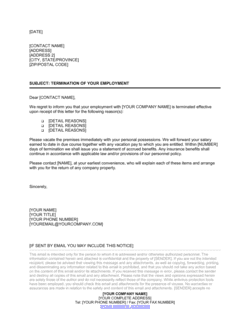
A Worksheet Termination of Employment is a structured legal document that records every material detail of an employee separation — the reason for termination, final pay calculation, benefits continuation, equipment return, and acknowledgment of ongoing confidentiality obligations. This free Word download gives HR teams and business owners a consistent, defensible record of each separation that you can edit online and export as PDF for signing and filing.
When you need it
Use it any time an employment relationship ends — whether by resignation, layoff, performance-based dismissal, or end of a fixed-term contract. It is especially critical when terminating for cause, where a documented paper trail directly supports the employer's position if a wrongful dismissal claim follows.
What's inside
Employee and employer details, termination date and reason, final pay and outstanding wages calculation, benefits and COBRA or continuation coverage notice, equipment and access return checklist, severance terms, confidentiality and non-disparagement reminders, and dual signatures confirming the employee has received all required notices.

What is a Worksheet Termination of Employment?

A Worksheet Termination of Employment is a structured legal document that records every material detail of an employee separation in a single, signed record. It covers the reason for the termination, the effective date, final pay calculations including accrued vacation and outstanding commissions, benefits continuation options and required statutory notices, company equipment and system access return, any applicable severance conditioned on a release, and the employee's acknowledgment that post-employment confidentiality and non-solicitation obligations remain in force. Unlike a termination letter, which communicates the decision, this worksheet documents the full administrative and legal offboarding process — creating the contemporaneous evidence an employer needs if a wrongful dismissal, wage-and-hour, or discrimination claim follows.

Why You Need This Document

Employment separations without consistent documentation are among the most common and costly legal exposures small businesses and HR teams face. A missing final pay record, an undocumented COBRA notice, or an asset-return dispute that was never written down can each become the basis of a separate statutory violation — compounding penalties well beyond any underlying claim. When a terminated employee alleges wrongful dismissal, the employer's entire defense rests on paper: disciplinary records, notice documentation, and the separation worksheet that ties them together. Without it, the employer's account of events is contested oral testimony against the employee's. This template gives HR teams and business owners a consistent, legally sound process for every separation — voluntary or involuntary — so that the paper trail exists before it is ever needed.

Which variant fits your situation?

If your situation is…Use this template
Terminating an employee for documented performance or conduct issuesTermination for Cause Letter
Laying off employees due to business restructuring or cost reductionEmployee Layoff Letter
Accepting a voluntary resignation and documenting the separationEmployee Resignation Acceptance Letter
Ending a fixed-term or contract employment at the agreed end dateEnd of Contract Notice
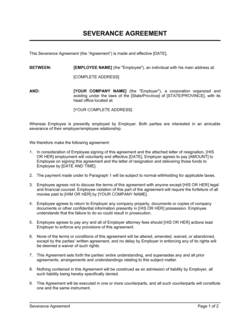
Providing severance terms and a release of claims at separationSeverance Agreement and Release
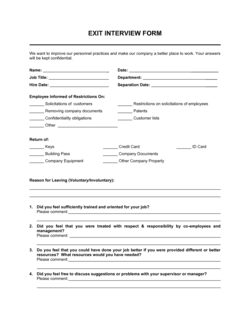
Conducting a formal exit interview alongside the termination processExit Interview Form
Notifying the employee of continued confidentiality obligations after separationPost-Employment Confidentiality Reminder Letter

Common mistakes to avoid

❌ Conflating last day worked with legal termination date

Why it matters: Final pay deadlines, COBRA qualification dates, and benefit end dates all trigger from the legal termination date. Using the wrong date can create statutory violations across multiple compliance areas simultaneously.

Fix: Define both dates explicitly in the worksheet and confirm each downstream deadline — final pay, COBRA notice, benefits end — against the correct trigger date.

❌ Skipping the equipment and IT access checklist

Why it matters: A former employee with active system credentials or unreturned assets is an ongoing data security risk and a potential liability if confidential information is accessed or disclosed after separation.

Fix: Complete the asset and access section before the signing meeting, verify physical returns in person, and document the IT access revocation with a timestamp from your IT administrator.

❌ Paying severance without a signed release

Why it matters: Severance paid without a valid release gives the employee full compensation while leaving the employer exposed to wrongful dismissal, discrimination, or wage-and-hour claims.

Fix: Make the worksheet's severance block conditional on execution of a separate Severance Agreement and Release, and withhold payment until the release is signed and any applicable revocation period has passed.

❌ Missing COBRA or benefits continuation notice deadlines

Why it matters: Under ERISA, late COBRA notice carries penalties of up to $110 per day per qualified beneficiary, plus exposure to the cost of any medical claims incurred during the gap in coverage.

Fix: Record the COBRA notice deadline date directly on the worksheet and assign a named HR contact responsible for mailing it within 14 days of the qualifying event.

❌ Using inflammatory language in the termination reason field

Why it matters: Phrases like 'gross incompetence' or 'dishonest conduct' in a form document become exhibits in litigation and can make a defensible termination look punitive or pretextual.

Fix: Limit the reason field to a factual category plus a neutral phrase referencing the supporting file — e.g., 'Performance — see PIP file reference HR-2026-042.'

❌ Not providing the employee time to review before signing

Why it matters: A worksheet signed under time pressure or on the spot can be challenged as signed under duress, undermining the enforceability of the confidentiality reminder and any attached release.

Fix: Provide the completed worksheet at least 24 hours before the signing meeting, and for any document that includes or references a release, allow the statutory review period required by jurisdiction.

The 9 key clauses, explained

Employee and Employer Identification

In plain language: Records the full legal names of both parties, the employee's job title, department, and employee ID, and the employer's registered entity name and location.

Sample language
This Termination Worksheet documents the separation of [EMPLOYEE FULL NAME], [JOB TITLE], Employee ID [NUMBER], Department [DEPARTMENT], from [EMPLOYER LEGAL NAME], a [STATE/PROVINCE] [ENTITY TYPE], effective [TERMINATION DATE].

Common mistake: Using a manager's name or trade name instead of the registered legal entity. If the entity name does not match payroll records, the document may be challenged as referring to a different employer.

Termination Date and Effective Date

In plain language: Specifies the last day of active employment and distinguishes it from any paid notice or garden-leave period, clarifying exactly when employment ends for benefit and pay purposes.

Sample language
Employee's last day of active work is [LAST WORKING DAY]. Employment terminates effective [TERMINATION DATE]. The period [LAST WORKING DAY] to [TERMINATION DATE] constitutes paid notice / garden leave / [OTHER ARRANGEMENT].

Common mistake: Conflating the last day worked with the legal termination date. In jurisdictions that calculate benefits continuation or severance from the termination date, an ambiguous date exposes the employer to overpayment or compliance failure.

Reason for Termination

In plain language: States the category of separation — termination for cause, termination without cause, layoff, resignation, or end of fixed term — and provides a brief factual basis for the decision.

Sample language
The reason for separation is: [ ] Termination for Cause — [BRIEF DESCRIPTION OF CONDUCT] [ ] Termination Without Cause / Layoff [ ] Voluntary Resignation [ ] End of Fixed-Term Contract on [DATE].

Common mistake: Writing a detailed narrative of misconduct directly on the worksheet. Detailed narratives belong in a separate disciplinary record — putting them here creates discovery risk if litigation follows.

Final Pay Calculation

In plain language: Itemizes all outstanding wages, accrued but unused vacation or PTO, commissions, bonuses, and any authorized deductions, along with the method and timing of the final payment.

Sample language
Final Pay Components: Base wages through [DATE]: $[AMOUNT] | Accrued vacation ([X] days at $[DAILY RATE]): $[AMOUNT] | Commission earned through [DATE]: $[AMOUNT] | Authorized deductions: $[AMOUNT] | Total Final Pay: $[AMOUNT] | Payment method: [Check / Direct Deposit] by [DATE].

Common mistake: Failing to pay out accrued vacation where state or provincial law requires it. Several jurisdictions treat accrued vacation as earned wages — withholding it triggers penalties separate from any wrongful dismissal claim.

Severance Terms

In plain language: Records whether severance is offered, the amount and payment schedule, and the condition (typically a signed release of claims) required before severance is paid.

Sample language
Employer agrees to provide severance of $[AMOUNT], equivalent to [X] weeks' base salary, payable [in a lump sum / bi-weekly] beginning [DATE], conditioned upon Employee's execution of the Severance Agreement and Release attached hereto.

Common mistake: Paying severance without obtaining a signed release. Without a valid release, the employer pays severance and retains full exposure to legal claims — defeating the primary commercial purpose of offering severance.

Benefits Continuation Notice

In plain language: Documents the status of each benefit at separation — health, dental, vision, life insurance, and retirement — and the employee's options for continuation coverage and the relevant deadlines.

Sample language
Health/Dental/Vision coverage ends [DATE]. Employee is eligible for COBRA continuation coverage for up to [18] months; election notice will be mailed to [ADDRESS] within [14] days. 401(k) balance of approximately $[AMOUNT] may be rolled over; plan administrator contact: [NAME / PHONE].

Common mistake: Omitting COBRA or equivalent notice deadlines. In the US, employers must provide COBRA election notice within 14 days of a qualifying event; late notice carries per-day penalties under ERISA.

Equipment, Access, and Asset Return

In plain language: Lists all company property the employee must return, confirms the return date, and records the revocation of system access credentials and physical access.

Sample language
Employee confirms return of: [ ] Laptop (Asset Tag [NUMBER]) [ ] Mobile device [ ] Access badge [ ] Company vehicle [ ] Other: [DESCRIPTION]. IT access revoked on [DATE] by [IT CONTACT]. Unreturned property will be subject to recovery under applicable law.

Common mistake: Not specifying IT access revocation in the worksheet. A checklist that covers physical assets but omits system access leaves former employees with active credentials — a data security and confidentiality risk.

Confidentiality and Non-Disparagement Reminder

In plain language: Confirms that post-employment confidentiality, non-solicitation, and any applicable non-compete obligations from the original employment contract survive the separation and remain in full force.

Sample language
Employee acknowledges that the confidentiality, non-solicitation, and [non-compete] obligations in the Employment Agreement dated [DATE] survive termination and remain in full force and effect. Employee agrees not to make disparaging public statements about [EMPLOYER NAME] or its officers.

Common mistake: Treating this clause as optional for 'friendly' separations. Even amicable departures create risk if an employee later joins a competitor or makes public statements — the reminder clause preserves the employer's ability to enforce existing obligations.

Employee Acknowledgment and Signature

In plain language: Confirms that the employee has received all required notices, understands the terms of separation, and has been given the opportunity to ask questions or consult legal counsel before signing.

Sample language
Employee acknowledges receipt of this Worksheet, all required statutory notices, and final pay as described above. Employee has had the opportunity to review this document and ask questions before signing. Employee Signature: _______________ Date: _______________.

Common mistake: Pressuring the employee to sign on the last day of work without allowing review time. Courts scrutinize documents signed under duress — allowing even 24–48 hours for review strengthens enforceability, particularly for attached releases.

How to fill it out

  1. 1

    Enter both parties' legal details

    Fill in the employer's full registered legal entity name and the employee's legal name, job title, department, and employee ID number. Cross-reference your payroll records to confirm exact names match.

    💡 Pull the entity name from your state or provincial corporate registry filing — not your trade name or brand — to avoid document-matching problems in litigation.

  2. 2

    Set the last working day and legal termination date

    Enter the final day the employee is expected to work, then the legal termination date, noting whether the intervening period is paid notice, garden leave, or immediate separation. These dates drive benefit end dates and final pay deadlines.

    💡 In most US states, final pay is due on the last day worked for involuntary terminations — not the legal termination date. Confirm your state's specific deadline before completing this field.

  3. 3

    Select and document the termination reason

    Check the appropriate termination category and add a brief, factual phrase — not a narrative — describing the basis. Keep detailed misconduct records in a separate disciplinary file referenced by number.

    💡 Use neutral, factual language in the reason field. Inflammatory phrasing ('gross incompetence,' 'dishonest behavior') in a worksheet creates admissibility risk in arbitration or court.

  4. 4

    Calculate and itemize final pay

    Compute base wages through the last day, accrued vacation at the daily rate, any earned commissions or bonuses, and authorized deductions. State the total, payment method, and the specific payment date.

    💡 Confirm your state or provincial rules on accrued vacation payout — roughly 25 US states and all Canadian provinces treat it as earned wages that cannot be forfeited.

  5. 5

    Complete the severance block if applicable

    Enter the severance amount, payment schedule, and confirm it is conditioned on a signed release. Attach the separate Severance Agreement and Release document and cross-reference it here.

    💡 Employees over 40 in the US must receive 21 days to consider a release under the Older Workers Benefit Protection Act — note this on the worksheet if applicable.

  6. 6

    Document benefits status and COBRA or continuation deadlines

    For each benefit line, enter the coverage end date and the employee's continuation options. Confirm the COBRA or provincial equivalent notice will be sent within the required window and record who is responsible for sending it.

    💡 Calendar the COBRA notice deadline as a task in your HR system the moment you complete this section — the 14-day ERISA clock starts on the qualifying event date, not the mailing date.

  7. 7

    Complete the equipment and access return checklist

    List every company asset by description and asset tag, confirm the return date, and log IT access revocation with the date and the IT contact who executed it.

    💡 Conduct the equipment handover before the signing meeting so the employee can confirm returned items are checked off in real time — eliminating post-separation disputes about what was returned.

  8. 8

    Obtain signatures and distribute copies

    Have both the authorized employer representative and the employee sign and date the completed worksheet. Provide the employee with a copy immediately. File the original in the employee's HR record.

    💡 If the employee refuses to sign, note 'Employee declined to sign; copy provided on [DATE]' and have a witness countersign. An unsigned copy with a witnessed delivery note is still a valuable contemporaneous record.

Frequently asked questions

What is a termination of employment worksheet?

A termination of employment worksheet is a structured legal document that records all the key details of an employee separation — the reason for termination, final pay calculation, benefits status, equipment return, severance terms, and reminders of surviving post-employment obligations. It creates a contemporaneous, signed record of the separation that protects the employer in the event of a wrongful dismissal or wage-and-hour claim.

When should a termination worksheet be completed?

Complete the worksheet before the termination meeting so it is ready for the employee to review. For terminations for cause, finalize it after confirming the factual basis and consulting HR or legal counsel. For layoffs, complete it as part of the broader reduction-in-force process. Never present a blank or partially completed form for the employee to sign at the meeting.

Is a termination worksheet legally required?

No federal or provincial law in North America specifically mandates a termination worksheet by that name, but the underlying components — final pay notice, COBRA or continuation coverage notice, and written termination reasons in some jurisdictions — are individually required by various employment standards statutes. Using a worksheet satisfies multiple obligations in one document and creates a defensible record that standalone notices do not.

What is the difference between a termination letter and a termination worksheet?

A termination letter formally notifies the employee that employment is ending and states the reason and effective date. A termination worksheet is a more detailed operational document that covers final pay, benefits, equipment return, severance, and acknowledgment signatures. The two documents serve different purposes — the letter communicates the decision; the worksheet documents the full administrative and legal separation process. Many employers use both at the same meeting.

Does the employee have to sign the termination worksheet?

The employer cannot legally compel an employee to sign a termination worksheet. However, the employee's signature is strong evidence that they received required notices and understood the separation terms. If an employee refuses to sign, note the refusal on the document, have a witness countersign confirming that a copy was provided, and file the unsigned original in the personnel record. This process preserves nearly all the evidentiary value of the document.

What final pay rules apply when terminating an employee?

Final pay deadlines vary significantly by jurisdiction. In the US, most states require final pay on the last day of work for involuntary terminations — California, Colorado, and several others impose penalties for late payment. In Canada, employment standards acts require final pay within one pay period of termination in most provinces. In the UK, final pay is due on the employee's contractual pay date unless the contract provides otherwise. The worksheet should confirm the specific deadline and payment method to demonstrate compliance.

How long should employers retain a termination worksheet?

Retain completed termination worksheets for at least 3–7 years post-separation, depending on jurisdiction. In the US, the EEOC requires retention of personnel records for 1 year after termination, but state wage-and-hour statutes often extend this to 3–4 years, and ERISA benefit records require 6 years. In Canada and the UK, 6–7 years is the standard. Store both the signed original and any supporting disciplinary records in the same employee file.

Can a termination worksheet be used for voluntary resignations?

Yes — while the worksheet is most critical for involuntary terminations, using it consistently for all separations, including resignations, ensures that final pay, benefits continuation, and equipment return are documented every time. A consistent process also prevents claims that the employer only documented separations when a legal dispute was anticipated.

What happens if an employer fails to follow termination documentation procedures?

Inadequate documentation is one of the most common reasons employers lose wrongful dismissal, discrimination, and wage-and-hour claims. Without a contemporaneous record of the separation terms, final pay calculation, and notices provided, the employer's account of events rests on oral testimony alone — which courts and arbitrators weigh less favorably than signed documents. Penalties for specific compliance failures, such as late COBRA notice, accrue independently of any litigation outcome.

How this compares to alternatives

vs Termination Letter

A termination letter formally communicates the decision to end employment and states the effective date and reason. A termination worksheet is a broader administrative document covering final pay, benefits, equipment return, and signed acknowledgment. The letter tells the employee; the worksheet documents the full separation process for compliance and legal defense. Most employers should use both.

vs Severance Agreement and Release

A severance agreement is a stand-alone binding contract in which the employee waives legal claims in exchange for severance pay. The termination worksheet records the overall separation terms and references the severance agreement as an attached exhibit. The worksheet without a release does not prevent legal claims; the release without the worksheet leaves the broader separation undocumented.

vs Exit Interview Form

An exit interview form captures voluntary feedback about the employee's experience, reasons for leaving, and suggestions for improvement. It is a qualitative HR tool, not a legal document. The termination worksheet is a compliance and legal record. The two serve different purposes — the worksheet is required; the exit interview is optional and typically conducted only for voluntary separations.

vs Employee Disciplinary Action Form

A disciplinary action form documents individual incidents of misconduct or performance failure during employment and forms the foundation of a for-cause termination record. The termination worksheet references and incorporates those prior records at separation but does not replace them. Using a worksheet without prior disciplinary documentation weakens a for-cause termination defense.

Industry-specific considerations

Technology / SaaS

IT access revocation is especially time-sensitive given access to source code, customer data, and cloud infrastructure; the worksheet's access checklist is often the primary compliance driver.

Healthcare

HIPAA obligations survive termination; the worksheet must confirm revocation of system access to patient records and remind departing staff of ongoing PHI confidentiality requirements.

Financial Services

Regulatory licensing notifications (FINRA U5 filings, FCA notifications) must be coordinated alongside the standard separation process; the worksheet can reference these as parallel action items.

Professional Services

Client non-solicitation enforcement is particularly critical; the worksheet's confidentiality reminder clause anchors the employer's ability to seek injunctive relief if a departing professional approaches clients.

Retail / Hospitality

High turnover volume makes a standardized worksheet essential for consistent compliance across store managers who may lack formal HR training.

Manufacturing

Physical asset return — uniforms, safety equipment, tools, and access badges — is more complex than in office environments; the equipment checklist section requires customization for plant-specific assets.

Jurisdictional notes

United States

Final pay deadlines vary sharply by state — California requires same-day payment for involuntary terminations; Texas allows up to 6 days. At-will employment means no notice is required in most states, but WARN Act obligations apply for mass layoffs of 50+ employees. COBRA election notice must be sent within 14 days of a qualifying event under ERISA. Non-compete enforceability varies by state, with California, Minnesota, and Oklahoma effectively prohibiting most post-employment restrictions.

Canada

At-will employment does not exist in Canada. Each province's Employment Standards Act sets minimum notice or pay-in-lieu requirements based on years of service, which the termination worksheet must document. Ontario common-law reasonable notice can extend to 1 month per year of service for long-tenured employees, creating significant exposure if contractual notice falls short. Quebec-based employees must receive documents in French. Severance pay under the Ontario ESA applies separately from notice pay for employers with a payroll over $2.5M.

United Kingdom

Employees with 2 or more years of continuous service have statutory unfair dismissal protection; the termination process must follow a fair procedure under the ACAS Code of Practice, including investigation, disciplinary hearing, and right of appeal. Statutory minimum notice is 1 week per year of service after 2 years, capped at 12 weeks. Statutory redundancy pay applies to layoffs and is calculated at 0.5–1.5 weeks' pay per year of service depending on age. Post-employment non-compete clauses must be supported by separate consideration to be enforceable.

European Union

EU member states require written termination reasons and impose significant procedural protections; works council consultation is mandatory in many countries before individual or collective terminations. Notice periods and severance mandates differ widely — Germany, France, and Spain impose some of the most employee-protective regimes. GDPR requires that personal data processed during the termination be handled and retained in compliance with data minimization and purpose-limitation principles. Post-employment non-competes typically require financial compensation of 25–100% of salary, depending on the member state, to be enforceable.

Template vs lawyer — what fits your deal?

PathBest forCostTime
Use the templateStandard involuntary or voluntary separations for non-executive employees in a single jurisdictionFree30–60 minutes per separation
Template + legal reviewSenior employees, terminations for cause with litigation risk, or cross-border separations$300–$800 for a one-hour employment lawyer review1–3 days
Custom draftedExecutive separations with equity, non-compete enforcement, regulatory reporting requirements, or mass layoffs$1,500–$5,000+1–2 weeks

Glossary

Termination for Cause
Dismissal based on specific, documented employee misconduct, fraud, gross negligence, or serious policy violation — typically carrying no severance entitlement.
Termination Without Cause
Separation initiated by the employer for reasons unrelated to employee misconduct, such as restructuring or role elimination, which typically triggers notice or severance obligations.
Constructive Dismissal
A situation in which an employer unilaterally changes working conditions so significantly that the employee is effectively forced to resign, treated legally as an employer-initiated termination.
Final Pay
All wages, accrued vacation, and other earned compensation owed to the employee at the time of separation, required to be paid within deadlines set by applicable employment law.
Severance Pay
Compensation provided to a departing employee beyond final wages, either as a contractual obligation or as consideration for signing a release of claims.
COBRA / Benefits Continuation
In the US, COBRA allows terminated employees to continue employer-sponsored health coverage at their own cost for up to 18 months; equivalent continuation rules apply in Canada and the UK.
Release of Claims
A contractual waiver in which the employee agrees not to pursue legal action against the employer in exchange for severance or other consideration.
Notice Period
The minimum time an employer must give before a termination takes effect, set by contract or by statute in the applicable jurisdiction.
Garden Leave
A notice period during which the employee remains on payroll but is required to stay away from work, clients, and company systems to protect business interests.
At-Will Employment
An employment arrangement — common in most US states — that allows either party to end the relationship at any time for any lawful reason without advance notice.
Wrongful Dismissal
A claim by a former employee that the termination violated a contractual obligation, statutory right, or anti-discrimination law, often resulting in a demand for damages or reinstatement.

Part of your Business Operating System

This document is one of 3,000+ business & legal templates included in Business in a Box.

  • Fill-in-the-blanks — ready in minutes
  • 100% customizable Word document
  • Compatible with all office suites
  • Export to PDF and share electronically

Create your document in 3 simple steps.

From template to signed document — all inside one Business Operating System.
1
Download or open template

Access over 3,000+ business and legal templates for any business task, project or initiative.

2
Edit and fill in the blanks with AI

Customize your ready-made business document template and save it in the cloud.

3
Save, Share, Send, Sign

Share your files and folders with your team. Create a space of seamless collaboration.

Save time, save money, and create top-quality documents.

★★★★★

"Fantastic value! I'm not sure how I'd do without it. It's worth its weight in gold and paid back for itself many times."

Managing Director · Mall Farm
Robert Whalley
Managing Director, Mall Farm Proprietary Limited
★★★★★

"I have been using Business in a Box for years. It has been the most useful source of templates I have encountered. I recommend it to anyone."

Business Owner · 4+ years
Dr Michael John Freestone
Business Owner
★★★★★

"It has been a life saver so many times I have lost count. Business in a Box has saved me so much time and as you know, time is money."

Owner · Upstate Web
David G. Moore Jr.
Owner, Upstate Web

Run your business with a system — not scattered tools

Stop downloading documents. Start operating with clarity. Business in a Box gives you the Business Operating System used by over 250,000 companies worldwide to structure, run, and grow their business.

Free Forever Plan · No credit card required