Work Rules Template

Free Word download β€’ Edit online β€’ Save & share with Drive β€’ Export to PDF

1 pageβ€’20–25 min to fillβ€’Difficulty: Standard
Learn more ↓
FreeWork Rules Template

At a glance

What it is
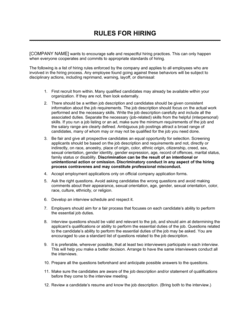
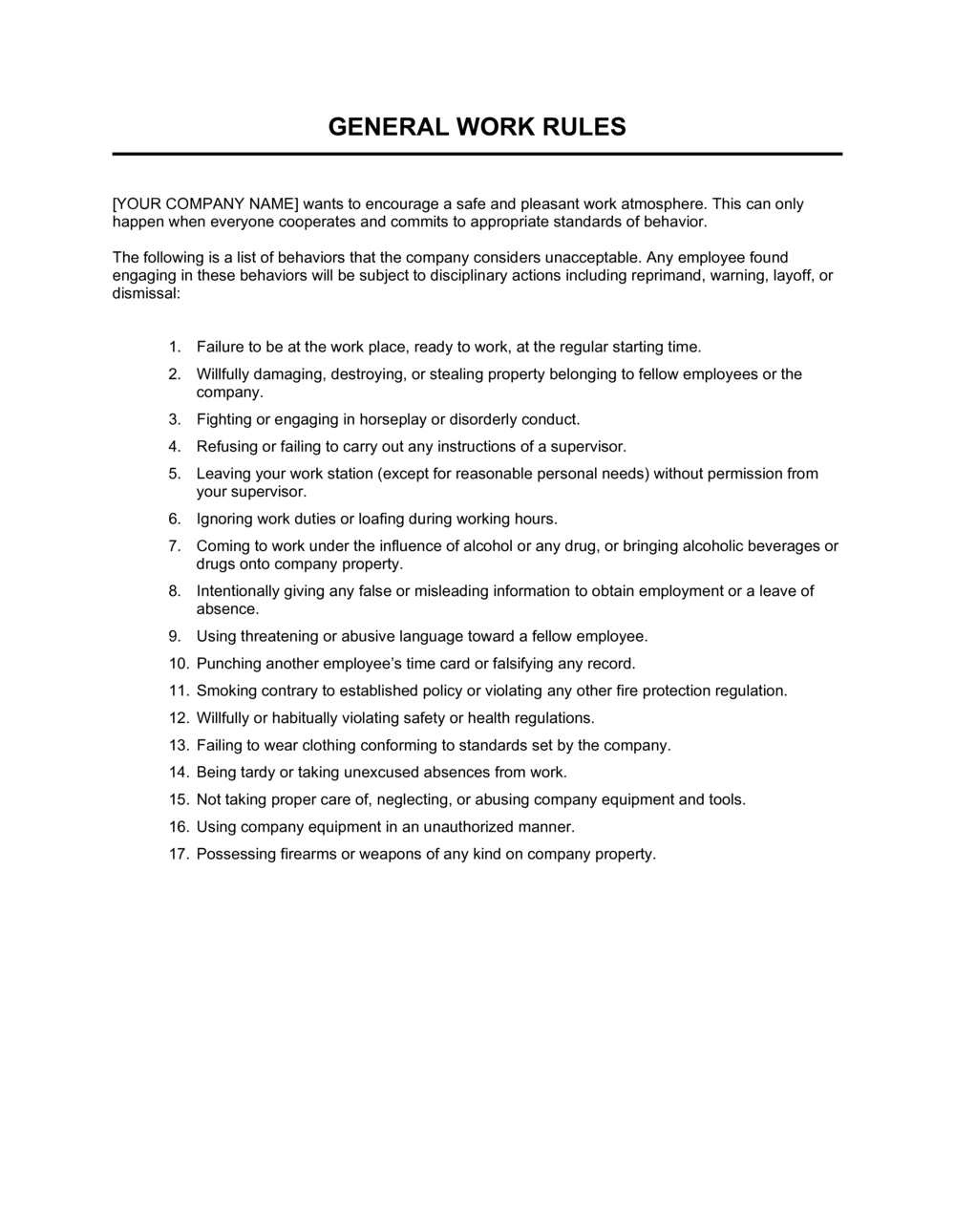
Work Rules is a formal workplace policy document that sets out the conduct, attendance, dress, safety, and disciplinary expectations the employer holds for all employees. This free Word download gives you a structured, ready-to-distribute template you can edit online and export as PDF β€” typically issued at onboarding and incorporated by reference into the employment contract.
When you need it
Use it when onboarding a new hire, updating an existing policy after a workplace incident, or formalizing unwritten expectations before they create inconsistency in discipline or termination decisions.
What's inside
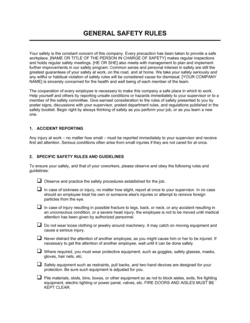
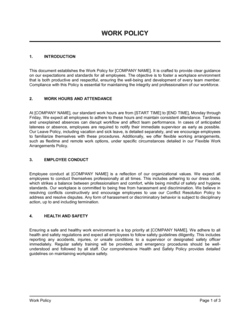
Standards for attendance and punctuality, code of conduct and professional behavior, dress and appearance guidelines, health and safety requirements, use of company equipment and technology, and a step-by-step disciplinary process with escalation levels from verbal warning through termination.

What is a Work Rules document?

A Work Rules document is a formal employer policy that sets out the behavioral, attendance, dress, safety, and disciplinary standards every employee is expected to meet as a condition of continued employment. Unlike an employee handbook, which covers the full breadth of HR policy, work rules focus on day-to-day operational expectations and the step-by-step disciplinary process β€” making them the practical reference point managers reach for when a conduct issue arises. This free Word download can be edited online, customized for your workplace, and distributed to staff as a standalone document or incorporated by reference into your employment contracts.

Why You Need This Document

Operating without written work rules leaves your managers making judgment calls from memory and your employees genuinely unsure where the line is β€” a combination that produces inconsistent discipline, contested terminations, and costly employment disputes. When a termination is challenged, the first question any employment tribunal or HR investigator asks is whether the employee knew the rule they violated and whether the employer applied it consistently. A signed, dated work rules document answers both questions. It also protects employees: clear standards mean staff are not subject to arbitrary decisions, and progressive discipline steps give people a real opportunity to correct behavior before termination becomes the outcome. This template gives you a professionally structured starting point that covers every core policy area, so you can focus your time on tailoring the specifics to your workplace rather than building from a blank page.

Which variant fits your situation?

If your situation is…Use this template
Comprehensive employee policies across all HR topicsEmployee Handbook
Specific health and safety obligations on a worksiteHealth and Safety Policy
Formal step-by-step disciplinary procedure documentDisciplinary Action Form
Rules for remote or hybrid employees working from homeRemote Work Policy
Conduct and ethics rules for senior or client-facing staffCode of Conduct
Attendance tracking with formal absenteeism policyAttendance Policy
Technology and internet acceptable-use policyIT Acceptable Use Policy

Common mistakes to avoid

❌ No signed acknowledgment collected

Why it matters: Without a signed receipt, an employee can credibly claim they never received or understood the rules β€” undermining any disciplinary action or termination decision based on those rules.

Fix: Include a detachable acknowledgment page and collect signatures before or on the employee's first day. File the signed copy in the personnel record immediately.

❌ Vague conduct standards with no defined prohibited behaviors

Why it matters: Language like 'behave professionally at all times' gives managers no enforceable standard and gives employees no clear line β€” making discipline challenges easy to win.

Fix: List specific prohibited behaviors β€” harassment, insubordination, use of profanity toward customers, unauthorized disclosure of client data β€” and the corresponding disciplinary step.

❌ Gross-misconduct offenses not listed separately

Why it matters: If the document only describes progressive discipline, terminating an employee immediately for theft or violence can be challenged as a breach of the stated procedure.

Fix: Dedicate a separate paragraph to gross misconduct with a named list of offenses and an explicit statement that these may result in immediate termination at any time.

❌ Rules never updated after initial publication

Why it matters: Work rules that reference outdated procedures, superseded laws, or roles that no longer exist create contradictions that complicate discipline and confuse employees.

Fix: Set a calendar reminder to review the document annually and note the review date and version number on the document's footer so staff and managers know which version is current.

❌ Single dress code applied to all roles

Why it matters: Applying office dress standards to warehouse or field workers is impractical and signals the policy was not written with the actual workforce in mind, reducing overall compliance.

Fix: Segment dress requirements by role or location: customer-facing, office, production, and field staff each need their own standard, even if brief.

❌ Technology section omits the no-privacy statement

Why it matters: Without an explicit statement that employees have no expectation of privacy on company systems, monitoring or accessing an employee's device communications may be challenged as an invasion of privacy.

Fix: Add a clear sentence: 'Employees have no expectation of privacy when using company-owned devices, networks, or accounts. [COMPANY NAME] reserves the right to monitor all activity at any time.'

The 9 key sections, explained

Purpose and scope

Attendance and punctuality

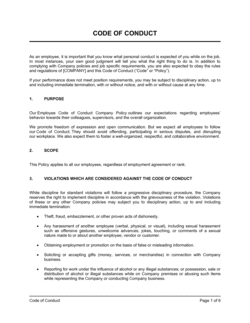
Code of conduct and professional behavior

Dress and appearance

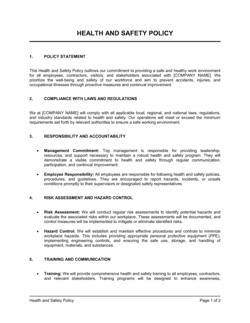
Health, safety, and workplace security

Use of company property and technology

Confidentiality and conflict of interest

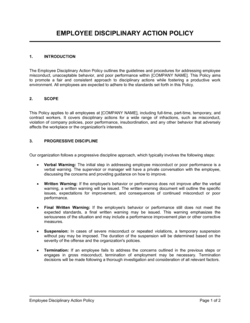
Disciplinary process and escalation levels

Acknowledgment and employee signature

How to fill it out

  1. 1

    Insert company name, locations, and effective date

    Replace all [COMPANY NAME] and [LOCATION] placeholders throughout the document. Set a specific effective date β€” not 'immediately' β€” so employees have a defined date to reference.

    πŸ’‘ If you are updating existing rules, include a 'supersedes' line: 'These rules supersede all prior Work Rules dated [PREVIOUS DATE].'

  2. 2

    Set specific attendance thresholds

    Enter the start time, break schedule, absence notification window, and the exact number of unexcused absences that triggers a formal review. Define 'excused' and 'unexcused' in plain terms.

    πŸ’‘ Use a rolling 90-day window rather than a calendar year β€” it applies consistent pressure year-round and prevents employees from 'resetting' at January 1.

  3. 3

    Customize the conduct and dress sections for your workplace

    Remove or add role-specific dress requirements. Add any prohibited behaviors specific to your industry β€” for example, no headphones on the production floor or no mobile phones during client meetings.

    πŸ’‘ Keep dress code language measurable: 'no visible tears or graphics in customer-facing areas' is enforceable; 'neat and tidy' is not.

  4. 4

    Complete the safety and reporting procedure fields

    Enter the name and contact of your safety officer, the incident reporting form reference, and any site-specific PPE requirements. Cross-reference your Health and Safety Policy if you have one.

    πŸ’‘ State the reporting window in hours, not days β€” 'within 4 hours' prevents delayed reporting that can compromise insurance claims.

  5. 5

    Define the technology acceptable-use boundaries

    Decide whether you permit incidental personal use of company devices and state this clearly. Include the explicit no-privacy statement and the employer's right to monitor.

    πŸ’‘ List prohibited activity types specifically: peer-to-peer file sharing, personal social media use during work hours, and accessing competitor systems are the most commonly litigated.

  6. 6

    List gross-misconduct offenses explicitly

    In the disciplinary section, name every behavior that permits immediate termination without progressive steps β€” typically theft, physical violence, harassment, fraud, and drug or alcohol use on premises.

    πŸ’‘ Use the phrase 'including but not limited to' before the list so the employer retains discretion for unlisted severe behaviors.

  7. 7

    Distribute, collect signed acknowledgments, and file them

    Send the final document to all employees, give them at least 48 hours to read it, collect a signed acknowledgment from each person, and file it in their personnel record.

    πŸ’‘ For existing employees, a signed acknowledgment of updated rules is as legally significant as a signed new-hire contract β€” treat it with the same care.

  8. 8

    Schedule an annual review date

    Add a 'next review date' line at the bottom of the document and calendar a reminder. Work rules that have not been reviewed in more than 18 months may no longer reflect current law or company practice.

    πŸ’‘ Align the review with your annual HR audit cycle so updates to the employee handbook, pay policies, and work rules happen in the same window.

Frequently asked questions

What are work rules?

Work rules are a formal employer document that sets out the conduct, attendance, dress, safety, and disciplinary standards expected of all employees. They provide a written reference point for both managers and staff, reduce inconsistency in how policy is applied, and create a documented basis for disciplinary action or termination when violations occur.

Are work rules the same as an employee handbook?

Work rules are typically a shorter, more operationally focused document than an employee handbook. An employee handbook covers the full range of HR policies β€” benefits, leave, compensation philosophy, anti-discrimination policy, and company culture β€” while work rules concentrate on day-to-day behavioral expectations and the disciplinary process. Many employers publish both, with work rules incorporated by reference into the handbook.

Do work rules need to be signed by employees?

There is no universal legal requirement to obtain a signature, but a signed acknowledgment is strongly recommended. It creates documented evidence that the employee received and understood the rules β€” evidence that is critical if a disciplinary decision or termination is later challenged in an employment tribunal or wrongful termination proceeding.

What should work rules cover?

A complete work rules document covers attendance and punctuality standards, code of conduct and prohibited behaviors, dress and appearance requirements, health and safety obligations, acceptable use of company property and technology, confidentiality and conflict-of-interest requirements, and the full disciplinary escalation process including which behaviors trigger immediate termination.

Can work rules be incorporated into an employment contract?

Yes β€” the most common approach is to include a clause in the employment contract stating that the employee agrees to comply with the company's work rules as amended from time to time, and to provide the rules as a separate document at onboarding. This avoids re-executing the employment contract every time the rules are updated, while still making compliance a contractual obligation.

How often should work rules be updated?

Review work rules at least once per year, and immediately after any workplace incident that reveals a gap in the existing rules, a change in applicable employment law, or a significant change in how work is performed β€” such as a shift to hybrid or remote work. Date and version-number each revision and collect fresh acknowledgments from all employees when material changes are made.

What is progressive discipline and does it have to be followed?

Progressive discipline is a step-by-step escalation process β€” typically verbal warning, written warning, suspension, then termination β€” that gives employees notice of problems and an opportunity to correct them. Most work rules adopt it as the default procedure but explicitly carve out gross misconduct offenses (theft, violence, harassment, fraud) for immediate termination without prior steps. If your work rules state a progressive process and you skip steps for a non-gross-misconduct issue, the termination can be challenged as a breach of your own policy.

What happens if a manager applies work rules inconsistently?

Inconsistent enforcement is one of the most common reasons disciplinary decisions are successfully challenged. If one employee is terminated for an offense that another employee received only a verbal warning for, the terminated employee may have grounds for a discrimination or unfair-dismissal claim. Document every disciplinary action in the personnel file and train managers to apply the escalation process uniformly across comparable situations.

How this compares to alternatives

vs Employee Handbook

An employee handbook is a comprehensive reference covering benefits, compensation philosophy, leave policies, anti-discrimination standards, and company culture alongside conduct rules. Work rules are a shorter, focused subset β€” behavioral expectations and disciplinary process only. Many employers issue both: the handbook as the authoritative HR reference and work rules as the day-to-day operational guide distributed at onboarding.

vs Code of Conduct

A code of conduct addresses ethics, values, and professional standards at a company-wide or senior-staff level β€” conflicts of interest, anti-bribery, and reputational conduct. Work rules are more operational, covering attendance, dress, safety, and the mechanics of the disciplinary process. Both documents can coexist and are often cross-referenced.

vs Disciplinary Action Form

A disciplinary action form is a transaction document completed when a specific policy violation occurs β€” it records the incident, the rule breached, and the corrective action taken. Work rules are the governing policy document that defines what the rules are and what the process looks like before any violation happens. You need both: the rules establish the standard; the form documents enforcement.

vs Health and Safety Policy

A health and safety policy is a standalone document dedicated entirely to workplace hazard identification, risk assessment, incident reporting, and regulatory compliance obligations. Work rules include a safety section, but at a summary level. For industries with significant physical risk β€” construction, manufacturing, healthcare β€” a separate health and safety policy is required alongside the work rules, not instead of them.

Industry-specific considerations

Retail and hospitality

Customer-facing conduct standards, uniform requirements, cash-handling rules, and shift swap procedures are the most frequently referenced sections in this sector.

Manufacturing and warehousing

PPE requirements, machine operation rules, incident reporting windows, and strict attendance standards for shift coverage are the core focus of work rules in production environments.

Professional services

Client confidentiality obligations, conflict-of-interest disclosure requirements, and business-appropriate dress standards are the highest-priority sections for law firms, accounting practices, and consulting firms.

Healthcare

HIPAA-aligned confidentiality language, infection-control compliance obligations, mandatory incident reporting, and zero-tolerance conduct standards for patient-facing staff require tailored language in healthcare work rules.

Template vs pro β€” what fits your needs?

PathBest forCostTime
Use the templateSmall and mid-sized businesses establishing or updating work rules for a domestic workforceFree1–2 hours
Template + professional reviewBusinesses with unionized staff, multi-location operations, or recent disciplinary disputes$200–$600 for an HR consultant or employment lawyer review2–5 days
Custom draftedEnterprises in regulated industries, multi-jurisdiction employers, or organizations rebuilding policy after a legal challenge$1,000–$3,500+1–3 weeks

Glossary

Work Rules
A written employer document specifying behavioral, attendance, safety, and disciplinary standards that all employees are expected to follow.
Progressive Discipline
A structured escalation process β€” typically verbal warning, written warning, suspension, then termination β€” that gives employees notice and an opportunity to correct behavior before termination.
At-Cause Termination
Dismissal based on documented, specific employee misconduct or policy violation, as opposed to a layoff or no-fault separation.
Gross Misconduct
Severe workplace behavior β€” theft, violence, harassment, or fraud β€” that justifies immediate termination without prior warnings.
Acknowledgment of Receipt
A signed employee statement confirming they received, read, and understood the work rules β€” used as evidence in disciplinary or legal proceedings.
Insubordination
An employee's deliberate refusal to follow a reasonable and lawful instruction from a supervisor or manager.
Zero-Tolerance Policy
A rule specifying that certain violations β€” typically violence, harassment, or drug use β€” result in immediate termination with no prior warning required.
Acceptable Use Policy
The section of work rules governing employee use of company-provided technology, internet access, email, and social media.
Absenteeism
A pattern of frequent unplanned or unexcused absences from work, tracked against a threshold that triggers disciplinary review.
Disciplinary Record
The documented history of a specific employee's policy violations and formal warnings, maintained in their personnel file.

Part of your Business Operating System

This document is one of 3,000+ business & legal templates included in Business in a Box.

  • Fill-in-the-blanks β€” ready in minutes
  • 100% customizable Word document
  • Compatible with all office suites
  • Export to PDF and share electronically

Create your document in 3 simple steps.

From template to signed document β€” all inside one Business Operating System.
1
Download or open template

Access over 3,000+ business and legal templates for any business task, project or initiative.

2
Edit and fill in the blanks with AI

Customize your ready-made business document template and save it in the cloud.

3
Save, Share, Send, Sign

Share your files and folders with your team. Create a space of seamless collaboration.

Save time, save money, and create top-quality documents.

β˜…β˜…β˜…β˜…β˜…

"Fantastic value! I'm not sure how I'd do without it. It's worth its weight in gold and paid back for itself many times."

Managing Director Β· Mall Farm
Robert Whalley
Managing Director, Mall Farm Proprietary Limited
β˜…β˜…β˜…β˜…β˜…

"I have been using Business in a Box for years. It has been the most useful source of templates I have encountered. I recommend it to anyone."

Business Owner Β· 4+ years
Dr Michael John Freestone
Business Owner
β˜…β˜…β˜…β˜…β˜…

"It has been a life saver so many times I have lost count. Business in a Box has saved me so much time and as you know, time is money."

Owner Β· Upstate Web
David G. Moore Jr.
Owner, Upstate Web

Run your business with a system β€” not scattered tools

Stop downloading documents. Start operating with clarity. Business in a Box gives you the Business Operating System used by over 250,000 companies worldwide to structure, run, and grow their business.

Free Forever PlanΒ Β·Β No credit card required