1
Enter sender and recipient information
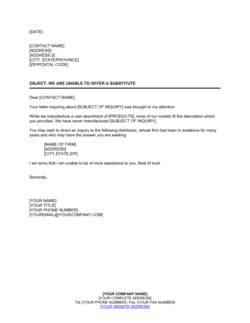
Add your company's full legal name, address, and the name and title of the authorized signatory. Enter the recipient's full name, company, and address. Reference the exact inquiry you are responding to by date and any reference number the recipient used.
💡 Use the legal entity name on the letterhead — not a brand name — to ensure the limitation of liability clause is attributed to the correct legal person.
2
Confirm the product model and discontinuation date
Insert the full product model name and SKU exactly as it appears in your catalog. State the official discontinuation date — the date the company formally stopped accepting new orders — not the date production ceased internally.
💡 If the inquiry refers to an informal or colloquial product name, include both names in parentheses to prevent disputes about which product the letter covers.
3
State the reason for discontinuation in neutral language
Provide one to two sentences explaining the discontinuation reason. Choose factually accurate language that does not admit fault, defect, or negligence — for example, 'component obsolescence' or 'product line consolidation.'
💡 Have your legal team or product manager approve the reason language before sending. Admissions of quality or safety issues in this section can be used in product liability litigation.
4
Identify and describe alternative or successor products
List the specific successor model or closest alternative by name and SKU. Include one to two sentences on functional compatibility and attach a product comparison sheet if available.
💡 If no direct successor exists, recommend a category of alternatives and provide a sales contact rather than leaving the recipient without a path forward.
5
Define warranty and parts support commitments
Enter the warranty expiry date for units already purchased and the end date for parts and service availability. State the claims channel clearly — email, portal, or phone.
💡 Coordinate with your service team to confirm parts inventory levels before committing to a specific end-of-support date. Overpromising parts availability is a common and costly error.
6
Add the last-time buy deadline if applicable
If remaining inventory exists, specify the order deadline, channel, and any minimum order quantity. Make the deadline explicit — a calendar date, not 'while supplies last.'
💡 Set the last-time buy deadline at least 30 days out to give procurement and accounts payable teams enough time to process an order internally.
7
Review and customize the limitation of liability clause
Confirm the liability cap amount or formula is consistent with your standard commercial terms. Ensure the clause excludes consequential, indirect, and incidental damages explicitly.
💡 If the letter is going to a customer in California, the EU, or another jurisdiction with strong consumer protection law, have local counsel review the liability limitation before sending.
8
Sign and distribute through a traceable channel
Have the authorized signatory sign the letter before sending. Distribute via a method that creates a delivery record — certified mail, email with read receipt, or a document portal with timestamp.
💡 Retain a signed copy of every discontinuation reply in your CRM or document management system against the customer account. These letters become key evidence in warranty disputes and supply-contract litigation.