Affidavit of Execution Template

Free Word download β€’ Edit online β€’ Save & share with Drive β€’ Export to PDF

1 pageβ€’20–30 min to fillβ€’Difficulty: Standardβ€’Signature requiredβ€’Legal review recommended
Learn more ↓
FreeAffidavit of Execution Template

At a glance

What it is
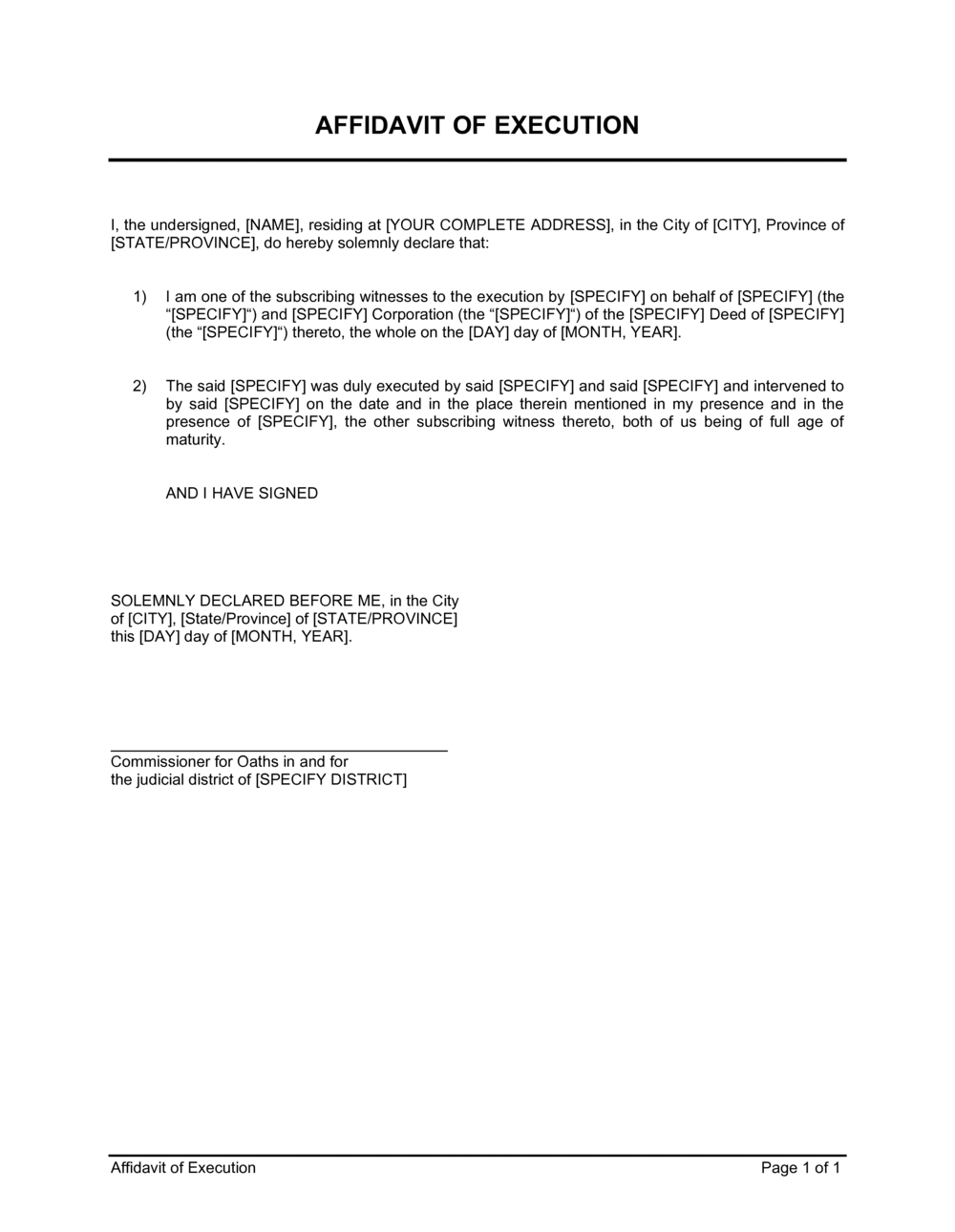
An Affidavit of Execution is a sworn legal statement made by a witness confirming that they were present when a document β€” such as a will, deed, contract, or power of attorney β€” was signed by the named parties. This template is a free Word download you can edit online and export as PDF, ready to be sworn before a commissioner of oaths, notary public, or similar officer with authority to administer oaths.
When you need it
Use it when a signed document must later be submitted to a court, land registry, financial institution, or government body that requires sworn proof of due execution. It is most commonly required after the signatory is unavailable, deceased, or unable to confirm their own signature.
What's inside
Deponent identification, sworn declaration of witness capacity, description of the primary document, confirmation of the signing event, identification of all parties present, a jurat block for the commissioner of oaths, and signature lines for the deponent and administering officer.

What is an Affidavit of Execution?

An Affidavit of Execution is a sworn legal statement made by a witness confirming that they were personally present when a named party signed a specific legal document β€” such as a will, deed, contract, or power of attorney. The deponent (the person making the affidavit) swears before a commissioner of oaths, notary public, or other authorized officer that the signing occurred on a stated date and at a stated location, that the signatory appeared to act voluntarily, and that the deponent subscribed their own name as a witness to that instrument. Unlike many legal documents, the affidavit of execution does not create new obligations β€” it provides sworn evidentiary proof that an existing document was properly executed in accordance with applicable legal requirements.

Why You Need This Document

Without a sworn affidavit of execution, a validly signed document can be effectively unenforceable the moment its original signatory becomes unavailable. Probate courts require proof that a will's witnesses observed the testator sign β€” and when those witnesses have themselves died or moved out of contact, an earlier affidavit of execution is the only available evidence. Land registries reject deeds and mortgage transfers that lack sworn confirmation of due execution, stalling property transactions that may involve hundreds of thousands of dollars in closing costs and penalties. Financial institutions freeze loan security documents and estate accounts for the same reason. The cost of not having this document in place is measured in months of delay, legal fees to seek court orders substituting for the missing evidence, and in the worst cases, the loss of rights the original document was meant to protect. This template gives witnesses and lawyers a complete, court-ready starting point that can be completed, sworn, and submitted in a single day.

Which variant fits your situation?

If your situation is…Use this template
Confirming execution of a will for probate purposesAffidavit of Execution (Will)
Verifying execution of a real property deed or mortgageAffidavit of Execution (Real Estate)
Confirming execution of a general contract or agreementAffidavit of Execution
Attesting to facts about your identity or personal circumstancesGeneral Affidavit
Confirming the identity of a signatory rather than the act of signingStatutory Declaration
Providing sworn witness evidence for a court proceedingAffidavit of Witness
Confirming due execution of a power of attorneyAffidavit of Execution (Power of Attorney)

Common mistakes to avoid

❌ Signing before appearing before the commissioner

Why it matters: An affidavit that was not signed in the presence of a commissioner of oaths cannot be sworn. Courts, registries, and financial institutions routinely reject it, requiring the entire process to be repeated.

Fix: Leave the deponent signature line blank until the swearing appointment. The commissioner must watch you sign β€” that act is the sworn oath.

❌ Failing to attach the exhibit

Why it matters: An affidavit of execution with no attached or referenced document floats free β€” there is no way to confirm which instrument it covers, making it legally useless.

Fix: Attach a true copy of the signed document (or the original) and mark it as Exhibit A before attending the swearing appointment. The commissioner will initial it.

❌ Using imprecise or approximate dates

Why it matters: Phrases like 'on or about' undermine the authority of a sworn statement and invite challenge. If the original document is dated, the signing date is known.

Fix: Cross-reference the date on the face of the primary document and any contemporaneous records. State the exact calendar date in full β€” day, month, and year.

❌ Deponent has a beneficial interest in the document

Why it matters: In many jurisdictions, a beneficiary under a will who also acts as a witness loses their bequest. Affidavits sworn by interested witnesses are also open to credibility challenges.

Fix: Before completing the affidavit, confirm the deponent has no financial or personal interest in the outcome of the document. If they do, engage a disinterested third party as witness instead.

❌ Misidentifying or incompletely describing the primary document

Why it matters: A description that does not match the title or parties on the face of the instrument creates ambiguity about which document the affidavit covers β€” grounds for rejection.

Fix: Copy the document's exact title, date, and party names directly from the instrument itself. Do not paraphrase.

❌ Submitting without the commissioner's seal or registration number

Why it matters: Many registries and courts require the commissioner's registration number and, in some jurisdictions, a notarial seal to authenticate the jurat. An incomplete jurat renders the affidavit invalid.

Fix: Before leaving the swearing appointment, verify that the jurat includes the commissioner's full name, title, registration or bar number, jurisdiction, and seal where required.

The 10 key clauses, explained

Deponent identification

In plain language: Identifies the person making the affidavit β€” their full legal name, occupation, and residential or business address.

Sample language
I, [DEPONENT FULL NAME], of [ADDRESS], [CITY], [STATE/PROVINCE], [OCCUPATION], make oath and say as follows:

Common mistake: Using a nickname or initials instead of the deponent's full legal name. Mismatches with government-issued ID can invalidate the affidavit or cause rejection by a court or registry.

Capacity and personal knowledge statement

In plain language: States that the deponent has personal knowledge of the facts β€” specifically that they were physically present at the signing event.

Sample language
I have personal knowledge of the matters herein deposed to, save where stated to be on information and belief, and where so stated I verily believe them to be true.

Common mistake: Omitting the personal-knowledge recital. Without it, the affidavit can be challenged on the basis that the deponent is relying on hearsay rather than direct observation.

Description of the primary document

In plain language: Identifies the document whose execution is being confirmed β€” its type, title, date, and the parties to it.

Sample language
I was present at the execution of the document described as [DOCUMENT TYPE β€” e.g., Last Will and Testament / Deed / Agreement] dated [DATE], between [PARTY 1 FULL NAME] and [PARTY 2 FULL NAME] (the 'Document').

Common mistake: Describing the document by its common name rather than its exact title as it appears on the face of the instrument. A mismatch creates uncertainty about which document the affidavit covers.

Confirmation of the signing event

In plain language: The core sworn statement: the deponent saw the named party sign the document, on a specific date, at a specific location.

Sample language
On [DATE], at [LOCATION β€” full address], I personally witnessed [SIGNATORY FULL NAME] sign the Document by placing their signature thereon.

Common mistake: Using approximate dates ('on or about' or 'sometime in') when the exact date is known or recorded on the document. Imprecise dates undermine the sworn statement's credibility.

Identification of the signatory

In plain language: Confirms that the person who signed is who they claim to be β€” either from prior personal knowledge or from identification produced at the time of signing.

Sample language
I am personally acquainted with [SIGNATORY FULL NAME] / [SIGNATORY FULL NAME] produced [IDENTIFICATION DOCUMENT TYPE AND NUMBER] as proof of identity.

Common mistake: Failing to record the identification method. If the signatory's identity is later disputed, the deponent must be able to explain how they confirmed it β€” a blank identification clause provides no protection.

Witness capacity and absence of pressure

In plain language: States that the signatory appeared to act voluntarily and of their own free will, and that the deponent had no interest in the outcome of the document.

Sample language
At the time of signing, [SIGNATORY FULL NAME] appeared to be of sound mind, acting freely and voluntarily, and under no apparent duress or undue influence. I have no beneficial interest in the Document.

Common mistake: Omitting the 'no beneficial interest' confirmation. A witness who stands to benefit from a will or contract may be disqualified as a witness under statute, and the affidavit should address this proactively.

Attestation details

In plain language: Records that the deponent also signed the original document as a witness, including when and where their own attestation was made.

Sample language
I subscribed my name as a witness to the Document in the presence of [SIGNATORY FULL NAME] on [DATE] at [LOCATION].

Common mistake: Describing the witness signature as having occurred at a different time or location than the principal's signature. Witnessing after the fact β€” even by minutes at a different address β€” may invalidate the execution.

Exhibit reference

In plain language: Attaches the primary document (or a true copy of it) as a marked exhibit to the affidavit, so the sworn statement and the document it covers are permanently linked.

Sample language
Attached to this affidavit and marked as Exhibit 'A' is a true copy of the Document referred to herein.

Common mistake: Failing to attach or mark the exhibit. Submitting an affidavit of execution without the underlying document or a certified copy attached causes routine rejection by courts and registries.

Jurat (oath/affirmation block)

In plain language: The closing block completed by the commissioner of oaths confirming when and where the oath was administered and identifying the administering officer.

Sample language
SWORN (or AFFIRMED) before me at [CITY], [STATE/PROVINCE/COUNTRY], this [DAY] day of [MONTH], [YEAR]. [SIGNATURE OF COMMISSIONER] [NAME, TITLE, REGISTRATION NUMBER IF APPLICABLE]

Common mistake: Leaving the jurat blank and submitting the affidavit unsigned by a commissioner. An unsworn affidavit is not an affidavit β€” it is a bare written statement with no evidentiary standing.

Deponent's signature block

In plain language: The line where the deponent signs the affidavit in front of the commissioner of oaths β€” the signature that transforms the statement into a sworn document.

Sample language
DEPONENT: _________________________ [FULL LEGAL NAME PRINTED BELOW]

Common mistake: Signing the affidavit before appearing before the commissioner. The deponent must sign in the commissioner's presence β€” a pre-signed affidavit cannot be sworn and is typically void.

How to fill it out

  1. 1

    Identify the deponent and confirm their capacity

    Enter the witness's full legal name, occupation, and complete address in the opening paragraph. Confirm the deponent has direct, personal knowledge of the signing event β€” not secondhand knowledge.

    πŸ’‘ The deponent's name must match their government-issued ID exactly. Arrange to have that ID at the swearing appointment.

  2. 2

    Describe the primary document precisely

    Identify the document being attested by its exact title, date, and full legal names of all parties as they appear on the face of the instrument.

    πŸ’‘ Photocopy or print the document's title page before filling this section to copy the exact wording β€” do not rely on memory.

  3. 3

    Record the signing event details

    State the exact date and full address where the signing occurred. Confirm that you, as the witness, were physically present when the signatory placed their signature on the document.

    πŸ’‘ If you are completing this affidavit weeks after the signing, verify the date against contemporaneous records such as a calendar entry or dated email.

  4. 4

    Confirm the signatory's identity and voluntary intent

    State whether you know the signatory personally or that they produced identification. Add the confirmation that they appeared to sign voluntarily and of sound mind, and that you have no beneficial interest in the document.

    πŸ’‘ Record the type and number of any ID produced at the time of signing β€” driver's license, passport number β€” even if this detail is not strictly required in your jurisdiction.

  5. 5

    Attach and mark the exhibit

    Attach a true copy of the primary document or the original instrument to the affidavit. Write 'Exhibit A' (or the next sequential letter) on the exhibit, and reference it in the body of the affidavit.

    πŸ’‘ The commissioner of oaths will typically initial each page of the exhibit at the swearing appointment β€” bring all pages, not just the signature page.

  6. 6

    Appear before a commissioner of oaths

    Book an appointment with a notary public, solicitor, or other authorized officer. Bring the completed (but unsigned) affidavit, your government-issued ID, and the exhibit. Sign the affidavit in the commissioner's presence.

    πŸ’‘ Do not sign the affidavit before the appointment. A pre-signed affidavit cannot be sworn and will be rejected β€” the commissioner must witness your actual act of signing.

  7. 7

    Obtain the commissioner's jurat and seal

    The commissioner completes the jurat β€” date, location, their signature, and registration details β€” and affixes any required seal or stamp. Confirm all fields are complete before leaving the appointment.

    πŸ’‘ Request two original sworn copies if the affidavit will be submitted to more than one institution β€” courts and land registries often require an original, not a photocopy.

  8. 8

    Submit to the relevant authority and retain a copy

    File the sworn affidavit with the court, land registry, financial institution, or other body that requested it. Keep a certified copy with your records alongside the original document it supports.

    πŸ’‘ Note the submission date and the name of the officer who accepted it β€” this creates a paper trail if the affidavit is later disputed or misrouted.

Frequently asked questions

What is an affidavit of execution?

An affidavit of execution is a sworn written statement made by a person who witnessed the signing of a legal document β€” such as a will, deed, contract, or power of attorney β€” confirming that they were present when the named party signed. It is used to prove that a document was properly executed when the original signatory is unavailable, deceased, or unable to confirm their signature. The affidavit must be sworn before a commissioner of oaths, notary public, or equivalent authorized officer.

When is an affidavit of execution required?

It is most commonly required during probate proceedings when a court needs sworn evidence that a will was properly witnessed, during real property transactions where a land registry requires proof of deed execution, and in commercial disputes where a party challenges whether a contract was genuinely signed. Financial institutions may also require one when processing mortgages or loan security documents where a signatory is later unavailable to confirm their own signature.

Who can act as the deponent on an affidavit of execution?

The deponent must be the person who was physically present at the signing event β€” typically the witness named on the original document. The deponent must be an adult with legal capacity and, in most jurisdictions, must have no beneficial interest in the document being attested. A beneficiary under a will, for example, is generally disqualified from acting as a witness and therefore cannot be the deponent in an affidavit of execution for that will.

Does an affidavit of execution need to be notarized?

Yes, in virtually all jurisdictions where affidavits carry legal weight. The affidavit must be sworn or affirmed before a commissioner of oaths, notary public, justice of the peace, or solicitor with authority to administer oaths. The jurat β€” the closing block completed by that officer β€” is what transforms a written statement into a sworn affidavit. An unsworn statement has no evidentiary standing as an affidavit.

What is the difference between an affidavit of execution and a statutory declaration?

Both are formal sworn documents, but they serve different purposes. An affidavit of execution specifically confirms that the deponent witnessed another person sign a named document. A statutory declaration is a more general sworn statement used to confirm facts about the declarant's own circumstances β€” identity, marital status, or loss of a document β€” rather than witnessing someone else's act. Courts and registries typically specify which form they require; they are not generally interchangeable.

Can an affidavit of execution be used to fix a defective signing?

An affidavit of execution confirms that a signing occurred as described β€” it does not cure an inherently defective execution. For example, if a will was signed without the required two witnesses present simultaneously, an affidavit from one witness cannot remedy the statutory defect. However, if execution was technically proper but the signatory is later unavailable to confirm it, the affidavit provides the sworn evidence that satisfies the court or registry requirement.

What should I bring to the swearing appointment?

Bring the completed but unsigned affidavit, a copy of the primary document to be attached as an exhibit, and your government-issued photo ID. Do not sign the affidavit in advance β€” you must sign it in the commissioner's presence. If the affidavit will be submitted to multiple institutions, arrange for two original sworn copies at the same appointment rather than photocopying a single original afterward.

How long does an affidavit of execution remain valid?

There is generally no fixed expiry on a sworn affidavit β€” once sworn, it records a historical fact and does not become stale in the way that a certificate or identification document does. However, courts and registries may scrutinize a significant delay between the signing event and the swearing of the affidavit, as it raises questions about the deponent's ability to recall precise details. Swearing the affidavit as soon as practicable after the signing event is always preferable.

Do I need a lawyer to prepare an affidavit of execution?

For straightforward attestations β€” a witnessed contract or standard deed β€” a high-quality template is typically sufficient. Consider engaging a lawyer when the underlying document is a will (where probate requirements vary by jurisdiction), when the affidavit will be used in contested litigation, or when it must be submitted in a foreign jurisdiction with specific form requirements. A lawyer or notary will also administer the oath, so their involvement at the swearing stage is always required regardless of who drafts the document.

How this compares to alternatives

vs General Affidavit

A general affidavit is a sworn statement about any facts the deponent has personal knowledge of β€” identity, events, or circumstances. An affidavit of execution is specifically and narrowly confined to confirming that a named document was signed by a named party in the deponent's presence. Use a general affidavit for broad factual assertions; use an affidavit of execution when you need to prove the valid signing of a specific instrument.

vs Statutory Declaration

A statutory declaration is a formal sworn statement about the declarant's own personal circumstances or facts β€” not about witnessing another person's act. It typically requires no attachment of an underlying document. An affidavit of execution is specifically tied to a named document and confirms an observed event rather than a personal assertion. Courts and registries specify which form is required.

vs Notarial Certificate

A notarial certificate is completed by a notary public and certifies facts about a document β€” such as a true copy or an authentication of a signature β€” from the notary's own authority. An affidavit of execution is sworn by the lay witness, not the notary, and describes what the witness personally observed. The notary's role in an affidavit of execution is limited to administering the oath and completing the jurat.

vs Affidavit of Service

An affidavit of service confirms that legal documents were delivered to a named party on a specific date and in a specified manner β€” used to prove compliance with service-of-process requirements in litigation. An affidavit of execution confirms that a document was signed, not served. Both are sworn affidavits, but they serve entirely different procedural purposes and are not interchangeable.

Industry-specific considerations

Legal and Professional Services

Estate lawyers use affidavits of execution routinely to prove a will's valid witnessing during probate, particularly when one or both witnesses have predeceased the testator.

Real Estate and Property

Land registries in many jurisdictions require an affidavit of execution accompanying deeds, transfers, and mortgage instruments where a witness must swear to the signatory's identity and voluntary signing.

Financial Services and Banking

Banks and trust companies require sworn execution evidence for loan security documents, guarantee agreements, and powers of attorney where a signatory is later unavailable to confirm their own signature.

Corporate and Commercial

Corporate counsel use affidavits of execution to prove due execution of material contracts, share purchase agreements, and settlement documents in regulatory filings and commercial disputes.

Jurisdictional notes

United States

Requirements vary significantly by state. Most states require affidavits to be sworn before a notary public, who must affix their seal and note their commission expiration date. For wills, the Uniform Probate Code allows a self-proving affidavit signed at the time of execution to replace a post-death affidavit of execution. Some states, notably California and Florida, have specific statutory forms for will execution affidavits. Real estate deeds in most states require notarization of the grantor's signature rather than a separate affidavit.

Canada

Affidavits of execution are required under provincial rules for wills and real property instruments in most provinces. In Ontario, for example, affidavits of execution for wills are governed by the Succession Law Reform Act and the Rules of Civil Procedure. Commissioners of oaths, lawyers, and notaries public are authorized to administer oaths. Quebec, as a civil law jurisdiction, uses notarized acts rather than common-law affidavits β€” the notary both drafts and authenticates the instrument.

United Kingdom

In England and Wales, affidavits of execution are most commonly used in probate where a will's witness must swear to the due execution under the Wills Act 1837. They must be sworn before a solicitor, commissioner for oaths, or court officer. In Scotland, which uses a separate legal system, documents are formally executed under the Requirements of Writing (Scotland) Act 1995, and the equivalent sworn confirmation is provided through a statutory declaration or court process rather than a strict affidavit format.

European Union

EU member states generally follow civil law traditions where notarized deeds replace common-law affidavit practice. In France, Germany, Spain, and most other member states, a notary public authenticates the original execution of important documents β€” making a post-hoc affidavit of execution less common. For cross-border recognition of foreign affidavits within the EU, the Hague Apostille Convention applies; a sworn affidavit from a common-law jurisdiction (Ireland, or an overseas territory) requires an Apostille stamp to be admissible before EU courts or registries.

Template vs lawyer β€” what fits your deal?

PathBest forCostTime
Use the templateWitnesses completing a standard affidavit for a witnessed contract, straightforward deed, or unchallenged documentFree (plus commissioner of oaths fee, typically $20–$75)30–60 minutes to complete; 1 swearing appointment
Template + legal reviewAffidavits supporting probate applications, real estate transactions, or documents with any dispute risk$150–$400 for a solicitor or notary review and oath administration1–3 days
Custom draftedContested estate litigation, cross-border document authentication, or high-value commercial disputes requiring jurisdiction-specific form compliance$500–$2,000+3–10 days

Glossary

Deponent
The person who makes and signs the affidavit β€” in an affidavit of execution, this is the witness to the original signing.
Jurat
The clause at the end of an affidavit certifying when, where, and before whom it was sworn β€” typically signed by the commissioner of oaths.
Commissioner of Oaths
An officer authorized by law to administer oaths and take sworn statements, such as a notary public, solicitor, or court official.
Execution
The formal act of signing a legal document in the manner required by law to make it valid and binding.
Testator
The person who makes and signs a will; an affidavit of execution for a will confirms the testator signed in the presence of the required witnesses.
Due Execution
The completion of all legal formalities β€” correct signatures, witnesses, and acknowledgments β€” necessary to make a document legally effective.
Probate
The court-supervised process of proving a will's validity and administering a deceased person's estate.
Notarization
The process by which a notary public or equivalent officer certifies the identity of a signatory and authenticates a document or sworn statement.
Solemn Declaration
A formal affirmation made without a religious oath, carrying the same legal weight as a sworn oath in most common-law jurisdictions.
Attestation Clause
The portion of a legal document β€” typically a will or deed β€” where a witness confirms they observed the signing and records their own name, address, and signature.

Part of your Business Operating System

This document is one of 3,000+ business & legal templates included in Business in a Box.

  • Fill-in-the-blanks β€” ready in minutes
  • 100% customizable Word document
  • Compatible with all office suites
  • Export to PDF and share electronically

Create your document in 3 simple steps.

From template to signed document β€” all inside one Business Operating System.
1
Download or open template

Access over 3,000+ business and legal templates for any business task, project or initiative.

2
Edit and fill in the blanks with AI

Customize your ready-made business document template and save it in the cloud.

3
Save, Share, Send, Sign

Share your files and folders with your team. Create a space of seamless collaboration.

Save time, save money, and create top-quality documents.

β˜…β˜…β˜…β˜…β˜…

"Fantastic value! I'm not sure how I'd do without it. It's worth its weight in gold and paid back for itself many times."

Managing Director Β· Mall Farm
Robert Whalley
Managing Director, Mall Farm Proprietary Limited
β˜…β˜…β˜…β˜…β˜…

"I have been using Business in a Box for years. It has been the most useful source of templates I have encountered. I recommend it to anyone."

Business Owner Β· 4+ years
Dr Michael John Freestone
Business Owner
β˜…β˜…β˜…β˜…β˜…

"It has been a life saver so many times I have lost count. Business in a Box has saved me so much time and as you know, time is money."

Owner Β· Upstate Web
David G. Moore Jr.
Owner, Upstate Web

Run your business with a system β€” not scattered tools

Stop downloading documents. Start operating with clarity. Business in a Box gives you the Business Operating System used by over 250,000 companies worldwide to structure, run, and grow their business.

Start freeΒ Β·Β No credit card required