Mediation Agreement Short Template

Free Word download β€’ Edit online β€’ Save & share with Drive β€’ Export to PDF

2 pagesβ€’25–30 min to fillβ€’Difficulty: Standardβ€’Signature requiredβ€’Legal review recommended
Learn more ↓
FreeMediation Agreement Short Template

At a glance

What it is
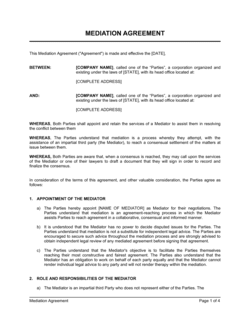
A Mediation Agreement (Short Form) is a concise legally binding document that commits two or more disputing parties to resolve their conflict through a neutral third-party mediator before pursuing litigation or arbitration. This free Word download covers mediator selection, process rules, confidentiality obligations, and cost allocation in a streamlined format you can edit online and export as PDF in under 30 minutes.
When you need it
Use it when a business dispute has arisen and both parties agree to attempt mediation β€” whether triggered by a dispute-resolution clause in an existing contract or reached voluntarily. It is also used at the start of a scheduled mediation session to confirm the parties' mutual commitment to the process before the mediator opens proceedings.
What's inside
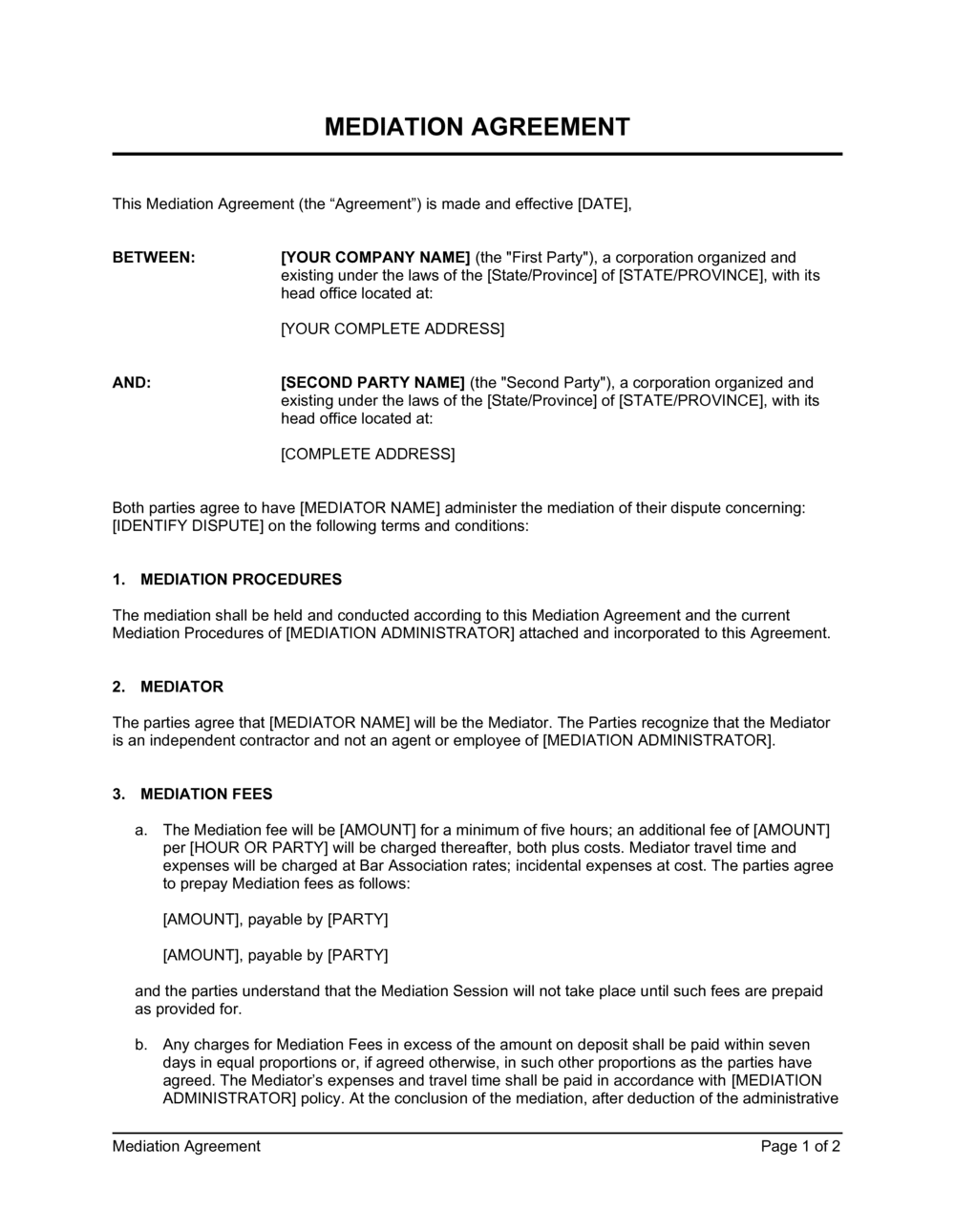
Parties and mediator identification, scope of the dispute, mediation process rules, confidentiality obligations, cost-sharing provisions, good-faith participation requirement, and a clause confirming that any resulting settlement must be recorded in a signed written agreement to be binding.

What is a Mediation Agreement (Short Form)?

A Mediation Agreement (Short Form) is a concise legally binding contract that commits two or more disputing parties to resolve a specific conflict through a neutral third-party mediator before pursuing litigation or arbitration. It establishes the ground rules for the mediation process β€” who the mediator is, what dispute is within scope, how sessions are conducted, what remains confidential, and how costs are shared β€” without the procedural complexity of a full multi-party mediation protocol. Unlike the outcome of a successful mediation (which is captured in a separate settlement agreement), the mediation agreement governs the process itself and creates enforceable obligations around participation, confidentiality, and cost contribution.

Why You Need This Document

Attempting to mediate a business dispute without a signed agreement leaves every participant exposed. Without a confidentiality clause binding all parties and the mediator, statements and settlement offers made in the room can be introduced as evidence in subsequent litigation. Without a tolling clause, the weeks spent in mediation may quietly extinguish a party's right to sue if negotiations fail. Without a written settlement requirement, a verbal agreement reached after hours of negotiation can be repudiated the next morning. A signed mediation agreement resolves all of these risks before the first session opens, giving every party a clear and enforceable framework to work within. This template provides that framework in under 30 minutes, and a brief legal review is all that is typically needed to confirm it is correctly scoped for your specific dispute.

Which variant fits your situation?

If your situation is…Use this template
Brief, single-issue commercial dispute between two businessesMediation Agreement Short
Multi-party or complex commercial dispute requiring detailed process rulesMediation Agreement (Long Form)
Employment or workplace dispute between employer and employeeEmployment Mediation Agreement
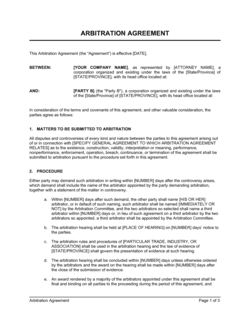
Parties prefer binding arbitration rather than non-binding mediationArbitration Agreement
Parties want a combined med-arb clause in an existing contractDispute Resolution Clause Addendum
Dispute has been resolved and parties need to record the outcomeSettlement Agreement
Pre-dispute clause to be embedded in a new commercial contractMediation Clause (Contract Addendum)

Common mistakes to avoid

❌ Sending a representative without settlement authority

Why it matters: Mediation requires real-time decision-making. A representative who must 'check with management' before agreeing to anything cannot settle, wasting all parties' time and the mediator's fees.

Fix: Explicitly require in the good-faith clause that each party attend with a person holding full authority to settle the dispute on behalf of the entity, and confirm this in writing before the session.

❌ Omitting a tolling clause for the statute of limitations

Why it matters: A party that participates in several weeks of mediation in good faith may inadvertently allow its litigation window to expire, permanently losing its legal remedy if mediation fails.

Fix: Include a clause that tolls any applicable limitation period from the date of the agreement until at least 30 days after mediation is formally terminated, preserving all parties' rights.

❌ Leaving mediator selection with no fallback mechanism

Why it matters: If the named mediator is unavailable and no selection procedure is specified, one party can block the process indefinitely by refusing to agree on an alternative, triggering a return to court.

Fix: Name a mediation institution (AAA, JAMS, CEDR) as a fallback appointing authority so a replacement mediator can be designated without further agreement between the parties.

❌ No written settlement requirement clause

Why it matters: Verbal agreements reached in the mediation room are difficult to enforce and frequently disputed after the session ends, particularly when one party has second thoughts overnight.

Fix: Include an explicit clause stating that no resolution is binding until both parties have signed a separate written settlement agreement, and draft that document before leaving the session.

❌ Defining the dispute scope too broadly

Why it matters: A scope clause covering 'all disputes between the parties' can drag unrelated claims into the mediation, inflating cost, time, and complexity beyond what either party anticipated.

Fix: Reference the specific contract, incident, or claim that gave rise to the dispute, and include a sentence confirming that claims outside this scope require written consent of all parties to be added.

❌ Failing to extend confidentiality to the mediator explicitly

Why it matters: Without an explicit mediator confidentiality obligation, the mediator could be compelled by subpoena to testify about statements made in caucus or joint session in subsequent litigation.

Fix: Draft the confidentiality clause to bind 'the parties and the Mediator' jointly, and reference any institutional rules that independently impose mediator confidentiality as a belt-and-suspenders measure.

The 10 key clauses, explained

Parties and mediator identification

In plain language: Identifies all disputing parties by legal name and entity type, and names the agreed mediator or the mechanism for selecting one.

Sample language
This Mediation Agreement is entered into on [DATE] between [PARTY A LEGAL NAME], a [ENTITY TYPE] ('Party A'), and [PARTY B LEGAL NAME], a [ENTITY TYPE] ('Party B'). The parties agree to engage [MEDIATOR FULL NAME / MEDIATION SERVICE NAME] as the neutral mediator ('Mediator').

Common mistake: Naming a mediator by first name or title only, without a full legal name or organization. If that mediator is unavailable, the agreement provides no fallback selection mechanism and the process stalls.

Scope of the dispute

In plain language: Defines the specific dispute or claims being submitted to mediation so the mediator and parties know exactly what is β€” and is not β€” within scope.

Sample language
The parties agree to submit the following dispute to mediation: [BRIEF DESCRIPTION OF DISPUTE], arising from [CONTRACT NAME / AGREEMENT DATED DATE / INCIDENT DESCRIPTION] ('the Dispute'). No claims outside the Dispute shall be addressed in this mediation without written consent of all parties.

Common mistake: Defining the scope so broadly ('all disputes between the parties') that unrelated claims are inadvertently included, expanding the mediation's complexity and cost beyond what either party intended.

Mediation process and rules

In plain language: Sets out the procedural framework β€” location or platform, session scheduling, document exchange, and whether any institutional rules (AAA, JAMS, CEDR) apply.

Sample language
Mediation shall be conducted in accordance with [AAA / JAMS / CEDR / ad hoc] rules at [LOCATION / via videoconference]. The first session shall be scheduled within [14 / 21 / 30] days of the date of this Agreement. Each party shall provide a brief written summary of its position at least [5] business days before the first session.

Common mistake: Omitting a scheduling deadline for the first session. Without one, a reluctant party can delay indefinitely while the other side waits, defeating the purpose of agreeing to mediate.

Confidentiality

In plain language: Prohibits the parties and the mediator from disclosing statements, documents, proposals, or settlement offers made during mediation in any subsequent legal proceeding.

Sample language
All communications, documents, and proposals made during the mediation, including any mediator proposals, are confidential and may not be disclosed to any third party or used as evidence in any arbitration, litigation, or other proceeding, except as required by law.

Common mistake: Failing to extend the confidentiality obligation to the mediator. Without an explicit mediator confidentiality obligation, the mediator could theoretically be subpoenaed as a witness in later proceedings.

Good faith participation

In plain language: Requires each party to attend sessions, engage constructively, disclose relevant information, and genuinely attempt to negotiate a resolution.

Sample language
Each party agrees to participate in the mediation in good faith, to attend all scheduled sessions with a representative having authority to settle, and to provide the Mediator with all information reasonably requested to facilitate resolution of the Dispute.

Common mistake: Sending a representative without settlement authority β€” for example, a junior employee who can only report back to management. This blocks real-time resolution and is a common bad-faith tactic that the clause should explicitly prohibit.

Cost allocation

In plain language: States how the mediator's fees and session costs will be divided between the parties β€” typically split equally unless otherwise agreed.

Sample language
The costs of mediation, including the Mediator's fees and session expenses, shall be shared equally by the parties unless otherwise agreed in writing. Each party shall bear its own legal and professional fees in connection with the mediation.

Common mistake: Leaving cost allocation silent. If one party later refuses to pay the mediator's invoice, the other has no contractual basis to enforce equal contribution without this clause.

Settlement recording

In plain language: Confirms that any resolution reached in mediation is not binding until reduced to a separate signed written settlement agreement.

Sample language
Any resolution of the Dispute reached through mediation shall not be binding on the parties until it is recorded in a separate written Settlement Agreement signed by authorized representatives of all parties.

Common mistake: Assuming a verbal agreement reached in a mediation session is immediately enforceable. Without this clause and a subsequent signed settlement, one party can later deny or walk back oral commitments made in the room.

Termination of mediation

In plain language: Specifies the conditions under which mediation ends β€” either by settlement, written withdrawal by any party, or mediator declaration of impasse β€” and the effect on subsequent proceedings.

Sample language
Either party may withdraw from mediation at any time by providing written notice to the other party and the Mediator. The Mediator may declare an impasse and terminate the mediation at any time. Termination does not affect any party's rights to pursue other dispute-resolution remedies.

Common mistake: No termination clause at all, which leaves parties unclear on whether mediation must be formally concluded before litigation can commence, potentially giving a court grounds to stay proceedings.

Effect on limitation periods

In plain language: Clarifies whether the mediation process tolls or suspends any applicable statute of limitations, preventing a party from losing legal rights while attempting to resolve the dispute.

Sample language
The parties agree that any applicable limitation period is tolled from the date of this Agreement until [30] days after mediation is terminated, to preserve each party's legal remedies in the event mediation is unsuccessful.

Common mistake: Omitting a tolling clause entirely. A party that mediated in good faith for several weeks may find its litigation window has closed while the process was ongoing β€” particularly in jurisdictions with short limitation periods.

Governing law

In plain language: Identifies the jurisdiction whose law governs the interpretation and enforcement of the mediation agreement itself.

Sample language
This Agreement is governed by the laws of [STATE / PROVINCE / COUNTRY], without regard to its conflict-of-laws provisions. Any dispute regarding the validity or enforceability of this Agreement shall be resolved in the courts of [JURISDICTION].

Common mistake: Selecting a governing law with no connection to where either party operates or the dispute arose. Courts in some jurisdictions will apply local law regardless of what the contract states, making an ill-chosen governing-law clause useless or misleading.

How to fill it out

  1. 1

    Identify all parties by their full legal names

    Enter each disputing party's complete registered legal name and entity type (LLC, corporation, sole proprietor) in the parties block. If an individual is a party, use their legal name as it appears on government ID.

    πŸ’‘ For corporate parties, verify the exact legal name against the state or provincial business registry β€” a trade name or common abbreviation may not match the registered entity and can complicate enforcement.

  2. 2

    Name the mediator or selection mechanism

    Enter the agreed mediator's full name and credentials, or specify the institution (e.g., AAA, JAMS, CEDR) and the selection procedure. If a specific mediator has not yet been agreed upon, describe the appointment process with a deadline.

    πŸ’‘ If the parties cannot agree on a mediator directly, naming a mediating institution that will appoint one eliminates that deadlock and keeps the process moving.

  3. 3

    Define the scope of the dispute precisely

    Describe the dispute in one to three sentences β€” referencing the underlying contract, date, and nature of the claim. Narrow scope reduces session time and prevents tangential claims from derailing the process.

    πŸ’‘ If the dispute involves multiple related claims, list each one separately rather than using an umbrella description. This prevents later disagreements about what was submitted to mediation.

  4. 4

    Select the procedural rules and set a first-session deadline

    Choose whether the mediation follows institutional rules (AAA Commercial, JAMS, CEDR) or will proceed on an ad hoc basis with rules agreed by the parties. Enter a specific deadline β€” 14 to 30 days from signing β€” for scheduling the first session.

    πŸ’‘ Institutional rules reduce drafting time and provide a ready-made framework for document exchange, caucus procedures, and mediator conduct. For a short-form agreement, referencing AAA or JAMS rules by name is sufficient.

  5. 5

    Confirm the cost-sharing arrangement

    Enter how the mediator's fees will be split β€” typically 50/50 β€” and confirm that each party bears its own legal fees. If a different arrangement has been negotiated, state it explicitly.

    πŸ’‘ For high-value disputes, request the mediator's daily or hourly rate in advance and include an agreed fee cap in the cost clause to prevent surprises.

  6. 6

    Review and agree on the confidentiality and tolling provisions

    Confirm the confidentiality clause covers all parties and the mediator, and that the tolling clause specifies the limitation-period suspension start and end dates accurately.

    πŸ’‘ If mediation is triggered by a contractual dispute-resolution clause, check that clause for any confidentiality terms that may conflict with or supplement this agreement's provisions.

  7. 7

    Have authorized representatives sign before the first session

    All parties must sign before β€” or at the opening of β€” the first mediation session. Each signatory must have actual authority to bind the entity they represent.

    πŸ’‘ For corporate parties, confirm that the signatory holds a title with binding authority (CEO, VP, authorized officer) or has a board resolution authorizing them to sign. A signature from someone lacking authority voids the agreement.

Frequently asked questions

What is a mediation agreement?

A mediation agreement is a binding contract that commits two or more disputing parties to attempt to resolve their conflict through a neutral third-party mediator before pursuing litigation or arbitration. It sets out the procedural rules for the mediation β€” who the mediator is, how sessions are conducted, what is confidential, and how costs are shared. Signing it does not guarantee a settlement, but it creates enforceable obligations around the process itself.

Is a mediation agreement legally binding?

The mediation agreement itself β€” governing the process β€” is generally enforceable as a contract in most jurisdictions when signed by parties with authority and supported by consideration (typically the mutual commitment to mediate). The outcome of mediation is not binding unless the parties execute a separate written settlement agreement recording the agreed terms. Courts in the US, UK, Canada, and EU member states routinely enforce mediation agreements and stay litigation pending completion.

What is the difference between mediation and arbitration?

In mediation, a neutral third party facilitates negotiation but has no authority to impose a decision β€” the parties control the outcome. In arbitration, a neutral arbitrator hears evidence and arguments and issues a binding decision similar to a court judgment. Mediation is typically faster, cheaper, and more flexible, but only works if both parties voluntarily reach agreement. Arbitration is appropriate when the parties need a definitive binding decision without going to court.

When should I use a short-form versus a long-form mediation agreement?

A short-form agreement is appropriate for two-party commercial disputes involving a single or closely related set of claims, where both parties want to proceed quickly and trust in institutional rules (AAA, JAMS) to fill procedural gaps. A long-form agreement is better suited to multi-party disputes, high-value or technically complex claims, or situations where the parties want every procedural detail spelled out rather than deferred to institutional rules.

Does mediating a dispute affect the statute of limitations?

Not automatically β€” participation in mediation does not toll the statute of limitations unless the mediation agreement includes an explicit tolling clause. Without one, a party that mediates in good faith for several weeks may find its litigation window has closed if mediation fails. Always include a tolling provision that suspends any applicable limitation period from the date of signing until at least 30 days after mediation terminates.

Can a mediation agreement be enforced if one party refuses to participate?

Yes, in most jurisdictions. Courts will typically stay litigation and compel mediation when a valid mediation agreement or clause exists and one party has refused to participate. The court cannot compel a party to settle, but it can require attendance and good-faith engagement as a condition of proceeding to litigation. Enforcement is strongest when the agreement references a recognized institution's rules and has a clear scope.

Does anything said in mediation become evidence in court?

Generally no β€” mediation communications are protected by confidentiality clauses in the agreement and, in many jurisdictions, by statute or common-law privilege. In the US, the Uniform Mediation Act provides statutory protection in adopting states. In the UK, communications made 'without prejudice' in settlement negotiations are inadmissible. However, these protections have limits β€” independently discoverable documents do not become privileged simply because they were shared in mediation.

Do both parties need a lawyer to sign a mediation agreement?

Legal representation is not required to sign or participate in mediation, and many parties attend without lawyers. However, for commercial disputes involving significant sums, complex contracts, or potential litigation following failed mediation, having legal counsel review the agreement before signing is advisable. A lawyer can confirm the scope is correctly defined, the governing law is appropriate, and the tolling clause adequately protects your limitation period.

What happens if mediation fails?

If mediation ends in impasse, any party may pursue litigation or arbitration as permitted by the underlying contract or applicable law. A well-drafted termination clause confirms this right explicitly, and the tolling clause preserves each party's limitation period for a defined window after the mediation ends. Statements and offers made during mediation remain confidential and generally cannot be used in subsequent proceedings.

How this compares to alternatives

vs Arbitration Agreement

An arbitration agreement commits parties to a binding adjudication by a neutral arbitrator who issues a final enforceable award β€” equivalent in effect to a court judgment. A mediation agreement commits parties only to a facilitated negotiation process; no decision is imposed and settlement requires mutual agreement. Mediation is typically faster and cheaper, but arbitration provides finality when the parties cannot reach voluntary resolution.

vs Settlement Agreement

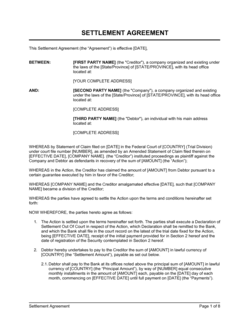
A settlement agreement records the specific terms the parties have already agreed to resolve a dispute β€” it is the outcome document. A mediation agreement governs the process used to reach that outcome. The mediation agreement comes first; if mediation succeeds, the resulting terms are then captured in a separate settlement agreement signed by all parties.

vs Dispute Resolution Clause (Contract Addendum)

A dispute resolution clause is embedded in an existing contract before any dispute arises, committing parties to a specified resolution process if a conflict occurs. A mediation agreement is signed after a dispute has already emerged to govern a specific mediation session. The clause creates the obligation; the mediation agreement executes it.

vs General Release Agreement

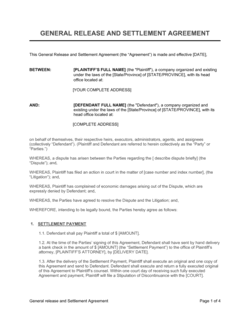
A general release is a post-settlement document in which one party relinquishes all current and future claims against another in exchange for consideration. A mediation agreement governs the process of attempting to reach that settlement β€” it does not itself release any claims. Parties often execute a general release as part of or alongside a settlement agreement after successful mediation.

Industry-specific considerations

Construction

Payment disputes, defect claims, and subcontractor disagreements are routinely mediated under AIA and AGC contract dispute-resolution frameworks before costly litigation.

Professional Services

Fee disputes, scope-of-work disagreements, and professional liability claims between agencies, consultants, and clients are well-suited to short-form mediation given the ongoing relationship value both parties typically want to preserve.

Real Estate

Commercial lease disputes, purchase agreement failures, and landlord-tenant conflicts frequently reference mediation clauses in underlying contracts, making a short-form agreement the standard first step.

Technology / SaaS

IP ownership disputes, SLA breach claims, and software development contract disagreements often include mediation clauses that require a short-form agreement before either party can escalate to arbitration or litigation.

Financial Services

Regulatory constraints mean financial services firms often prefer mediation over public litigation to resolve adviser-client, inter-bank, or fintech partnership disputes confidentially.

Healthcare

Vendor contract disputes, joint-venture breakdowns between practices, and billing disagreements with insurers are increasingly resolved through structured mediation to avoid the cost and publicity of court proceedings.

Jurisdictional notes

United States

The Uniform Mediation Act (UMA), adopted in approximately 12 states, provides statutory confidentiality for mediation communications. In non-UMA states, protection relies on contract and common law. Courts routinely enforce mediation clauses and will stay litigation pending completion. The FRE and most state evidence rules independently protect settlement communications under Rule 408, though this rule has scope limitations.

Canada

Mediation is widely used and court-encouraged across Canadian provinces. Ontario's civil procedure rules and the ADR Institute of Canada provide established institutional frameworks. Quebec mediation is conducted primarily in French and regulated separately under the Code of Civil Procedure. Courts in most provinces have inherent jurisdiction to stay litigation pending contractually agreed mediation.

United Kingdom

UK courts actively encourage mediation and may impose cost sanctions on a party that unreasonably refuses to mediate β€” confirmed in cases such as Halsey v. Milton Keynes (2004) and reinforced in subsequent Court of Appeal decisions. CEDR and the Centre for Effective Dispute Resolution are the leading institutional providers. Mediation communications are protected by the without-prejudice rule and contract confidentiality.

European Union

The EU Mediation Directive (2008/52/EC) establishes a common framework for cross-border civil and commercial mediation, requiring member states to ensure court referral to mediation and enforceability of mediated settlements. Limitation periods are suspended during cross-border mediation under the Directive. Several member states β€” Italy, Germany, and France β€” have mandatory mediation requirements for specific dispute categories before court access is permitted.

Template vs lawyer β€” what fits your deal?

PathBest forCostTime
Use the templateTwo-party commercial disputes where both sides have already agreed to mediate and the dispute value is under $100KFree30 minutes to complete and sign
Template + legal reviewDisputes involving significant contract rights, IP, or employment claims where the limitation period needs careful tolling analysis$200–$500 for a 1-hour lawyer review1–2 business days
Custom draftedMulti-party disputes, high-value commercial claims over $500K, cross-border disputes, or regulated industries requiring tailored procedural rules$800–$3,000+3–7 business days

Glossary

Mediation
A voluntary, confidential process in which a neutral third party helps disputing parties negotiate a mutually acceptable resolution β€” without imposing a decision.
Mediator
The neutral third party who facilitates the mediation session, helps parties communicate, and proposes options β€” but has no authority to impose a binding outcome.
Good Faith Participation
An obligation requiring each party to engage honestly and constructively in the mediation process, attending sessions, sharing relevant information, and genuinely attempting to reach resolution.
Confidentiality Clause
A provision preventing parties from disclosing statements, documents, or offers made during mediation in any subsequent court or arbitration proceeding.
Without Prejudice
A legal protection that prevents communications made during settlement negotiations β€” including mediation β€” from being used as evidence against the disclosing party in later proceedings.
Settlement Agreement
A separate binding written contract recording the specific terms agreed by the parties at the conclusion of a successful mediation.
Caucus
A private session between the mediator and one party only, used to explore positions and options confidentially without the other party present.
Impasse
A point in mediation where the parties cannot reach agreement and the mediator declares the process concluded without settlement.
BATNA
Best Alternative to a Negotiated Agreement β€” each party's realistic fallback option if mediation fails, typically litigation or arbitration.
Med-Arb
A hybrid dispute-resolution process where the parties first attempt mediation; if it fails, the same neutral (or a different one) proceeds to binding arbitration.

Part of your Business Operating System

This document is one of 3,000+ business & legal templates included in Business in a Box.

  • Fill-in-the-blanks β€” ready in minutes
  • 100% customizable Word document
  • Compatible with all office suites
  • Export to PDF and share electronically

Create your document in 3 simple steps.

From template to signed document β€” all inside one Business Operating System.
1
Download or open template

Access over 3,000+ business and legal templates for any business task, project or initiative.

2
Edit and fill in the blanks with AI

Customize your ready-made business document template and save it in the cloud.

3
Save, Share, Send, Sign

Share your files and folders with your team. Create a space of seamless collaboration.

Save time, save money, and create top-quality documents.

β˜…β˜…β˜…β˜…β˜…

"Fantastic value! I'm not sure how I'd do without it. It's worth its weight in gold and paid back for itself many times."

Managing Director Β· Mall Farm
Robert Whalley
Managing Director, Mall Farm Proprietary Limited
β˜…β˜…β˜…β˜…β˜…

"I have been using Business in a Box for years. It has been the most useful source of templates I have encountered. I recommend it to anyone."

Business Owner Β· 4+ years
Dr Michael John Freestone
Business Owner
β˜…β˜…β˜…β˜…β˜…

"It has been a life saver so many times I have lost count. Business in a Box has saved me so much time and as you know, time is money."

Owner Β· Upstate Web
David G. Moore Jr.
Owner, Upstate Web

Run your business with a system β€” not scattered tools

Stop downloading documents. Start operating with clarity. Business in a Box gives you the Business Operating System used by over 250,000 companies worldwide to structure, run, and grow their business.

Free Forever PlanΒ Β·Β No credit card required