Sexual Harassment IQ Test Template

Free Word download β€’ Edit online β€’ Save & share with Drive β€’ Export to PDF

3 pagesβ€’20–30 min to fillβ€’Difficulty: Standardβ€’Signature requiredβ€’Legal review recommended
Learn more ↓
FreeSexual Harassment IQ Test Template

At a glance

What it is
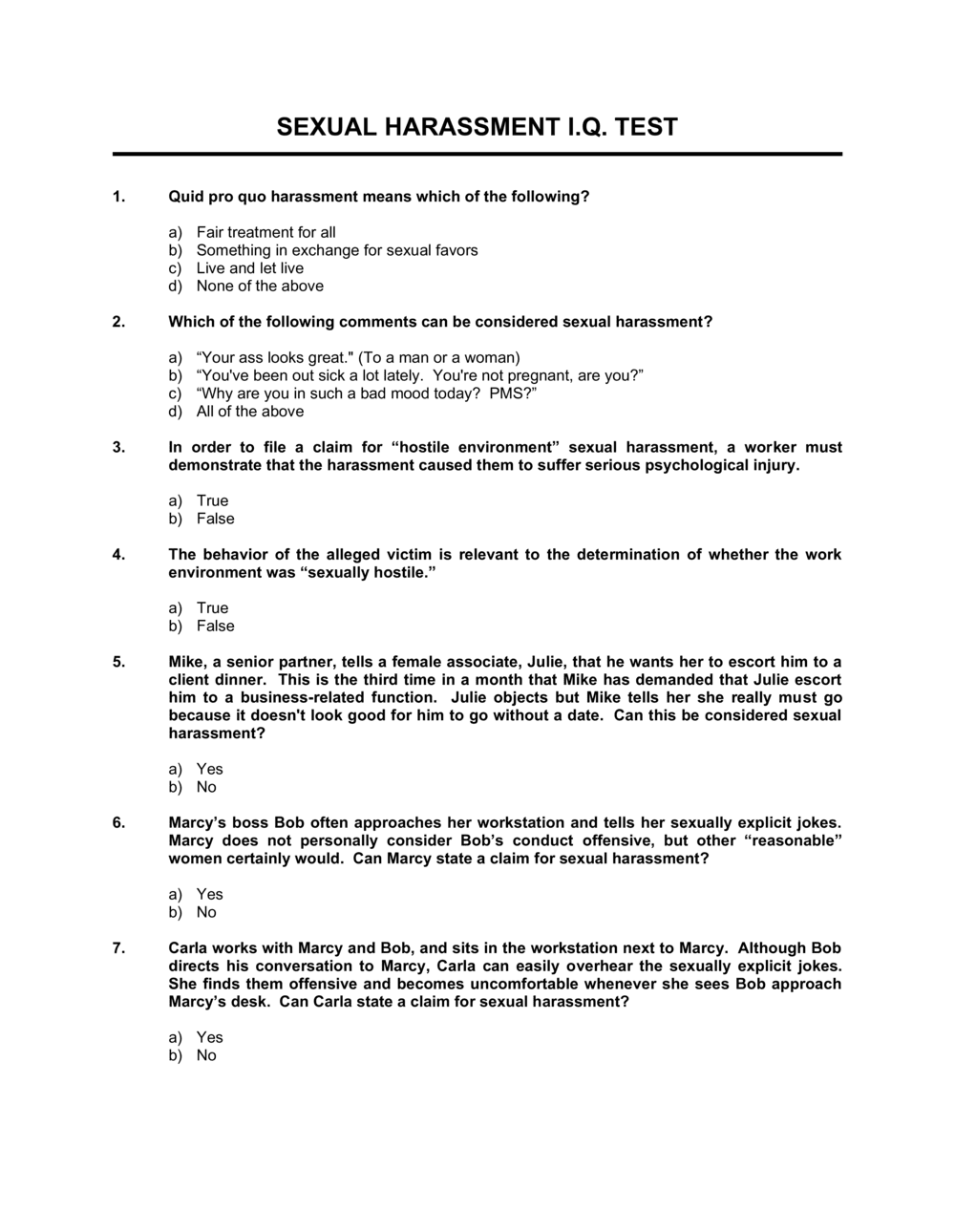
A Sexual Harassment IQ Test is a structured workplace compliance assessment that measures employees' understanding of what constitutes sexual harassment, how to report it, and what the organization's policies require. This free Word download includes scenario-based questions, a scoring key, and an employee acknowledgment section you can customize and export as PDF for training records.
When you need it
Use it during onboarding, annual compliance training cycles, or following an update to your harassment policy. It is also appropriate after a workplace incident to document that remedial training was completed.
What's inside
Scenario-based multiple-choice questions, true/false policy statements, a scoring rubric, space for employee comments, and a signed acknowledgment confirming the employee completed the assessment and reviewed applicable policies.

What is a Sexual Harassment IQ Test?

A Sexual Harassment IQ Test is a structured workplace compliance assessment that measures employees' practical understanding of sexual harassment β€” what it is, how to recognize it, how to report it, and what happens when they do. Unlike a simple policy acknowledgment, the test uses scenario-based questions and scored responses to confirm that employees can apply the organization's harassment prevention policy to realistic situations, not just recite definitions. The completed, signed assessment serves as a training record that employers retain in personnel files as evidence that harassment prevention training was delivered and understood.

Why You Need This Document

Without documented training records, an employer's harassment prevention program has no evidentiary foundation. In US federal harassment litigation, the Faragher-Ellerth affirmative defense requires showing that the employer took reasonable preventive steps β€” and a signed, scored assessment is among the most concrete forms of that evidence. An unsigned policy buried in an employee handbook provides almost no protection compared to a completed assessment showing the employee understood how to report harassment and what conduct is prohibited. Beyond litigation risk, states including California, New York, and Illinois impose statutory training mandates with content and duration requirements; non-compliance carries direct regulatory penalties. This template gives you a customizable, legally grounded starting point that you can tailor to your industry, adapt for supervisory versus non-supervisory staff, and roll out consistently across your entire workforce β€” creating a defensible training record without the cost of a third-party training vendor for standard annual cycles.

Which variant fits your situation?

If your situation is…Use this template
Annual all-staff compliance refresherSexual Harassment IQ Test
Comprehensive written anti-harassment policy for the employee handbookSexual Harassment Policy
Formal complaint intake and investigation recordSexual Harassment Complaint Form
Documenting that an employee read and accepted the harassment policyEmployee Acknowledgment Form
Broader workplace conduct training covering all forms of harassmentWorkplace Harassment Policy
Post-incident remedial training with written confirmationEmployee Warning Letter (Policy Violation)
Manager-level training on responding to harassment complaintsSupervisory Harassment Training Guide

Common mistakes to avoid

❌ Using only true/false questions with no scenario-based items

Why it matters: True/false questions test recall, not judgment. Regulators and courts in EEOC proceedings look for evidence that employees understood how to apply the policy to real situations, not just that they could identify a definition.

Fix: Include at least four scenario-based multiple-choice questions drawn from realistic workplace situations in your industry, and retain completed tests in personnel files as training records.

❌ Setting no minimum passing score

Why it matters: Without a pass threshold, the test becomes a paperwork exercise. An employee who scores 40% has documented evidence they do not understand the policy β€” and the employer has documented evidence it did nothing about it.

Fix: Set a minimum passing score of at least 75–80%, specify what remedial action is triggered by a failing score, and complete that remediation within a defined timeframe such as 10 business days.

❌ Failing to collect and retain signed acknowledgments

Why it matters: In EEOC investigations and harassment litigation, the employer's affirmative defense often rests on proving the employee received training and knew the reporting procedures. An unsigned or unfiled test cannot prove either.

Fix: Require a signature on the acknowledgment block before the employee receives their score, and file every completed form in the employee's personnel record immediately.

❌ Distributing the test without updating it after a policy revision

Why it matters: A test tied to an outdated policy may reference superseded procedures or incorrect contact information. If an employee follows the test's instructions and reaches a defunct reporting channel, the employer's knowledge of the incident is harder to establish.

Fix: Assign a version number and effective date to both the policy and the test, and issue a new test version any time the underlying policy is amended.

❌ Omitting retaliation from the assessment entirely

Why it matters: Retaliation charges account for more than half of EEOC filings. Employees who understand harassment but not retaliation may discourage colleagues from reporting, or engage in retaliatory behavior without recognizing it as prohibited conduct.

Fix: Include at least two questions specifically on retaliation β€” what it looks like, who is protected, and how it is reported β€” and cross-reference the retaliation prohibition in the acknowledgment text.

❌ Using the same test for supervisors and non-supervisory employees

Why it matters: Supervisors have distinct legal obligations: they are required to report harassment they observe or learn of, and they are held to a higher standard of conduct. A test that does not address supervisory duties creates a training gap regulators will identify.

Fix: Maintain separate test versions for supervisors and individual contributors, with additional scenario questions for supervisors covering their mandatory reporting and response obligations.

The 9 key clauses, explained

Instructions and assessment purpose

In plain language: Explains to the employee why they are completing the test, what the score means, and how results will be used by the employer.

Sample language
This assessment is designed to measure your understanding of [COMPANY NAME]'s Sexual Harassment Prevention Policy. Completion is required as part of [ONBOARDING / ANNUAL TRAINING]. Results are confidential and will be retained in your personnel file.

Common mistake: Omitting a clear statement of purpose β€” employees who do not understand why they are being assessed are more likely to treat it as a formality, reducing its value as a training tool and a legal record.

Definition questions (quid pro quo)

In plain language: Scenario and definitional questions testing whether the employee can identify quid pro quo harassment in realistic workplace situations.

Sample language
A supervisor tells a subordinate that a positive performance review depends on going to dinner with them. This is an example of: (a) acceptable workplace mentoring, (b) quid pro quo harassment, (c) friendly social interaction, (d) none of the above.

Common mistake: Using only textbook definitions without scenarios. Courts and regulators look for evidence that employees understood how policies apply to real situations, not just that they could recite a definition.

Hostile work environment questions

In plain language: Questions testing the employee's ability to distinguish casual workplace behavior from conduct that could create a legally actionable hostile environment.

Sample language
A coworker repeatedly shares sexually explicit jokes in team meetings after being asked to stop. This behavior: (a) is acceptable if others laugh, (b) may constitute a hostile work environment, (c) only matters if directed at one person, (d) is not the employer's responsibility.

Common mistake: Framing hostile environment questions as binary obvious choices. Real-world situations are ambiguous β€” test questions should reflect that ambiguity so employees practice applying judgment.

Bystander and reporting obligations

In plain language: Questions covering what witnesses to harassment are expected to do and how to report incidents using the company's complaint process.

Sample language
You observe a colleague being subjected to unwanted physical contact by a supervisor. As a bystander, you should: (a) assume it is a personal matter, (b) report what you witnessed to HR or [DESIGNATED CONTACT] within [X] business days, (c) speak privately to the harasser only, (d) take no action unless asked.

Common mistake: Leaving bystander obligations undefined β€” if employees don't know they have a responsibility to report observed harassment, the organization loses an early-detection layer and may face liability for ignoring known conduct.

Retaliation prohibition questions

In plain language: Questions confirming the employee understands that reporting harassment or participating in an investigation is protected activity and that retaliation is independently prohibited.

Sample language
An employee who reports a harassment complaint is later denied a promotion. This situation: (a) is unrelated to the complaint if the decision was performance-based, (b) may constitute unlawful retaliation, (c) is only retaliation if the denial is in writing, (d) is permitted if the complaint was found unsubstantiated.

Common mistake: Not covering retaliation at all. Retaliation claims are the most frequently filed EEOC charge category β€” if employees do not understand the prohibition, the training fails its most practically important objective.

Company reporting procedures

In plain language: Questions and acknowledgment language confirming the employee knows the specific internal channels available for reporting harassment β€” who to contact, how, and within what timeframe.

Sample language
At [COMPANY NAME], harassment complaints should be directed to [HR CONTACT NAME / TITLE] at [EMAIL / PHONE] or to [ALTERNATIVE CONTACT] if the complaint involves that person. Reports may also be submitted anonymously via [HOTLINE / PORTAL].

Common mistake: Referencing a generic 'your manager or HR' without named contacts or alternatives. If the harasser is the employee's manager, a vague instruction leaves the employee with no actionable path.

Scoring key and pass threshold

In plain language: Defines the score required to demonstrate satisfactory understanding and states what happens if an employee scores below the threshold β€” typically a mandatory remedial session.

Sample language
A score of [X] out of [Y] ([Z]%) or above indicates satisfactory completion. Employees scoring below [Z]% must complete a [60-minute / 90-minute] remedial training session with [HR / DESIGNATED TRAINER] within [10] business days.

Common mistake: Setting no minimum passing score or failing to specify what happens when an employee scores below it. Without consequences for non-comprehension, the test cannot function as a compliance safeguard.

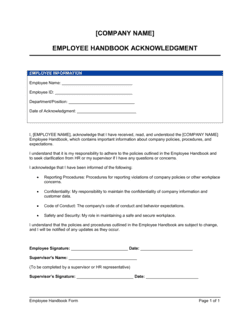
Employee acknowledgment and signature

In plain language: A signed statement confirming the employee completed the assessment, reviewed the current harassment policy, understands their reporting obligations, and acknowledges the company's zero-tolerance position.

Sample language
I, [EMPLOYEE FULL NAME], confirm that I have completed this assessment on [DATE], reviewed [COMPANY NAME]'s Sexual Harassment Prevention Policy (version [VERSION / DATE]), and understand that violations may result in disciplinary action up to and including termination. Signature: _______________ Date: _______________

Common mistake: Collecting signatures without retaining a copy in the personnel file. The signature is only useful as evidence if it can be produced during an EEOC investigation or litigation β€” an unsigned or unfiled form provides no protection.

Supervisor and administrator certification

In plain language: A secondary certification block for the administering HR representative or manager confirming the test was completed under proper conditions and results were recorded.

Sample language
Administered by: [HR REP / MANAGER NAME], [TITLE], on [DATE]. Score recorded: [X/Y]. Remedial action required: Yes / No. Copy retained in personnel file: Yes / No.

Common mistake: Relying solely on the employee's self-report without a supervisor or HR certification. Self-administered tests without an oversight record are difficult to authenticate if the results are later disputed.

How to fill it out

  1. 1

    Customize the company header and policy reference

    Replace all [COMPANY NAME] placeholders with your registered legal entity name and add the version date of the harassment policy the test is tied to. This ensures the form can be matched to the correct policy document during an audit.

    πŸ’‘ Tie every test to a specific policy version number β€” if the policy is updated, issue a new version of the test rather than reusing the old one.

  2. 2

    Adapt questions to reflect your actual workplace scenarios

    Replace generic scenarios with situations realistic for your industry, workplace size, and workforce. Remote-work scenarios, social-media conduct, and third-party harassment (by vendors or clients) should be included if relevant to your context.

    πŸ’‘ Scenario-based questions are more defensible in court than definition-recall questions because they demonstrate applied understanding, not just memorization.

  3. 3

    Set the passing score and remedial process

    Decide on a minimum passing score β€” 80% is a common threshold β€” and document the remedial action employees must complete if they fall short. Write both into the scoring key section.

    πŸ’‘ Keep remedial session records in the same personnel file as the failed test β€” the remediation record is as important as the original score.

  4. 4

    Name specific reporting contacts and channels

    Replace generic 'HR or your manager' language with actual names, titles, emails, and phone numbers of the people designated to receive harassment complaints. Include an alternative contact for situations involving the employee's direct supervisor.

    πŸ’‘ If you use a third-party ethics hotline, include the number and confirm it is operational before distributing the test.

  5. 5

    Distribute and administer under consistent conditions

    Decide whether the test will be self-administered, proctored, or completed in a group session. Apply the same administration conditions to all employees in the same role category to ensure the results are comparable and defensible.

    πŸ’‘ For remote employees, a time-stamped online form with IP logging provides stronger authentication than an emailed PDF.

  6. 6

    Collect signed acknowledgments before returning tests

    Require the employee to sign the acknowledgment block before the test is returned or submitted. Do not allow employees to complete the acknowledgment after reviewing their score β€” the signature should precede feedback.

    πŸ’‘ Collect signatures in the same session as the test β€” a signature added days later raises authenticity questions.

  7. 7

    File completed tests in personnel records

    Retain a copy of each completed, signed test in the employee's personnel file with a notation of the score, date, and whether remedial action was required. Set a calendar reminder for the next training cycle.

    πŸ’‘ Retention periods for training records vary by jurisdiction β€” consult local employment law, but a minimum of 3 years is defensible in most US and Canadian contexts.

  8. 8

    Have HR or legal review the final template before rollout

    Before distributing to employees, have an employment lawyer or senior HR professional review the questions for legal accuracy, jurisdictional compliance, and inadvertent bias in scenario framing.

    πŸ’‘ A single legally inaccurate answer key β€” for example, suggesting that one-time comments cannot constitute harassment β€” can undermine the entire training program if cited in litigation.

Frequently asked questions

What is a sexual harassment IQ test in the workplace?

A sexual harassment IQ test is a structured written assessment used by employers to measure employees' understanding of what constitutes sexual harassment, how to recognize it, and how to report it under the company's policy. It is typically completed as part of onboarding or annual compliance training. The signed and scored test serves as a training record that can support an employer's affirmative defense in harassment litigation by demonstrating that employees received and understood harassment prevention training.

Is sexual harassment training legally required?

In the United States, several states mandate harassment training, including California (AB 1825 and SB 1343), New York, Illinois, and Connecticut. Federal law does not impose a universal training mandate, but the EEOC strongly recommends it and considers training evidence in evaluating employer liability. In Canada, provincial occupational health and safety legislation in Ontario, British Columbia, and Quebec imposes workplace harassment prevention obligations that typically include training. Consult an employment lawyer to confirm the requirements in your specific jurisdiction.

How often should employees complete a sexual harassment awareness assessment?

Annual completion is the most widely adopted standard and is required by several state statutes. California mandates training every two years for supervisors and annual training for non-supervisory staff in organizations with five or more employees. New York requires annual training for all employees. Beyond legal minimums, employers should also administer the assessment during onboarding, after a policy update, and following any workplace incident requiring remedial training.

What score should employees be required to achieve?

Most HR professionals set a minimum passing score of 75–80%. The threshold should be high enough to confirm genuine comprehension but calibrated to the complexity of the questions. Any employee who scores below the threshold should complete a documented remedial training session within a defined timeframe β€” typically 10 business days β€” and retake the assessment. Both the original score and the remediation record should be retained in the employee's personnel file.

Should supervisors and employees complete the same test?

No. Supervisors have distinct legal obligations β€” they are typically required to report harassment they observe or become aware of, regardless of whether the affected employee files a formal complaint. A supervisor- specific version of the test should include scenario questions that address mandatory reporting, how to respond when an employee discloses harassment, and how to avoid retaliation against a complaining employee. Several state statutes, including California's, mandate separate training content and minimum durations for supervisors versus non-supervisory staff.

What should happen when an employee fails the assessment?

The employer should document the failing score, notify the employee privately, and schedule a mandatory remedial training session within a defined window such as 10 business days. After completing remediation, the employee should retake the assessment and achieve the passing score before the record is closed. Do not simply file a failing test without follow-up β€” an employer who documents that an employee did not understand the policy and took no corrective action has created a problematic record in the event of a later complaint.

Can this test be used as evidence in a harassment investigation?

Yes, in two directions. A signed test showing the employee understood the policy and reporting procedures supports the employer's position that the employee had access to complaint channels and chose not to use them. Conversely, a failing test or an absence of any training record can be used to argue the employer failed to take reasonable preventive steps. Retain all completed tests β€” including failing ones with remediation records β€” for at least three years, or longer if required by your jurisdiction's employment records retention rules.

Do remote and hybrid employees need to complete harassment training?

Yes. Remote and hybrid employees are covered by the same harassment prevention obligations as on-site staff. Virtual harassment β€” including conduct over video calls, messaging platforms, and email β€” is subject to the same legal standards as in-person conduct. Employers should ensure the test includes at least one scenario addressing remote-work harassment situations and that the administration process for remote employees produces an authenticated, time-stamped record equivalent to an in-person signed test.

How this compares to alternatives

vs Sexual Harassment Policy

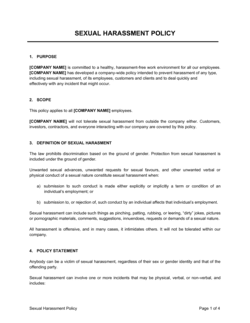
A sexual harassment policy is the governing document that defines prohibited conduct, reporting procedures, and consequences. The IQ test is an assessment tool used to confirm that employees have read and understood the policy. Both documents are needed: the policy creates the legal framework; the test creates the training record that supports the employer's affirmative defense.

vs Sexual Harassment Complaint Form

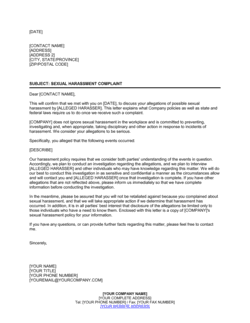
A complaint form is used reactively β€” it captures the details of an alleged incident after it has occurred and initiates the investigation process. The IQ test is used proactively β€” it measures awareness before an incident arises. An employer needs both: the test to demonstrate prevention efforts, and the complaint form to demonstrate a functional response mechanism.

vs Employee Acknowledgment Form

An acknowledgment form records only that the employee received and read a document β€” it does not test comprehension. The IQ test goes further by assessing whether the employee actually understands the policy's application. For compliance purposes, a signed acknowledgment is the minimum; a scored test with a signed acknowledgment is stronger evidence of a genuine training effort.

vs Workplace Harassment Policy

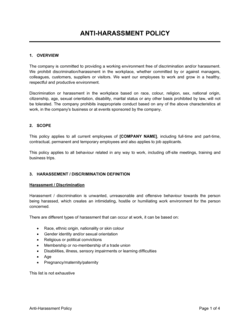
A workplace harassment policy covers all protected-class harassment β€” race, disability, religion, age, and others β€” in addition to sexual harassment. The Sexual Harassment IQ Test focuses specifically on sex-based conduct, which has its own statutory framework and more detailed regulatory guidance. Employers in high-risk industries often maintain both a comprehensive harassment policy and a sex-specific training assessment.

Industry-specific considerations

Financial Services

High-pressure sales environments and client-entertainment norms make harassment awareness training particularly important; FINRA and SEC-regulated firms face heightened scrutiny of workplace conduct records.

Healthcare

Patient-facing staff and hierarchical clinical environments create elevated risk; Joint Commission accreditation standards and state health department audits often include review of harassment training documentation.

Hospitality and Retail

High turnover and frequent customer-facing interactions make regular, easily administered assessments essential; several states require training specifically tailored to industries with tipped employees.

Technology / SaaS

Remote and distributed teams require scenario questions addressing digital communication channels; California's AB 1825 and SB 1343 mandates apply to most tech employers with California-based employees regardless of company headquarters.

Professional Services

Client-facing professionals and partner-track structures create power-imbalance scenarios that should be reflected in assessment questions; law firms and accounting firms face professional licensing consequences for harassment violations.

Manufacturing

Shift-based environments with limited HR access require assessments that are easy to administer on the floor; OSHA's general duty clause and state-specific workplace safety laws intersect with harassment prevention obligations.

Jurisdictional notes

United States

Federal law (Title VII) prohibits sexual harassment but does not mandate employer training. California (AB 1825, SB 1343), New York, Illinois, Connecticut, Delaware, and Maine impose specific training mandates, minimum durations, and content requirements. California requires supervisors to receive two hours of training and non-supervisory employees one hour every two years. The EEOC's 2016 task force report identifies interactive training as a best practice; passive acknowledgment-only approaches are less likely to support an affirmative defense.

Canada

Provincial occupational health and safety and human rights legislation governs harassment prevention. Ontario's Bill 132 (Workplace Safety and Insurance Act amendments) requires written harassment policies, investigation procedures, and training. British Columbia's WorkSafeBC regulations and Quebec's Act Respecting Labour Standards impose similar obligations. Employers in federally regulated industries are subject to the Canada Labour Code Part II, which requires harassment prevention programs. Training records should be retained for the duration of employment plus a minimum of two years in most provinces.

United Kingdom

The UK Equality Act 2010 prohibits sexual harassment and requires employers to take reasonable steps to prevent it. The Worker Protection (Amendment of Equality Act 2010) Act 2023, effective October 2024, imposes a positive duty on employers to proactively prevent sexual harassment β€” making documented training materially more important. The Equality and Human Rights Commission's updated statutory code of practice identifies training as a key reasonable step. Training records should be retained for at least six years given the limitation period for employment tribunal claims.

European Union

The EU Equal Treatment Directive (2006/54/EC) prohibits sexual harassment as a form of sex discrimination. Member state implementation varies significantly: France requires annual training for employers with 250 or more employees under the Rixain Law; Germany's General Equal Treatment Act requires employers to take preventive action; Ireland's Employment Equality Act mandates reasonable steps. GDPR requires that employee training records containing personal data be retained only as long as necessary and be secured against unauthorized access β€” consider anonymizing aggregate scores when retaining summary compliance records.

Template vs lawyer β€” what fits your deal?

PathBest forCostTime
Use the templateSmall to mid-size employers conducting standard annual harassment training with a documented policy already in placeFree1–2 hours to customize and distribute
Template + legal reviewEmployers in states with mandatory training requirements or those who have experienced a prior complaint or investigation$300–$700 for an employment lawyer or HR consultant review3–5 business days
Custom draftedMulti-state employers, heavily regulated industries, or organizations with 250+ employees requiring jurisdiction-specific question sets and tracked digital delivery$1,500–$5,000+ for a custom compliance training program2–6 weeks

Glossary

Quid Pro Quo Harassment
Harassment in which a person in authority conditions employment benefits β€” a promotion, raise, or continued job β€” on an employee's submission to sexual conduct.
Hostile Work Environment
A workplace made intimidating, offensive, or abusive by pervasive conduct based on sex, gender, or other protected characteristics, even without a tangible employment action.
Affirmative Defense
A legal argument available to employers in certain harassment claims that they took reasonable steps to prevent harassment and the employee failed to use available reporting mechanisms.
Protected Class
A group of people sharing a characteristic β€” such as sex, gender identity, or sexual orientation β€” that is legally protected from workplace discrimination and harassment.
Reasonable Person Standard
The legal test asking whether a reasonable person in the same situation would find the conduct hostile, offensive, or abusive β€” used to evaluate harassment claims objectively.
Bystander Intervention
Actions taken by a witness to harassment β€” not the target β€” to interrupt, report, or otherwise address the harassing behavior.
Retaliation
Any adverse employment action taken against an employee for reporting harassment, participating in an investigation, or opposing discriminatory conduct.
Acknowledgment Signature
A signed statement by the employee confirming they completed the assessment, reviewed the policy, and understand the reporting process β€” used as a training record.
Title VII
The US federal statute prohibiting workplace discrimination and harassment based on sex, race, color, religion, and national origin, enforced by the EEOC.
Severity and Pervasiveness
The twin legal thresholds courts apply to determine whether harassment rose to the level of a hostile work environment β€” a single severe incident can qualify, as can repeated less-severe conduct.

Part of your Business Operating System

This document is one of 3,000+ business & legal templates included in Business in a Box.

  • Fill-in-the-blanks β€” ready in minutes
  • 100% customizable Word document
  • Compatible with all office suites
  • Export to PDF and share electronically

Create your document in 3 simple steps.

From template to signed document β€” all inside one Business Operating System.
1
Download or open template

Access over 3,000+ business and legal templates for any business task, project or initiative.

2
Edit and fill in the blanks with AI

Customize your ready-made business document template and save it in the cloud.

3
Save, Share, Send, Sign

Share your files and folders with your team. Create a space of seamless collaboration.

Save time, save money, and create top-quality documents.

β˜…β˜…β˜…β˜…β˜…

"Fantastic value! I'm not sure how I'd do without it. It's worth its weight in gold and paid back for itself many times."

Managing Director Β· Mall Farm
Robert Whalley
Managing Director, Mall Farm Proprietary Limited
β˜…β˜…β˜…β˜…β˜…

"I have been using Business in a Box for years. It has been the most useful source of templates I have encountered. I recommend it to anyone."

Business Owner Β· 4+ years
Dr Michael John Freestone
Business Owner
β˜…β˜…β˜…β˜…β˜…

"It has been a life saver so many times I have lost count. Business in a Box has saved me so much time and as you know, time is money."

Owner Β· Upstate Web
David G. Moore Jr.
Owner, Upstate Web

Run your business with a system β€” not scattered tools

Stop downloading documents. Start operating with clarity. Business in a Box gives you the Business Operating System used by over 250,000 companies worldwide to structure, run, and grow their business.

Start freeΒ Β·Β No credit card required