Sales Engineer Job Description Template

Free Word download • Edit online • Save & share with Drive • Export to PDF

2 pages20–30 min to fillDifficulty: StandardSignature requiredLegal review recommended
Learn more ↓
FreeSales Engineer Job Description Template

At a glance

What it is
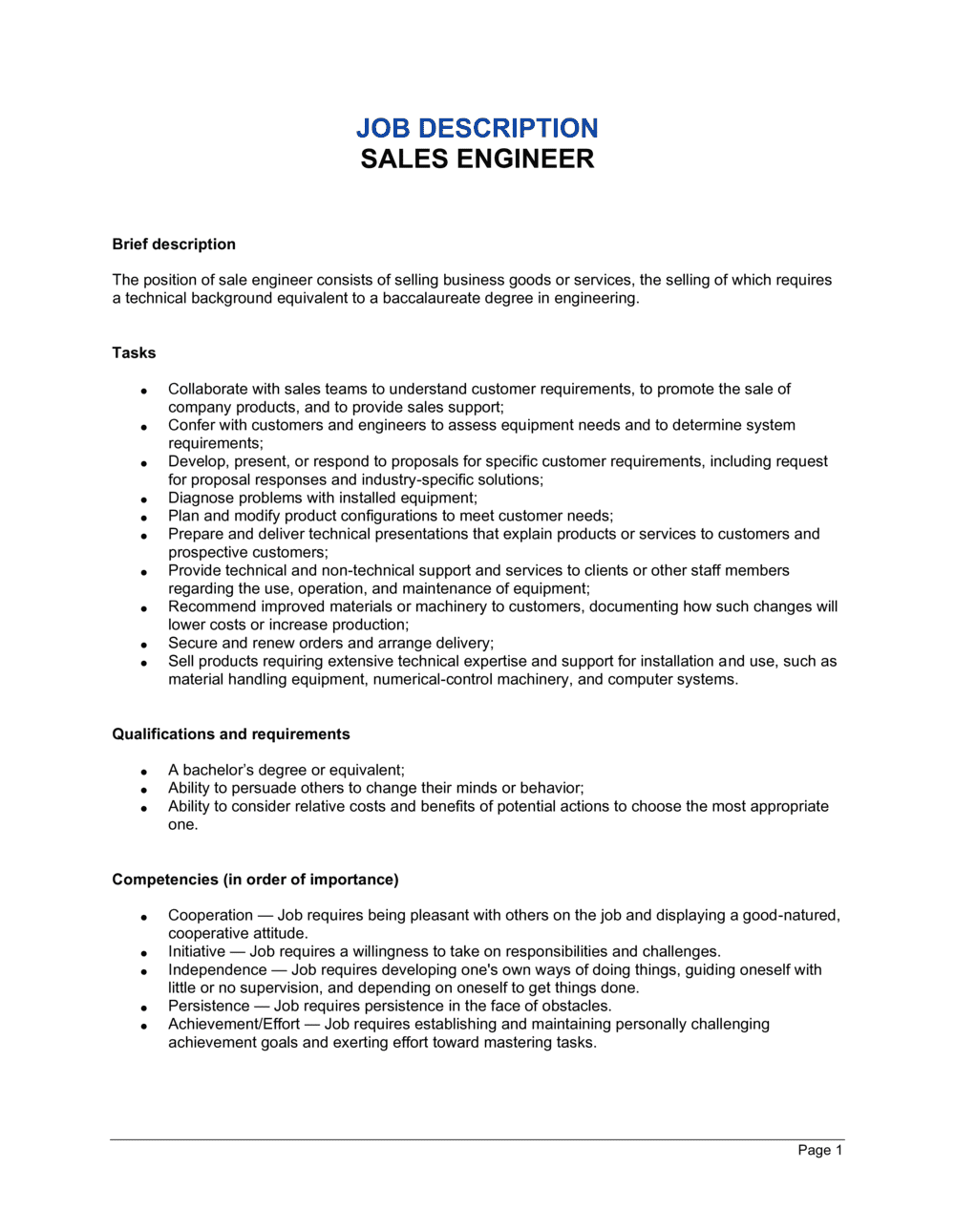
A Sales Engineer Job Description is a formal employment document that defines the duties, technical requirements, compensation structure, reporting relationships, and legal obligations for a sales engineer role. This free Word download gives you an editable, legally structured starting point you can tailor to your product, industry, and jurisdiction, then export as PDF for candidate review and signature.
When you need it
Use it when hiring a sales engineer for a full-time, part-time, or contract position — or when formalizing an existing informal arrangement that currently lacks enforceable written terms covering IP, confidentiality, and non-solicitation.
What's inside
Role title and reporting structure, core duties and technical responsibilities, required and preferred qualifications, compensation and commission structure, IP assignment, confidentiality obligations, non-compete and non-solicitation restrictions, and governing law.

What is a Sales Engineer Job Description?

A Sales Engineer Job Description is a formal employment document that defines the duties, technical qualifications, compensation structure, and binding legal obligations for a sales engineer role. It identifies the employer and candidate as parties, specifies the scope of pre-sales and technical responsibilities, sets measurable performance expectations, and incorporates enforceable clauses covering intellectual property assignment, confidentiality, non-compete restrictions, and termination. When properly executed before the employee's first day, it functions both as a role definition for recruiting purposes and as a legally binding agreement governing the working relationship.

Why You Need This Document

Without a written, signed sales engineer job description, four critical risks remain unaddressed. First, any demo environments, integration scripts, or technical configurations built by the employee may not legally belong to the company — especially for remote engineers working on personal devices. Second, a departing sales engineer faces no enforceable barrier to joining a direct competitor and approaching the accounts they developed on your behalf. Third, commission disputes become credibility contests rather than straightforward contract interpretation when the governing plan is never documented. Fourth, vague or undocumented performance expectations make it difficult to manage or terminate a sales engineer for cause without litigation exposure. This template closes all four gaps in under 30 minutes, with a clear attorney-review pathway for senior or cross-border hires where the stakes are higher.

Which variant fits your situation?

If your situation is…Use this template
Hiring a senior solutions engineer focused on enterprise pre-salesSolutions Engineer Job Description
Engaging a technical sales specialist as an independent contractorIndependent Contractor Agreement
Hiring a full-time sales engineer with equity and complex severanceEmployment Agreement (At-Will)
Defining the broader technical sales team structure and KPIsSales Plan Template
Formalizing performance targets for an existing sales engineerSales Commission Agreement
Onboarding a remote sales engineer in a different jurisdictionRemote Work Employment Agreement
Documenting a sales engineer's annual performance expectationsEmployee Performance Review

Common mistakes to avoid

❌ Omitting the commission plan as an exhibit

Why it matters: A job description that references commissions but does not attach the governing plan leaves the compensation structure open to dispute every time the plan is updated or a quota is missed.

Fix: Attach the current commission plan as Exhibit A, reference it explicitly in the compensation clause, and include a statement that future plan updates will be communicated in writing.

❌ Using a generic sales title instead of 'Sales Engineer'

Why it matters: The title affects FLSA overtime classification, compensation benchmarking, and whether technical IP assignment clauses read as reasonable for the role — courts and regulators look at actual duties, but the title sets the initial framing.

Fix: Use 'Sales Engineer' or the specific variant (Solutions Engineer, Pre-Sales Engineer) that accurately reflects the technical nature of the role and supports the intended FLSA exemption.

❌ Applying an identical non-compete to all sales engineer levels

Why it matters: A 24-month, nationwide non-compete applied to a mid-level sales engineer with regional accounts is routinely struck down as unreasonable, leaving the company with no restriction at all.

Fix: Calibrate duration (6–12 months for most roles), geography (the employee's actual territory), and scope (specific product categories, not the entire industry) to the employee's actual competitive impact.

❌ Signing after the employee's start date

Why it matters: In common-law jurisdictions, an employee already working has provided no new consideration for post-start restrictions — courts have voided IP assignment, non-compete, and confidentiality clauses signed on day two or later.

Fix: Execute the document before day one of employment. If circumstances require a later signature, provide a documented additional benefit — a signing bonus, salary increase, or extra PTO — as fresh consideration at the time of signing.

❌ Defining confidential information as 'everything'

Why it matters: An overbroad confidentiality definition that covers all information without any carve-outs fails the reasonableness test in many jurisdictions, potentially voiding the entire clause and leaving trade secrets unprotected.

Fix: Define confidential information by category — customer data, pricing models, product roadmaps, technical specifications — and include a standard carve-out for information already in the public domain.

❌ No documented performance metrics or quota

Why it matters: Without measurable performance benchmarks written into the job description, terminating a sales engineer for poor performance becomes a credibility dispute rather than a documented breach of objective targets.

Fix: Attach a Schedule A with specific, measurable targets — quarterly pipeline contribution, PoC conversion rate, customer satisfaction score — and specify the review cadence.

The 10 key clauses, explained

Role title, reporting structure, and employment type

In plain language: Identifies the exact job title, the manager or team the sales engineer reports to, the employment classification (full-time, part-time, or contract), and whether the role is remote, hybrid, or on-site.

Sample language
[COMPANY NAME] seeks a [FULL-TIME / PART-TIME] Sales Engineer reporting to the [VP OF SALES / DIRECTOR OF SOLUTIONS ENGINEERING] at our [LOCATION / REMOTE] office. This is an [AT-WILL / FIXED-TERM] position.

Common mistake: Using a generic 'Sales Representative' title instead of 'Sales Engineer' — the distinction affects FLSA exemption eligibility, compensation benchmarking, and the enforceability of technical IP clauses.

Core duties and technical responsibilities

In plain language: Lists the specific pre-sales, demonstration, proof-of-concept, and post-sale support tasks the sales engineer is expected to perform, along with any customer-facing travel or on-site requirements.

Sample language
Employee will (a) lead technical product demonstrations for prospective enterprise clients, (b) build and present proofs of concept tailored to client requirements, (c) respond to technical sections of RFPs and RFIs, and (d) support customer onboarding for the first [X] days post-close.

Common mistake: Defining duties so narrowly that a change in product focus requires a formal contract amendment — build in a catch-all clause granting the employer the right to reasonably adjust responsibilities over time.

Required and preferred qualifications

In plain language: Separates mandatory technical credentials, certifications, and years of experience from preferred qualifications, to avoid excluding strong candidates or exposing the company to claims that the bar was set arbitrarily.

Sample language
Required: [X] years of experience in [INDUSTRY / TECHNOLOGY], proficiency in [PLATFORM / LANGUAGE], and [CERTIFICATION]. Preferred: experience with [TOOL], familiarity with [VERTICAL], and a bachelor's degree in [FIELD] or equivalent.

Common mistake: Listing preferred qualifications as required — overly rigid requirements can narrow the candidate pool unnecessarily and may create disparate-impact exposure in jurisdictions with strict hiring-practice regulations.

Compensation, commission, and OTE

In plain language: States the base salary, the commission or variable pay structure, the OTE at 100% quota attainment, payment frequency, and whether any bonus is discretionary or formulaic.

Sample language
Base salary: $[X] per year, paid bi-weekly. Variable compensation: up to $[X] per year based on [QUOTA METRIC], per the Company's Sales Commission Plan in effect from time to time. OTE at 100% quota: $[X].

Common mistake: Referencing a commission plan without attaching it or making it part of the agreement — if the plan changes and the employee disputes the new terms, the absence of a written baseline creates significant legal exposure.

Intellectual property assignment

In plain language: Transfers ownership of all technical work product — demos, configurations, scripts, integrations, and documentation — created by the employee in connection with their role to the employer.

Sample language
Employee agrees that all work product, configurations, scripts, technical documentation, and other materials created during employment that relate to the Company's business are the sole property of the Company and are hereby irrevocably assigned to the Company.

Common mistake: Scoping the assignment only to work performed on company equipment or premises — sales engineers frequently build demos and integrations remotely on personal devices, which falls outside a premises-limited clause.

Confidentiality

In plain language: Prohibits the employee from disclosing or misusing the company's confidential information — pricing, product roadmaps, customer data, and technical architecture — during and after employment.

Sample language
Employee shall not, during or after employment, disclose or use any Confidential Information of the Company without prior written consent. 'Confidential Information' includes, without limitation, customer lists, pricing models, product roadmaps, and proprietary technical specifications.

Common mistake: Relying on a blanket 'everything is confidential' statement without defining the category — courts apply a reasonableness test, and an overbroad definition risks invalidating the entire confidentiality clause.

Non-compete and non-solicitation

In plain language: Restricts the employee from joining direct competitors or soliciting the company's customers and employees for a defined period and geography after departure.

Sample language
For [12] months following separation, Employee shall not (a) engage with a Competing Business in [GEOGRAPHIC SCOPE], or (b) solicit any customer or employee of the Company with whom Employee had material contact during the preceding [24] months.

Common mistake: Applying the same non-compete duration and scope to a junior sales engineer as to a VP of Sales — courts routinely void overbroad restrictions, leaving no protection at all where a narrower clause would have been enforced.

Performance metrics and quota

In plain language: Documents the measurable outcomes the sales engineer is accountable for — pipeline contribution, win rate, PoC completion rate, or customer satisfaction scores — and the review cadence.

Sample language
Employee is expected to meet or exceed the performance targets set out in Schedule A, including a quarterly pipeline contribution of $[X], a PoC-to-close conversion rate of [X]%, and a customer satisfaction score of [X] or above. Targets will be reviewed [annually / quarterly].

Common mistake: Omitting performance metrics from the job description entirely — without documented benchmarks, performance management and termination-for-cause proceedings become difficult to defend.

Termination, notice, and severance

In plain language: States the notice required from either party to end the relationship, the conditions for immediate termination for cause, and the severance formula, if any.

Sample language
Either party may terminate this Agreement with [X weeks'] written notice. The Company may terminate immediately for Cause. In the event of termination without Cause, Employee shall receive [X weeks per year of service] severance, subject to execution of a release.

Common mistake: Leaving severance undefined or inconsistent with statutory minimums — in Canada and the UK, a contractual severance below the legal floor is void, and the statutory minimum applies regardless.

Governing law and dispute resolution

In plain language: Specifies which jurisdiction's employment law governs the agreement and how disputes are resolved — arbitration, mediation, or litigation.

Sample language
This Agreement is governed by the laws of [STATE / PROVINCE / COUNTRY]. Disputes shall be resolved by binding arbitration in [CITY] under [AAA / JAMS] rules, except that either party may seek injunctive relief in a court of competent jurisdiction.

Common mistake: Selecting a governing law with no connection to where the employee actually works — several jurisdictions, including California, apply local law to employees working within their borders regardless of what the contract states.

How to fill it out

  1. 1

    Enter the employer's legal entity name and location

    Use the full registered corporate name — not a brand name or DBA — and confirm the primary work location or remote designation. This determines the applicable employment law jurisdiction.

    💡 Cross-reference your corporate registry filing to confirm the exact legal entity name before the document is signed.

  2. 2

    Define the role title and reporting structure

    Specify the exact job title, the direct manager's title, and whether the role is individual-contributor or team-lead. Use 'Sales Engineer' rather than a generic sales title to support FLSA exemption and compensation benchmarking.

    💡 If the role has a dotted-line reporting relationship (e.g., to both a regional VP and a technical director), document both lines to avoid authority ambiguity later.

  3. 3

    List core duties with a reasonable adjustment clause

    Itemize the five to eight most critical responsibilities — technical demonstrations, PoC delivery, RFP responses, customer onboarding support — and end with a clause reserving the employer's right to reasonably adjust duties over time.

    💡 Attaching a detailed Schedule A for granular responsibilities keeps the main document clean and lets you update the duties without amending the contract body.

  4. 4

    Separate required from preferred qualifications

    List mandatory credentials, certifications, and minimum years of experience in one block and preferred qualifications in a second. Label each clearly to avoid narrowing the talent pool unnecessarily.

    💡 Review required qualifications against equal-opportunity guidelines in your jurisdiction to avoid inadvertent disparate-impact exposure.

  5. 5

    Complete the compensation and commission block

    Enter base salary, OTE, payment frequency, and the quota metric that drives variable pay. Attach the current commission plan as an exhibit and reference it explicitly in the body.

    💡 State the currency explicitly for any hire working in a different country from the employer's home jurisdiction.

  6. 6

    Calibrate the non-compete and non-solicit terms

    Set duration and geographic scope proportionate to the employee's seniority and customer access. Most enforceable non-competes for sales engineers run 6–12 months and are limited to the specific product categories and territories the employee worked in.

    💡 Check current enforceability rules in the employee's work state or province before finalizing — California, Minnesota, and several EU member states ban most post-employment non-competes.

  7. 7

    Set notice and severance terms above statutory minimums

    Choose a notice period and severance formula, then verify both meet or exceed the statutory floor in the governing jurisdiction. Include a clause making severance conditional on execution of a release.

    💡 In Ontario, common-law notice can reach one month per year of service for long-tenured employees — include an entire-agreement clause confirming the written contract displaces common-law entitlements.

  8. 8

    Execute before the employee's first day

    Both parties must sign before day one of employment. Post-start-date signatures require fresh consideration to make restrictive covenants enforceable in common-law jurisdictions.

    💡 Use a digital signature tool that timestamps execution and stores the fully signed copy automatically — a missing signature on a filed copy creates enforceability questions.

Frequently asked questions

What is a sales engineer job description?

A sales engineer job description is a formal document that defines the duties, technical qualifications, compensation structure, and legal obligations for a sales engineer role. It serves as the binding reference for performance expectations, IP ownership, confidentiality, and post-employment restrictions. Unlike a casual posting, a properly drafted job description creates enforceable obligations on both sides and reduces the risk of disputes over compensation, IP, and competitive conduct after departure.

What does a sales engineer do?

A sales engineer bridges technical product expertise and the sales process. Core responsibilities include leading product demonstrations for prospective customers, building proofs of concept tailored to client requirements, responding to the technical sections of RFPs and RFIs, providing pre-sales support to account executives, and assisting with post-close onboarding. In technology and manufacturing industries, sales engineers often serve as the primary technical voice in enterprise deals.

What qualifications should a sales engineer job description require?

Required qualifications typically include a minimum of 3–5 years of experience in the relevant technology or industry, demonstrated ability to communicate complex technical concepts to non-technical audiences, and proficiency in the company's product category or platform. A bachelor's degree in engineering, computer science, or a related field is commonly preferred. Industry certifications — AWS Solutions Architect, Salesforce, or similar — are often listed as preferred rather than required.

Is a sales engineer job description legally binding?

A job description that includes signed IP assignment, confidentiality, non-compete, and severance clauses is generally enforceable when properly executed in most jurisdictions, provided both parties sign before the employment relationship begins. The enforceability of specific clauses — particularly non-competes — varies significantly by jurisdiction. Consider having an employment lawyer review the document before use, especially for senior hires or cross-border arrangements.

Can I include a non-compete clause in a sales engineer job description?

Yes, but enforceability depends entirely on jurisdiction, seniority, and scope. California, Minnesota, and Oklahoma ban most post-employment non-competes. In jurisdictions that permit them, restrictions must be reasonable in duration (typically 6–12 months), geographic scope (the employee's actual territory), and breadth of activity (the specific product categories the employee worked with). Overbroad clauses are struck down entirely in many states rather than narrowed by a court.

How is a sales engineer different from an account executive?

An account executive owns the commercial relationship and is responsible for closing deals. A sales engineer supports the technical side of the sale — demonstrations, proofs of concept, RFP responses, and technical objection handling. In most organizations, the account executive drives the commercial negotiation while the sales engineer validates the product's fit for the customer's technical environment. Both roles are typically required for complex enterprise sales cycles.

What compensation structure should a sales engineer job description include?

Most sales engineers are compensated on a base-plus-variable model, with OTE at 100% quota typically split 70/30 or 60/40 between base and variable. The variable component is often tied to pipeline contribution, PoC-to-close conversion rate, or a share of closed revenue in the engineer's territory. The job description should state the base salary, OTE at 100%, and reference the governing commission plan as an attached exhibit.

Does a sales engineer job description need to be signed?

If the document includes IP assignment, confidentiality, non-compete, or severance clauses — as it typically should — both parties must sign it for those terms to be enforceable. A job description used purely for recruiting purposes (posted externally without binding legal clauses) does not require a signature, but it provides no legal protection. The binding version should be executed before the employee's first day of work.

What is the difference between a sales engineer job description and an employment contract?

A job description focused on recruiting describes duties, qualifications, and compensation to attract candidates. An employment contract is the binding legal document that governs the full working relationship — including IP, confidentiality, non-compete, termination, and severance. This template combines both functions: it defines the role for recruiting and includes the legal clauses needed to protect the employer. Using it as both documents reduces paperwork and ensures alignment between the advertised role and the signed terms.

How this compares to alternatives

vs Employment Contract (At-Will)

An at-will employment contract is the full governing document for the entire employment relationship — covering termination, benefits, equity, and every material obligation. A sales engineer job description focuses on role-specific duties, qualifications, and technical IP but can incorporate binding legal clauses for use as a standalone agreement. For senior or high-risk hires, a full employment contract is the stronger instrument; for standard sales engineer hires, this template covers the essential legal ground efficiently.

vs Independent Contractor Agreement

An independent contractor agreement engages a self-employed technical sales professional for project-based work with no employment entitlements — no benefits, no tax withholding, and no overtime. Misclassifying a full-time sales engineer as a contractor triggers back taxes, penalties, and potential benefit liability. The key test is the degree of control the company exercises over how the work is performed, not the title on the document.

vs Sales Commission Agreement

A sales commission agreement governs the variable compensation structure — quota, commission rates, accelerators, clawbacks, and payment timing — in standalone detail. A sales engineer job description sets the role framework and references the commission plan but does not replace it. For roles where commission disputes are a realistic risk, both documents should exist and cross-reference each other.

vs Executive Employment Agreement

An executive employment agreement covers the same core legal terms but adds equity grant details, change-of-control provisions, enhanced severance, and D&O indemnification. A sales engineer job description is not appropriate for VP-of-Sales-Engineering or C-suite technical sales leadership roles where equity and material severance exposure are present. Use the executive agreement for director-level and above.

Industry-specific considerations

SaaS / Technology

IP assignment covers product configurations, demo environments, integration scripts, and proprietary data models built during pre-sales engagements.

Manufacturing and Industrial

Technical demonstrations often involve on-site customer visits, equipment handling, and product specifications that require detailed duty and safety obligation clauses.

Financial Services / Fintech

Sales engineers handling regulated products must have confidentiality clauses that explicitly cover client data, trading algorithms, and compliance-sensitive technical documentation.

Healthcare / MedTech

HIPAA data-handling obligations, FDA-regulated product demonstration restrictions, and clinical data confidentiality requirements must be incorporated by reference into the role's legal clauses.

Professional Services

Non-solicitation clauses are particularly important given the relationship-driven nature of the role and the risk of a departing sales engineer taking key accounts to a competitor.

Telecommunications

Multi-site customer environments require detailed travel and on-call obligations, and IP clauses must cover network configuration templates and proprietary integration tooling.

Jurisdictional notes

United States

At-will employment is the default in 49 states. Non-compete enforceability varies sharply by state — California, Minnesota, and Oklahoma ban most post-employment restrictions, and the FTC's proposed near-total ban remains subject to ongoing litigation as of 2025. Sales engineers may qualify as FLSA-exempt under the administrative or highly compensated employee exemptions depending on their specific duties and salary level. Confirm the applicable exemption with an employment attorney before finalizing the compensation structure.

Canada

At-will employment does not exist in Canada. Each province's Employment Standards Act sets minimum notice and termination pay floors — contracts providing less are void. Ontario common-law notice can reach one month per year of service, and contractual severance must be drafted carefully to displace that entitlement. Non-competes are enforceable only if reasonable in scope and duration. Quebec employers must provide the document in French for provincially regulated roles.

United Kingdom

Employers must provide a written statement of employment particulars on or before the first day of work. Statutory minimum notice is one week per year of service after two years, capped at 12 weeks. Garden leave is a commonly used tool for senior sales engineers in transition. Post-termination restrictive covenants — including non-competes and non-solicitation clauses — are enforceable if limited to a legitimate business interest and reasonable in duration and scope.

European Union

The EU Transparent and Predictable Working Conditions Directive requires written employment terms within seven days of hire. Post-employment non-competes typically require financial compensation to the employee — ranging from 25% to 100% of salary depending on the member state — to be enforceable. GDPR obligations must be reflected in the confidentiality clause when the sales engineer handles personal data of EU-resident customers. Member state rules vary significantly; France, Germany, and the Netherlands each impose distinct requirements.

Template vs lawyer — what fits your deal?

PathBest forCostTime
Use the templateStandard domestic full-time sales engineer hires below director level in a single US state or Canadian provinceFree20–30 minutes
Template + legal reviewCross-border hires, senior sales engineers with complex commission structures, or jurisdictions with restrictive non-compete rules$300–$6001–3 days
Custom draftedDirector-level or VP technical sales hires with equity, regulated industries such as healthcare or financial services, or multi-jurisdiction employment$1,500–$4,000+1–2 weeks

Glossary

Sales Engineer
A professional who combines technical product expertise with sales skills to explain complex solutions to prospective customers and support the sales cycle.
Pre-Sales
The stage of the sales process before a deal closes, during which a sales engineer demonstrates the product, answers technical objections, and builds proof-of-concept solutions.
Proof of Concept (PoC)
A limited implementation of a product or solution built to demonstrate technical feasibility to a specific prospective customer.
IP Assignment
A clause transferring ownership of any work product, configurations, or technical materials created by the employee to the employer during the employment relationship.
Non-Compete Clause
A post-employment restriction preventing the sales engineer from working for direct competitors or launching a competing business within a defined time and geography.
Non-Solicitation Clause
A restriction preventing a departing employee from poaching the employer's customers or colleagues for a defined period after leaving.
OTE (On-Target Earnings)
Total expected compensation — base salary plus variable commission or bonus — when the employee achieves 100% of their performance targets.
FLSA Exemption
US classification under the Fair Labor Standards Act determining whether a role qualifies as exempt from overtime pay based on duties, salary level, and salary basis tests.
Confidential Information
Any non-public business data — product roadmaps, customer lists, pricing, technical architecture — that the employee agrees not to disclose or use outside their employment duties.
At-Will Employment
An employment arrangement in most US states where either party may end the relationship at any time, for any lawful reason, without advance notice unless otherwise contracted.
Garden Leave
A notice period during which the departing employee is paid but prohibited from attending work or contacting clients, limiting competitive damage during the transition.

Part of your Business Operating System

This document is one of 3,000+ business & legal templates included in Business in a Box.

  • Fill-in-the-blanks — ready in minutes
  • 100% customizable Word document
  • Compatible with all office suites
  • Export to PDF and share electronically

Create your document in 3 simple steps.

From template to signed document — all inside one Business Operating System.
1
Download or open template

Access over 3,000+ business and legal templates for any business task, project or initiative.

2
Edit and fill in the blanks with AI

Customize your ready-made business document template and save it in the cloud.

3
Save, Share, Send, Sign

Share your files and folders with your team. Create a space of seamless collaboration.

Save time, save money, and create top-quality documents.

★★★★★

"Fantastic value! I'm not sure how I'd do without it. It's worth its weight in gold and paid back for itself many times."

Managing Director · Mall Farm
Robert Whalley
Managing Director, Mall Farm Proprietary Limited
★★★★★

"I have been using Business in a Box for years. It has been the most useful source of templates I have encountered. I recommend it to anyone."

Business Owner · 4+ years
Dr Michael John Freestone
Business Owner
★★★★★

"It has been a life saver so many times I have lost count. Business in a Box has saved me so much time and as you know, time is money."

Owner · Upstate Web
David G. Moore Jr.
Owner, Upstate Web

Run your business with a system — not scattered tools

Stop downloading documents. Start operating with clarity. Business in a Box gives you the Business Operating System used by over 250,000 companies worldwide to structure, run, and grow their business.

Free Forever Plan · No credit card required