Request for Payment_Credit Line Exceeded Template

Free Word download β€’ Edit online β€’ Save & share with Drive β€’ Export to PDF

1 pageβ€’15–20 min to fillβ€’Difficulty: Standard
Learn more ↓
FreeRequest for Payment_Credit Line Exceeded Template

At a glance

What it is
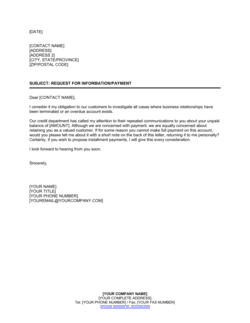
A Request for Payment Credit Line Exceeded is a formal business letter sent by a seller or creditor to a customer whose outstanding balance has surpassed their approved credit limit. This free Word download gives you a ready-to-send notice you can edit online in minutes and export as PDF or send directly to the customer.
When you need it
Send it as soon as an account balance crosses the approved credit ceiling β€” before processing additional orders or extending further goods and services on credit. Early notification reduces the risk of the balance growing beyond a collectible amount.
What's inside
Sender and recipient details, a clear statement of the credit limit and current outstanding balance, a specific payment request with a deadline, a notice that further credit is suspended pending payment, and professional closing language that preserves the customer relationship.

What is a Request for Payment Credit Line Exceeded?

A Request for Payment Credit Line Exceeded is a formal business letter sent by a seller or creditor to a customer whose total outstanding account balance has surpassed their approved credit limit. It states the credit ceiling, the current balance, and the amount by which the limit has been breached, then requests a specific payment by a firm deadline to bring the account back into compliance. The letter also notifies the customer that further purchases on credit terms are suspended until the account is resolved β€” serving as both a collections prompt and a credit-hold enforcement tool.

Why You Need This Document

Without a formal written notice, customers who have exceeded their credit limit may continue placing orders under the assumption that no action will be taken β€” and your exposure grows with every additional shipment. A clearly worded letter creates a documented record of the notification, establishes a payment deadline, and signals that your credit policy is actively enforced. Businesses that skip this step and rely on informal follow-up calls typically collect later and less than those with a consistent written notice process. This template gives you a professional, ready-to-send letter that protects the customer relationship while making the financial stakes unambiguous.

Which variant fits your situation?

If your situation is…Use this template
Customer has exceeded their credit limit for the first timeRequest For Payment Credit Line Exceeded
Customer has an overdue invoice but has not exceeded their credit limitPast Due Payment Request Letter
Customer has ignored previous payment requests and is significantly overdueFinal Demand for Payment Letter
Customer account needs to be formally placed on credit holdCredit Hold Notice
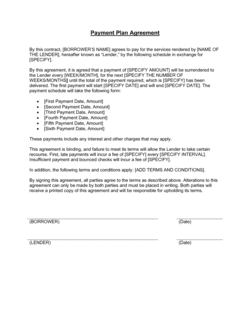
Offering a payment plan to a customer with a large overdue balancePayment Plan Agreement
Referring an unresolved overdue account to a collection agencyDebt Collection Letter

Common mistakes to avoid

❌ Using approximate figures instead of exact balances

Why it matters: A customer who receives a letter with rounded or estimated numbers can question the accuracy of the entire balance and use the discrepancy to delay payment while requesting documentation.

Fix: Pull exact figures directly from your AR system on the day the letter is drafted, and reference the specific invoice numbers that make up the outstanding balance.
❌ Waiting too long after the limit is breached to send the notice

Why it matters: Every week of delay increases the outstanding balance as new invoices accumulate, making the account harder to collect and increasing your bad-debt exposure.

Fix: Set an automated AR alert that triggers a review immediately when any account exceeds 95% of its credit limit, so the letter goes out within one to two business days of the breach.

❌ Demanding full payment of the entire balance as the only option

Why it matters: An all-or-nothing demand for a large balance often triggers a dispute or silence rather than payment, particularly from customers who are genuinely cash-constrained.

Fix: Offer the option to pay the excess amount first to restore credit access, and indicate willingness to discuss a short-term arrangement for the remaining balance.

❌ Omitting the credit suspension notice

Why it matters: Without a clear statement that further credit is suspended, the customer has no urgency to act β€” and your sales team may continue shipping goods against a growing uncollectible balance.

Fix: Always include explicit language that no new orders will be processed on credit terms until the account is resolved, and communicate this to your internal sales and fulfillment teams simultaneously.

The 8 key clauses, explained

Sender and recipient header

In plain language: Identifies the sending company and the customer receiving the notice, including names, addresses, and the date.

Sample language
[YOUR COMPANY NAME] | [ADDRESS] | [CITY, STATE, ZIP] | [DATE] | Attn: [CUSTOMER CONTACT NAME] | [CUSTOMER COMPANY NAME] | [CUSTOMER ADDRESS]

Common mistake: Addressing the letter to a project contact rather than the accounts payable or finance contact β€” the right person never sees it and payment is delayed further.

Subject line

In plain language: A single line that states the purpose of the letter and references the account, so the recipient immediately understands the nature of the notice.

Sample language
Re: Credit Line Exceeded β€” Account #[ACCOUNT NUMBER] | Immediate Payment Required

Common mistake: Omitting the account number in the subject line, making it harder for the customer's AP team to locate and act on the correct account.

Opening statement β€” credit limit and current balance

In plain language: States the customer's approved credit limit and their current outstanding balance clearly and factually, without accusatory language.

Sample language
We are writing to inform you that your account (#[ACCOUNT NUMBER]) currently carries an outstanding balance of $[AMOUNT], which exceeds your approved credit limit of $[CREDIT LIMIT] by $[EXCESS AMOUNT].

Common mistake: Using vague language like 'your account is in a difficult position' instead of quoting the exact figures β€” specificity removes ambiguity and is harder to dispute.

Payment request and deadline

In plain language: Requests payment of a specific amount by a specific date to bring the account back within or below the credit limit.

Sample language
We kindly request that you remit payment of $[REQUESTED AMOUNT] no later than [DUE DATE] to bring your account within your approved credit terms.

Common mistake: Requesting full payment of the entire balance when only the excess amount needs to be cleared to resume normal trading β€” an unreasonable demand can trigger a dispute instead of a payment.

Credit suspension notice

In plain language: Informs the customer that no further orders will be processed on credit until the account is brought back within the approved limit.

Sample language
Please be advised that we are unable to process additional orders on credit terms until this matter is resolved. Existing orders scheduled for shipment may be placed on hold pending receipt of payment.

Common mistake: Omitting the credit suspension notice entirely, leaving the customer with no incentive to prioritize payment and allowing the balance to grow further.

Payment instructions

In plain language: Provides the specific methods and details by which the customer can submit payment β€” bank transfer, check, or online portal.

Sample language
Payment may be submitted via bank transfer to [BANK NAME], Account #[ACCOUNT NUMBER], Routing #[ROUTING NUMBER], or by check payable to [COMPANY NAME], referencing Account #[ACCOUNT NUMBER] in the memo line.

Common mistake: Including payment instructions only in the email body when the letter is attached as a PDF β€” if the recipient forwards only the attachment, the payment details are missing.

Invitation to contact and relationship preservation

In plain language: Encourages the customer to reach out if they have questions or need to discuss a short-term payment arrangement, keeping the tone constructive.

Sample language
If you are experiencing difficulty meeting this obligation, we encourage you to contact [CONTACT NAME] at [PHONE / EMAIL] by [DATE] to discuss available options. We value our relationship with [CUSTOMER COMPANY NAME] and wish to resolve this matter promptly.

Common mistake: Skipping this clause entirely and issuing a purely punitive notice β€” customers who feel they have no options are more likely to dispute the balance than customers who are offered a resolution path.

Closing and authorization

In plain language: Closes the letter professionally with the sender's name, title, and department, confirming the notice comes from a person with authority over the account.

Sample language
Sincerely, [SENDER FULL NAME] | [TITLE] | [DEPARTMENT] | [COMPANY NAME] | [PHONE] | [EMAIL]

Common mistake: Signing as 'The Accounts Receivable Team' with no named individual β€” customers are more likely to respond and pay when there is a named person they can contact directly.

How to fill it out

  1. 1

    Enter your company and customer details

    Add your company's legal name, address, and contact information at the top of the letter. Then enter the customer's full legal entity name, billing address, and the name of their accounts payable or finance contact.

    πŸ’‘ Confirm the AP contact name and email before sending β€” letters addressed to the wrong person routinely go unanswered for weeks.

  2. 2

    Insert the account number and date

    Enter the customer's account number in the subject line and header, and set the letter date to today. The account number is the fastest way for the customer's AP team to locate the record.

    πŸ’‘ Add the account number to the email subject line as well if sending electronically β€” many AP departments filter emails by account reference.

  3. 3

    State the credit limit, current balance, and excess amount

    Pull the exact figures from your accounts receivable system: the approved credit limit, the total outstanding balance, and the dollar amount by which the balance exceeds the limit.

    πŸ’‘ Double-check these numbers against your AR aging report before sending β€” a disputed figure gives the customer a reason to delay payment while they 'investigate'.

  4. 4

    Set the payment amount and deadline

    Specify whether you are requesting the full outstanding balance or the excess amount only, and set a firm due date β€” typically 5 to 10 business days from the letter date.

    πŸ’‘ Requesting only the excess amount is often more effective than demanding the full balance β€” it is a smaller, more achievable ask that gets the account back in good standing faster.

  5. 5

    Confirm the credit suspension language

    Verify that the credit hold notice reflects your actual policy β€” whether all orders are paused or only orders above a certain value. Adjust the template language to match what you will actually enforce.

    πŸ’‘ Only include suspension language you intend to follow through on β€” an empty threat undermines your credibility on future notices.

  6. 6

    Add payment instructions and a named contact

    Enter your bank transfer details or other accepted payment methods directly in the letter body. Add a named contact person with a direct phone number and email for the customer to reach.

    πŸ’‘ If your company uses an online payment portal, include the URL and the customer's login reference β€” it is the fastest path to payment.

  7. 7

    Review, sign, and send

    Proofread for accuracy β€” especially the dollar amounts and due date β€” then export as PDF and send to the customer's AP contact. Send a copy to your sales account manager so they are not blindsided.

    πŸ’‘ Sending the letter via email with a read receipt and following up by phone within 24 hours increases response rates significantly compared to sending by post alone.

Frequently asked questions

What is a request for payment credit line exceeded letter?

It is a formal written notice sent by a seller or creditor to a customer whose outstanding account balance has surpassed their approved credit limit. The letter states the credit limit, the current balance, the amount by which the limit has been exceeded, and requests payment by a specific date to restore the account to good standing. It also typically notifies the customer that further credit purchases are suspended until the matter is resolved.

When should I send a credit line exceeded notice?

Send it as soon as the account balance crosses the approved credit ceiling β€” ideally within one to two business days of the breach. Waiting allows the balance to grow as new invoices are added and reduces the likelihood of full collection. The earlier the notice, the more likely the customer will treat it as a routine correction rather than a collections escalation.

Should I request the full balance or just the excess amount?

Requesting the excess amount β€” the portion above the credit limit β€” is often more effective as an immediate ask. It is a smaller, more achievable figure that brings the account back into compliance quickly and restores the trading relationship. You can separately request payment of older invoices that are approaching or past their due dates.

Does this letter require a signature to be valid?

No formal signature is required for a credit line exceeded notice to be effective. It is a business communication, not a legal instrument. However, including the name and title of a specific individual β€” rather than just a department name β€” makes the notice more credible and gives the customer a direct point of contact, which typically improves response rates.

What happens if the customer ignores this letter?

If the customer does not respond by the stated deadline, escalate to a second formal notice referencing the first letter, then to a final demand for payment. If payment is still not received, consider placing the account on a formal credit hold, referring the balance to a collections agency, or consulting a lawyer about small claims or civil recovery options depending on the amount involved.

Can I continue shipping orders while this letter is outstanding?

This depends on your credit policy, but in most cases it is advisable to pause further credit shipments until the customer pays down the excess. Continuing to ship increases your exposure and signals that the credit limit is not actually enforced. You may offer to fulfill urgent orders on a prepayment or cash-on-delivery basis while the account is under review.

How is this letter different from a standard overdue payment reminder?

An overdue payment reminder focuses on a specific invoice or invoices that have passed their due date. A credit line exceeded notice focuses on the aggregate outstanding balance relative to the approved credit ceiling β€” some of the invoices involved may not yet be technically overdue. The credit line notice is triggered by the total balance, not by the age of any individual invoice.

Should I notify my sales team before sending this letter?

Yes. Always notify the account manager or sales representative responsible for the customer before sending the letter. They may have context about pending payments or disputes that affects the timing or tone of the notice. Blindsiding a sales rep with a collections letter to their key account damages the internal relationship and can cause the customer to receive conflicting messages.

How this compares to alternatives

vs Past due payment reminder

A past due payment reminder targets specific invoices that have missed their due date. A credit line exceeded notice targets the total outstanding balance relative to the approved credit ceiling, regardless of whether individual invoices are technically overdue. Use the reminder when individual invoices are late; use the credit line notice when the aggregate balance is the problem.

vs Final demand for payment letter

A final demand letter is a late-stage escalation used after one or more prior notices have been ignored β€” it typically references previous correspondence and signals imminent legal or collections action. A credit line exceeded notice is an earlier, more neutral notification with a constructive tone. Send the credit line notice first; escalate to a final demand if it goes unanswered.

vs Payment plan agreement

A payment plan agreement is a bilateral document signed by both parties that formalizes a structured repayment schedule for an overdue or overlimit balance. The credit line exceeded letter is a unilateral notice requesting payment. If the customer responds to the notice but cannot pay immediately, move to a payment plan agreement to document the arrangement.

vs Credit application form

A credit application form is used at the start of the customer relationship to establish the credit limit and payment terms. The credit line exceeded notice is issued after the relationship is in place when that limit is breached. The credit application is the front-end control; the exceeded notice is the enforcement mechanism when that control is triggered.

Industry-specific considerations

Wholesale and Distribution

High-volume trade accounts with thin margins make credit limit enforcement critical to prevent a single customer's overextension from creating a cash-flow shortfall.

Manufacturing

Manufacturers often ship goods before payment is received; a credit line exceeded notice is a key tool for pausing production or shipment of pending orders before exposure grows.

Professional Services

Retainer-based and project billing clients can accumulate large balances between billing cycles; the notice is used to pause new work rather than new shipments.

Retail and E-commerce

Trade accounts with retail buyers may have seasonal credit spikes; the notice is commonly used before peak shipping seasons when retailers place large orders against insufficient credit headroom.

Template vs pro β€” what fits your needs?

PathBest forCostTime
Use the templateAny business issuing a standard first notice to a customer whose account has exceeded its approved credit limitFree5–10 minutes per letter
Template + professional reviewBusinesses with complex credit agreements, large overdue balances, or customers who have previously disputed charges$100–$300 for a finance or legal advisor review1–2 hours
Custom draftedHigh-value accounts, legally disputed balances, or situations where collections litigation is being considered$300–$800+ for a collections attorney1–3 days

Glossary

Credit Limit
The maximum outstanding balance a seller agrees to extend to a customer at any one time before requiring payment.
Outstanding Balance
The total amount a customer currently owes, including all unpaid invoices regardless of whether they are yet due.
Credit Line
A pre-approved borrowing or purchasing arrangement that allows a customer to buy goods or services up to a set dollar ceiling on deferred payment terms.
Credit Hold
A temporary suspension of a customer's ability to place new orders on credit, triggered by an overdue balance or exceeded credit limit.
Accounts Receivable
Money owed to a business by its customers for goods or services already delivered but not yet paid for.
Net Terms
A payment deadline expressed as a number of days from the invoice date β€” for example, Net 30 means full payment is due within 30 days.
Aging Report
An accounts-receivable summary that groups outstanding invoices by how long they have been unpaid, typically in 0–30, 31–60, 61–90, and 90+ day buckets.
Bad Debt
An outstanding receivable that is considered uncollectible and written off as a loss on the company's financial statements.
Collections Escalation
The sequential process of moving an overdue account through progressively firmer collection actions β€” reminder, formal notice, final demand, and legal referral.

Part of your Business Operating System

This document is one of 3,000+ business & legal templates included in Business in a Box.

  • Fill-in-the-blanks β€” ready in minutes
  • 100% customizable Word document
  • Compatible with all office suites
  • Export to PDF and share electronically

Create your document in 3 simple steps.

From template to signed document β€” all inside one Business Operating System.
1
Download or open template

Access over 3,000+ business and legal templates for any business task, project or initiative.

2
Edit and fill in the blanks with AI

Customize your ready-made business document template and save it in the cloud.

3
Save, Share, Send, Sign

Share your files and folders with your team. Create a space of seamless collaboration.

Save time, save money, and create top-quality documents.

β˜…β˜…β˜…β˜…β˜…

"Fantastic value! I'm not sure how I'd do without it. It's worth its weight in gold and paid back for itself many times."

Managing Director Β· Mall Farm
Robert Whalley
Managing Director, Mall Farm Proprietary Limited
β˜…β˜…β˜…β˜…β˜…

"I have been using Business in a Box for years. It has been the most useful source of templates I have encountered. I recommend it to anyone."

Business Owner Β· 4+ years
Dr Michael John Freestone
Business Owner
β˜…β˜…β˜…β˜…β˜…

"It has been a life saver so many times I have lost count. Business in a Box has saved me so much time and as you know, time is money."

Owner Β· Upstate Web
David G. Moore Jr.
Owner, Upstate Web

Run your business with a system β€” not scattered tools

Stop downloading documents. Start operating with clarity. Business in a Box gives you the Business Operating System used by over 250,000 companies worldwide to structure, run, and grow their business.

Free Forever PlanΒ Β·Β No credit card required