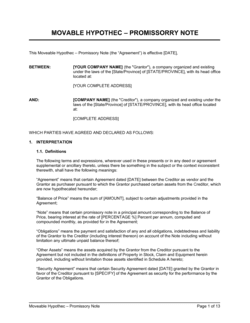
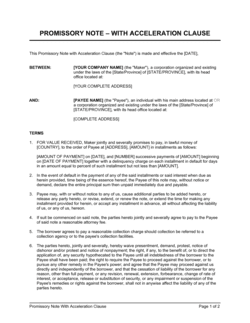
Guarantee of Claim Promissory Note Template

Free Word download β€’ Edit online β€’ Save & share with Drive β€’ Export to PDF

6 pagesβ€’25–35 min to fillβ€’Difficulty: Complexβ€’Signature requiredβ€’Legal review recommended
Learn more ↓
FreeGuarantee of Claim Promissory Note Template

At a glance

What it is
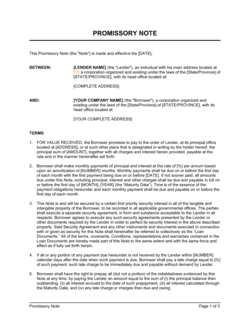
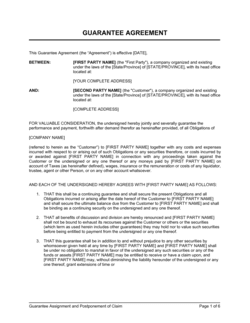
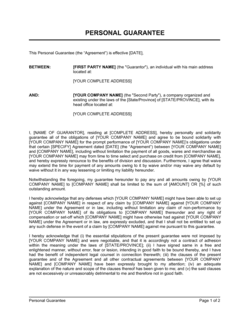
A Guarantee of Claim Promissory Note is a legally binding instrument that combines a borrower's written promise to repay a specified debt with a third-party guarantor's enforceable commitment to satisfy that obligation if the borrower defaults. This free Word download gives lenders, businesses, and private creditors a single, court-ready document covering principal amount, interest rate, repayment schedule, guarantor obligations, and default remedies β€” ready to edit online and export as PDF.
When you need it
Use it when extending credit to a borrower whose standalone creditworthiness is insufficient, when a lender requires a personal or corporate guarantee as a condition of financing, or when formalizing an inter-company loan that requires a named guarantor to backstop repayment.
What's inside
Parties and recitals, principal debt amount and disbursement terms, interest rate and accrual method, repayment schedule and maturity date, guarantor obligations and scope of guarantee, events of default and acceleration, representations and warranties, and governing law and dispute resolution.

What is a Guarantee of Claim Promissory Note?

A Guarantee of Claim Promissory Note is a legally binding instrument that merges two distinct financial obligations into one enforceable document: the borrower's unconditional written promise to repay a specified sum on defined terms, and a third-party guarantor's independent commitment to satisfy that debt if the borrower defaults. Unlike a plain promissory note β€” which creates recourse against the borrower alone β€” this instrument gives the lender a direct claim against both parties simultaneously, secured by the guarantor's personal or corporate assets. It records the principal amount, interest rate, repayment schedule, events of default, and the full scope of the guarantor's obligations, making it the preferred format for private lenders, business creditors, and inter-company financing arrangements where the borrower's standalone creditworthiness requires a backstop.

Why You Need This Document

Without a guarantee of claim promissory note, a lender advancing funds to an undercapitalized borrower has only one avenue of recovery β€” and if that borrower becomes insolvent, the debt may be unrecoverable. A properly executed guarantee closes that gap by making a creditworthy third party independently liable for repayment, converting a single-party credit risk into a two-party recourse structure the lender can enforce in court. For the borrower, the document provides clear and predictable repayment terms that prevent future disputes over interest accrual or payment timing. For the guarantor, it defines the precise scope of exposure β€” principal, interest, costs β€” so there are no surprises if the lender calls on the guarantee. Operating without this document means relying on handshake agreements or incomplete notes that courts routinely decline to enforce as written, leaving all parties in costly litigation over what was actually agreed. This template gives lenders, borrowers, and guarantors a court-ready starting point that covers every material term from disbursement to default in a single, signed instrument.

Which variant fits your situation?

If your situation is…Use this template
Simple loan between two private parties with no guarantorPromissory Note
Personal guarantee standing alone without an attached notePersonal Guarantee Agreement
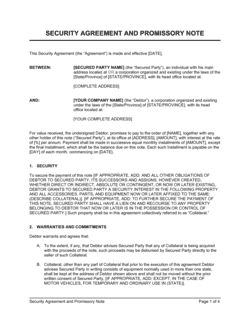
Secured loan backed by specific collateral rather than a guarantorSecured Promissory Note
Loan repayable on demand rather than on a fixed scheduleDemand Promissory Note
Corporate guarantee issued by a parent company for subsidiary debtCorporate Guarantee Agreement
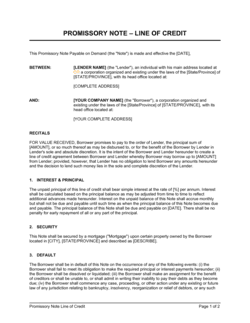
Revolving credit facility with a guarantee covering multiple drawdownsLine of Credit Agreement
Installment loan with collateral and a co-signerLoan Agreement

Common mistakes to avoid

❌ Executing after funds have already been advanced

Why it matters: In common-law jurisdictions, a note signed after disbursement may lack consideration for the guarantor's obligations, making the guarantee unenforceable without proof of a separate benefit received at signing.

Fix: Always execute the note β€” including the guarantee β€” before or simultaneously with fund disbursement, and record the disbursement date in the body of the document.

❌ Omitting the guarantor's waiver of presentment and exhaustion defenses

Why it matters: Without an explicit waiver, many jurisdictions require the lender to demand payment from and exhaust remedies against the borrower before calling on the guarantor β€” adding months of delay and cost to recovery.

Fix: Include a comprehensive waiver clause in which the guarantor explicitly waives presentment, demand, notice of dishonor, and the right to require the lender to proceed first against the borrower.

❌ Setting the default interest rate equal to the contractual rate

Why it matters: If there is no financial penalty for default, the borrower has no economic incentive to cure a missed payment promptly, and the lender loses the compensation that reflects increased collection risk.

Fix: Set the default rate at least 3–5 percentage points above the contractual rate, subject to the applicable usury ceiling, and confirm it applies from the date of default without a grace period.

❌ Failing to verify the guarantor's authority to guarantee

Why it matters: A corporate guarantor whose board has not authorized the guarantee, or an individual guarantor who lacks capacity, can void the guarantee entirely β€” leaving the lender with only the borrower as recourse.

Fix: Require a board resolution or operating-agreement authorization from any corporate or LLC guarantor, and confirm that any individual guarantor is of legal age and not under a legal disability.

❌ Using a rate that violates the governing jurisdiction's usury cap

Why it matters: An interest rate above the legal ceiling can render the entire interest clause void, and in some jurisdictions it exposes the lender to penalties or forfeiture of the principal as well.

Fix: Verify the applicable usury limit for the governing jurisdiction and transaction type before inserting the interest rate β€” commercial loan caps differ from consumer loan caps in most states and provinces.

❌ Leaving the repayment schedule ambiguous with no balloon clause

Why it matters: If monthly installments do not fully amortize the loan by the maturity date and no balloon payment is specified, neither party has clear legal certainty about the final payment obligation, creating a dispute at maturity.

Fix: Either size installments to fully amortize by maturity or add an explicit balloon payment clause stating the exact outstanding balance due on the maturity date.

The 10 key clauses, explained

Parties and recitals

In plain language: Identifies the lender (payee), the borrower (maker), and the guarantor by full legal name, and states the background purpose of the note.

Sample language
This Guarantee of Claim Promissory Note is entered into as of [DATE] by and among [LENDER LEGAL NAME] ('Lender'), [BORROWER LEGAL NAME] ('Borrower'), and [GUARANTOR LEGAL NAME] ('Guarantor').

Common mistake: Naming a trade name instead of the registered legal entity for any party β€” if enforcement is needed, the wrong name on the note forces a court application to correct the record before proceedings can advance.

Principal amount and disbursement

In plain language: States the exact dollar amount lent and how and when the funds will be or have been disbursed to the borrower.

Sample language
Borrower promises to pay to the order of Lender the principal sum of $[AMOUNT] ([WRITTEN AMOUNT] dollars), disbursed on [DATE] by [WIRE / CHECK / ACH] to account ending [XXXX].

Common mistake: Omitting the disbursement method and date β€” if a dispute arises over whether funds were actually advanced, the absence of these details makes the note harder to enforce.

Interest rate and accrual

In plain language: Sets the annual interest rate, the accrual method (simple or compound), and the day-count convention used to calculate interest.

Sample language
Interest shall accrue on the outstanding principal balance at a rate of [X]% per annum, calculated on a 365-day year basis, commencing on the Disbursement Date and continuing until paid in full.

Common mistake: Failing to specify simple versus compound interest β€” courts in some jurisdictions default to simple interest when the method is ambiguous, materially reducing the lender's recovery on long-term notes.

Repayment schedule and maturity date

In plain language: Defines whether repayment is in installments or a lump sum, sets the payment dates, and states the maturity date on which any remaining balance is due.

Sample language
Borrower shall repay the principal and accrued interest in [X] equal monthly installments of $[AMOUNT], due on the [DAY] of each month, commencing [DATE], with all remaining amounts due and payable in full on [MATURITY DATE].

Common mistake: Setting installment amounts that do not fully amortize the principal by the maturity date without including a balloon payment clause β€” this creates an unaddressed gap in the repayment structure.

Guarantor obligations and scope of guarantee

In plain language: Defines the guarantor's commitment β€” whether it is unconditional and absolute, the full scope of amounts covered (principal, interest, fees, costs), and whether the guarantee is continuing.

Sample language
Guarantor unconditionally and irrevocably guarantees to Lender the full and punctual payment of all amounts owing under this Note, including principal, accrued interest, default interest, and reasonable collection costs, without requiring Lender to first proceed against Borrower.

Common mistake: Limiting the guarantee to principal only and omitting interest and costs β€” leaving the lender to absorb collection expenses and accrued interest if the guarantor is called upon to perform.

Events of default and acceleration

In plain language: Lists the specific acts or omissions that trigger default β€” missed payment, insolvency, breach of representation β€” and confirms that all outstanding amounts accelerate and become immediately due.

Sample language
Each of the following constitutes an Event of Default: (a) Borrower fails to make any payment within [X] days of its due date; (b) Borrower or Guarantor becomes insolvent or files for bankruptcy protection; (c) any material representation proves false. Upon an Event of Default, Lender may declare the entire unpaid balance immediately due and payable.

Common mistake: Defining only payment default as a trigger and omitting insolvency, change-of-control, or breach of representations β€” leaving the lender exposed if the borrower's financial position deteriorates without a missed payment.

Representations and warranties

In plain language: The borrower and guarantor confirm that they have the legal capacity and authority to enter into the note, that no prior obligations prevent performance, and that the information provided to the lender is accurate.

Sample language
Each of Borrower and Guarantor represents and warrants that: (a) it has full legal capacity and authority to execute this Note; (b) this Note constitutes a valid and binding obligation; (c) no outstanding indebtedness or legal proceeding prevents performance hereunder.

Common mistake: Omitting representations from the guarantor β€” focusing only on the borrower's warranties leaves the lender without a basis to void the guarantee if the guarantor misrepresented their financial position.

Waiver of defenses and subrogation

In plain language: The guarantor waives common law defenses β€” presentment, notice, demand, and the requirement to exhaust remedies against the borrower β€” and the lender acknowledges the guarantor's subrogation rights after payment.

Sample language
Guarantor waives presentment, demand, notice of dishonor, protest, and any right to require Lender to proceed first against Borrower. Upon full satisfaction of the guaranteed obligations, Guarantor shall be subrogated to Lender's rights against Borrower.

Common mistake: Omitting the waiver of the guarantor's right to require the lender to exhaust remedies against the borrower first β€” without this waiver, the lender may be forced into costly litigation against the borrower before calling on the guarantor.

Default interest and costs of collection

In plain language: Sets a higher interest rate that applies automatically after default and confirms the borrower and guarantor are jointly liable for the lender's reasonable attorney's fees and collection costs.

Sample language
From and after the occurrence of an Event of Default, interest shall accrue at [DEFAULT RATE]% per annum on all outstanding amounts. Borrower and Guarantor shall be jointly and severally liable for all reasonable attorney's fees, court costs, and collection expenses incurred by Lender.

Common mistake: Setting the default rate identical to the contractual rate β€” this removes any financial incentive for the borrower to cure a default promptly.

Governing law and dispute resolution

In plain language: Specifies the jurisdiction whose law governs the note and the mechanism β€” arbitration, mediation, or litigation β€” for resolving disputes.

Sample language
This Note shall be governed by and construed in accordance with the laws of the State of [STATE], without regard to conflict-of-laws principles. Any dispute arising hereunder shall be resolved by binding arbitration in [CITY, STATE] under the rules of [AAA / JAMS], except claims for injunctive relief.

Common mistake: Choosing a governing law with no connection to the parties or the transaction β€” some states' usury caps may make the stated interest rate unlawful, and courts in unrelated jurisdictions add unpredictable delay.

How to fill it out

  1. 1

    Identify all three parties by full legal name

    Enter the lender's, borrower's, and guarantor's complete registered legal names, addresses, and entity types (individual, LLC, corporation). For individuals, include their legal name as it appears on government-issued ID.

    πŸ’‘ Run a quick secretary-of-state search to confirm the exact registered name of any corporate party before filling in the template β€” a mismatch between the note and the registration can delay enforcement.

  2. 2

    Specify the principal amount and disbursement details

    Enter the exact loan amount in both numerals and written-out words to prevent alteration disputes. Record the disbursement date and the method of transfer β€” wire, ACH, or check β€” along with the receiving account reference.

    πŸ’‘ If disbursement occurs in tranches rather than a single advance, attach a drawdown schedule as an exhibit and reference it in this clause.

  3. 3

    Set the interest rate and accrual method

    Enter the annual interest rate and specify whether interest accrues as simple or compound. Confirm the rate does not exceed your state or province's usury cap β€” rates above the legal maximum can void the interest clause entirely.

    πŸ’‘ Check the applicable usury limit before finalizing the rate. In most US states, commercial loan rates are capped between 10% and 25% per annum depending on the lender and transaction type.

  4. 4

    Define the repayment schedule and maturity date

    Choose between installment payments and a lump-sum balloon structure. If installments, enter the payment amount, frequency, and first payment date. Enter the maturity date by which all remaining principal and interest must be paid.

    πŸ’‘ Use an amortization calculator to confirm that the installment amounts you enter will fully repay principal plus interest by the maturity date β€” or explicitly add a balloon payment clause for any remaining balance.

  5. 5

    Scope the guarantor's obligations precisely

    Confirm the guarantee is unconditional and covers principal, interest, default interest, and collection costs. If the guarantor is a corporation, verify that its organizational documents authorize the execution of a guarantee of this size.

    πŸ’‘ For corporate guarantors, request a board resolution authorizing the guarantee before execution β€” without it, the guarantee may be challenged as unauthorized and unenforceable.

  6. 6

    List events of default comprehensively

    Include at minimum: payment default with a specified cure period, insolvency or bankruptcy filing by either the borrower or guarantor, material breach of representations, and any cross-default to other material obligations.

    πŸ’‘ A 5-business-day cure period for payment default is standard β€” it avoids a technical default from a bank processing delay while still giving the lender timely recourse.

  7. 7

    Select governing law and dispute resolution

    Choose the jurisdiction whose courts and law are most convenient for the lender and have a clear connection to the transaction. Decide between litigation and binding arbitration based on the size of the loan and the lender's preference for speed versus formality.

    πŸ’‘ For loans above $250,000, binding arbitration with JAMS or AAA typically resolves disputes 6–12 months faster than state court litigation β€” at a higher upfront cost but lower total cost for complex disputes.

  8. 8

    Execute before funds are advanced

    All three parties β€” lender, borrower, and guarantor β€” must sign the note before or simultaneously with disbursement. Have each party sign in front of a witness or notary if required by the governing jurisdiction.

    πŸ’‘ Send the final execution copy to each party's legal counsel for a 24-hour review before signing β€” this reduces post-execution amendment requests and confirms each party's authority to sign.

Frequently asked questions

What is a guarantee of claim promissory note?

A guarantee of claim promissory note is a single legal instrument that combines two obligations: the borrower's written promise to repay a specified debt on defined terms, and a third-party guarantor's binding commitment to satisfy that debt if the borrower fails to pay. It gives the lender a direct claim against both the borrower and the guarantor, making it significantly stronger than an unsecured promissory note alone.

What is the difference between a promissory note and a guarantee of claim promissory note?

A standard promissory note creates an obligation only between the lender and the borrower. A guarantee of claim promissory note adds a third party β€” the guarantor β€” who is contractually bound to repay the debt if the borrower defaults. The guarantee converts what would be a single-party credit risk into a two-party recourse structure, making it the preferred format when the borrower's standalone creditworthiness is insufficient.

Who signs a guarantee of claim promissory note?

All three parties must sign: the lender (payee), the borrower (maker), and the guarantor. For corporate parties, the signing individual must have authority to bind the entity β€” typically confirmed by a board resolution or operating agreement. The note should be executed before or simultaneously with the disbursement of funds to ensure all obligations are supported by valid consideration.

Is a guarantee of claim promissory note legally binding?

A guarantee of claim promissory note is generally enforceable in most jurisdictions when it is signed by all parties with legal capacity, supported by consideration (the loan disbursement), and contains the essential terms β€” principal, interest, repayment schedule, and guarantor obligations. Enforceability can be affected by usury violations, lack of guarantor authorization, or execution after disbursement. Legal review is recommended, particularly for loans above $50,000 or cross-border transactions.

What happens if the borrower defaults?

Upon a defined event of default β€” typically a missed payment after a short cure period β€” the lender can accelerate the full outstanding balance, making it immediately due. The lender may then demand payment from the borrower, and if an unconditional guarantee is in place, can simultaneously or subsequently demand payment from the guarantor without first exhausting remedies against the borrower. The guarantor then acquires subrogation rights against the borrower for any amounts paid.

Can the guarantor's liability be limited?

Yes. A guarantee can be structured as limited β€” capping the guarantor's exposure at a fixed dollar amount or a percentage of the outstanding balance β€” rather than unconditional and unlimited. Limited guarantees are common in commercial real estate and inter-company lending. However, from the lender's perspective, an unconditional and unlimited guarantee provides the strongest protection and is standard for most private and business lending arrangements.

Does a promissory note guarantee need to be notarized?

Notarization is not required for a promissory note or guarantee to be legally binding in most US states, Canadian provinces, or UK jurisdictions. However, notarization adds evidentiary weight in enforcement proceedings and may be required by certain lenders, jurisdictions, or if the note is to be recorded as a lien against real property. Confirm local requirements when the loan amount is material or real property is involved.

What is the difference between a personal guarantee and a guarantee of claim promissory note?

A personal guarantee is a standalone document in which an individual promises to satisfy another party's debt obligation. A guarantee of claim promissory note integrates that guarantee directly into the note instrument itself, so the lender holds one document that evidences both the debt and the guarantee. For most private lending transactions, the combined format is more convenient and reduces the risk of the guarantee being separated from or inconsistent with the underlying note.

Do I need a lawyer to prepare a guarantee of claim promissory note?

For loans between known parties where the amount is modest and the jurisdiction's usury rules are straightforward, a high-quality template is often sufficient. Legal review is strongly recommended for loans exceeding $50,000, cross-border transactions, corporate guarantors requiring board authorization, or situations where the enforceability of non-compete or IP-assignment obligations is intertwined with the note. A one-hour lawyer review typically costs $200–$500 and is worthwhile for any commercially significant loan.

How this compares to alternatives

vs Promissory Note

A standard promissory note creates a repayment obligation between lender and borrower only. A guarantee of claim promissory note adds a third-party guarantor who is independently bound to pay if the borrower defaults. Use a plain promissory note only when the borrower's creditworthiness is sufficient on its own; add the guarantee clause whenever the lender requires additional security from a third party.

vs Personal Guarantee Agreement

A personal guarantee is a standalone document separate from the underlying note. A guarantee of claim promissory note integrates both obligations into a single instrument, reducing the risk of inconsistency or the guarantee being overlooked. When the guarantee and the note are negotiated simultaneously with the same parties, the combined format is generally preferred for simplicity and enforcement clarity.

vs Loan Agreement

A loan agreement is a more comprehensive lending contract covering covenants, conditions precedent, representations, reporting obligations, and complex default provisions β€” typically used for institutional or multi-tranche financing. A guarantee of claim promissory note is simpler and more suitable for single-advance private loans where a full credit agreement would be disproportionate to the transaction.

vs Line of Credit Agreement

A line of credit agreement governs a revolving facility under which the borrower can draw, repay, and redraw up to a ceiling β€” making the outstanding balance variable. A guarantee of claim promissory note is suited to a fixed, single-advance loan with a defined repayment schedule. If the credit facility is revolving or the exposure fluctuates, a line of credit agreement with a separate continuing guarantee is the appropriate structure.

Industry-specific considerations

Financial Services and Private Lending

Private lenders routinely require a guarantee of claim promissory note for bridge loans, hard-money advances, and peer-to-peer lending where the borrower's credit profile requires a backstop.

Commercial Real Estate

Property developers and landlords use guarantor-backed notes when a special-purpose vehicle lacks standalone creditworthiness, requiring a principal or parent-company guarantee to satisfy the lender.

Manufacturing and Wholesale

Suppliers extending trade credit to undercapitalized buyers use promissory notes with shareholder guarantees to convert open-account receivables into enforceable instruments with personal recourse.

Professional Services

Law firms, accounting practices, and consulting firms advancing fees or loans to partners or associates use guarantee-backed notes to secure repayment from a senior partner or managing entity.

Jurisdictional notes

United States

Promissory notes and guarantees are governed by state law under Article 3 of the UCC for negotiable instruments. Usury caps vary widely β€” most states set commercial loan ceilings between 10% and 25% per annum, but some states (Delaware, South Dakota) have minimal caps for business loans. In California, the statute of frauds requires guarantees to be in writing. California also restricts deficiency judgments in certain real-property-secured note contexts.

Canada

Promissory notes are governed federally by the Bills of Exchange Act, but guarantee enforceability is a matter of provincial contract law. Ontario and BC require guarantees to be in writing under the Statute of Frauds. Quebec's civil law system requires explicit consent from the guarantor's spouse for personal guarantees that may affect the family patrimony. Federal interest provisions cap criminal interest at an effective annual rate of 60%.

United Kingdom

Under the Statute of Frauds 1677, a guarantee must be in writing and signed by the guarantor to be enforceable. English courts apply a strict construction approach to guarantee clauses β€” any ambiguity is typically resolved in the guarantor's favor. The Consumer Credit Act 1974 imposes additional requirements for guarantees given by individuals on consumer loans. Stamp duty is no longer levied on promissory notes in the UK.

European Union

Guarantee law varies significantly across member states. In Germany, personal guarantees by consumers require specific formality requirements (Schriftform) to be binding. French law imposes a written statement requirement under which the guarantor must handwrite the guaranteed amount. The EU Mortgage Credit Directive and Consumer Credit Directive impose disclosure and cooling-off obligations for guarantees on consumer-related credit. GDPR considerations apply when lenders process guarantor personal data in underwriting.

Template vs lawyer β€” what fits your deal?

PathBest forCostTime
Use the templatePrivate loans between known parties, inter-company loans, and loans under $50,000 in a single domestic jurisdictionFree30–45 minutes
Template + legal reviewLoans above $50,000, corporate guarantors requiring board authorization, or borrowers in states with complex usury rules$200–$6001–3 days
Custom draftedCross-border transactions, institutional lenders, loans with security interests in real property, or multi-party guarantee structures$1,000–$4,000+1–2 weeks

Glossary

Guarantor
A third party who agrees to fulfill the borrower's repayment obligation if the borrower defaults β€” making their own assets available to the lender.
Principal Amount
The original sum of money lent, before any interest accrues or payments are made.
Promissory Note
A written, unconditional promise by a borrower to pay a specified sum to a named payee on a defined date or on demand.
Guarantee of Claim
A formal assurance by the guarantor that the lender's claim against the borrower will be satisfied, either by the borrower or by the guarantor directly.
Acceleration Clause
A provision that makes the entire outstanding balance immediately due and payable upon a specified event of default, such as a missed payment.
Unconditional Guarantee
A guarantee that requires the guarantor to pay the lender without first requiring the lender to exhaust remedies against the borrower.
Subrogation
The guarantor's right to step into the lender's shoes and pursue the borrower for reimbursement after the guarantor has satisfied the debt.
Maturity Date
The date on which the full outstanding principal and accrued interest must be repaid in full.
Default Interest Rate
A higher interest rate that applies automatically to any unpaid balance after a payment default, compensating the lender for the increased risk.
Recourse
The lender's legal right to pursue the guarantor's personal or corporate assets to recover an unpaid debt after the borrower fails to pay.
Waiver of Presentment
A clause in which the borrower and guarantor waive their right to formal demand, notice of dishonor, and protest before the lender can enforce the note.

Part of your Business Operating System

This document is one of 3,000+ business & legal templates included in Business in a Box.

  • Fill-in-the-blanks β€” ready in minutes
  • 100% customizable Word document
  • Compatible with all office suites
  • Export to PDF and share electronically

Create your document in 3 simple steps.

From template to signed document β€” all inside one Business Operating System.
1
Download or open template

Access over 3,000+ business and legal templates for any business task, project or initiative.

2
Edit and fill in the blanks with AI

Customize your ready-made business document template and save it in the cloud.

3
Save, Share, Send, Sign

Share your files and folders with your team. Create a space of seamless collaboration.

Save time, save money, and create top-quality documents.

β˜…β˜…β˜…β˜…β˜…

"Fantastic value! I'm not sure how I'd do without it. It's worth its weight in gold and paid back for itself many times."

Managing Director Β· Mall Farm
Robert Whalley
Managing Director, Mall Farm Proprietary Limited
β˜…β˜…β˜…β˜…β˜…

"I have been using Business in a Box for years. It has been the most useful source of templates I have encountered. I recommend it to anyone."

Business Owner Β· 4+ years
Dr Michael John Freestone
Business Owner
β˜…β˜…β˜…β˜…β˜…

"It has been a life saver so many times I have lost count. Business in a Box has saved me so much time and as you know, time is money."

Owner Β· Upstate Web
David G. Moore Jr.
Owner, Upstate Web

Run your business with a system β€” not scattered tools

Stop downloading documents. Start operating with clarity. Business in a Box gives you the Business Operating System used by over 250,000 companies worldwide to structure, run, and grow their business.

Start freeΒ Β·Β No credit card required