Board Resolution Authorizing the Signing of Checks Template

Free Word download • Edit online • Save & share with Drive • Export to PDF

1 page20–30 min to fillDifficulty: StandardSignature requiredLegal review recommended
Learn more ↓
FreeBoard Resolution Authorizing the Signing of Checks Template

At a glance

What it is
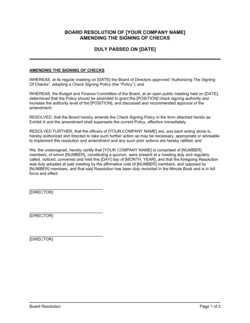
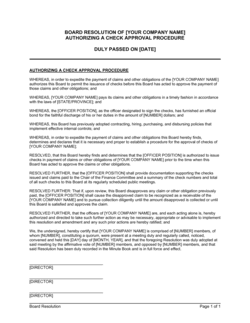
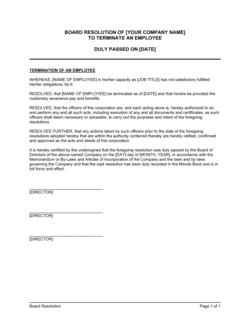
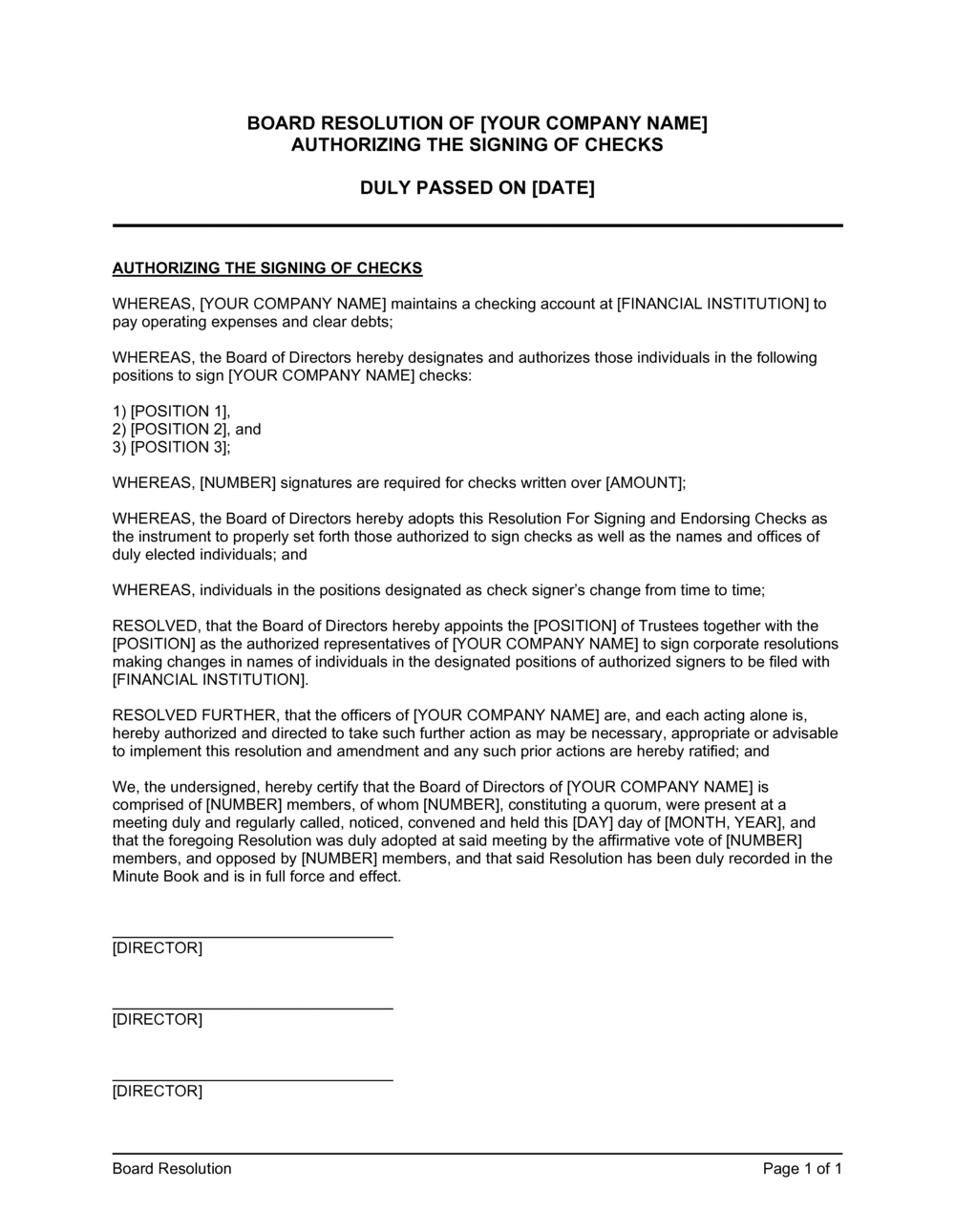
A Board Resolution Authorizing the Signing of Checks is a formal corporate document in which a company's board of directors officially designates one or more individuals to sign checks and disburse funds on behalf of the organization. This free Word download gives you a bank-ready template you can edit online and export as PDF, covering authorized signatories, signing thresholds, account references, and effective date in a single document.
When you need it
Use it when opening a new bank account, changing who is authorized to sign checks after a staffing or leadership change, adding a dual-signature requirement above a spending threshold, or satisfying a bank's internal compliance requirements for corporate account management.
What's inside
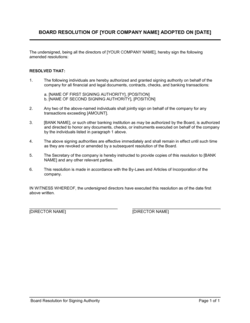
Corporate identification and meeting recitals, names and titles of authorized signatories, signing authority conditions (sole vs. dual signature), account and financial institution details, spending limits per signatory tier, revocation of prior authorizations, and board officer attestation with signature blocks.

What is a Board Resolution Authorizing the Signing of Checks?

A Board Resolution Authorizing the Signing of Checks is a formal corporate document in which a company's board of directors designates one or more specific individuals to sign checks and disburse funds from the organization's bank accounts. It functions as both an internal governance record and an external banking instruction — identifying authorized signatories by full legal name and title, specifying the accounts and financial institution covered, setting any spending thresholds or dual-signature requirements, and formally revoking prior authorizations that are no longer current. Banks require this document before updating their records to reflect a new or changed signatory, and auditors treat it as primary evidence that disbursements were made under proper authority.

Why You Need This Document

Without a current, properly adopted board resolution, your bank has no formal basis to recognize a new check signatory — checks issued by an unauthorized individual may be returned, vendor payments may be delayed, and the company may face internal liability exposure if funds are disbursed without documented board approval. When a CFO, treasurer, or other financial officer changes, a verbal instruction to the bank is not sufficient; most institutions require a certified corporate resolution before updating their compliance records. Beyond the banking relationship, a resolution that sets clear spending thresholds and dual-signature requirements is one of the most effective and low-cost internal controls a business can implement — reducing fraud risk and satisfying the governance requirements of auditors, grant funders, and board fiduciary standards. This template gives you a bank-ready, attorney-reviewed starting point that covers every required element, so you can complete the update in a single meeting rather than discovering gaps when a payment is rejected.

Which variant fits your situation?

If your situation is…Use this template
Authorizing a single officer to sign all checks without a thresholdBoard Resolution Authorizing Signing of Checks (Single Signatory)
Requiring two signatures for checks above a defined dollar amountBoard Resolution — Dual Signature Authorization
Authorizing an officer to open and manage a new bank accountBoard Resolution to Open a Bank Account
Revoking a former officer's check-signing authorityBoard Resolution Revoking Signatory Authority
Authorizing electronic payments and wire transfers in addition to checksBoard Resolution Authorizing Electronic Fund Transfers
Granting a general financial authority package to the CEO or CFOBoard Resolution Authorizing Financial Transactions
Certifying corporate officers to a bank for general account purposesCertificate of Incumbency

Common mistakes to avoid

❌ Using a trade name instead of the registered legal entity name

Why it matters: Banks compare the corporation name on the resolution against the name on file for the account. A mismatch — even a minor one — triggers a compliance review and delays the change taking effect.

Fix: Pull the corporation's articles of incorporation or current registry filing and copy the exact legal name, including entity designator (Inc., LLC, Corp.), before completing the document.

❌ Omitting a spending threshold for check-signing authority

Why it matters: Without a threshold, a single signatory has uncapped authority to disburse corporate funds by check, eliminating a critical internal fraud-prevention control.

Fix: Include a dual-signature requirement for checks above a defined amount. Set the threshold based on your typical transaction size — a common starting point is sole authority up to $5,000 and dual authority above that.

❌ Failing to revoke prior authorizations in the new resolution

Why it matters: If a departing officer's name remains on file at the bank, they may technically retain the ability to sign checks until the bank is formally notified of the change.

Fix: Include an explicit revocation clause and promptly deliver a certified copy of the new resolution to your bank's commercial banking department. Follow up to confirm the prior signatory has been removed from the account.

❌ Having a named signatory also certify the resolution

Why it matters: Self-certification creates a conflict of interest — the person authorizing their own check-signing power is also attesting to the resolution's validity. Banks and auditors may question the document's integrity.

Fix: Designate a director or officer who is not named as an authorized signatory in the resolution to complete the secretary's certification block.

❌ Obtaining fewer director signatures than the bylaws require

Why it matters: A resolution signed by an insufficient number of directors is not validly adopted, meaning any checks signed under its authority could be challenged as unauthorized.

Fix: Review your bylaws before circulating the resolution for signature. If a quorum meeting is required, document the meeting properly; if written consent is permitted, ensure all required signatories execute the consent.

❌ Not delivering a certified copy to the bank before the next check run

Why it matters: A board-passed resolution has no effect on bank operations until the institution receives and processes it. Checks signed by a new signatory before the bank updates its records may be returned.

Fix: Deliver a certified copy of the resolution — with original signatures or a notarized copy if required — to the bank at least 2–3 business days before the new signatory needs to issue checks.

The 9 key clauses, explained

Corporate identification and recitals

In plain language: Identifies the corporation by its full legal name, state or province of incorporation, and confirms that the board meeting was properly convened with a quorum present.

Sample language
WHEREAS, [CORPORATION LEGAL NAME], a [STATE/PROVINCE] [ENTITY TYPE] (the 'Company'), held a duly noticed meeting of its Board of Directors on [DATE], at which a quorum was present and acting throughout;

Common mistake: Using a trade name or DBA instead of the registered legal entity name. Banks compare the resolution to the account-opening documents and will reject a mismatch.

Resolution to authorize signatories

In plain language: The operative clause that formally authorizes named individuals to sign checks on behalf of the corporation, referencing their titles as well as names.

Sample language
RESOLVED, that the following officers of the Company are hereby authorized to sign checks, drafts, and other payment orders drawn on any account maintained by the Company: [FULL NAME], [TITLE]; [FULL NAME], [TITLE].

Common mistake: Listing only a person's name without their corporate title. If the individual's employment ends, there is no clear mechanism for the bank to verify their authorization status by title alone.

Account and bank designation

In plain language: Specifies the financial institution, account number(s), and account type(s) to which the signing authority applies, limiting the resolution's scope to defined accounts.

Sample language
RESOLVED FURTHER, that the foregoing authorization applies to Account No. [ACCOUNT NUMBER] and any other accounts maintained by the Company at [BANK NAME], [BRANCH ADDRESS].

Common mistake: Drafting the resolution without referencing specific account numbers, which can cause compliance officers to reject the document as insufficiently specific for bank purposes.

Signing conditions — sole vs. dual signature

In plain language: Sets out whether a single authorized signatory may act alone or whether two signatories must co-sign, and specifies any threshold above which dual signatures are required.

Sample language
RESOLVED FURTHER, that any authorized signatory acting alone may sign checks up to $[AMOUNT]; checks exceeding $[AMOUNT] shall require the co-signature of a second authorized signatory named herein.

Common mistake: Omitting a spending threshold entirely. Without one, a single signatory technically has unlimited check-writing authority, which removes an important internal fraud control.

Revocation of prior authorizations

In plain language: Formally cancels any previous resolutions or authorizations covering check-signing authority, ensuring the bank acts only on the current document.

Sample language
RESOLVED FURTHER, that all prior resolutions or authorizations granted to any person regarding the signing of checks or payment orders on behalf of the Company are hereby revoked and superseded by this resolution.

Common mistake: Omitting this clause when replacing a former signatory. Without it, the bank may honor checks signed by the removed individual until a separate revocation notice is delivered.

Authority to provide bank certifications

In plain language: Authorizes the corporate secretary or a named officer to deliver certified copies of this resolution to the bank and to execute any additional bank forms required to give effect to the authorization.

Sample language
RESOLVED FURTHER, that the Secretary of the Company is authorized and directed to certify this resolution and to provide copies thereof, together with any required bank signature cards or account forms, to [BANK NAME].

Common mistake: Failing to include this clause, which causes delays when the bank requires its own internal signature card or certification form to be completed alongside the resolution.

Effective date

In plain language: States the date on which the authorization takes effect, which may be the date of the meeting or a later date to align with a staffing transition.

Sample language
This resolution shall be effective as of [DATE] and shall remain in full force and effect until modified or revoked by a subsequent resolution of the Board of Directors.

Common mistake: Leaving the effective date blank or stating 'immediately.' A blank date creates ambiguity about when prior authorizations were superseded, which matters if a check is disputed.

Certification by the corporate secretary

In plain language: A statement signed by the corporate secretary (or equivalent) confirming that the resolution was validly adopted, the date it was passed, and that it has not been amended or rescinded.

Sample language
I, [SECRETARY NAME], Secretary of [CORPORATION LEGAL NAME], hereby certify that the foregoing is a true and correct copy of a resolution duly adopted by the Board of Directors on [DATE], that said resolution has not been amended or rescinded, and that it is in full force and effect.

Common mistake: Having a person certify a resolution in which they are also named as an authorized signatory. This self-certification creates a conflict of interest that some banks and auditors will flag.

Director signatures and attestation

In plain language: Signature blocks for the required number of directors (or all directors, depending on the corporation's bylaws) confirming their vote in favor of the resolution.

Sample language
The undersigned, being all/a majority of the Directors of [CORPORATION LEGAL NAME], hereby consent to and adopt the foregoing resolution as of [DATE]. [DIRECTOR NAME] _________________ Date: _______ [DIRECTOR NAME] _________________ Date: _______

Common mistake: Obtaining fewer signatures than required by the corporation's bylaws for a valid resolution. If bylaws require a majority of the full board, unanimous written consent signatures from only two of five directors are insufficient.

How to fill it out

  1. 1

    Confirm the corporation's legal name and state of incorporation

    Enter the exact registered legal name and state or province of incorporation as they appear on your articles of incorporation. Cross-reference your corporate registry filing before completing this step.

    💡 Banks run the resolution against the account-opening records — even a minor name variation (e.g., 'Inc.' vs. 'Incorporated') can trigger a compliance review.

  2. 2

    Record the board meeting date, location, and quorum

    Enter the date and location of the meeting at which the resolution was passed, and confirm in the recitals that a quorum was present. If using written consent in lieu of a meeting, replace the recitals with the applicable written consent language.

    💡 Check your bylaws for the quorum requirement before completing this field — it is typically a majority of the total number of directors.

  3. 3

    List each authorized signatory by full legal name and title

    Enter the full legal name and current corporate title for every individual being authorized. Use the title as it appears in your corporate records — President, CFO, Treasurer, or similar.

    💡 If an individual holds multiple titles, use the one most closely associated with financial authority. Avoid informal titles like 'Finance Lead.'

  4. 4

    Specify the bank name, branch, and account numbers

    Enter the full name of the depository bank, the branch address, and the specific account numbers to which the authorization applies. If authorizing across multiple accounts, list each separately.

    💡 Call your bank's commercial banking team before finalizing — some institutions require their own resolution form to be completed alongside yours.

  5. 5

    Set the signing threshold and dual-signature conditions

    Decide whether any signatory may act alone for all amounts, or whether a second co-signature is required above a defined dollar threshold. Enter the specific threshold amount in the signing conditions clause.

    💡 A threshold of $5,000–$10,000 for sole signature is common for small to mid-size businesses. Nonprofits receiving grant funding often have tighter controls — check your grant agreement requirements.

  6. 6

    Include revocation language for prior authorizations

    Confirm the revocation clause is present and references any prior resolutions by date if known. Deliver a copy of the new resolution to the bank promptly so the revocation takes effect in their records.

    💡 Follow up with the bank in writing to confirm the prior signatory's credentials have been removed from their system — do not assume the resolution alone is sufficient.

  7. 7

    Have the corporate secretary certify and sign

    The corporate secretary — or another officer not named as an authorized signatory in the resolution — completes the certification block, signs, and dates it. Attach the corporate seal if required by your jurisdiction or bank.

    💡 Keep the original signed resolution in your corporate minute book and deliver a certified copy to the bank. Many banks will not process the change until they hold a signed original or notarized copy.

  8. 8

    Collect director signatures per bylaws requirements

    Obtain signatures from the number of directors required by your bylaws to make the resolution valid — typically a majority of the full board, or all directors if acting by unanimous written consent.

    💡 Date each signature individually at the time of signing. A signature block with a single 'as of' date for multiple directors is weaker evidence of separate, individual consent if the resolution is later challenged.

Frequently asked questions

What is a board resolution authorizing the signing of checks?

A board resolution authorizing the signing of checks is a formal corporate document in which a company's board of directors designates specific individuals to sign checks and disburse funds on the organization's behalf. It identifies the authorized signatories by name and title, specifies the bank accounts covered, sets any spending thresholds or dual-signature requirements, and revokes any prior authorizations. Banks typically require this document before recognizing a new or changed signatory on a corporate account.

When does a company need this resolution?

A company needs this resolution whenever it opens a new bank account, replaces an officer who previously held check-signing authority, adds a new signatory, implements dual-signature controls, or when a bank's compliance team requests updated authorization documentation. Nonprofits may also need one to satisfy funder audit requirements. It is best practice to update the resolution any time the list of authorized signatories changes, rather than waiting for the bank to flag an issue.

Does a board resolution need to be notarized?

In most US states and Canadian provinces, notarization is not required for a board resolution to be legally effective. However, some banks — particularly for high-value accounts or international wire authority — request a notarized copy for their compliance files. Check with your specific bank before finalizing the document. A certified copy signed by the corporate secretary is usually sufficient for standard commercial banking purposes.

What is the difference between a board resolution and a corporate authorization?

A board resolution is the formal action taken by the full board of directors at a properly convened meeting (or by unanimous written consent). A corporate authorization is a broader term that can include delegated authority from a single officer or the board acting under standing authority. For check-signing purposes, most banks specifically require a board resolution — not a simple letter of authorization from the CEO — because it reflects collective governing body approval rather than individual instruction.

Can a single director pass a board resolution?

Only if the corporation has a single director and the bylaws permit sole-director action, or if the single director constitutes a quorum under the articles. For multi-director boards, a resolution typically requires a quorum to be present and a majority vote, or unanimous written consent in lieu of a meeting. A resolution passed without the required quorum or vote is not validly adopted and may be challenged by the bank or in litigation.

How do I update the resolution when a signatory changes?

Pass a new board resolution naming the updated list of authorized signatories, including an explicit clause revoking all prior authorizations. Certify the new resolution and deliver it to the bank with any required signature cards. Do not simply cross out a name on an existing resolution — banks require a fresh, properly adopted document. Update your corporate minute book to reflect the change.

What happens if a check is signed by someone not named in the resolution?

A check signed by an unauthorized individual may be returned by the bank, creating a dishonored payment. Beyond the operational disruption, the signatory could face personal liability for exceeding their authority, and the company may have difficulty recovering funds disbursed without board authorization. Keeping the resolution current and ensuring the bank's records match the current resolution eliminates this risk.

Should the resolution specify a dollar limit per signatory?

Yes — including a spending threshold is strongly recommended as an internal control. A common structure grants sole-signature authority up to a defined amount (e.g., $5,000 or $10,000) and requires dual signatures for checks above that amount. This tiered approach reduces fraud exposure and is often required by auditors, grant funders, and corporate governance best-practice frameworks. Without a threshold, any named signatory has uncapped disbursement authority.

Do nonprofits have different requirements for check-signing resolutions?

Nonprofits generally follow the same corporate resolution process as for-profit entities, but are often subject to stricter controls. Grant agreements frequently require dual signatures above low thresholds (sometimes as low as $1,000), and state charity registration regulators may audit disbursement controls. The board resolution should reflect these requirements precisely, and a copy is often filed with the nonprofit's auditors as part of the annual audit package.

How this compares to alternatives

vs Board Resolution to Open a Bank Account

A resolution to open a bank account authorizes the act of establishing the account relationship itself — designating who may sign the account agreement and initial bank forms. A check-signing resolution governs ongoing disbursement authority after the account exists. In practice, many companies pass both resolutions simultaneously when opening a new account, but each addresses a distinct authorization.

vs Certificate of Incumbency

A certificate of incumbency certifies who currently holds named corporate offices — it confirms identity and title but does not grant any authority. A check-signing resolution actively grants disbursement authority to specific individuals. Banks may require both: the incumbency certificate to verify that the named signatories actually hold the titles claimed in the resolution.

vs Board Resolution Authorizing Financial Transactions (General)

A general financial authority resolution grants an officer broad authority over a range of financial actions — loans, credit facilities, contracts, and payments. A check-signing resolution is narrower, covering only check disbursements from specified accounts. Where broader authority is needed, a general resolution is more appropriate; where the bank specifically requires check authorization, the dedicated resolution is cleaner and less likely to confuse the bank's compliance review.

vs Board Resolution Authorizing Electronic Fund Transfers

An electronic fund transfer resolution covers ACH payments, wire transfers, and online banking authority — payment methods that operate differently from paper checks. A check-signing resolution covers only physical or electronic check instruments. Companies that use both payment types typically need both resolutions, as banks treat check and electronic payment authorizations as separate compliance categories.

Industry-specific considerations

Financial Services

Regulatory compliance requires documented signatory authority; dual-signature thresholds are typically set very low and audited quarterly by internal compliance teams.

Nonprofit Organizations

Grant funders and state charity regulators often audit disbursement controls, making a current board resolution a required document in annual financial reviews.

Real Estate

High-value transactions mean check-signing authority is tightly controlled; escrow agents and title companies routinely request certified copies before releasing funds.

Professional Services

Partnership-structured firms use resolutions to formalize which managing partners hold disbursement authority, particularly following partner changes or firm restructurings.

Jurisdictional notes

United States

State corporate law governs what constitutes a valid board resolution — most states follow the Model Business Corporation Act, requiring a quorum and majority vote or written unanimous consent. Banks are regulated at the federal and state level and set their own internal policies for accepting resolutions; some require signature cards in addition to the resolution. Delaware corporations should confirm whether the resolution must be filed in the minute book under 8 Del. C. § 141.

Canada

Canadian federal corporations under the CBCA and provincial corporations under comparable statutes (e.g., OBCA in Ontario, ABCA in Alberta) may pass resolutions by written consent in lieu of a meeting if all directors entitled to vote sign. Quebec civil law corporations follow similar principles. Most Canadian chartered banks require a certified resolution plus a bank signature card. French-language requirements apply to Quebec-based corporations operating in the province.

United Kingdom

Under the Companies Act 2006, private companies may pass resolutions by written resolution signed by the requisite majority of shareholders (for shareholder matters) or directors. For board-level check-signing authority, a directors' resolution or board minute is the standard instrument. UK banks typically require a certified copy of the resolution and may ask for a copy of the company's articles of association to verify that the board has authority to delegate financial signing power.

European Union

Requirements vary significantly by member state. German GmbHs and AGs follow strict formality requirements under the GmbHG and AktG, and banks may require a notarized or apostilled copy. French SAS and SARL structures delegate signing authority through the statuts or a board decision (procès-verbal). EU anti-money laundering directives (AMLD5 and AMLD6) require banks to verify beneficial ownership and authorized signatories as part of KYC, making a current, signed resolution essential for account maintenance across all member states.

Template vs lawyer — what fits your deal?

PathBest forCostTime
Use the templateSmall to mid-size businesses with straightforward signatory changes at a single domestic bankFree15–30 minutes
Template + legal reviewCompanies with multiple bank accounts, tiered signing thresholds, or recent board composition changes$150–$400 for a one-hour attorney or corporate secretary review1–2 days
Custom draftedPublicly traded companies, regulated financial institutions, multi-jurisdiction banking, or resolutions tied to major financing transactions$500–$2,000+3–7 days

Glossary

Board Resolution
A formal written decision made by a company's board of directors that documents an official action or authorization and serves as a binding corporate record.
Authorized Signatory
An individual formally designated by the board or governing body to sign checks, contracts, or other legal documents on behalf of the organization.
Dual Signature Requirement
A control requiring two authorized individuals to co-sign a check or payment instrument before it can be processed, typically applied above a set spending threshold.
Signing Threshold
A dollar amount above which additional authorization — such as a second signature or board approval — is required before a check may be issued.
Corporate Seal
A stamped or embossed mark used by a corporation to authenticate formal documents; some banks and jurisdictions still require its use on resolutions.
Quorum
The minimum number of board members who must be present or vote for a board resolution to be validly adopted.
Incumbent Officer
A person currently holding a named corporate office — such as President, CFO, or Treasurer — at the time the resolution is passed.
Revocation Clause
A provision in a new resolution that formally cancels any prior resolution or authorization covering the same subject matter.
Attestation
A certified statement by the corporate secretary or another authorized officer confirming that a resolution was duly adopted at a properly convened meeting.
Depository Bank
The financial institution where the corporate account is held and against which authorized checks are drawn.

Part of your Business Operating System

This document is one of 3,000+ business & legal templates included in Business in a Box.

  • Fill-in-the-blanks — ready in minutes
  • 100% customizable Word document
  • Compatible with all office suites
  • Export to PDF and share electronically

Create your document in 3 simple steps.

From template to signed document — all inside one Business Operating System.
1
Download or open template

Access over 3,000+ business and legal templates for any business task, project or initiative.

2
Edit and fill in the blanks with AI

Customize your ready-made business document template and save it in the cloud.

3
Save, Share, Send, Sign

Share your files and folders with your team. Create a space of seamless collaboration.

Save time, save money, and create top-quality documents.

★★★★★

"Fantastic value! I'm not sure how I'd do without it. It's worth its weight in gold and paid back for itself many times."

Managing Director · Mall Farm
Robert Whalley
Managing Director, Mall Farm Proprietary Limited
★★★★★

"I have been using Business in a Box for years. It has been the most useful source of templates I have encountered. I recommend it to anyone."

Business Owner · 4+ years
Dr Michael John Freestone
Business Owner
★★★★★

"It has been a life saver so many times I have lost count. Business in a Box has saved me so much time and as you know, time is money."

Owner · Upstate Web
David G. Moore Jr.
Owner, Upstate Web

Run your business with a system — not scattered tools

Stop downloading documents. Start operating with clarity. Business in a Box gives you the Business Operating System used by over 250,000 companies worldwide to structure, run, and grow their business.

Start free · No credit card required