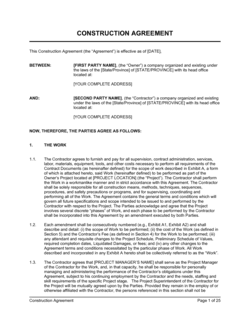
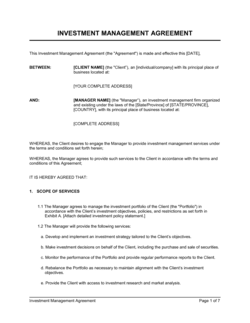
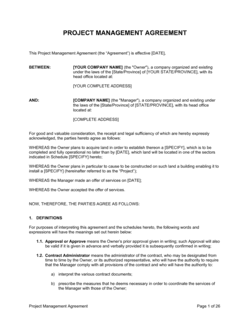
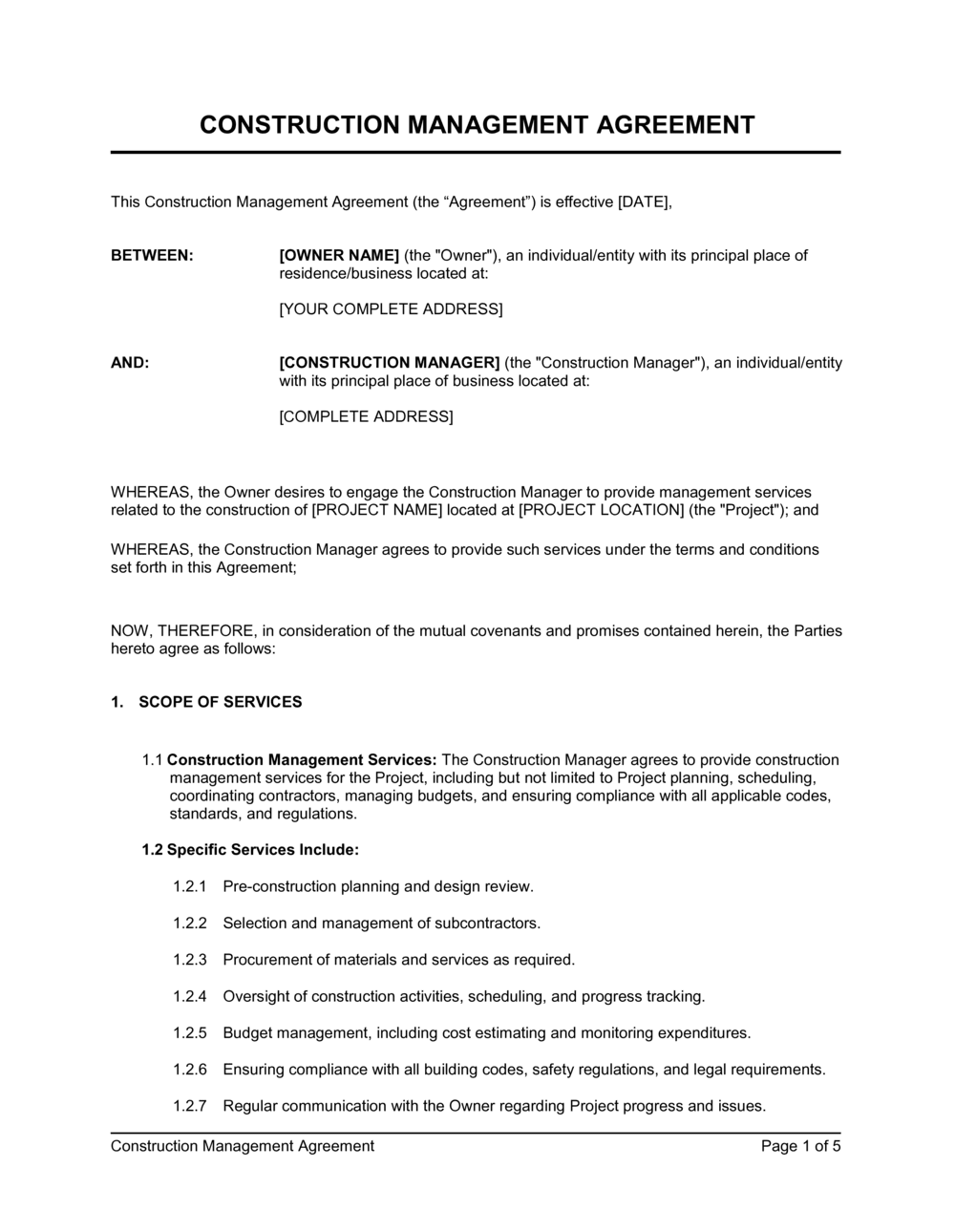
Construction Management Agreement Template

Free Word download • Edit online • Save & share with Drive • Export to PDF

5 pages25–35 min to fillDifficulty: ComplexSignature requiredLegal review recommended
Learn more ↓
FreeConstruction Management Agreement Template

At a glance

What it is
A Construction Management Agreement is a legally binding contract between a property owner and a construction manager (CM) that defines the scope of management services, fee structure, schedule obligations, risk allocation, and termination rights for a construction project. This free Word download gives you a professionally structured starting point you can edit online and export as PDF for execution before any mobilization begins.
When you need it
Use it whenever you engage a professional construction manager to oversee subcontractors, coordinate scheduling, manage budgets, and act as the owner's representative on a commercial, residential, or infrastructure project. It is essential before the CM incurs any project costs on your behalf.
What's inside
Scope of construction management services, compensation model (lump sum, fee-plus-cost, or GMP), project schedule and milestone obligations, authority to bind subcontracts, insurance and indemnification requirements, change order procedures, and termination rights with cost-settlement provisions.

What is a Construction Management Agreement?

A Construction Management Agreement is a legally binding contract between a property owner and a professional construction manager that defines the scope of management services, the compensation model, scheduling obligations, procurement authority, risk allocation, and termination rights for a construction project. Unlike a standard general contractor agreement — where the GC assumes full delivery risk at a fixed price — a CM agreement often preserves the owner's direct relationship with trade contractors while engaging the CM to coordinate, schedule, and oversee the work as the owner's expert representative. The document governs both the preconstruction phase (budgeting, scheduling, procurement planning) and the construction phase (subcontractor coordination, cost reporting, quality oversight, and closeout).

Why You Need This Document

Starting a construction project without a signed CM agreement exposes the owner to unlimited cost liability, no contractual mechanism to enforce the schedule, and no clear authority limits on what the CM can commit in the owner's name. Courts routinely award quantum meruit compensation to CMs who begin work without a written contract — at market rates, without the fee caps, scope limitations, or liability provisions the owner would have negotiated. A properly executed CM agreement locks in the management fee before mobilization, caps the CM's procurement authority to prevent unauthorized spending, establishes a change order process that protects the approved budget, and gives both parties a defined path to resolve disputes — or terminate the relationship — without litigation. This template gives you a professionally structured starting point that covers every material clause, so you can focus negotiation time on project-specific terms rather than building a contract from scratch.

Which variant fits your situation?

If your situation is…Use this template
CM takes full financial risk and guarantees project costConstruction Management at Risk Agreement (CMAR)
CM acts purely as owner's agent with no cost liabilityConstruction Management as Agent Agreement
Single entity designs and builds the projectDesign-Build Agreement
Traditional general contractor hired to deliver a complete scopeGeneral Contractor Agreement
Owner needs a guaranteed maximum price on a cost-plus projectGuaranteed Maximum Price (GMP) Contract
Engaging individual trade contractors directly under CM oversightSubcontractor Agreement
Smaller residential renovation or remodeling projectHome Renovation Contract

Common mistakes to avoid

❌ Vague scope of services

Why it matters: An ambiguous scope clause is the leading cause of CM fee disputes. If the contract says 'manage the project' without specifics, the CM can claim additional compensation for any task the owner assumed was included.

Fix: Attach a detailed Exhibit A that itemizes every service by phase, specifies each deliverable, and explicitly excludes services outside the CM's mandate.

❌ No definition of 'Cost of the Work'

Why it matters: In fee-plus-cost arrangements, an undefined cost-of-work clause allows the CM to pass through overhead, home-office expenses, and markups the owner never intended to pay, inflating the reimbursable cost significantly.

Fix: Define Cost of the Work exhaustively in a dedicated exhibit, listing each allowable cost category and capping or excluding CM overhead, profit on subcontracts, and home-office expenses.

❌ Allowing verbal change order approvals

Why it matters: A single undocumented verbal authorization can unravel a GMP or fixed-fee structure, leaving the owner liable for costs that exceed the approved budget with no written record to contest.

Fix: Insert a clause stating that no change is effective until a written Change Order is signed by both parties, and train project staff to enforce it without exception.

❌ Omitting a termination-for-convenience clause

Why it matters: Without this clause, an owner who needs to cancel the project for business reasons — not CM default — may have no contractual right to terminate, leaving them exposed to a claim for the full remaining fee.

Fix: Include a termination-for-convenience provision that limits the owner's payment obligation to work performed and committed costs through the termination date, plus a defined demobilization allowance.

❌ Governing law jurisdiction misaligned with project location

Why it matters: Construction lien rights, contractor licensing requirements, and statutory warranties are governed by the location where the project is built — not the state where the parties are incorporated. A misaligned governing-law clause cannot override these mandatory local statutes.

Fix: Set the governing law to the state or province where the project is physically located, and confirm that the CM holds an active contractor license in that jurisdiction.

❌ No procurement spending limits

Why it matters: A CM with unlimited authority to enter subcontracts can commit the owner to costs that exceed the approved budget before the owner is aware, eliminating cost control on the project entirely.

Fix: Set a per-contract approval threshold — typically $50,000–$100,000 for mid-scale projects — above which every subcontract requires prior written owner approval, and require competitive bidding for major trade packages.

The 10 key clauses, explained

Parties, Project Description, and Recitals

In plain language: Identifies the owner and the construction manager as legal entities, describes the project by address and scope, and states the intent of the agreement.

Sample language
This Construction Management Agreement ('Agreement') is entered into as of [DATE] between [OWNER LEGAL NAME], a [STATE] [ENTITY TYPE] ('Owner'), and [CM FIRM LEGAL NAME], a [STATE] [ENTITY TYPE] ('Construction Manager'), for the construction of [PROJECT DESCRIPTION] located at [PROJECT ADDRESS].

Common mistake: Using trade names instead of registered legal entity names. If the CM operates under a DBA, the registered entity must appear in the contract — mismatched names complicate lien rights and insurance claims.

Scope of Construction Management Services

In plain language: Enumerates every service the CM is obligated to perform — from preconstruction budgeting through punch-list closeout — and explicitly excludes services not covered.

Sample language
Construction Manager shall provide the following services: (a) preconstruction cost estimating and scheduling; (b) procurement of subcontractors and material suppliers; (c) on-site supervision and quality control; (d) progress reporting to Owner on a [WEEKLY / MONTHLY] basis; and (e) project closeout and documentation, as further described in Exhibit A.

Common mistake: Describing scope in vague terms like 'manage the project.' Ambiguous scope is the single most common source of fee disputes — every material service must be enumerated or excluded in writing.

Compensation and Fee Structure

In plain language: States how the CM is paid — fixed fee, percentage of cost, or fee-plus-cost — and sets out the billing cycle, payment terms, and any performance incentives.

Sample language
Owner shall pay Construction Manager a Construction Management Fee of [LUMP SUM / X% of Cost of the Work], invoiced monthly. Owner shall reimburse the Cost of the Work within [30] days of a properly submitted invoice. Disputed amounts shall not delay payment of undisputed sums.

Common mistake: Failing to define 'Cost of the Work' in the compensation clause. Without a precise definition, the CM and owner will disagree on which expenses are reimbursable, creating invoice disputes on every payment cycle.

Project Schedule and Milestone Obligations

In plain language: Sets the project start date, substantial completion date, and key milestones, along with the CM's obligation to maintain and update the schedule.

Sample language
Construction Manager shall prepare and maintain a project schedule showing key milestones including: [MILESTONE 1] by [DATE], [MILESTONE 2] by [DATE], and Substantial Completion by [DATE]. Construction Manager shall update the schedule monthly and notify Owner immediately of any delay exceeding [5] business days.

Common mistake: Setting only a final completion date without intermediate milestones. Without milestones, the owner has no early-warning mechanism to detect schedule slippage before it becomes a costly delay.

Authority to Enter Subcontracts and Purchase Orders

In plain language: Defines the CM's authority to bind the owner (or the CM itself) to subcontracts and purchase orders, including per-transaction and aggregate spending limits.

Sample language
Construction Manager is authorized to enter into subcontracts and purchase orders on behalf of Owner up to $[SINGLE CONTRACT LIMIT] per contract and an aggregate project cost not exceeding $[TOTAL BUDGET]. Any commitment exceeding these limits requires prior written approval from Owner.

Common mistake: Granting unlimited procurement authority. A CM with no spending ceiling can commit the owner to subcontract costs that far exceed the approved budget, creating significant financial exposure.

Insurance and Bonding Requirements

In plain language: Specifies the types and minimum limits of insurance the CM must maintain — general liability, professional liability, workers' compensation, and builder's risk — and requires the owner to be named as an additional insured.

Sample language
Construction Manager shall maintain: (a) Commercial General Liability insurance with limits of not less than $[X] per occurrence / $[X] aggregate; (b) Professional Liability (Errors & Omissions) of not less than $[X]; (c) Workers' Compensation as required by applicable law; and (d) Automobile Liability of not less than $[X] combined single limit. Owner shall be named as additional insured on all policies except Workers' Compensation and Professional Liability.

Common mistake: Omitting professional liability (E&O) coverage from the insurance requirements. General liability does not cover errors in scheduling, budgeting, or CM decision-making — the most likely sources of construction management claims.

Change Order Procedure

In plain language: Establishes the formal process for modifying scope, cost, or schedule, requiring written authorization from the owner before the CM proceeds with any change.

Sample language
No change to the scope, cost, or schedule of the Project shall be effective unless documented in a written Change Order signed by both parties. Construction Manager shall submit a Change Order Proposal within [5] business days of identifying a potential change, including cost and schedule impact.

Common mistake: Allowing verbal change order approvals as a matter of practice. Undocumented changes are the leading cause of construction disputes — even a single large verbal approval can invalidate the entire fixed-fee or GMP structure.

Indemnification and Limitation of Liability

In plain language: Allocates responsibility for losses, personal injury, property damage, and third-party claims between the owner and CM, and typically caps the CM's aggregate liability at the fee amount or a defined multiplier.

Sample language
Construction Manager shall indemnify and hold harmless Owner from claims arising from Construction Manager's negligence or willful misconduct. Owner shall indemnify and hold harmless Construction Manager from claims arising from Owner's acts, omissions, or pre-existing site conditions. In no event shall Construction Manager's total liability exceed [the total fees paid under this Agreement / $X].

Common mistake: Using a broad mutual indemnification without carving out the indemnifying party's own negligence. Several US states (anti-indemnity statutes) prohibit clauses that require a party to indemnify another for that other party's own negligence — overly broad language can void the entire indemnification clause.

Termination for Convenience and for Cause

In plain language: Grants each party the right to end the agreement under defined conditions, and specifies the cost-settlement process — including work in place, committed costs, and fee earned — upon termination.

Sample language
Owner may terminate this Agreement for convenience upon [14] days' written notice. Upon termination for convenience, Owner shall pay Construction Manager: (a) all costs incurred through the termination date; (b) the pro-rata portion of the Construction Management Fee earned; and (c) reasonable demobilization costs. Either party may terminate for Cause upon [7] days' written notice if the other party materially breaches this Agreement and fails to cure within the notice period.

Common mistake: No termination-for-convenience clause at all. Without one, an owner who needs to pause or cancel the project for business reasons — not breach — may have no contractual right to terminate without paying the full remaining fee.

Governing Law, Dispute Resolution, and Venue

In plain language: Specifies which jurisdiction's law governs the contract and whether disputes go to arbitration, mediation, or litigation — including the venue and any mandatory pre-litigation mediation step.

Sample language
This Agreement shall be governed by the laws of [STATE / PROVINCE]. Any dispute shall first be submitted to non-binding mediation administered by [MEDIATOR / AAA] within [30] days of written notice. If mediation fails, disputes shall be resolved by binding arbitration under [AAA Construction Industry Rules] in [CITY, STATE]. Either party may seek injunctive relief in a court of competent jurisdiction without first mediating.

Common mistake: Specifying a governing law jurisdiction that differs from the project location. Construction law — including lien rights, licensing requirements, and statutory warranties — is location-specific, and a governing-law clause cannot override mandatory local statutes.

How to fill it out

  1. 1

    Enter the legal entity names and project details

    Insert the owner's and CM's full registered legal names, entity types, and state of formation. Include the project address, a brief scope description, and the expected project value.

    💡 Verify the CM's contractor license number and confirm it is active in the project's jurisdiction before executing — unlicensed CM work can void lien rights and expose the owner to statutory penalties.

  2. 2

    Define the scope of services precisely

    Attach a detailed Exhibit A listing every service the CM will perform, broken into preconstruction and construction phases. Explicitly exclude services that will be provided by the owner's architect, separate consultants, or the owner directly.

    💡 The more granular the scope exhibit, the fewer fee disputes you will face. Bullet every deliverable — weekly progress reports, monthly cost reports, RFI logs — not just phase labels.

  3. 3

    Select and populate the compensation model

    Choose lump-sum fee, percentage-of-cost, or fee-plus-cost-of-work. If using GMP, specify the GMP amount, the savings-sharing formula, and the contingency allocation. Define 'Cost of the Work' exhaustively in an exhibit.

    💡 For percentage-of-cost arrangements, cap the fee at a maximum dollar figure — otherwise the CM has a financial incentive to allow cost overruns.

  4. 4

    Set the schedule with milestone dates

    Insert the project start date, substantial completion date, and at least four intermediate milestones (design completion, permit issuance, structural topping-out, and MEP rough-in are standard). Specify the schedule update frequency.

    💡 Tie liquidated damages to the substantial completion date, not the final completion date — substantial completion is when the owner needs the facility functional, which is the commercially material deadline.

  5. 5

    Set procurement authority limits

    Enter the per-contract and aggregate spending limits the CM may commit without prior written owner approval. Cross-reference these limits against the approved project budget.

    💡 Set the single-contract limit at no more than 15–20% of the total project budget — this forces CM consultation on major subcontracts while allowing routine procurement to proceed without delay.

  6. 6

    Specify insurance types, limits, and additional insured requirements

    Fill in the minimum coverage limits for each policy type based on project scale. Confirm the owner is named as additional insured on the CM's general liability and auto policies, and require certificates of insurance before execution.

    💡 Require the CM's insurance broker to deliver ACORD certificates directly to the owner — certificates delivered by the CM can be altered after the fact.

  7. 7

    Complete the termination and dispute resolution clauses

    Confirm the notice periods for termination for convenience and for cause, and verify the cost-settlement formula covers committed subcontract costs, not just incurred costs. Select arbitration or litigation as the dispute mechanism and confirm the venue aligns with the project location.

    💡 Include a mandatory 30-day mediation step before arbitration — mediation resolves more than 70% of construction disputes at a fraction of the cost of arbitration.

  8. 8

    Attach all exhibits and execute before mobilization

    Confirm that Exhibit A (scope), Exhibit B (project schedule), Exhibit C (fee and cost-of-work definition), and any GMP exhibit are attached and initialed by both parties. Both parties must execute before the CM commits any project costs.

    💡 Use a dated digital signature platform to create a timestamped execution record — undated signatures are routinely challenged in construction disputes to determine which party's obligations came first.

Frequently asked questions

What is a construction management agreement?

A construction management agreement is a legally binding contract between a property owner and a professional construction manager that defines the services the CM will provide, how they will be compensated, the project schedule, and each party's rights and responsibilities. It is the primary governing document for the CM relationship and replaces informal arrangements or simple letters of intent before any project costs are committed.

What is the difference between a construction management agreement and a general contractor agreement?

Under a general contractor agreement, the GC takes on the financial risk of the project — typically at a fixed price or GMP — and is responsible for delivering the completed scope. Under a construction management agreement, the CM typically acts as the owner's agent, coordinating subcontractors and managing the budget without bearing the full cost risk. The CM is usually compensated by a management fee rather than a markup on subcontract costs, and trade contracts may be held directly by the owner.

What delivery methods use a construction management agreement?

Two primary delivery methods use a CM agreement: Construction Management as Agent (CM-Agency), where the CM acts purely as the owner's representative with no financial risk, and Construction Management at Risk (CMAR), where the CM provides a GMP and absorbs overruns. A third variant, the Owner's Representative Agreement, is used when the CM oversees the design phase as well. The appropriate variant depends on how much cost risk the owner is willing to transfer.

When should a construction management agreement be signed?

The agreement must be executed before the CM incurs any project costs, enters any subcontract on the owner's behalf, or begins preconstruction services. Allowing the CM to start work before execution eliminates the owner's ability to negotiate scope limitations, fee caps, and liability provisions — courts will imply reasonable compensation for work already performed even without a written contract.

What insurance does a construction manager need to carry?

At minimum, a CM should carry Commercial General Liability (typically $2M–$5M per occurrence on mid-scale projects), Professional Liability (Errors & Omissions) covering scheduling and cost management decisions, Workers' Compensation at statutory limits, and Commercial Auto. The owner should also require the CM to maintain or coordinate a Builder's Risk policy covering the project itself. Coverage limits should scale with project value — a $50M project warrants higher limits than a $5M project.

What is a guaranteed maximum price (GMP) in a CM contract?

A GMP is a contractual ceiling on the total cost of the work, above which the CM absorbs overruns rather than passing them to the owner. It converts a cost-plus arrangement into a cost-certain delivery model. The GMP is typically established during preconstruction once design documents are sufficiently complete to price. Savings below the GMP are shared between the owner and CM under a formula negotiated in the agreement.

Can the owner terminate a construction management agreement early?

Yes, if the agreement includes a termination-for-convenience clause — which all well-drafted CM agreements should. On termination for convenience, the owner typically pays the CM for all costs incurred, committed subcontract obligations, the earned portion of the management fee, and agreed demobilization costs. Termination for cause — arising from the CM's material breach — typically allows the owner to complete the project using others and back-charge any excess completion cost against the CM.

Are construction management agreements enforceable without a lawyer?

A well-drafted template is generally enforceable when properly executed for straightforward projects. However, construction management agreements involve complex risk allocation — GMP exposure, lien rights, delay liability, and professional negligence — that varies significantly by jurisdiction and project type. Legal review is strongly recommended for any project above $500K, any CM arrangement involving a GMP, or any project in a jurisdiction with strict contractor licensing or lien laws.

What happens if no construction management agreement is in place?

Without a written agreement, courts impose an implied contract based on the parties' conduct and industry custom — almost always less favorable to the owner than a well-drafted written contract. The CM may claim quantum meruit compensation at market rates for all services rendered, the owner has no contractual basis for liquidated damages or lien protection, and disputes over scope and cost become credibility contests rather than contract interpretation exercises.

How this compares to alternatives

vs General Contractor Agreement

A general contractor agreement transfers full delivery risk to the GC at a fixed price or GMP — the GC hires and pays all subcontractors and is responsible for the complete scope. A CM agreement typically keeps the owner more involved, with trade contracts often held directly by the owner. Use a GC agreement when you want cost certainty and limited involvement; use a CM agreement when you want transparency and control over subcontractor selection and costs.

vs Subcontractor Agreement

A subcontractor agreement governs the relationship between the CM (or GC) and a specific trade contractor performing a defined scope — electrical, mechanical, concrete. The CM agreement governs the relationship between the owner and the CM who coordinates those subcontractors. Both documents are needed on a CM-delivery project: the CM agreement sets the management framework, and individual subcontractor agreements bind each trade.

vs Owner's Representative Agreement

An owner's representative agreement engages an individual or firm to act as the owner's eyes and ears during design and construction without the procurement authority or cost management responsibilities of a full CM. The CM agreement is broader — the CM directs subcontractors, manages budgets, and may hold financial risk. Use an owner's rep agreement for advisory oversight; use a CM agreement when you need active project management authority.

vs Home Renovation Contract

A home renovation contract is a simpler bilateral agreement between a homeowner and a single contractor for defined residential work at a fixed price. A construction management agreement is a more complex document suited to multi-trade projects where a professional CM coordinates multiple subcontractors on behalf of the owner. Residential renovation projects rarely require the procurement authority, GMP, or indemnification structures found in a CM agreement.

Industry-specific considerations

Commercial Real Estate

Tenant improvement projects, core-and-shell developments, and portfolio-wide capital programs where the owner retains trade contracts and the CM manages multiple simultaneous scopes.

Healthcare

Infection control protocols, phased construction in occupied facilities, Joint Commission compliance, and equipment procurement coordination require detailed scope and authority clauses specific to healthcare construction.

Government and Infrastructure

Public procurement rules, prevailing wage requirements, Davis-Bacon Act compliance, MBE/WBE subcontracting goals, and mandatory public-records retention obligations shape every clause of a government CM agreement.

Higher Education

Campus master plan alignment, board approval thresholds for change orders, phased delivery around academic calendars, and LEED or sustainability certification requirements are standard considerations for university CM arrangements.

Jurisdictional notes

United States

Construction management licensing requirements vary by state — some states require a general contractor license for any CM holding a GMP, while others regulate CM-agency services separately. Anti-indemnity statutes in states including Texas, California, and Florida prohibit clauses requiring a party to indemnify another for that party's own negligence. Mechanic's lien rights are governed by the project state and cannot be waived by contract in most jurisdictions.

Canada

Construction liens in Canada are provincially regulated under Construction Act statutes (e.g., Ontario's Construction Act, 2018), which impose mandatory holdback obligations — typically 10% of each progress payment — that override any contractual payment terms. Quebec's Civil Code governs construction relationships differently from common-law provinces, and CM agreements used in Quebec should be reviewed by a Quebec-licensed attorney. Prompt payment legislation now applies in Ontario, Saskatchewan, and several other provinces.

United Kingdom

Construction contracts in the UK are subject to the Housing Grants, Construction and Regeneration Act 1996 (as amended), which mandates adjudication as a dispute resolution right, requires periodic payment provisions with payment notices, and prohibits pay-when-paid clauses. Construction managers operating under the JCT suite or NEC4 standard forms must ensure any bespoke CM agreement does not conflict with these statutory requirements. CDM Regulations 2015 impose duty-holder obligations on the principal contractor role that a CM may assume.

European Union

EU member states regulate construction procurement and contractor liability through national law with significant variation — Germany's VOB/B standard terms, France's CCAG-Travaux, and Spain's Ley de Contratos del Sector Público each impose different default obligations on construction managers. Late Payment Directive requirements (maximum 30-day payment terms for public contracts, 60 days for private) apply across member states and override any longer payment terms in the CM agreement. GDPR considerations arise where the CM processes worker or subcontractor personal data.

Template vs lawyer — what fits your deal?

PathBest forCostTime
Use the templateStraightforward CM-agency arrangements on projects under $500K with a well-defined scope and no GMP structureFree1–2 hours
Template + legal reviewProjects between $500K and $5M, GMP arrangements, or CM agreements in jurisdictions with complex lien or licensing laws$500–$1,500 for a construction attorney review3–5 business days
Custom draftedProjects above $5M, public-sector procurement, CMAR delivery with significant GMP exposure, or multi-jurisdiction infrastructure programs$2,500–$10,000+2–4 weeks

Glossary

Construction Manager (CM)
The firm or individual hired to plan, coordinate, and oversee all phases of a construction project on behalf of the owner.
Owner's Representative
A role in which the CM acts as the agent of the property owner, making day-to-day project decisions within agreed authority limits.
Guaranteed Maximum Price (GMP)
A contract ceiling above which the construction manager absorbs cost overruns, giving the owner cost certainty on a project.
Cost of the Work
All direct project costs — labor, materials, subcontractor invoices, permits — that are reimbursable to the CM beyond the management fee.
Preconstruction Services
CM services provided before construction begins, including scheduling, budgeting, constructability review, and procurement planning.
Change Order
A written amendment to the contract that adjusts the scope, cost, or schedule after the original agreement is executed.
Substantial Completion
The stage at which construction is sufficiently complete for the owner to occupy or use the facility for its intended purpose.
Retainage
A percentage of each progress payment — typically 5–10% — withheld until substantial completion to incentivize the CM to finish punch-list items.
Indemnification
A contractual obligation by one party to compensate the other for specified losses, damages, or legal costs arising from the project.
Force Majeure
A clause excusing a party from performance obligations when extraordinary events beyond their control — floods, strikes, pandemics — prevent timely delivery.
Liquidated Damages
A pre-agreed dollar amount the CM pays the owner for each day the project exceeds the contractual completion date, representing estimated delay costs.
Lien Waiver
A document signed by a contractor or subcontractor waiving the right to file a mechanic's lien against the property in exchange for payment.

Part of your Business Operating System

This document is one of 3,000+ business & legal templates included in Business in a Box.

  • Fill-in-the-blanks — ready in minutes
  • 100% customizable Word document
  • Compatible with all office suites
  • Export to PDF and share electronically

Create your document in 3 simple steps.

From template to signed document — all inside one Business Operating System.
1
Download or open template

Access over 3,000+ business and legal templates for any business task, project or initiative.

2
Edit and fill in the blanks with AI

Customize your ready-made business document template and save it in the cloud.

3
Save, Share, Send, Sign

Share your files and folders with your team. Create a space of seamless collaboration.

Save time, save money, and create top-quality documents.

★★★★★

"Fantastic value! I'm not sure how I'd do without it. It's worth its weight in gold and paid back for itself many times."

Managing Director · Mall Farm
Robert Whalley
Managing Director, Mall Farm Proprietary Limited
★★★★★

"I have been using Business in a Box for years. It has been the most useful source of templates I have encountered. I recommend it to anyone."

Business Owner · 4+ years
Dr Michael John Freestone
Business Owner
★★★★★

"It has been a life saver so many times I have lost count. Business in a Box has saved me so much time and as you know, time is money."

Owner · Upstate Web
David G. Moore Jr.
Owner, Upstate Web

Run your business with a system — not scattered tools

Stop downloading documents. Start operating with clarity. Business in a Box gives you the Business Operating System used by over 250,000 companies worldwide to structure, run, and grow their business.

Free Forever Plan · No credit card required