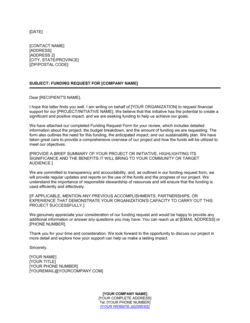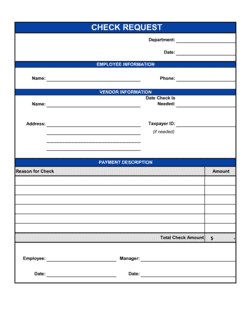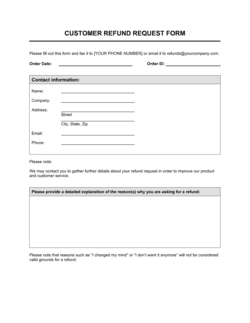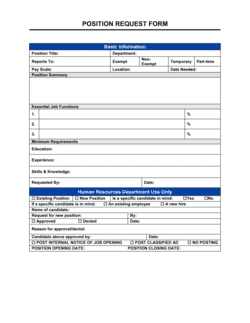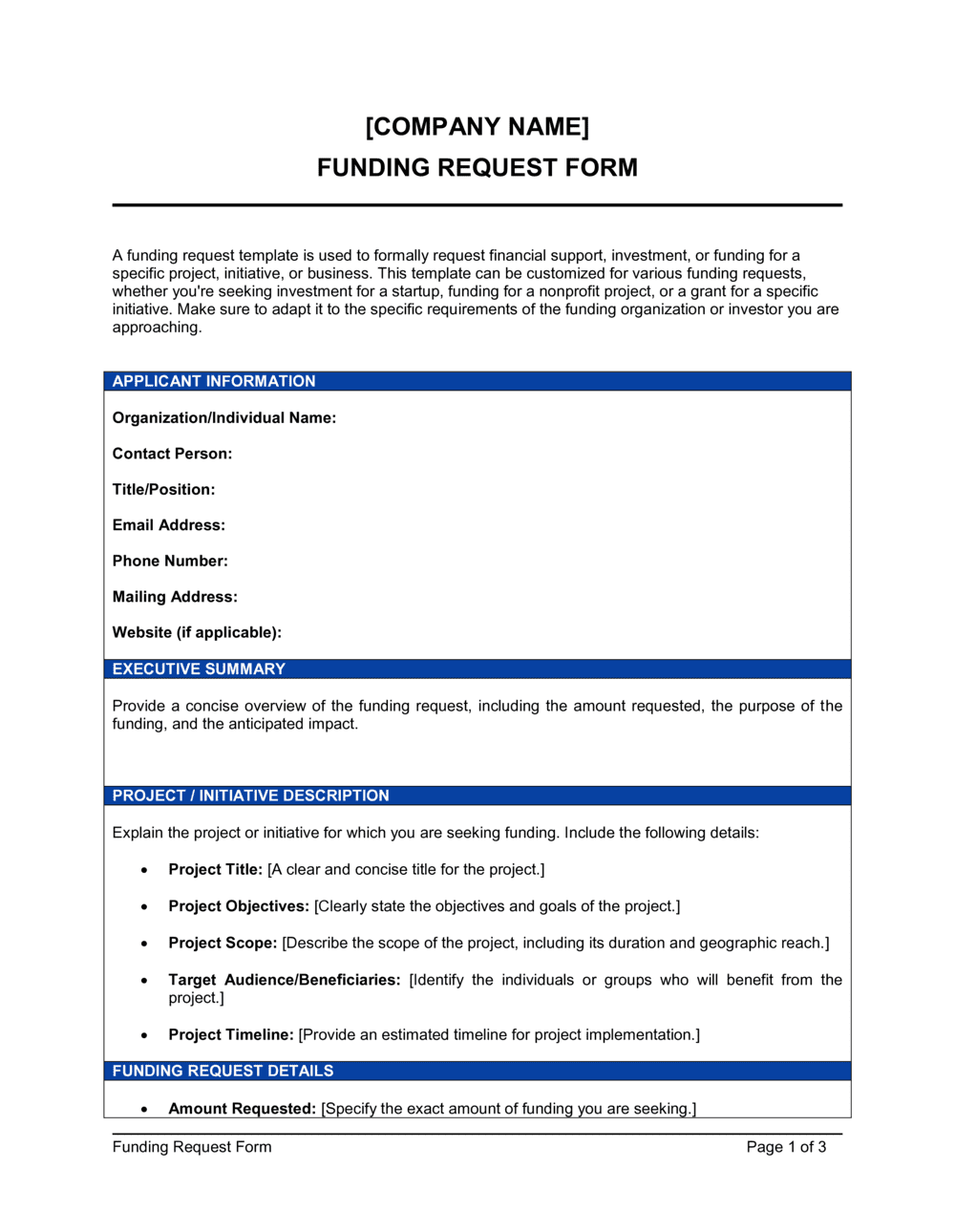
Funding Request Form Template

Free Word download β€’ Edit online β€’ Save & share with Drive β€’ Export to PDF

3 pagesβ€’20–25 min to fillβ€’Difficulty: Standard
Learn more ↓
FreeFunding Request Form Template

At a glance

What it is
A Funding Request Form is a structured internal document used to formally request budget, project capital, or resource allocation from a finance committee, department head, or executive team. This free Word download captures requestor details, the amount sought, business purpose, expected ROI, alternatives considered, and the approval routing chain β€” all in a single standardized form you can edit online and export as PDF.
When you need it
Use it whenever a team member, project lead, or department manager needs to request capital or budget that falls outside routine operating expenses β€” new equipment, software licenses, headcount additions, or project investments requiring formal sign-off.
What's inside
Requestor and department identification, funding amount and timeline, project description and business justification, expected return or benefit, alternatives considered, risk summary, and a multi-level approval signature block for managers and finance reviewers.

What is a Funding Request Form?

A Funding Request Form is a structured internal document used to formally request budget, project capital, or resource allocation from a manager, finance committee, or executive team. It captures who is requesting the funds, the exact amount and breakdown, the business purpose, the expected return or benefit, alternatives that were evaluated, key risks, and the approval routing chain β€” all in a single standardized form. By replacing ad-hoc emails and verbal asks with a consistent format, the form ensures every capital decision is made on the same criteria and leaves a clear audit trail.

Why You Need This Document

Without a standard funding request form, capital decisions get made informally β€” over email threads, in hallway conversations, or via a manager's verbal approval that no one documents. The consequences are predictable: budget overruns with no paper trail, duplicate spend on overlapping projects, and disputes over what was actually authorized. Finance teams waste time chasing down justifications after the fact, and auditors find no record of how significant expenditures were approved. A completed funding request form, routed through the right approval chain before any commitment is made, eliminates all of these problems. It protects the requestor by documenting the approved purpose and amount, protects the approver by recording the basis for their decision, and gives the finance team the data they need for variance reporting and forecasting. This template gives your organization a professional, editable starting point in minutes.

Which variant fits your situation?

If your situation is…Use this template
Requesting annual operating budget for a departmentAnnual Budget Template
Applying for external grant funding from a foundation or government programGrant Proposal
Seeking equity or debt investment from outside investorsInvestment Proposal
Requesting approval to purchase a specific asset or piece of equipmentPurchase Request Form
Proposing a new project with full scope and budget breakdownProject Proposal
Documenting expected costs and returns for a capital expenditureCapital Expenditure Proposal

Common mistakes to avoid

❌ Submitting without a cost breakdown

Why it matters: A single total figure gives reviewers no basis for evaluating whether the amount is reasonable, and finance will return the form for detail before processing.

Fix: Itemize every cost component β€” vendor quotes, labor hours, licensing fees, contingency β€” before submitting.

❌ Qualitative-only benefit statements

Why it matters: Claims like 'will improve team efficiency' are impossible to approve against a budget β€” decision-makers need a number to compare against the cost.

Fix: Translate every benefit into at least one measurable metric: hours saved per week, dollars saved per year, or percentage reduction in error rate.

❌ Skipping the alternatives section

Why it matters: A request with no alternatives documented signals that the requestor jumped to a solution without evaluating options, eroding approver confidence.

Fix: List at least two alternatives with a one-sentence rationale for why each was ruled out.

❌ Routing to the wrong approver level for the amount

Why it matters: Sending a $50,000 request to a manager with a $10,000 spend authority causes delays when the form is returned for re-routing, often after the funds-needed date has passed.

Fix: Check your organization's spend-authority policy before submitting and pre-fill the full approval chain accordingly.

The 9 key fields, explained

Requestor and department information

Funding amount and currency

Project title and description

Business justification

Expected return or benefit

Alternatives considered

Risk summary

Timeline and milestones

Approval routing block

How to fill it out

  1. 1

    Complete the requestor and department block

    Enter your full name, job title, department, cost center code, and the submission date. Confirm the cost center with your finance team if you are unsure of the correct code.

    πŸ’‘ Using the wrong cost center code is one of the most common reasons finance returns a request for correction β€” check before submitting.

  2. 2

    State the exact funding amount with a cost breakdown

    Enter the total amount requested, split into one-time and recurring components. Include a line for any contingency buffer β€” typically 10–15% of the total.

    πŸ’‘ A itemized breakdown shows due diligence and pre-empts the most common finance follow-up question.

  3. 3

    Write a specific project description and title

    Give the project a short, descriptive title and summarize in two to three sentences what the funding will support, what it will produce, and by when.

    πŸ’‘ Pretend the reviewer has no prior context β€” if they cannot understand the scope in 30 seconds, the description needs tightening.

  4. 4

    Build the business justification around consequences

    Explain what organizational objective this funding supports and what the specific cost or risk of not funding it would be. Tie it to a current strategic priority if possible.

    πŸ’‘ Quantify the cost of inaction β€” 'without this, we estimate $X in additional labor cost per quarter' is far more compelling than 'this will help the team.'

  5. 5

    Quantify the expected return or benefit

    Enter at least one measurable outcome β€” cost savings, hours recovered, revenue enabled, or risk reduced. Include the estimated payback period and ROI percentage where calculable.

    πŸ’‘ Even a rough estimate is better than a blank field β€” 'approximately $15,000 in annual savings based on current labor rates' anchors the conversation.

  6. 6

    Document alternatives considered and your rationale

    List at least two real alternatives you evaluated, summarize why each was ruled out, and state clearly why this approach is the best option.

    πŸ’‘ Reviewers who see only one alternative β€” or none β€” assume the requestor has not done the analysis. Two genuine alternatives signal thorough preparation.

  7. 7

    Identify risks and route for approval

    Note the top two or three risks with a mitigation note for each, fill in the timeline and milestones, then submit to your direct manager first. Confirm the spend-authority threshold so you route to all required approvers.

    πŸ’‘ Submit at least five business days before the funds-required date β€” last-minute requests are more likely to be deferred regardless of merit.

Frequently asked questions

What is a funding request form?

A funding request form is an internal document used to formally request budget, capital, or resource allocation from a finance committee, department head, or executive team. It captures the requestor's details, the amount sought, the business purpose, expected return, alternatives considered, and the approval routing chain. Standardizing this process ensures every request is evaluated on the same criteria and creates an auditable record of how capital decisions were made.

When should I use a funding request form instead of a verbal request?

Use a written form for any request above your organization's informal approval threshold β€” typically $1,000–$5,000 for most small businesses and any amount that requires more than one approver. A written form protects the requestor by documenting the approved purpose and amount, and protects the organization by creating a record for audit and budget-variance reporting.

What is the difference between a funding request form and a purchase order?

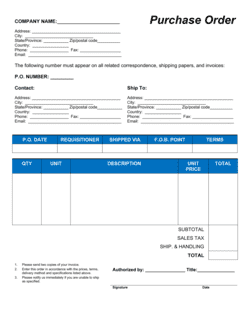
A purchase order is issued to an external vendor to authorize a specific transaction once internal approval has already been granted. A funding request form is the internal approval step that happens before a purchase order is raised. The funding request secures the budget authority; the purchase order commits it to a specific supplier.

How do I calculate ROI for a funding request?

Divide the net expected benefit by the total cost of the investment, then multiply by 100 to get a percentage. For example, a $10,000 investment that saves $4,000 per year has a 40% annual ROI and a 2.5-year payback period. For non-financial benefits like risk reduction or compliance, estimate the cost of the alternative outcome β€” a data breach or regulatory fine β€” and use that as the benefit figure.

Who typically approves a funding request form?

Approval routing depends on the amount and your organization's spend-authority policy. A common structure is direct manager approval for amounts under $5,000, department head approval for $5,000–$25,000, and CFO or executive team approval above that threshold. Some organizations also require a second sign-off from IT or legal for technology or compliance-related requests.

What should I include in the 'alternatives considered' section?

List at least two genuine options you evaluated before settling on your recommendation β€” for example, building internally versus buying a vendor solution, or purchasing new equipment versus extending a maintenance contract. For each alternative, write one sentence explaining why it was ruled out. This section demonstrates due diligence and significantly strengthens the overall request.

Can this form be used for grant funding or investor requests?

This form is designed for internal capital allocation β€” requests made within an organization to its own finance or leadership team. For external grant applications, use a grant proposal template that meets the funder's specific format requirements. For investor funding, an investment proposal or pitch deck is more appropriate. The internal funding request form can, however, be a useful internal precursor to preparing either of those external documents.

How far in advance should I submit a funding request?

Submit at least five to ten business days before the date funds are needed, and longer β€” four to six weeks β€” if the request must go through multiple approval levels or a scheduled committee review. Last-minute requests are disproportionately deferred, even when the merit is strong, because approvers have less time to evaluate them carefully.

How this compares to alternatives

vs Project Proposal

A project proposal is a full document pitching a new initiative β€” covering scope, methodology, timeline, team, and budget β€” often to an external audience or senior leadership. A funding request form is the streamlined internal form used once a project is conceptually approved and a specific budget amount needs formal authorization. The proposal justifies the idea; the form authorizes the money.

vs Purchase Order

A purchase order is an external-facing document issued to a vendor to authorize a specific transaction. A funding request form is internal β€” it secures the budget authority before any vendor commitment is made. The funding form comes first; the purchase order follows once approval is granted.

vs Investment Proposal

An investment proposal is designed for external audiences β€” investors, lenders, or boards β€” and includes market analysis, financial projections, and a capitalization strategy. A funding request form is a lean internal document focused solely on routing a specific budget ask through the organization's approval chain. Use the investment proposal when raising external capital; use this form for internal budget decisions.

vs Budget Template

A budget template plans total anticipated income and expenditure for a department or organization over a period. A funding request form is used when a specific spend falls outside or exceeds the approved budget and requires a separate authorization. Budget templates set the envelope; funding request forms handle exceptions.

Industry-specific considerations

Technology / SaaS

Software license renewals, infrastructure scaling costs, and new tooling requests require a documented ROI case to pass quarterly finance reviews.

Healthcare

Equipment purchases, facility upgrades, and compliance-driven technology investments require multi-level approval and a documented risk summary before procurement.

Professional Services

Training programs, certification costs, and client-delivery tooling requests are evaluated against billable utilization impact and client contract requirements.

Nonprofit

Program expansion funding requests must document alignment with the organizational mission and grant restrictions, and route through board-level approval for amounts above reserve thresholds.

Template vs pro β€” what fits your needs?

PathBest forCostTime
Use the templateTeams and managers standardizing internal capital requests without a dedicated finance operations toolFree15–30 minutes per request
Template + professional reviewOrganizations adding custom approval tiers, cost-center coding, or integration with accounting workflows$0–$200 (finance manager or operations consultant review)1–2 hours
Custom draftedEnterprises requiring ERP-integrated request workflows, automated routing rules, or multi-currency capital controls$500–$3,000+ (process design or system configuration)1–4 weeks

Glossary

Capital Allocation
The process of deciding how to distribute available financial resources across competing projects, departments, or investments.
ROI (Return on Investment)
The expected financial or operational benefit from a funded project, expressed as a ratio or percentage of the amount invested.
Budget Variance
The difference between the budgeted amount for a period and the actual amount spent or received.
Approval Routing
The defined sequence of reviewers β€” typically manager, department head, and finance β€” who must authorize a request before funds are released.
Business Justification
A written explanation of why a requested expenditure is necessary, how it aligns with organizational goals, and what happens if it is not approved.
Payback Period
The estimated time β€” in months or years β€” required for a project's benefits or savings to equal the initial investment amount.
Alternatives Considered
A summary of other options evaluated before settling on the requested approach, demonstrating due diligence to approvers.
Risk Assessment
A brief identification of the key uncertainties or potential downsides associated with the requested funding and how they will be managed.
Cost Center
An organizational unit tracked separately for budget and expense purposes, used to assign the funding request to the correct accounting code.
Spend Authority
The maximum dollar amount a given role or level of management is authorized to approve without escalating to a higher authority.

Part of your Business Operating System

This document is one of 3,000+ business & legal templates included in Business in a Box.

  • Fill-in-the-blanks β€” ready in minutes
  • 100% customizable Word document
  • Compatible with all office suites
  • Export to PDF and share electronically

Create your document in 3 simple steps.

From template to signed document β€” all inside one Business Operating System.
1
Download or open template

Access over 3,000+ business and legal templates for any business task, project or initiative.

2
Edit and fill in the blanks with AI

Customize your ready-made business document template and save it in the cloud.

3
Save, Share, Send, Sign

Share your files and folders with your team. Create a space of seamless collaboration.

Save time, save money, and create top-quality documents.

β˜…β˜…β˜…β˜…β˜…

"Fantastic value! I'm not sure how I'd do without it. It's worth its weight in gold and paid back for itself many times."

Managing Director Β· Mall Farm
Robert Whalley
Managing Director, Mall Farm Proprietary Limited
β˜…β˜…β˜…β˜…β˜…

"I have been using Business in a Box for years. It has been the most useful source of templates I have encountered. I recommend it to anyone."

Business Owner Β· 4+ years
Dr Michael John Freestone
Business Owner
β˜…β˜…β˜…β˜…β˜…

"It has been a life saver so many times I have lost count. Business in a Box has saved me so much time and as you know, time is money."

Owner Β· Upstate Web
David G. Moore Jr.
Owner, Upstate Web

Run your business with a system β€” not scattered tools

Stop downloading documents. Start operating with clarity. Business in a Box gives you the Business Operating System used by over 250,000 companies worldwide to structure, run, and grow their business.

Free Forever PlanΒ Β·Β No credit card required