This forbearance agreement with release provision template has 3 pages and is a MS Word file type listed under our legal agreements documents.
Forbearance agreement with release provision template
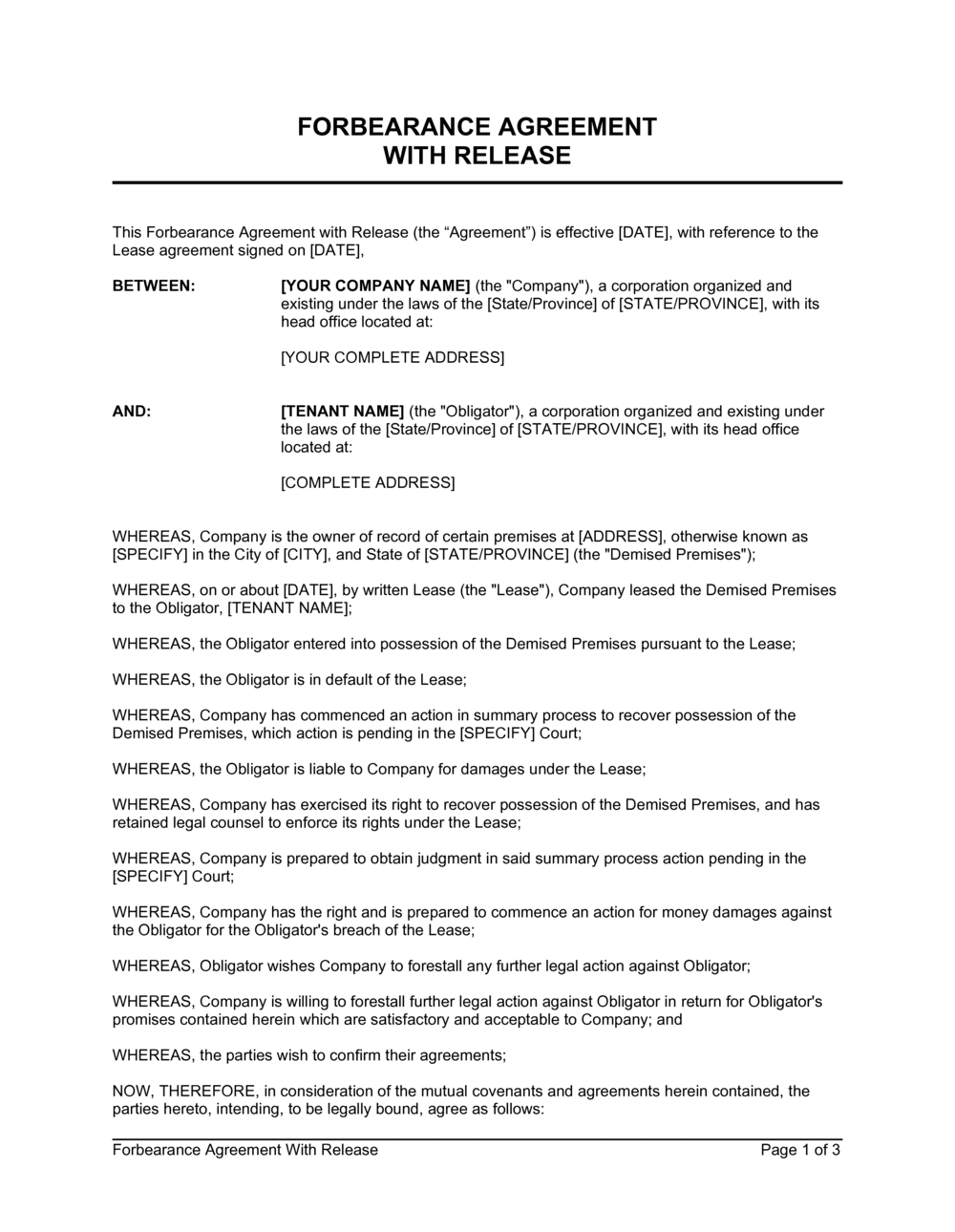
FORBEARANCE AGREEMENT WITH RELEASE This Forbearance Agreement with Release (the "Agreement") is effective [DATE], with reference to the Lease agreement signed on [DATE], BETWEEN: [YOUR COMPANY NAME] (the "Company"), a corporation organized and existing under the laws of the [State/Province] of [STATE/PROVINCE], with its head office located at: [YOUR COMPLETE ADDRESS] AND: [TENANT NAME] (the "Obligator"), a corporation organized and existing under the laws of the [State/Province] of [STATE/PROVINCE], with its head office located at: [COMPLETE ADDRESS] WHEREAS, Company is the owner of record of certain premises at [ADDRESS], otherwise known as [SPECIFY] in the City of [CITY], and State of [STATE/PROVINCE] (the "Demised Premises"); WHEREAS, on or about [DATE], by written Lease (the "Lease"), Company leased the Demised Premises to the Obligator, [TENANT NAME]; WHEREAS, the Obligator entered into possession of the Demised Premises pursuant to the Lease; WHEREAS, the Obligator is in default of the Lease; WHEREAS, Company has commenced an action in summary process to recover possession of the Demised Premises, which action is pending in the [SPECIFY] Court; WHEREAS, the Obligator is liable to Company for damages under the Lease; WHEREAS, Company has exercised its right to recover possession of the Demised Premises, and has retained legal counsel to enforce its rights under the Lease; WHEREAS, Company is prepared to obtain judgment in said summary process action pending in the [SPECIFY] Court; WHEREAS, Company has the right and is prepared to commence an action for money damages against the Obligator for the Obligator's breach of the Lease; WHEREAS, Obligator wishes Company to forestall any further legal action against Obligator; WHEREAS, Company is willing to forestall further legal action against Obligator in return for Obligator's promises contained herein which are satisfactory and acceptable to Company; and WHEREAS, the parties wish to confirm their agreements; NOW, THEREFORE, in consideration of the mutual covenants and agreements herein contained, the parties hereto, intending, to be legally bound, agree as follows: VACATING OF PREMISES Obligator shall vacate the Demised Premises for possession by Company on or before [TIME] on [DATE], time being of the essence. Thereafter, the Obligator shall have no further rights of possession under the Lease or operation of law; and Company shall be released from any further performance or obligation under the Lease. PAYMENT BY OBLIGATOR Upon the execution of this Agreement by Obligator, Obligator shall tender to Company the sum of $[AMOUNT] in good funds. On or before [TIME] on [DATE], the Obligator shall tender to Company the additional sum of $[AMOUNT] in good funds, time being of the essence. CONDITIONS FOR RELEASE OF OBLIGATOR LIABILITY
 Dashboard
 HR Management
 Links
Links Chat
Chat Connect
 Contacts
 Inbox
Inbox Business Al
 Project Management
 Notes
Notes Business Templates
 Cloud Drive
 Docs
Docs Sheets