Drug Testing Policies Template

Free Word download β€’ Edit online β€’ Save & share with Drive β€’ Export to PDF

3 pagesβ€’20–30 min to fillβ€’Difficulty: Standard
Learn more ↓
FreeDrug Testing Policies Template

At a glance

What it is
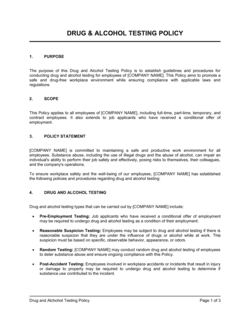
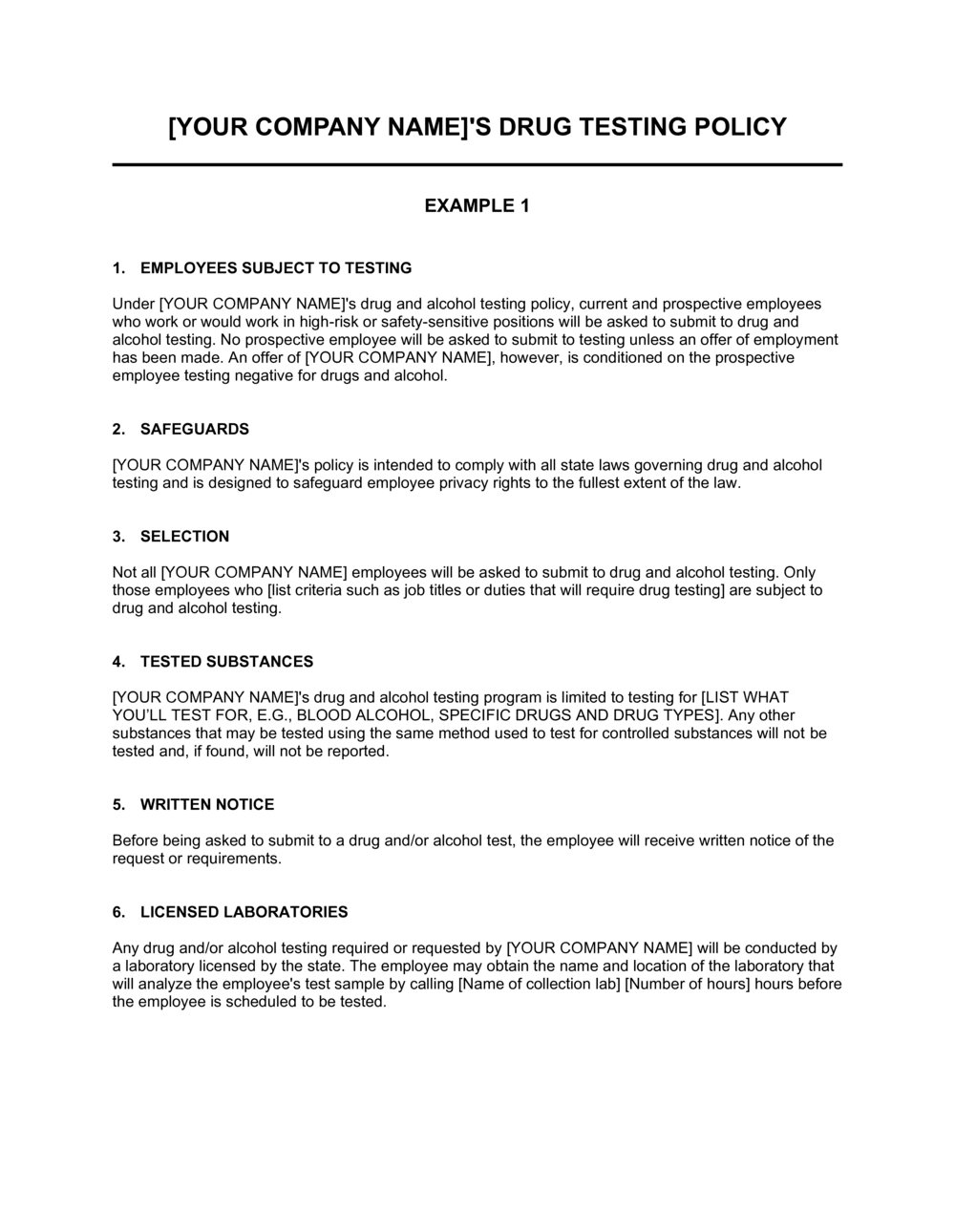
A Drug Testing Policy is a formal written document that defines an employer's rules, procedures, and consequences related to employee substance use and workplace drug testing. This free Word download gives you a structured, ready-to-edit policy covering all major testing scenarios β€” from pre-employment screening to reasonable suspicion β€” that you can tailor to your industry and state requirements and distribute to employees on day one.
When you need it
Use it when onboarding new hires who must pass a pre-employment screen, when federal or state law requires a written drug-free workplace policy, or when a safety-sensitive role or recent workplace incident calls for a clear and enforceable testing protocol.
What's inside
Policy purpose and scope, definitions of prohibited substances and conduct, types of testing and the triggers for each, specimen collection and chain-of-custody procedures, employee rights and confidentiality protections, consequences for positive results or refusals, and return-to-duty and Employee Assistance Program (EAP) referral processes.

What is a Drug Testing Policy?

A Drug Testing Policy is a formal written document that establishes an employer's rules, procedures, and consequences related to employee substance use and workplace drug testing. It defines which substances are prohibited, identifies the testing types and the specific conditions that trigger each, describes the specimen collection and laboratory process, protects employee confidentiality, and states the employment consequences for a confirmed positive result or a refusal to test. A written policy is not merely an administrative formality β€” it is the legal instrument that makes any subsequent employment action based on a drug test defensible against wrongful termination, discrimination, or privacy claims.

Why You Need This Document

Operating without a written drug testing policy creates serious exposure on multiple fronts. If you conduct a test and terminate an employee without a documented policy they acknowledged receiving, that termination is difficult to defend in court regardless of the test result. Federal contractors and DOT-regulated employers face statutory penalties for operating without a compliant written policy. Beyond legal risk, the absence of clear procedures β€” who gets tested, under what triggers, and with what consequences β€” leads to inconsistent enforcement that generates discrimination claims far more expensive than the policy itself. A well-drafted drug testing policy protects your employees' rights, gives supervisors a defensible process to follow, and reduces the liability exposure that comes with any adverse employment action tied to substance use.

Which variant fits your situation?

If your situation is…Use this template
DOT-regulated employer (trucking, aviation, rail, or pipeline)DOT Drug and Alcohol Testing Policy
Federal contractor subject to the Drug-Free Workplace ActDrug-Free Workplace Policy
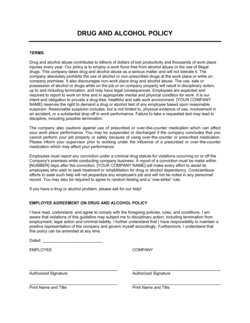
Employer adding alcohol testing alongside drug testingDrug and Alcohol Policy
Healthcare employer testing for prescription drug diversionHealthcare Substance Abuse Policy
Small business needing a single-page acknowledgment formDrug Testing Acknowledgment Form
Employer in a state with recreational cannabis legalizationCannabis-Inclusive Substance Use Policy
Employer managing return-to-duty after a positive resultReturn-to-Duty Agreement

Common mistakes to avoid

❌ Skipping MRO review before taking employment action

Why it matters: Acting on a non-negative screening result without MRO confirmation exposes the employer to wrongful termination claims if the result is later explained by a valid prescription.

Fix: Build MRO review into every non-negative workflow as a required step before any supervisor is notified of a positive result.

❌ No signed acknowledgment form at onboarding

Why it matters: Without documented proof that an employee received the policy, they can challenge a termination or suspension on the grounds that they were never informed of the testing rules.

Fix: Include the drug testing policy acknowledgment in the standard new-hire paperwork packet and retain signed copies in confidential medical files.

❌ Vague consequence language ('disciplinary action may apply')

Why it matters: Undefined consequences enable inconsistent enforcement across managers and departments, creating material exposure to discrimination claims from employees who receive harsher treatment than peers in similar situations.

Fix: Define specific, tiered consequences for each violation type β€” confirmed positive, refusal, adulteration β€” and document deviations from standard consequences with written justification.

❌ Ignoring state cannabis law before finalizing the policy

Why it matters: Several states prohibit adverse employment action based solely on off-duty cannabis use or a positive THC test without additional evidence of impairment, making a standard positive-equals-termination policy legally indefensible.

Fix: Review the cannabis employment law in every state where you have employees before distributing the policy and add state-specific carve-outs where required.

❌ Naming specific vendors in the policy body

Why it matters: When a collection site or laboratory contract changes, the policy requires a formal amendment and re-acknowledgment β€” adding administrative burden and creating gaps if the update is delayed.

Fix: Reference the collection process and certification standards in the policy; maintain vendor names and contact details in a separate, easily updated addendum.

❌ Omitting reasonable suspicion documentation requirements

Why it matters: Sending an employee for reasonable suspicion testing without a written contemporaneous record of the observed behaviors exposes the employer to claims that the testing was pretextual or discriminatory.

Fix: Require supervisors to complete a standardized reasonable suspicion observation form before initiating testing and retain the form in the employee's confidential file.

The 10 key sections, explained

Purpose and scope

Prohibited conduct

Substances covered

Testing types and triggers

Collection procedures

Laboratory testing and MRO review

Consequences for violations

Employee rights and confidentiality

EAP referral and return-to-duty process

Policy acknowledgment and training

How to fill it out

  1. 1

    Confirm your legal obligations before drafting

    Identify whether federal law (DOT, Drug-Free Workplace Act), state law, or industry regulation requires specific policy elements. States with recreational cannabis laws may restrict adverse action based on off-duty use.

    πŸ’‘ Check your state's department of labor website for any mandatory drug testing notice, consent, or timing requirements before completing the policy.

  2. 2

    Define the scope and covered employees

    Specify which workers the policy covers β€” full-time employees, part-time staff, contractors, temps, and on-site vendors. Note whether the policy applies at all company locations or only specific sites.

    πŸ’‘ If safety-sensitive roles are subject to stricter testing than office roles, create a clearly labeled subsection rather than a separate document β€” it keeps enforcement consistent.

  3. 3

    Select the substances and testing panel

    Start with the standard federal 5-panel (THC, cocaine, opiates, amphetamines, PCP) and add any industry-specific substances. Decide whether alcohol testing is included and under what triggers.

    πŸ’‘ For healthcare, construction, or transportation employers, adding extended opioid panels and synthetic cannabinoids to the standard 5-panel closes common gaps.

  4. 4

    Configure each testing type and its trigger criteria

    Draft the specific conditions for each testing category: pre-employment timing, random selection percentage, reasonable suspicion observation standards, post-incident thresholds, and return-to-duty requirements.

    πŸ’‘ Set your random testing rate as a percentage of covered employees per year (e.g., 50% for safety-sensitive DOT positions) rather than a fixed number β€” the percentage scales automatically as headcount changes.

  5. 5

    Document the collection and chain-of-custody process

    Name the specimen type, describe the collection site selection process, and outline chain-of-custody documentation requirements. Reference your MRO arrangement and the certified laboratory used.

    πŸ’‘ Keep specific vendor names and collection-site addresses in a separate addendum rather than the policy body β€” this avoids a formal policy amendment every time a vendor changes.

  6. 6

    State consequences clearly and by tier

    Write out specific outcomes for each violation type β€” confirmed positive, refusal, adulteration β€” and distinguish safety-sensitive roles from non-safety-sensitive ones. Include EAP eligibility criteria.

    πŸ’‘ Add a clause reserving management discretion to determine consequences for borderline situations, but define the floor (minimum consequence) so enforcement stays consistent.

  7. 7

    Prepare the acknowledgment form and supervisor training plan

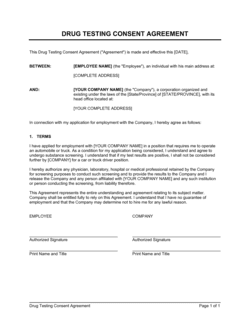
    Attach a standalone acknowledgment form employees sign at onboarding. Confirm which supervisors need reasonable suspicion training and set a training completion deadline.

    πŸ’‘ Store signed acknowledgment forms in confidential medical files β€” not the main personnel file β€” to comply with ADA and state privacy requirements.

  8. 8

    Review with HR counsel before distributing

    Have an HR attorney or employment law specialist review the final policy against your specific state laws and any applicable collective bargaining agreements before it goes to employees.

    πŸ’‘ In states with recreational cannabis laws (CA, CO, NY, IL, NJ, and others), a single paragraph on off-duty cannabis use can determine whether terminating a positive-testing employee is legally defensible.

Frequently asked questions

What is a drug testing policy?

A drug testing policy is a formal written document that defines an employer's rules for workplace substance use and the procedures for testing employees. It specifies which substances are prohibited, what types of testing are conducted, how specimens are collected and analyzed, and what consequences follow a positive result or refusal to test. A written policy is the legal foundation that makes any employment action based on a drug test defensible.

Is a drug testing policy required by law?

Federal law requires written drug-free workplace policies for federal contractors and grantees covered by the Drug-Free Workplace Act of 1988. DOT regulations mandate specific written policies for safety-sensitive transportation employees. Outside those requirements, most states do not compel private employers to conduct drug testing β€” but those that permit testing typically require a written policy distributed to employees before any test is administered.

What types of drug testing should a workplace policy cover?

A complete policy typically addresses six testing types: pre-employment (before the start date), random (ongoing, unannounced), reasonable suspicion (triggered by observed behavior), post-incident (after a workplace accident or near-miss), return-to-duty (before resuming work after a violation), and follow-up (unannounced testing after return to duty). Not every employer needs all six β€” align the types to your industry risk profile and legal requirements.

How does recreational cannabis legalization affect a drug testing policy?

Several states β€” including California, Colorado, New York, Illinois, and New Jersey β€” restrict employers from taking adverse action based solely on a positive THC test or off-duty cannabis use. These laws vary significantly: some protect only off-duty use, others restrict pre-employment THC screening entirely for most roles, and safety-sensitive positions often remain exempt. Review your state's specific statute before finalizing any policy consequence tied to a positive THC result.

What is a Medical Review Officer and why does the policy need one?

A Medical Review Officer (MRO) is a licensed physician who reviews all non-negative drug test results before they are reported to the employer. The MRO contacts the employee to determine whether a positive result has a legitimate medical explanation β€” such as a valid prescription. Using an MRO is mandatory under DOT regulations and is considered best practice for all employers because it significantly reduces wrongful termination exposure.

Can an employee refuse a drug test?

Yes, but the policy should specify the consequences of refusal. Under DOT regulations, refusal is treated the same as a positive result and triggers the full return-to-duty process. For non-DOT employers, most policies treat refusal as a terminable offense. The policy must clearly state this consequence before any refusal situation arises β€” employees cannot be penalized for refusing a test the policy did not mention.

What specimen types can a workplace drug test use?

The most common specimen is urine, which detects recent use and is required by DOT regulations. Hair follicle testing offers a longer detection window (up to 90 days) and is harder to adulterate, making it popular for pre-employment screens. Oral fluid (saliva) testing detects very recent use and is increasingly accepted by regulators. Breath testing is used primarily for alcohol. Employers should confirm which specimen types are permitted or required by applicable regulations before specifying them in the policy.

How should drug test results be stored?

Drug test results and related medical information must be stored in confidential medical files that are separate from an employee's standard personnel file β€” a requirement under the Americans with Disabilities Act (ADA) and similar state laws. Access should be restricted to HR personnel with a need to know, the MRO, and management on a strict need-to-know basis. Retention periods vary by state and regulation, but three to five years is a common minimum for non-DOT employers.

Do supervisors need training to administer a drug testing policy?

Yes. Supervisors who are authorized to initiate reasonable suspicion testing must be trained to recognize the specific behavioral, physical, and performance signs that indicate possible impairment. Without this training, reasonable suspicion referrals risk being seen as arbitrary or discriminatory. DOT requires a minimum of 60 minutes of training on alcohol and 60 minutes on controlled substances for supervisors of safety-sensitive employees; non-DOT employers should use this as a practical baseline.

How this compares to alternatives

vs Employee Handbook

An employee handbook is a broad reference covering all workplace policies β€” conduct, benefits, leave, and more. A drug testing policy is a standalone document that goes into the procedural and legal detail a handbook cannot. Most employers include a summary of the drug testing policy in the handbook and attach the full policy as a separate document employees sign independently.

vs Substance Abuse Policy

A substance abuse policy addresses the broader category of alcohol and drug misuse, often including education, counseling referrals, and return-to-duty provisions without a testing component. A drug testing policy adds the operational layer β€” specimen collection, lab procedures, MRO review, and specific testing triggers. Organizations with safety-sensitive roles typically need both documents working together.

vs Drug-Free Workplace Policy

A drug-free workplace policy is a compliance declaration required for federal contractors under the Drug-Free Workplace Act. It states the prohibition and the employer's commitment to a drug-free environment but does not specify testing procedures. A drug testing policy is the operational companion that defines how the commitment is enforced through actual testing.

vs Code of Conduct

A code of conduct sets behavioral expectations broadly across all aspects of professional conduct. A drug testing policy is a specific, procedurally detailed document governing one category of conduct β€” substance use β€” with its own collection protocols, MRO requirements, and consequence tiers. The code of conduct may reference the drug testing policy, but cannot substitute for it.

Industry-specific considerations

Transportation and logistics

DOT mandates written policies, 5-panel urine testing, and MRO review for all safety-sensitive roles including CDL drivers β€” non-compliance triggers FMCSA audits and potential operating authority suspension.

Construction and trades

Post-incident and random testing are standard on union and non-union job sites; many general contractors require subcontractors to produce a written drug testing policy before granting site access.

Healthcare

Extended opioid panels and testing for prescription drug diversion are common; accreditation bodies such as The Joint Commission expect documented substance abuse policies as part of patient safety standards.

Manufacturing

Safety-sensitive machine and equipment operators often face stricter random testing rates; post-incident testing policies are essential for OSHA recordkeeping and workers' compensation cost management.

Template vs pro β€” what fits your needs?

PathBest forCostTime
Use the templatePrivate employers in non-regulated industries establishing a standard pre-employment or random testing programFree1–2 hours to customize
Template + professional reviewEmployers in states with recreational cannabis laws, unionized workplaces, or those adding reasonable suspicion testing$300–$700 for an employment attorney review3–5 business days
Custom draftedDOT-regulated employers, federal contractors under the Drug-Free Workplace Act, or multi-state employers with varying state obligations$1,000–$3,000+1–3 weeks

Glossary

Chain of Custody
A documented process tracking a specimen from collection through laboratory analysis to ensure the sample has not been tampered with or misidentified.
Medical Review Officer (MRO)
A licensed physician trained to review and interpret laboratory drug test results, verify legitimate medical explanations for positive findings, and report final results to the employer.
Reasonable Suspicion Testing
Drug or alcohol testing triggered when a supervisor has specific, documented observations of behavior or appearance that suggest an employee may be impaired on the job.
Post-Incident Testing
Testing conducted after a workplace accident, injury, or near-miss to determine whether substance use was a contributing factor.
Return-to-Duty Testing
A mandatory drug test an employee must pass before returning to work following a positive result, policy violation, or leave for substance abuse treatment.
Follow-Up Testing
Unannounced testing conducted at intervals after an employee returns to duty, typically for 12 months or longer, as required by policy or regulation.
EAP (Employee Assistance Program)
A confidential employer-sponsored counseling and referral service that connects employees with substance abuse treatment, mental health support, and other resources.
Confirmatory Test
A second, more specific laboratory analysis β€” typically GC-MS β€” used to confirm a non-negative screening result before any employment action is taken.
Cut-Off Level
The minimum concentration of a substance in a specimen at which a test is reported as positive, set by regulatory standards or employer policy.
Adulteration
The intentional manipulation of a urine or other specimen β€” through dilution, substitution, or chemical additives β€” to defeat a drug test.

Part of your Business Operating System

This document is one of 3,000+ business & legal templates included in Business in a Box.

  • Fill-in-the-blanks β€” ready in minutes
  • 100% customizable Word document
  • Compatible with all office suites
  • Export to PDF and share electronically

Create your document in 3 simple steps.

From template to signed document β€” all inside one Business Operating System.
1
Download or open template

Access over 3,000+ business and legal templates for any business task, project or initiative.

2
Edit and fill in the blanks with AI

Customize your ready-made business document template and save it in the cloud.

3
Save, Share, Send, Sign

Share your files and folders with your team. Create a space of seamless collaboration.

Save time, save money, and create top-quality documents.

β˜…β˜…β˜…β˜…β˜…

"Fantastic value! I'm not sure how I'd do without it. It's worth its weight in gold and paid back for itself many times."

Managing Director Β· Mall Farm
Robert Whalley
Managing Director, Mall Farm Proprietary Limited
β˜…β˜…β˜…β˜…β˜…

"I have been using Business in a Box for years. It has been the most useful source of templates I have encountered. I recommend it to anyone."

Business Owner Β· 4+ years
Dr Michael John Freestone
Business Owner
β˜…β˜…β˜…β˜…β˜…

"It has been a life saver so many times I have lost count. Business in a Box has saved me so much time and as you know, time is money."

Owner Β· Upstate Web
David G. Moore Jr.
Owner, Upstate Web

Run your business with a system β€” not scattered tools

Stop downloading documents. Start operating with clarity. Business in a Box gives you the Business Operating System used by over 250,000 companies worldwide to structure, run, and grow their business.

Free Forever PlanΒ Β·Β No credit card required