Absence Policies Template

Free Word download β€’ Edit online β€’ Save & share with Drive β€’ Export to PDF

2 pagesβ€’20–25 min to fillβ€’Difficulty: Standard
Learn more ↓
FreeAbsence Policies Template

At a glance

What it is
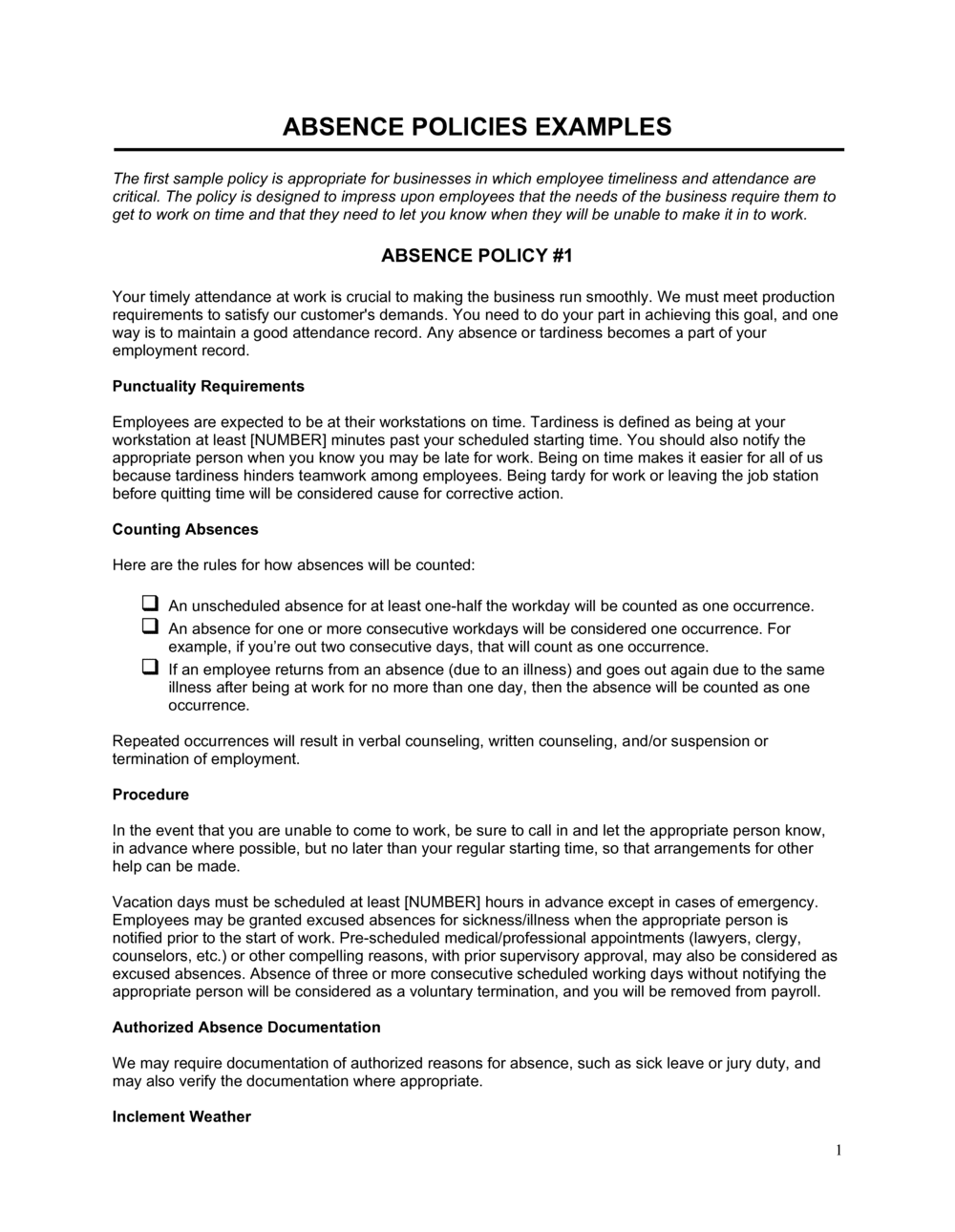
An Absence Policies document is a formal HR policy that defines how a business classifies, records, and responds to employee absences β€” including planned leave, unplanned sick days, tardiness, and no-call/no-show events. This free Word download gives you a structured, editable template you can tailor to your workforce and export as PDF for distribution during onboarding or policy updates.
When you need it
Use it when onboarding your first employees, updating an outdated attendance policy, or standardizing inconsistent absence management practices across departments. It is also essential when a company reaches a size where informal verbal rules no longer scale.
What's inside
Policy scope and objectives, definitions of absence types, notification and reporting procedures, documentation requirements, progressive discipline steps, return-to-work protocols, and manager responsibilities β€” all in a single coherent policy document.

What is an Absence Policies document?

An Absence Policies document is a formal HR policy that establishes how a business defines, records, and manages employee absences β€” covering unplanned sick days, authorised leave, lateness, no-call/no-show events, and long-term incapacity. It sets out precisely how employees must report an absence, what documentation they must provide, how managers track and respond to patterns, and what progressive steps follow when attendance falls below an acceptable threshold. Rather than leaving these decisions to individual managers to interpret case by case, a written absence policy creates a single, consistently applied standard across the entire organisation.

Why You Need This Document

Without a written absence policy, even a single attendance dispute can expose your business to an unfair dismissal or discrimination claim β€” because inconsistent management of absence is one of the most common procedural failures cited in employment tribunal decisions. When one manager tracks absences diligently and another ignores them, or when discipline is applied to some employees but not others with identical records, the inconsistency itself becomes the legal problem. A well-structured absence policy eliminates that risk by making the rules, the thresholds, and the process explicit and visible to everyone. It also reduces absenteeism in practice: organisations that publish clear absence policies, train managers to conduct return-to-work interviews, and apply trigger thresholds consistently typically see measurable reductions in short-term unplanned absence within the first year. This template gives you a ready-to-edit framework that covers every material element, so you spend your time on the decisions specific to your workforce rather than building the structure from scratch.

Which variant fits your situation?

If your situation is…Use this template
Managing a workforce with high unplanned absenteeismAbsence Policies
Tracking vacation and PTO accrual alongside absence rulesVacation and PTO Policy
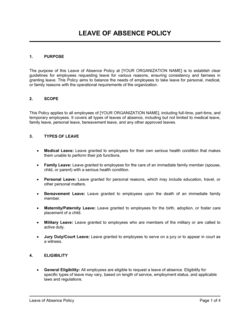
Handling extended medical or family leave separatelyLeave of Absence Policy
Documenting a formal disciplinary process tied to attendanceProgressive Discipline Policy
Formalizing remote work attendance and availability expectationsRemote Work Policy
Consolidating all HR policies into a single reference documentEmployee Handbook
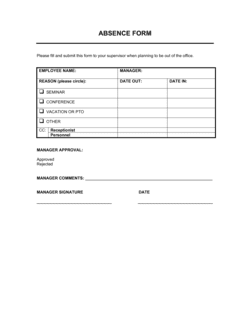
Recording a specific employee's absence incidents over timeEmployee Attendance Record

Common mistakes to avoid

❌ Applying the same discipline ladder to disability-related absences

Why it matters: Progressing an employee through warnings for absences tied to a disability, without first exploring reasonable adjustments, is one of the most common grounds for a successful disability discrimination claim.

Fix: Add a clear carve-out for disability and long-term health conditions, and require an occupational health referral before any formal capability step is taken.

❌ Vague notification instructions with no named backup contact

Why it matters: If an employee texts a colleague or sends an email to a general inbox, and the policy doesn't prohibit it, the absence notification is technically compliant and disciplinary action becomes procedurally difficult.

Fix: Specify the exact method (phone call), the deadline (30 minutes before start), the primary contact (direct manager), and a named fallback contact if the manager is unavailable.

❌ Setting trigger points without piloting them against actual absence data

Why it matters: Thresholds set too low will flag the majority of employees for formal review β€” creating an administrative burden and eroding trust β€” while thresholds set too high allow chronic absenteeism to go unmanaged for months.

Fix: Run the proposed trigger numbers against the previous 12 months of absence records before publishing, and adjust until fewer than 10–15% of employees would have been flagged.

❌ Publishing the policy without training line managers on consistent application

Why it matters: When one manager applies trigger points strictly and another ignores them, the inconsistency creates grounds for discrimination claims and undermines the policy's deterrent effect.

Fix: Pair the policy rollout with a 30–60 minute manager briefing covering trigger thresholds, return-to-work interview technique, and when to escalate to HR.

The 10 key sections, explained

Policy scope and objectives

Definitions of absence types

Notification and reporting procedure

Documentation requirements

Absence recording and tracking

Trigger points and management review

Progressive discipline procedure

Return-to-work protocol

Long-term and disability-related absence

Manager responsibilities and policy review

How to fill it out

  1. 1

    Define the scope and covered employee groups

    Insert your company name and specify which employee categories fall under the policy β€” full-time, part-time, casual, and contractors if applicable. Confirm whether the policy applies to remote and hybrid workers.

    πŸ’‘ If remote workers are covered, add a sentence clarifying that availability during core hours constitutes 'attendance' for the purpose of this policy.

  2. 2

    Set your absence categories and definitions

    Review the draft definitions for unplanned absence, authorised absence, unauthorised absence, lateness, and no-call/no-show. Adjust the language to match the terminology already used in your employment contracts and employee handbook.

    πŸ’‘ Consistency with your employment contract terminology prevents employees from arguing that a policy term means something different from the contract.

  3. 3

    Specify notification requirements in detail

    Enter the exact notification deadline (e.g., 30 minutes before shift start), the required contact method (phone call to direct manager), and the fallback if the manager is unreachable.

    πŸ’‘ Name a specific backup contact (e.g., the department head or HR inbox) for when the line manager cannot be reached β€” vague fallback instructions are the most common source of first-day notification disputes.

  4. 4

    Set the self-certification and medical certificate thresholds

    Enter the number of days after which a medical certificate is required. The common range is 4–8 calendar days. Confirm who receives the certificate β€” HR, the line manager, or both.

    πŸ’‘ Aligning your threshold with statutory sick pay rules in your jurisdiction avoids administrative duplication and signals to employees that the policy is built around compliance, not surveillance.

  5. 5

    Configure trigger points for management review

    Insert the specific numbers for your trigger thresholds β€” separate absence episodes within a rolling period and total days in a 12-month window. Consider adding a pattern-based trigger (e.g., repeated absence on specific days).

    πŸ’‘ Pilot the trigger thresholds against last year's absence data before publishing β€” if more than 20% of your workforce would have hit a trigger, the thresholds are too low.

  6. 6

    Map the progressive discipline stages

    Confirm the number of formal stages and the conditions for escalation. Insert the retention periods for each warning β€” typically 6 months for a verbal warning, 12 months for a written warning.

    πŸ’‘ Reference your disciplinary policy or employee handbook here rather than restating the full procedure β€” this prevents the two documents from falling out of sync.

  7. 7

    Add the return-to-work interview requirement and attach the RTW form

    Confirm that a return-to-work interview is required after all absences (or absences exceeding a minimum duration) and reference the RTW form template managers should use.

    πŸ’‘ Making the RTW interview mandatory for all absences β€” not just those over three days β€” reduces recurrence rates measurably without increasing management burden significantly.

  8. 8

    Set the policy review date and assign ownership

    Enter the last-reviewed date, the next scheduled review date (typically 12 months), and the name or role responsible for maintaining and updating the policy.

    πŸ’‘ Calendar a reminder 30 days before the review date so the update is never reactive β€” post-incident rewrites carry less legal weight than proactively maintained policies.

Frequently asked questions

What is an absence policy?

An absence policy is a written HR document that defines how a company classifies, records, and manages employee absences β€” including sick leave, unplanned days off, lateness, and no-call/no-show events. It sets out notification procedures, documentation requirements, trigger thresholds for management review, and the progressive discipline steps that apply when absence reaches unacceptable levels. A well-written absence policy protects both the employer and the employee by creating clear, consistent expectations.

What should an absence policy include?

At minimum, an absence policy should cover: the categories of absence it applies to, how and when employees must report an absence, what documentation is required and after how many days, how absences are tracked, the trigger thresholds that initiate a formal review, the progressive discipline steps, return-to-work procedures, and how the policy treats disability-related absences differently from general unplanned absence. Missing any of these creates gaps that are difficult to manage consistently.

Is an absence policy legally required?

In most jurisdictions, no law explicitly mandates a written absence policy by that name. However, employment law in the US, UK, Canada, and Australia requires employers to treat employees consistently and fairly when managing attendance. A written policy is the primary evidence of consistent treatment and is routinely requested during employment tribunal, labor board, and wrongful-termination proceedings. In the UK, statutory sick pay rules and the Equality Act 2010 make having a clear, disability-aware policy effectively essential.

How many unplanned absences are acceptable before formal action?

There is no universal legal standard β€” it depends on your industry, role criticality, and workforce size. Common practice in the UK applies the Bradford Factor, with scores above 45 or 100 triggering review. A widely used US and Canadian approach is three separate unplanned absence episodes in any rolling 90-day period. The key is that whatever thresholds you set, you apply them consistently across all employees β€” selective enforcement exposes you to discrimination claims.

How is an absence policy different from a leave policy?

An absence policy focuses on unplanned, short-term attendance failures β€” sick days, no-shows, lateness β€” and the management response to them. A leave policy (or leave of absence policy) covers planned, pre-approved extended absences such as parental leave, medical leave, bereavement leave, and jury duty. Both are needed in a complete HR framework, and they should reference each other to avoid overlap or contradiction.

Should remote employees be covered by the same absence policy?

Yes, remote employees should be covered by the same absence policy with minor adaptations. The core obligations β€” notification timing, absence recording, return-to-work conversations β€” apply equally. The main adjustment is defining what 'attendance' means for remote workers: typically, being available and responsive during agreed core hours. Add a short paragraph to the policy clarifying this so remote employees and their managers are not operating on different assumptions.

What is a return-to-work interview and is it required?

A return-to-work interview is a brief, structured conversation between a manager and employee on their first day back after an absence. It covers confirmation of the absence reason, fitness to return, any outstanding documentation, and whether workplace adjustments are needed. It is not legally mandated in most jurisdictions, but CIPD and SHRM research consistently identifies it as the single most effective tool for reducing repeat unplanned absence. Most employment law advisors recommend making it mandatory for all absences regardless of duration.

Can you dismiss an employee for excessive absence?

Dismissal for persistent unauthorised absence or long-term incapacity can be lawful if the employer has followed a fair procedure β€” including documented warnings, regular review meetings, consideration of reasonable adjustments, and, for long-term illness, an occupational health assessment. Dismissing without following these steps, or without distinguishing disability-related absence from general attendance issues, is one of the most common causes of unfair dismissal and disability discrimination findings. Consider consulting an employment lawyer before taking this step.

How often should an absence policy be reviewed?

An absence policy should be reviewed at least annually and updated whenever applicable employment law changes β€” for example, when statutory sick pay rates or leave entitlements are revised. It should also be reviewed after any significant disciplinary case or employment tribunal outcome that reveals a gap in the policy. Assign a named HR owner and calendar the review date in the document itself so it never becomes stale by default.

How this compares to alternatives

vs Leave of Absence Policy

A leave of absence policy governs planned, extended absences β€” parental leave, medical leave, sabbatical, and jury duty β€” that are requested in advance and approved. An absence policy focuses on unplanned, short-term attendance failures and the disciplinary response to them. Most HR frameworks need both, and they should cross-reference each other to prevent employees or managers from conflating the two.

vs Employee Handbook

An employee handbook consolidates all HR policies β€” including absence β€” into a single reference document distributed to all staff. A standalone absence policy provides greater detail, is easier to update independently, and can be issued separately when a specific attendance issue needs to be addressed without reissuing the full handbook. The handbook typically includes a summary of the absence policy and points to the full standalone document.

vs Progressive Discipline Policy

A progressive discipline policy covers the formal warning and escalation framework for all misconduct and performance issues β€” absence being one subset. An absence policy references the discipline steps but focuses specifically on absence classification, notification, documentation, and trigger thresholds. Having both prevents the absence-specific rules from getting lost in a general discipline framework.

vs Attendance Record Form

An attendance record form is the transactional tool used to log individual absence events β€” dates, reasons, and duration. The absence policy is the governing framework that tells managers and employees what to do, when to do it, and what happens when attendance falls short. The form has no effect without the policy to back it; the policy is difficult to enforce without the tracking records the form provides.

Industry-specific considerations

Manufacturing and warehousing

Shift-based operations make even a single unplanned absence a scheduling and safety problem, making trigger thresholds and rapid notification procedures especially critical.

Healthcare and social care

Minimum staffing ratios mean absence directly affects patient safety, and disability-related absence provisions must be carefully drafted given the high incidence of occupational health conditions.

Retail and hospitality

High turnover and variable shift patterns require clear rules on what constitutes a no-call/no-show and how last-minute cover requests interact with the formal absence record.

Professional services

Client-facing roles mean absence has direct revenue and relationship consequences, making return-to-work protocols and workload transition planning particularly important.

Template vs pro β€” what fits your needs?

PathBest forCostTime
Use the templateSMEs and startups creating their first formal absence policy or updating an outdated oneFree1–3 hours
Template + professional reviewCompanies in regulated industries, those with a recent absence-related dispute, or employers with unionised workforces$200–$600 (HR consultant or employment lawyer review)2–5 days
Custom draftedLarge employers, multi-site or multi-jurisdiction operations, or businesses implementing absence management alongside a new HRIS$1,000–$3,500+2–4 weeks

Glossary

Unplanned Absence
Any absence not scheduled in advance β€” typically a same-day call-out for illness, personal emergency, or unexplained non-attendance.
Planned Absence
Leave requested and approved in advance, such as vacation, scheduled medical appointments, or pre-approved personal days.
No-Call/No-Show
When an employee fails to report to work and does not notify their manager before the shift or workday begins.
Bradford Factor
A formula used to measure the impact of short, frequent absences β€” calculated as SΒ² Γ— D, where S is the number of absence spells and D is total days absent.
Return-to-Work Interview
A brief, structured conversation between a manager and employee on the employee's first day back after an absence, used to verify fitness for work and identify underlying issues.
Trigger Point
A predefined absence threshold β€” such as three unplanned absences in 90 days β€” that automatically initiates a formal management review or disciplinary step.
Fit Note
A medical certificate (historically called a sick note) issued by a healthcare provider confirming that an employee is either unfit for work or fit with adjustments.
Absence Rate
Total days lost to absence divided by total available working days, expressed as a percentage β€” a standard workforce health metric.
Reasonable Adjustment
A change to working conditions β€” altered hours, modified duties, or remote work β€” made to support an employee with a disability or health condition in attending work.
Self-Certification
An employee's own written declaration confirming the reason and dates of a short-term absence, typically accepted for absences of seven days or fewer before a medical certificate is required.

Part of your Business Operating System

This document is one of 3,000+ business & legal templates included in Business in a Box.

  • Fill-in-the-blanks β€” ready in minutes
  • 100% customizable Word document
  • Compatible with all office suites
  • Export to PDF and share electronically

Create your document in 3 simple steps.

From template to signed document β€” all inside one Business Operating System.
1
Download or open template

Access over 3,000+ business and legal templates for any business task, project or initiative.

2
Edit and fill in the blanks with AI

Customize your ready-made business document template and save it in the cloud.

3
Save, Share, Send, Sign

Share your files and folders with your team. Create a space of seamless collaboration.

Save time, save money, and create top-quality documents.

β˜…β˜…β˜…β˜…β˜…

"Fantastic value! I'm not sure how I'd do without it. It's worth its weight in gold and paid back for itself many times."

Managing Director Β· Mall Farm
Robert Whalley
Managing Director, Mall Farm Proprietary Limited
β˜…β˜…β˜…β˜…β˜…

"I have been using Business in a Box for years. It has been the most useful source of templates I have encountered. I recommend it to anyone."

Business Owner Β· 4+ years
Dr Michael John Freestone
Business Owner
β˜…β˜…β˜…β˜…β˜…

"It has been a life saver so many times I have lost count. Business in a Box has saved me so much time and as you know, time is money."

Owner Β· Upstate Web
David G. Moore Jr.
Owner, Upstate Web

Run your business with a system β€” not scattered tools

Stop downloading documents. Start operating with clarity. Business in a Box gives you the Business Operating System used by over 250,000 companies worldwide to structure, run, and grow their business.

Free Forever PlanΒ Β·Β No credit card required