Company Reimbursement Policy Template

Free Word download β€’ Edit online β€’ Save & share with Drive β€’ Export to PDF

3 pagesβ€’20–25 min to fillβ€’Difficulty: Standard
Learn more ↓
FreeCompany Reimbursement Policy Template

At a glance

What it is
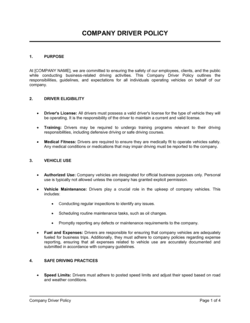
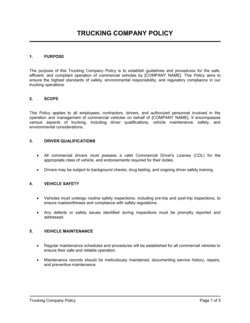
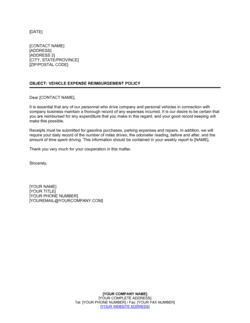
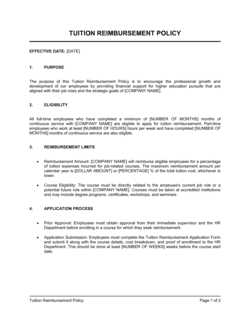
A Company Reimbursement Policy is an internal operational document that defines which employee expenses the company will repay, the spending limits that apply, the documentation required to claim reimbursement, and the process for submitting and approving requests. This free Word download gives you a structured, ready-to-customize starting point you can edit online and distribute to staff or embed in your employee handbook.
When you need it
Use it when onboarding your first expense-incurring employees, when informal reimbursement practices are generating inconsistent or disputed claims, or when an auditor, investor, or lender asks for documented financial controls.
What's inside
Scope and eligible expense categories, per-diem and spending limits by expense type, documentation and receipt requirements, the approval and submission workflow, timelines for reimbursement payment, and consequences for non-compliance β€” all in a single structured policy document.

What is a Company Reimbursement Policy?

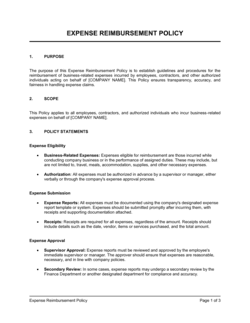
A Company Reimbursement Policy is an internal operational document that establishes the rules governing which employee out-of-pocket expenses the company will repay, the spending limits that apply to each category, the documentation required to support a claim, and the workflow for submitting and approving expense reports. It replaces informal, manager-by-manager decisions with a single authoritative reference that applies consistently across the organization. When structured to meet IRS accountable-plan requirements β€” business purpose documented, receipts substantiated, excess advances returned β€” approved reimbursements are excluded from employees' taxable wages, which benefits both staff and the company's payroll tax obligations.

Why You Need This Document

Without a written reimbursement policy, every expense decision defaults to individual manager judgment, producing inconsistent outcomes that generate disputes, erode employee trust, and create audit exposure. Employees submit claims for personal items because no one told them those costs were out of scope. Finance teams spend hours chasing missing receipts because no documentation standard exists. Month-end close extends because batched, undated expense reports arrive weeks after costs were incurred. Auditors, investors, and lenders treating your financials as evidence of operational maturity look specifically for documented expense controls β€” and the absence of a policy is a red flag. This template gives you a complete, immediately customizable policy that closes those gaps in an afternoon, establishes the controls your finance team needs to do their job efficiently, and gives employees a clear, fair set of rules they can follow from day one.

Which variant fits your situation?

If your situation is…Use this template
Employees travel frequently for client meetings or conferencesTravel Expense Report
Field staff submit weekly mileage claimsMileage Reimbursement Form
Remote employees claim home office setup costsRemote Work Expense Policy
Sales team members entertain clients regularlyEntertainment Expense Report
Project teams need a per-project budget and tracking documentProject Budget Template
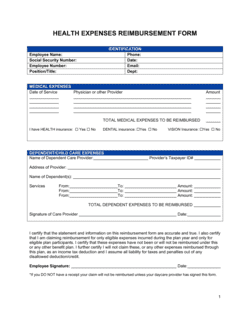
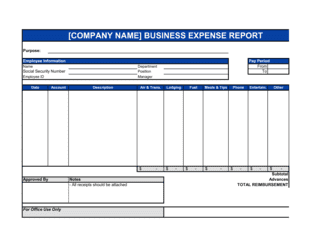
Company wants a single multi-category expense submission formEmployee Expense Report
Finance needs to track all reimbursements against departmental budgetsDepartment Budget Template

Common mistakes to avoid

❌ No submission deadline

Why it matters: Employees batch several months of expenses into a single report, disrupting month-end close and making budget variance analysis impossible in real time.

Fix: Set a 30-day submission window from the date the expense is incurred and state that late claims require CFO exception approval to be processed.
❌ Accepting credit card statements as receipts

Why it matters: Card statements show the merchant and total but not the items purchased, which fails IRS substantiation requirements and leaves the company unable to verify that claimed costs were business-related.

Fix: Require itemized receipts for all expenses above the stated threshold and specify in writing that card statements alone are not acceptable documentation.

❌ Using a single meals limit regardless of city

Why it matters: A flat $50/day meal limit is adequate in a mid-sized market but forces employees to pay out of pocket for legitimate costs in high-cost cities like San Francisco, New York, or London.

Fix: Tier meal limits by city category β€” at minimum distinguish high-cost metros from standard markets β€” using the IRS M&IE per-diem table as a reference baseline.

❌ Omitting consequences for non-compliant submissions

Why it matters: A policy with no stated penalty for misuse has limited deterrent value β€” employees learn they can submit borderline or unsupported claims with no downside beyond a correction request.

Fix: Add a non-compliance section that specifies denial for unsupported claims, repayment obligations for approved-then-discovered fraudulent claims, and potential disciplinary action up to termination.

The 9 key sections, explained

Purpose and scope

Eligible expense categories and limits

Documentation and receipt requirements

Pre-approval requirements

Submission process and deadlines

Approval workflow

Reimbursement payment timeline

Non-compliance and consequences

Policy review and updates

How to fill it out

  1. 1

    Define scope and employee coverage

    Identify which employees the policy applies to β€” all staff, full-time only, or those with specific travel or purchasing roles. State explicitly which expense categories are in scope and list at least three categories that are out of scope.

    πŸ’‘ Adding a short 'out of scope' list prevents the most common disputed claims before they are submitted.

  2. 2

    Set per-category spending limits

    Enter a maximum reimbursable amount for each expense category: nightly hotel rate, per-meal limit, mileage rate (use the current IRS standard rate as a baseline), and any equipment or training caps.

    πŸ’‘ Tier hotel and meal limits by city type β€” at minimum distinguish between major metros and smaller markets β€” to keep limits fair and realistic.

  3. 3

    Specify receipt and documentation requirements

    Set the minimum dollar threshold above which receipts are required, and write out exactly what each receipt must show. Add a field for business purpose on meal and entertainment claims.

    πŸ’‘ Requiring itemized receipts (not just totals) is an IRS best practice that also deters personal-item pass-through claims.

  4. 4

    Define which expenses need pre-approval

    List the categories or dollar thresholds that require written manager or executive approval before the expense is incurred. Include the lead time and the channel for requesting approval.

    πŸ’‘ Keep the pre-approval list short β€” three to five high-risk categories β€” or employees will route around the process entirely.

  5. 5

    Set submission deadlines

    Enter the number of days after an expense is incurred by which the employee must submit a report. State what happens to late submissions β€” denial, exception process, or CFO override.

    πŸ’‘ 30-day submission windows align well with monthly close cycles and give Finance clean data for budget variance reporting.

  6. 6

    Map the approval chain

    Name the approver at each dollar threshold tier and set a maximum turnaround time at each stage. Include an escalation rule for approvers who miss the deadline.

    πŸ’‘ Naming roles rather than individuals (e.g., 'Department Head' not 'Jane Smith') keeps the workflow valid when personnel change.

  7. 7

    State the reimbursement payment schedule

    Tie payment to a specific payroll run or AP cycle date. For international employees, add language covering wire transfer timelines and currency conversion basis.

    πŸ’‘ Publishing a predictable payment date β€” even if it is Net 15 β€” reduces Finance team follow-up inquiries more than any other single policy element.

  8. 8

    Communicate, distribute, and collect acknowledgment

    Share the final policy with all employees via email or your HR system, and collect a signed or click-to-confirm acknowledgment that each employee has read and understood it.

    πŸ’‘ Store acknowledgment records in your HRIS β€” they are your evidence of notice in any future dispute over a denied claim.

Frequently asked questions

What is a company reimbursement policy?

A company reimbursement policy is an internal document that defines which employee out-of-pocket expenses the company will repay, the spending limits that apply to each category, what documentation is required to support a claim, and the process for submitting and approving expense reports. It gives both employees and finance teams a shared set of rules that removes ambiguity and reduces disputes.

Why does a company need a written reimbursement policy?

Without a written policy, reimbursement decisions are made informally and inconsistently β€” some managers approve expenses others deny, creating employee relations issues and audit risk. A documented policy also supports IRS accountable-plan status, which means approved reimbursements are not treated as taxable income to the employee. Auditors, investors, and lenders routinely ask for evidence of expense controls, and a written policy is the primary evidence.

What expenses should a reimbursement policy cover?

Standard categories include business travel (airfare, rail, car rental, hotel), meals and client entertainment, mileage for personal vehicle use, home office equipment and supplies for remote workers, professional development and training, conference registrations and dues, and incidental business supplies. The policy should explicitly list what is not covered β€” personal travel upgrades, alcohol outside approved entertainment, fines, and personal subscriptions β€” to prevent the most common disputed claims.

What is an IRS accountable plan and why does it matter?

An IRS accountable plan is a reimbursement arrangement that meets three requirements: the expense must have a business connection, the employee must substantiate it with documentation within a reasonable time, and any excess advance must be returned. When a policy meets these criteria, reimbursements are excluded from the employee's taxable wages. A policy that does not qualify as an accountable plan β€” for example, one that pays flat allowances without requiring receipts β€” means all payments are subject to income tax and payroll tax withholding.

How quickly should the company reimburse employees?

Best practice is to tie reimbursement to a standing payroll or accounts- payable run and publish the specific date in the policy β€” typically within 10 to 15 business days of an approved expense report. Longer timelines require employees to float company costs on personal credit, which generates goodwill problems. Publishing a predictable payment schedule also reduces follow-up inquiries to the Finance team.

Do employees need to sign the reimbursement policy?

While a signature is not legally required for an internal policy to be enforceable, collecting a written or electronic acknowledgment that the employee has read and understood the policy is strongly recommended. An acknowledgment record is your evidence of notice in a dispute over a denied claim. Distribute the policy during onboarding and collect acknowledgment again whenever a material update is made.

What mileage rate should the policy use?

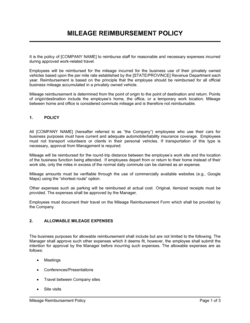
The IRS publishes a standard mileage rate each year for business use of a personal vehicle β€” 67 cents per mile for 2024. Most companies adopt this rate because it is a recognized safe harbor that satisfies IRS substantiation requirements and is tax-free to the employee. Companies may pay above the IRS rate, but the excess is taxable to the employee. The policy should reference the current IRS rate rather than hardcoding a fixed number that becomes outdated when rates change.

How often should a reimbursement policy be updated?

Review it at minimum annually, timed to coincide with IRS per-diem and mileage rate updates typically published in late December or early January. Trigger an out-of-cycle review any time there is a material change in company operations β€” adding remote workers, expanding internationally, or shifting to a travel-heavy sales model. Communicate changes to all employees at least 15 days before the new version takes effect.

Can the policy set different limits for different employee levels?

Yes β€” tiered limits by seniority or role are common and legally permissible. For example, many companies allow business-class airfare for executives on flights over six hours while requiring economy for all other staff. The policy must document these tiers clearly and consistently to avoid perceptions of favoritism. Finance teams should apply the tiers uniformly during the approval review.

How this compares to alternatives

vs Employee Expense Report

An expense report is the form an individual employee submits to claim reimbursement for specific costs already incurred. A reimbursement policy is the governing document that defines the rules β€” what qualifies, what limits apply, and how reports are reviewed. The policy exists once; expense reports are generated for every submission. Both are needed for a functional expense management process.

vs Travel Expense Report

A travel expense report is a category-specific form for documenting trip-related costs β€” airfare, hotel, ground transport, and meals β€” on a per-trip basis. A reimbursement policy sets the rules that govern whether those costs qualify and at what limits. Companies need the policy to give the travel report its authority; the travel report operationalizes the policy for each trip.

vs Corporate Credit Card Policy

A corporate card policy governs expenses charged directly to a company-issued card β€” covering card eligibility, approved categories, and statement reconciliation. A reimbursement policy covers out-of-pocket costs paid by the employee and reclaimed afterward. Many companies maintain both, with the reimbursement policy handling categories where cards are not issued or not practical.

vs Employee Handbook

An employee handbook is a comprehensive policy reference covering all aspects of employment β€” conduct, benefits, leave, and operational procedures including expenses. A standalone reimbursement policy gives the expense section enough depth and detail to function as its own authoritative document, and is typically incorporated into the handbook by reference. Use the standalone version when expense management complexity warrants dedicated documentation.

Industry-specific considerations

Professional services

Client entertainment limits and documentation requirements are critical because meal and entertainment deductions are capped at 50% under the tax code and require business-purpose records naming each attendee.

Technology / SaaS

Home office equipment stipends and co-working space allowances are a standard category for distributed teams, requiring defined annual caps and a clear policy on company ownership versus personal ownership of purchased equipment.

Construction and field services

Mileage and per-diem claims are high-volume and require GPS or odometer log substantiation; tool and safety equipment reimbursements need category-specific limits and documentation requirements.

Healthcare

Pharmaceutical and medical device companies face strict anti-kickback regulations on meals and entertainment with healthcare professionals, requiring lower per-person limits and more detailed attendee documentation than standard corporate policies.

Retail and e-commerce

Buyer travel and trade show attendance generate high-volume travel claims; the policy needs clear pre-approval thresholds for vendor-hosted events to prevent conflict-of-interest exposure.

Nonprofit organizations

Nonprofits are held to heightened scrutiny by donors and regulators, requiring tighter spending limits, mandatory pre-approval for all non-routine expenses, and documented board-level oversight of reimbursement controls.

Template vs pro β€” what fits your needs?

PathBest forCostTime
Use the templateSmall businesses and startups building their first structured expense controls without a dedicated finance teamFree1–2 hours to customize and distribute
Template + professional reviewGrowing companies adding remote workers, international employees, or client entertainment that triggers IRS documentation rules$200–$600 for an accountant or HR consultant review3–5 business days
Custom draftedEnterprises with multi-country operations, regulated industries with strict entertainment rules, or companies integrating the policy into an automated expense management system$1,000–$3,000+2–4 weeks

Glossary

Reimbursable Expense
A cost paid by an employee out of pocket on behalf of the company that the company agrees to repay under the terms of its expense policy.
Per Diem
A fixed daily allowance for meals, lodging, or incidentals while an employee is traveling on company business, set at a flat rate rather than actual cost.
Accountable Plan
An IRS-recognized expense reimbursement arrangement that requires a business purpose, adequate documentation, and return of any excess advances β€” making reimbursements non-taxable to the employee.
Non-Accountable Plan
A reimbursement arrangement that does not meet IRS accountable-plan rules, meaning all payments are treated as taxable wages subject to withholding.
Substantiation
The documentation required to support an expense claim β€” typically a receipt showing merchant name, date, amount, and business purpose.
Approval Authority
The designated person β€” typically a direct manager or finance officer β€” empowered to review and approve an expense report before payment is issued.
Spending Limit
A maximum dollar amount the company will reimburse for a given expense category, such as $75 per person for a business meal.
Expense Report
A form or system entry submitted by an employee listing out-of-pocket expenses incurred for business purposes, with supporting receipts attached.
Corporate Card Policy
A companion policy governing use of company-issued credit cards, defining which expenses may be charged and how statements are reconciled.
Misappropriation
Intentional submission of false or personal expenses for reimbursement as business expenses β€” a form of fraud subject to disciplinary action and potential legal consequences.

Part of your Business Operating System

This document is one of 3,000+ business & legal templates included in Business in a Box.

  • Fill-in-the-blanks β€” ready in minutes
  • 100% customizable Word document
  • Compatible with all office suites
  • Export to PDF and share electronically

Create your document in 3 simple steps.

From template to signed document β€” all inside one Business Operating System.
1
Download or open template

Access over 3,000+ business and legal templates for any business task, project or initiative.

2
Edit and fill in the blanks with AI

Customize your ready-made business document template and save it in the cloud.

3
Save, Share, Send, Sign

Share your files and folders with your team. Create a space of seamless collaboration.

Save time, save money, and create top-quality documents.

β˜…β˜…β˜…β˜…β˜…

"Fantastic value! I'm not sure how I'd do without it. It's worth its weight in gold and paid back for itself many times."

Managing Director Β· Mall Farm
Robert Whalley
Managing Director, Mall Farm Proprietary Limited
β˜…β˜…β˜…β˜…β˜…

"I have been using Business in a Box for years. It has been the most useful source of templates I have encountered. I recommend it to anyone."

Business Owner Β· 4+ years
Dr Michael John Freestone
Business Owner
β˜…β˜…β˜…β˜…β˜…

"It has been a life saver so many times I have lost count. Business in a Box has saved me so much time and as you know, time is money."

Owner Β· Upstate Web
David G. Moore Jr.
Owner, Upstate Web

Run your business with a system β€” not scattered tools

Stop downloading documents. Start operating with clarity. Business in a Box gives you the Business Operating System used by over 250,000 companies worldwide to structure, run, and grow their business.

Free Forever PlanΒ Β·Β No credit card required