Sales Expenses Reimbursement Policy Template

Free Word download β€’ Edit online β€’ Save & share with Drive β€’ Export to PDF

1 pageβ€’15–25 min to fillβ€’Difficulty: Standard
Learn more ↓
FreeSales Expenses Reimbursement Policy Template

At a glance

What it is
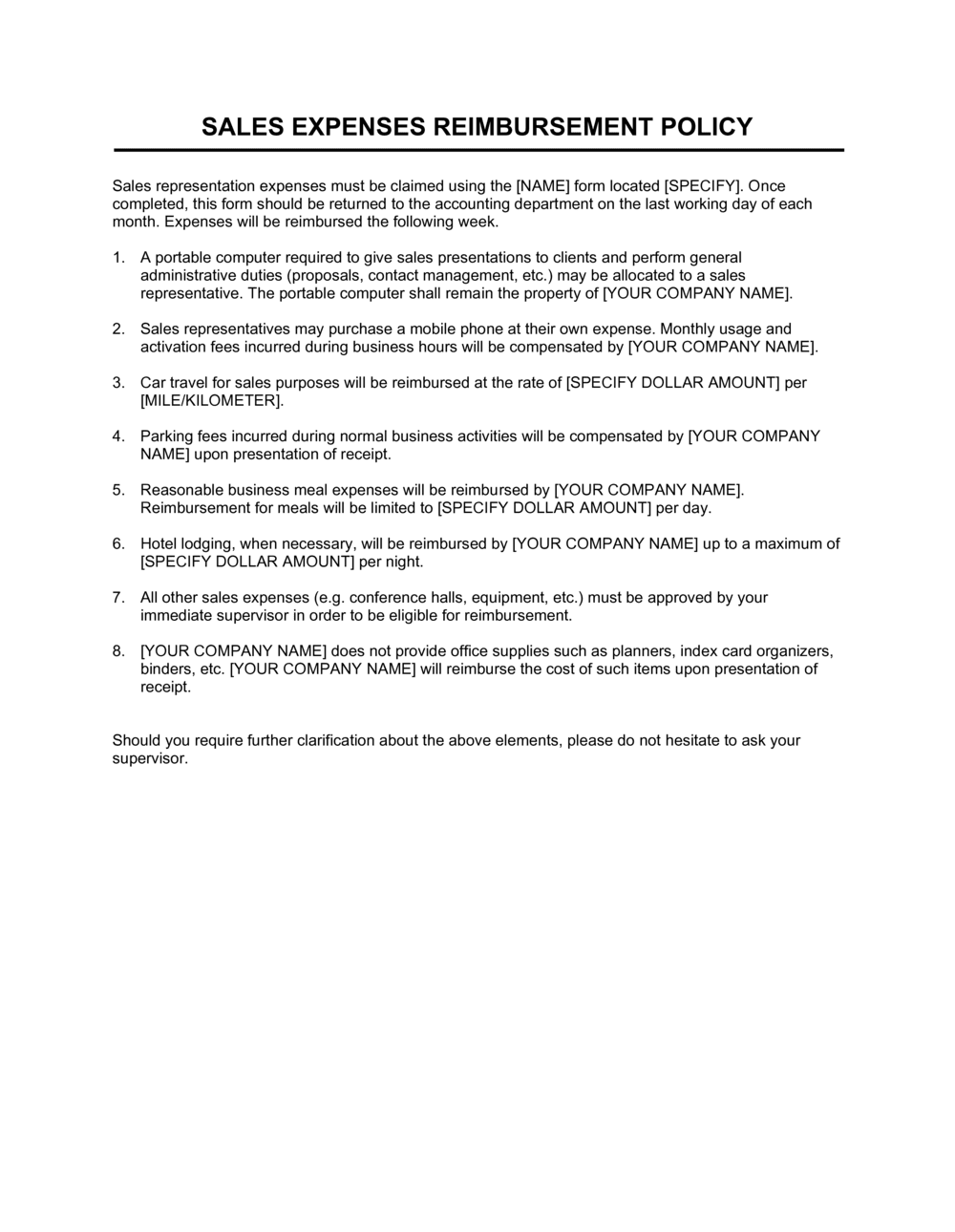
A Sales Expenses Reimbursement Policy is an internal operational document that defines which sales-related expenses the company will reimburse, the spending limits for each category, the required documentation, and the approval and payment process. This free Word download gives you a structured, ready-to-edit policy you can tailor to your team's size and reimbursement cycles, then export as PDF for distribution.
When you need it
Use it when onboarding your first sales hires, when inconsistent reimbursement decisions are creating friction between sales and finance, or when an audit or rapid headcount growth requires formal controls around discretionary selling costs.
What's inside
Policy scope and eligibility criteria, an itemized list of covered expense categories with per-diem and per-transaction limits, receipt and documentation requirements, the submission and approval workflow, payment timing, consequences for policy violations, and an employee acknowledgment section.

What is a Sales Expenses Reimbursement Policy?

A Sales Expenses Reimbursement Policy is an internal operational document that defines which costs incurred by sales staff the company will repay, the spending limits for each expense category, the documentation employees must provide to substantiate a claim, and the workflow for submitting, approving, and processing payments. It covers the full range of selling-related costs β€” airfare, hotels, client meals, entertainment, mileage, and conference fees β€” and establishes clear boundaries so sales reps know what they can spend without prior approval and what requires escalation. Unlike a general employee expense policy, it is calibrated specifically to the higher-volume, client-facing spend patterns of a revenue team.

Why You Need This Document

Without a written reimbursement policy, every expense claim becomes a negotiation. Reps submit what they think is reasonable; finance approves or denies based on informal norms; managers make inconsistent exceptions; and the resulting friction damages trust across the organization. The financial consequences are concrete β€” companies without documented T&E controls consistently overspend their selling-cost budgets and face audit exposure when IRS substantiation requirements for meals and entertainment are not met. A signed, distributed policy eliminates ambiguity, gives managers a defensible basis for denying out-of-policy claims, and creates the documentation trail that both internal auditors and tax authorities require. This template gives you a complete, ready-to-customize policy in under four hours.

Which variant fits your situation?

If your situation is…Use this template
Policy covering all employee types, not just sales staffEmployee Expense Reimbursement Policy
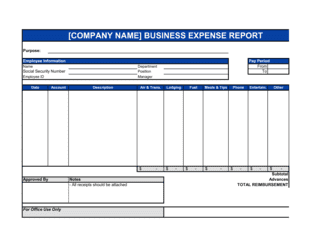
Tracking and submitting individual expense claimsSales Expense Report
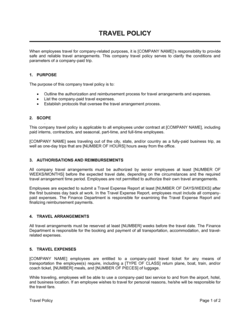
Managing overall travel and accommodation spendingTravel and Expense Policy
Reimbursing entertainment and client-hospitality costs specificallyEntertainment Expense Policy
Issuing company credit cards instead of out-of-pocket reimbursementCorporate Credit Card Policy
Controlling a fixed monthly allowance per rep rather than itemized reimbursementSales Allowance and Stipend Policy

Common mistakes to avoid

❌ No per-category spending limits

Why it matters: A policy that says 'reasonable expenses are reimbursable' leaves every claim open to interpretation β€” what a rep considers reasonable for a client dinner may be three times what finance expects.

Fix: Assign a specific dollar ceiling to every expense category and publish the limits in a reference table employees can access without reading the full policy.

❌ Missing submission deadline

Why it matters: Without a hard cutoff, reps submit six months of expenses in one batch, making it impossible to reconcile costs to the periods they were incurred and creating cash flow surprises for finance.

Fix: State a specific deadline β€” '30 calendar days from the date the expense was incurred' β€” and a consequence for late submissions, even if it is just a required manager exception approval.

❌ Accepting credit card statements as receipts

Why it matters: A credit card statement shows a total charge but not the individual items β€” for meals and entertainment, the IRS requires itemized documentation showing what was purchased, for whom, and why.

Fix: Explicitly state in the documentation section that itemized vendor receipts are required and that credit card statements are not acceptable substitutes.

❌ No employee acknowledgment on file

Why it matters: If a claim is denied or an employee is terminated for expense fraud, the company's position is substantially weaker if it cannot prove the employee knew the rules.

Fix: Add a signature page to the policy and collect signed acknowledgments at onboarding and each time the policy is materially updated.

The 9 key sections, explained

Purpose and scope

Eligible expense categories and limits

Non-reimbursable expenses

Receipt and documentation requirements

Submission process and deadlines

Approval workflow and authority levels

Payment timing and method

Policy violations and consequences

Employee acknowledgment

How to fill it out

  1. 1

    Define scope and eligible employees

    Enter your company name and specify exactly which employee groups the policy covers β€” full-time sales reps, part-time staff, contractors, or a combination. State whether the policy applies from day one of employment or after a probationary period.

    πŸ’‘ If contractors are covered, note that their reimbursements may need to be reported differently for tax purposes than W-2 employee reimbursements β€” flag this for your accountant.

  2. 2

    Set limits for each expense category

    Work through every category β€” airfare, hotels, ground transport, meals, client entertainment, office supplies, and professional development β€” and set a specific dollar ceiling for each. Reference current IRS per diem rates for domestic cities as a calibration point.

    πŸ’‘ Pull your last 12 months of T&E data before setting limits β€” if most hotel claims in New York run $280/night, a $150 ceiling will generate constant exception requests rather than behavioral change.

  3. 3

    Write the non-reimbursable list explicitly

    List every category the company will not cover. Be specific: 'personal meals on non-travel days' rather than 'personal expenses.' Include alcohol limits, upgrade restrictions, and any category that has historically caused disputes.

    πŸ’‘ Review your last year's declined claims to build the list β€” the most useful non-reimbursable entries are the ones that have already created friction.

  4. 4

    Define documentation requirements by expense type

    Specify the minimum threshold requiring a receipt (commonly $25 or $50), list what a qualifying receipt must show (date, amount, vendor, items), and state what additional information is required for meals and entertainment (attendees, business purpose).

    πŸ’‘ Set the receipt threshold low enough to capture meaningful spend but high enough that reps aren't scanning $4 parking slips β€” $25 is a widely used standard.

  5. 5

    Map the approval workflow to your org chart

    Assign dollar thresholds to each approval level β€” sales manager, director, VP, CFO β€” and document the sequence. Specify whether approvals can be given verbally or must be in writing, and whether expense software (Concur, Expensify, etc.) is the system of record.

    πŸ’‘ Pre-approval requirements for large expenses (client dinners over $500, international flights) are more effective than after-the-fact denials β€” build pre-approval steps into the workflow for your highest-risk categories.

  6. 6

    Set submission deadlines and payment dates

    Enter a hard submission deadline (30 days is standard) and specify the monthly cut-off for inclusion in the current payment cycle. State the payment method (direct deposit, check) and the exact payment date or cycle.

    πŸ’‘ Align the expense submission cut-off with your payroll processing calendar β€” processing expenses on the same cycle as payroll simplifies reconciliation significantly.

  7. 7

    Distribute and collect signed acknowledgments

    Share the completed policy with all covered employees before it takes effect. Collect a signed acknowledgment from each employee and store the originals in HR files. For updates to an existing policy, re-collect acknowledgments from all affected staff.

    πŸ’‘ Add the acknowledgment step to your new-hire onboarding checklist so every future sales hire signs before their first sales trip or client dinner.

Frequently asked questions

What is a sales expenses reimbursement policy?

A sales expenses reimbursement policy is an internal company document that defines which business costs incurred by sales staff the company will repay, the spending limits for each category, the documentation required to substantiate a claim, and the process for submitting and approving expense reports. It protects both the employee β€” by setting clear expectations β€” and the company β€” by establishing audit-ready controls over discretionary selling costs.

What expenses are typically covered in a sales reimbursement policy?

Most policies cover airfare (economy class), hotels up to a nightly cap, ground transportation including mileage at the IRS standard rate, solo meals while traveling with a per diem or daily limit, client meals and entertainment up to a per-person ceiling, conference registration fees, and business-related office supplies. Personal expenses, upgrades, fines, and alcohol above a stated per-person limit are typically excluded.

How do I set spending limits for each expense category?

Start by pulling your last 12 months of T&E data to understand actual spending patterns by category and city tier. Cross-reference IRS per diem rates for domestic travel and GSA lodging rates as a market benchmark. Set limits high enough to cover legitimate expenses without constant exception requests, but low enough to require manager approval for above-average spend. Review and update limits at least annually as costs change.

Do reimbursements under this policy count as taxable income for employees?

Generally, no β€” provided the policy operates as an IRS accountable plan, which requires three conditions: the expense must have a genuine business connection, the employee must substantiate it with adequate documentation (receipts, business purpose), and any excess advance must be returned within a reasonable time. Reimbursements that fail these conditions are treated as taxable wages. Consider asking your accountant to confirm your plan qualifies.

What is the standard submission deadline for expense reports?

Thirty calendar days from the date the expense was incurred is the most common standard for US companies and aligns with IRS accountable plan guidance. Some companies extend this to 60 days for field sales staff traveling frequently. Claims submitted beyond the stated deadline are typically denied or require written CFO approval as an exception β€” publish the deadline prominently and enforce it consistently.

How should the approval workflow be structured?

A tiered workflow tied to dollar thresholds works best: first-line sales managers handle routine claims up to a defined ceiling (commonly $500–$1,000), directors approve mid-range amounts, and the CFO or VP Finance approves large individual claims, international travel, or client entertainment events above a total event budget. Pre-approval requirements for the highest-risk categories β€” large client dinners, multi-day trips β€” are more effective than after-the-fact denials.

What happens if an employee submits a fraudulent expense claim?

The policy should state clearly that submitting false, altered, or duplicate receipts constitutes fraud and is grounds for immediate termination and potential referral for criminal prosecution. For lesser violations β€” repeated limit overages or missing receipts β€” a graduated consequence framework (written warning, then formal disciplinary action) is more appropriate and easier to defend in an employment dispute than a binary termination standard.

Should contractors be included in the sales expense reimbursement policy?

That depends on the contractor's engagement terms. If a contractor agreement includes expense reimbursement, they can be covered by the same policy β€” but reimbursements to contractors are reported differently for tax purposes than W-2 employee reimbursements and may need to be included in 1099 reporting. Confirm treatment with your accountant before extending coverage to contractors.

How often should a sales expense reimbursement policy be updated?

Review the policy at least once a year, aligned to your fiscal year budget cycle. Trigger an out-of-cycle review when IRS per diem rates change significantly, when the company expands into new geographies with different cost structures, when expense software changes, or when a pattern of exception requests signals that existing limits are out of step with actual market costs.

How this compares to alternatives

vs Sales Expense Report

A sales expense report is the form an employee submits to claim reimbursement for specific costs already incurred. The reimbursement policy is the governing document that defines which costs are eligible, what limits apply, and how reports are processed. The policy comes first; the expense report is the mechanism for operating under it. Both documents are needed β€” the policy without a report form leaves no standard submission process, and a report form without a policy leaves reps guessing what will be approved.

vs Employee Expense Reimbursement Policy

A general employee expense policy covers all staff β€” HR, finance, operations, and sales β€” with broad, company-wide rules. A sales expenses reimbursement policy is purpose-built for the higher-volume, client-facing spend of a sales organization, with specific categories like client entertainment, prospect meals, and demo travel that a company-wide policy typically handles inadequately. Use the general policy for all other departments and the sales-specific version for your revenue team.

vs Corporate Credit Card Policy

A corporate credit card policy governs company-issued cards β€” spending limits, acceptable use, and reconciliation β€” so employees do not need to front costs out of pocket. A reimbursement policy covers out-of-pocket expenses that are paid back after the fact. Many companies use both: a corporate card policy for travel and large costs, and a reimbursement policy for incidentals, mileage, and expenses incurred before a card was available.

vs Travel and Expense Policy

A travel and expense policy is a broader document covering all employee travel β€” booking procedures, preferred vendors, class of service, and per diem β€” for any business purpose. A sales expense reimbursement policy is narrower and specifically addresses the selling-cost categories unique to a revenue team, including client entertainment, prospect meals, and trade show expenses. Companies with a large sales force often maintain both: T&E for travel mechanics and the sales policy for selling-cost controls.

Industry-specific considerations

Technology / SaaS

Field sales teams attending enterprise customer sites and industry conferences generate high T&E; city-tier hotel caps and per-rep annual T&E budgets are common controls.

Professional Services

Client-billable versus non-billable expense distinction is critical β€” the policy must specify which categories can be passed through to clients and at what markup, if any.

Manufacturing

Distribution sales reps cover large territories and incur high mileage and overnight travel costs; IRS standard mileage rate reimbursement and regional hotel caps are the primary policy levers.

Financial Services

FINRA and SEC rules restrict gifts and entertainment to clients in regulated contexts β€” the policy must align client-meal and entertainment limits with applicable regulatory thresholds, currently $100 per person per year for FINRA-registered reps.

Retail / Wholesale

Account managers visiting retail chains and trade shows need clear per-diem rules for multi-day events and specific guidance on sample and promotional item costs.

Healthcare / Life Sciences

The Physician Payments Sunshine Act caps and disclosure requirements apply to any meal or gift provided to healthcare professionals β€” the policy must reference these limits explicitly and require reporting of covered transfers of value.

Template vs pro β€” what fits your needs?

PathBest forCostTime
Use the templateSmall and mid-size sales teams that need clear, enforceable expense rules without a dedicated compensation or legal teamFree2–4 hours to customize and distribute
Template + professional reviewCompanies in regulated industries (financial services, life sciences) or those with international sales teams where local law affects reimbursement rules$300–$800 for an HR consultant or employment attorney review3–5 business days
Custom draftedEnterprise sales organizations with complex multi-country operations, expense software integrations, or Sunshine Act and FINRA compliance requirements$1,500–$4,000 for a compensation consultant or specialized legal firm2–4 weeks

Glossary

Reimbursable Expense
A cost paid out of pocket by the employee that the company agrees to repay, provided it meets the policy's eligibility criteria.
Per Diem
A fixed daily allowance for meals and incidentals while traveling on company business, paid in lieu of itemized meal receipts.
Expense Report
A structured form the employee submits listing each expense, its business purpose, date, and supporting receipt.
Approval Threshold
The maximum expense amount a manager can authorize independently; claims above this amount require a higher level of sign-off.
Receipt
A vendor-issued document showing the date, amount, and items purchased β€” required to substantiate an expense claim for reimbursement and tax purposes.
Business Purpose
A brief explanation of how an expense relates to a specific sales activity, client, or opportunity β€” required on every claim to satisfy IRS and CRA substantiation rules.
Accountable Plan
An IRS-defined reimbursement arrangement requiring a business connection, adequate documentation, and return of excess advances β€” reimbursements under an accountable plan are not taxable income to the employee.
T&E (Travel and Entertainment)
The broad expense category covering transportation, lodging, meals, and client entertainment incurred while conducting sales activities.
Submission Deadline
The number of days after incurring an expense within which the employee must submit a claim β€” commonly 30 days; claims outside this window may be denied.
Non-Reimbursable Expense
A cost the company explicitly excludes from reimbursement, such as personal meals during non-travel days, fines, or alcohol above a stated per-person limit.

Part of your Business Operating System

This document is one of 3,000+ business & legal templates included in Business in a Box.

  • Fill-in-the-blanks β€” ready in minutes
  • 100% customizable Word document
  • Compatible with all office suites
  • Export to PDF and share electronically

Create your document in 3 simple steps.

From template to signed document β€” all inside one Business Operating System.
1
Download or open template

Access over 3,000+ business and legal templates for any business task, project or initiative.

2
Edit and fill in the blanks with AI

Customize your ready-made business document template and save it in the cloud.

3
Save, Share, Send, Sign

Share your files and folders with your team. Create a space of seamless collaboration.

Save time, save money, and create top-quality documents.

β˜…β˜…β˜…β˜…β˜…

"Fantastic value! I'm not sure how I'd do without it. It's worth its weight in gold and paid back for itself many times."

Managing Director Β· Mall Farm
Robert Whalley
Managing Director, Mall Farm Proprietary Limited
β˜…β˜…β˜…β˜…β˜…

"I have been using Business in a Box for years. It has been the most useful source of templates I have encountered. I recommend it to anyone."

Business Owner Β· 4+ years
Dr Michael John Freestone
Business Owner
β˜…β˜…β˜…β˜…β˜…

"It has been a life saver so many times I have lost count. Business in a Box has saved me so much time and as you know, time is money."

Owner Β· Upstate Web
David G. Moore Jr.
Owner, Upstate Web

Run your business with a system β€” not scattered tools

Stop downloading documents. Start operating with clarity. Business in a Box gives you the Business Operating System used by over 250,000 companies worldwide to structure, run, and grow their business.

Start freeΒ Β·Β No credit card required