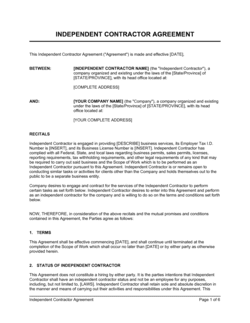
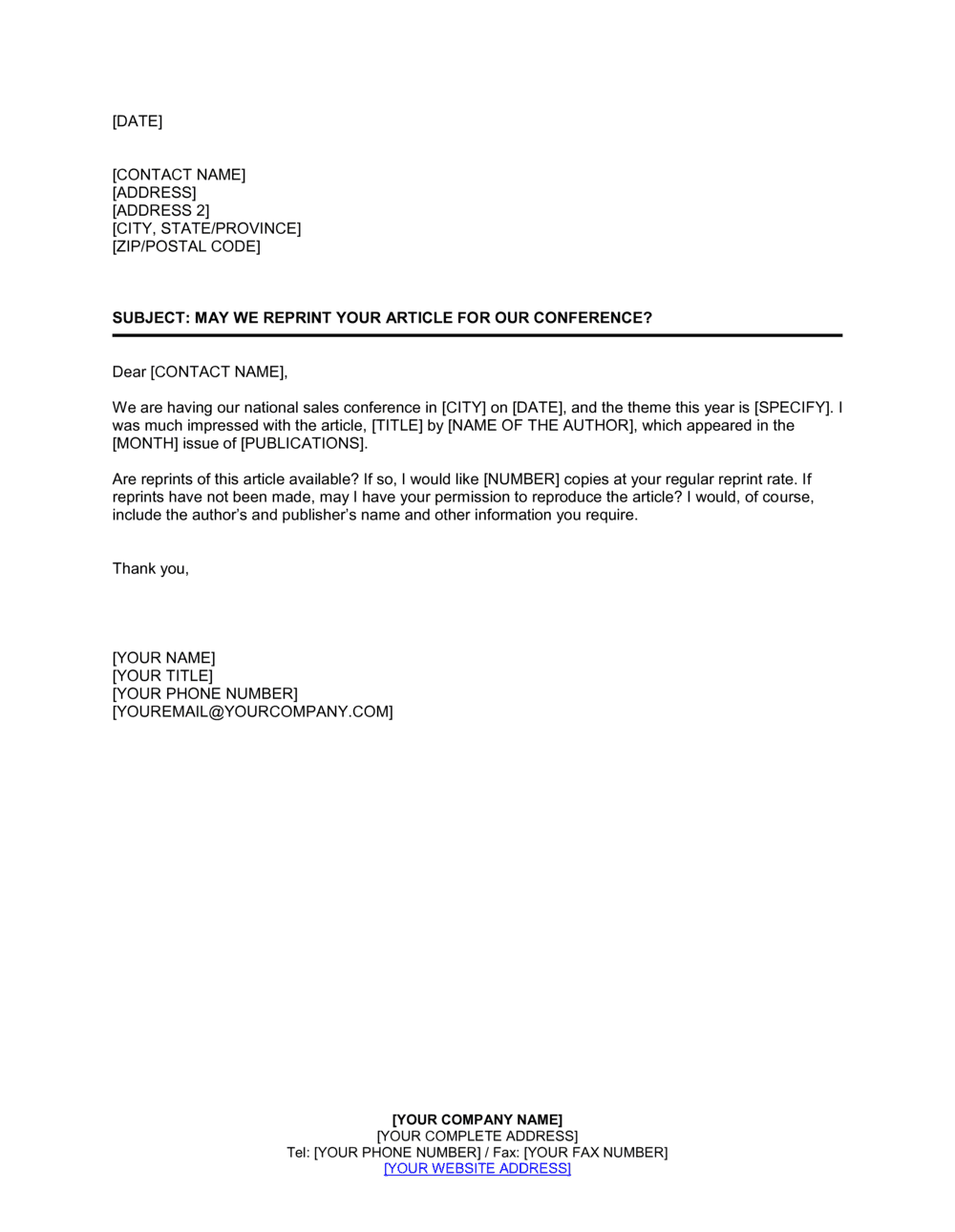
May We Reprint Your Article for our Conference Template

Free Word download • Edit online • Save & share with Drive • Export to PDF

1 page20–30 min to fillDifficulty: StandardSignature requiredLegal review recommended
Learn more ↓
FreeMay We Reprint Your Article for our Conference Template

At a glance

What it is
A "May We Reprint Your Article For Our Conference" letter is a legally binding permission agreement sent by a conference organizer to a copyright holder — typically an author or publisher — requesting the right to reproduce a specific article in conference materials such as proceedings, handouts, or digital attendee packets. This free Word download gives you a structured, professionally worded template you can edit online and export as PDF to obtain clear, documented authorization before distributing any third-party content.
When you need it
Use it any time you plan to reproduce, distribute, or include a published article — in print or digital form — in conference proceedings, workshop handouts, attendee resource packets, or online event portals. Without written permission, reproducing a copyrighted article exposes your organization to copyright infringement claims regardless of how the content is attributed.
What's inside
The template covers identification of the article and original publication, the specific reprint rights being requested, attribution and credit-line requirements, territory and format limitations, the term of the permission, any fees or royalties, representations by both parties, and signature blocks for formal written consent.

What is a May We Reprint Your Article For Our Conference Letter?

A May We Reprint Your Article For Our Conference letter is a formal written permission agreement used by conference organizers to request — and obtain documented consent for — the reproduction of a copyrighted article in conference proceedings, attendee handouts, or digital event materials. Once countersigned by the copyright holder, it becomes a binding license that defines exactly which article may be reproduced, in what format and territory, for which event, and under what attribution and fee conditions. Copyright in a published article belongs to the author or publisher automatically under the laws of every major jurisdiction — no registration is required — meaning any reproduction without explicit written consent is an infringement regardless of how prominently the original source is credited.

Why You Need This Document

Distributing a published article at a conference without a signed permission letter exposes your organization to copyright infringement claims that can result in injunctions, demands to destroy printed materials, and statutory damages of up to $150,000 per work under US law. Beyond the financial risk, a dispute with an author or publisher generates reputational damage that can complicate speaker relationships and sponsor confidence for future events. An informal email reply is not a substitute — it defines no scope, no territory, and no expiry, leaving every material term open to dispute. This template closes those gaps in 15–30 minutes: it records the exact article, the permitted use, the credit line, the term, and the consideration, then captures binding signatures from both parties before a single copy is printed or uploaded. For any conference that reproduces third-party content — from a single journal article to a curated reading packet — the signed reprint letter is the one document that turns a legal liability into a documented, enforceable right.

Which variant fits your situation?

If your situation is…Use this template
Reprinting a single article in printed conference proceedingsMay We Reprint Your Article For Our Conference
Licensing multiple articles or an entire issue from a publisherContent Licensing Agreement
Reproducing an article on a publicly accessible conference websiteDigital Content License Agreement
Using an article excerpt rather than the full textExcerpt Reprint Permission Letter
Requesting ongoing permission to reuse content across multiple eventsMaster Reprint License Agreement
Granting a third party permission to reprint your organization's articleReprint Authorization Letter (Outbound)
Translating and reprinting an article for an international conferenceTranslation and Reprint Permission Agreement

Common mistakes to avoid

❌ Relying on an email reply instead of a signed letter

Why it matters: An informal email grants permission of unknown scope. If the copyright holder later claims the email only covered a limited use, you have no signed document defining the agreed terms — leaving your organization exposed to an infringement claim.

Fix: Always require a countersigned copy of the formal permission letter before reproducing the article. An email confirmation is acceptable only as a preliminary step, not as a substitute for the executed document.

❌ Assuming fair use covers conference reproduction

Why it matters: Fair use and fair dealing exceptions are narrow and unpredictable. Reproducing a complete article for distribution to hundreds of conference attendees — even for educational purposes — is unlikely to qualify, and a wrong assumption can result in a copyright infringement claim.

Fix: Treat any full-article reproduction as requiring explicit written permission regardless of the educational nature of the conference. Obtain the signed reprint letter before printing or distributing any materials.

❌ Failing to confirm who actually holds the copyright

Why it matters: Authors often assign copyright to publishers upon submission. Permission from the author alone may be insufficient if the publisher holds the exclusive reproduction right — and acting on author-only permission can still result in a publisher infringement claim.

Fix: Check the original article's copyright notice and the publication's author agreement to confirm whether the author retained reprint rights or assigned them to the publisher. Contact the correct rights holder.

❌ Omitting digital and post-conference distribution from the scope

Why it matters: A permission limited to 'printed proceedings' does not cover the conference app, attendee portal, post-event PDF download, or recording. Distributing the article through any unlicensed channel — even after the event — is a separate infringement.

Fix: List every format and channel explicitly in the scope clause: print, digital download, conference app, post-event proceedings archive, and any recording or live stream. Request permission for all anticipated uses in a single letter.

The 10 key clauses, explained

Identification of the article and original publication

In plain language: Specifies exactly which article is being reprinted — full title, author name(s), original publication, volume/issue number, and publication date — to prevent any ambiguity about the scope of consent.

Sample language
Permission is requested to reprint the article titled '[ARTICLE TITLE]' by [AUTHOR NAME], originally published in [PUBLICATION NAME], Vol. [X], Issue [X], [MONTH YEAR] (the 'Work').

Common mistake: Using a partial or informal article title. If the cited title does not exactly match the published version, the copyright holder may dispute whether consent was given for the correct work.

Scope of reprint rights granted

In plain language: Defines precisely how the article may be reproduced — print only, digital only, or both — and the specific conference materials in which it may appear.

Sample language
Permission is granted to reproduce the Work in [print / digital / print and digital] format solely for inclusion in the official proceedings and attendee materials of [CONFERENCE NAME] held on [DATE].

Common mistake: Describing the permitted use too broadly — for example, 'conference materials' without specifying whether that includes the event website, recordings, or post-conference digital archives.

Attribution and credit line

In plain language: States the exact credit line that must appear adjacent to the reprinted article, including the author, original publication, and publisher.

Sample language
The following credit line shall appear prominently with each reproduction of the Work: 'Reprinted with permission from [PUBLICATION NAME], [YEAR]. © [AUTHOR / PUBLISHER NAME]. All rights reserved.'

Common mistake: Omitting the required credit line from the final printed or digital materials. Failure to attribute is a separate breach from the reproduction itself and can invalidate the permission.

Territory

In plain language: Limits where the reprinted materials may be distributed — for example, to attendees physically present at a domestic conference versus a global online event.

Sample language
This permission applies to distribution within [COUNTRY / REGION / WORLDWIDE] only. Distribution beyond the stated territory requires a separate written agreement.

Common mistake: Assuming a domestic permission covers digital distribution to international attendees. Online conference packets can cross borders automatically — without a worldwide grant, distribution to foreign attendees may infringe copyright.

Term and single-use limitation

In plain language: Specifies that the permission covers only the identified conference event and expires after a defined date, after which the reprinted materials must be withdrawn from circulation.

Sample language
This permission is valid solely for the [CONFERENCE NAME] event on [DATE] and expires on [EXPIRY DATE]. After expiry, the Licensee shall cease distribution of all materials containing the Work.

Common mistake: Leaving the term open-ended. Without a defined expiry, conference handouts or digital files containing the article may continue to circulate indefinitely without triggering additional compensation or renewal.

Fee or royalty (or waiver)

In plain language: States whether the copyright holder requires a fee, royalty, or complimentary registration in exchange for permission — or expressly waives any fee for the stated use.

Sample language
In consideration for this permission, the Licensee shall [pay a one-time fee of $[AMOUNT] / provide [X] complimentary conference registrations / no fee is required for this non-commercial use].

Common mistake: Proceeding without any consideration clause. Even a $1 nominal fee or a complimentary registration strengthens the enforceability of the agreement in jurisdictions that require consideration for a binding contract.

Representations and warranties

In plain language: Requires the licensor to confirm they own or control the rights being granted, and the licensee to confirm they will not use the article outside the stated scope.

Sample language
The Licensor represents that it has the right and authority to grant the permissions set out herein. The Licensee represents that the Work will be used solely as described in this letter and will not be modified, excerpted, or sublicensed without prior written consent.

Common mistake: Skipping warranties when dealing with a third-party licensor who is not the original author. If the licensor does not actually hold the relevant rights, the conference organizer may still face a claim from the true copyright owner.

Prohibition on modification

In plain language: Prohibits the licensee from editing, abridging, or adapting the article without separate written consent, protecting the author's moral rights and the integrity of the work.

Sample language
The Licensee shall reproduce the Work in its entirety without alteration, abridgment, or modification of any kind. Any use of an excerpt or adapted version requires separate written authorization from the Licensor.

Common mistake: Reprinting only a portion of the article — or reformatting it for layout reasons — without checking whether the permission covers excerpts. Most blanket reprint permissions cover the full text only.

Governing law and jurisdiction

In plain language: Identifies which country's or state's copyright and contract law governs the agreement and where disputes will be resolved.

Sample language
This agreement shall be governed by the laws of [STATE / PROVINCE / COUNTRY]. Any dispute arising under this agreement shall be resolved in the courts of [JURISDICTION].

Common mistake: Leaving governing law blank or defaulting to 'applicable law.' Copyright law differs significantly by jurisdiction — an unspecified governing law creates uncertainty about which fair-use or moral-rights rules apply.

Signatures and effective date

In plain language: Provides signature blocks for both the requesting party and the copyright holder, making the permission binding only upon written execution by both sides.

Sample language
By signing below, the parties agree to the terms of this reprint permission. Licensor: [NAME / TITLE / ORGANIZATION] _________ Date: _____ Licensee: [NAME / TITLE / ORGANIZATION] _________ Date: _____

Common mistake: Treating an email reply of 'yes, go ahead' as sufficient authorization. Without a signed document, the scope of permission remains ambiguous and may be unenforceable if the copyright holder later disputes the terms.

How to fill it out

  1. 1

    Identify the exact article and copyright holder

    Locate the full published title, author name(s), publication name, volume, issue, and publication date. Then confirm whether copyright is held by the author, the journal, or a publisher — check the copyright notice on the original article or the publication's copyright page.

    💡 Many academic and trade publishers have a rights and permissions department with a dedicated email address — contacting them directly is faster than routing through an editor.

  2. 2

    Enter your organization and conference details

    Fill in your organization's legal name, the conference name, the event date, the expected number of attendees, and the specific materials in which the article will appear (e.g., printed proceedings, digital handout packet, conference app).

    💡 Specifying attendee count matters — some publishers base reprint fees on the print run or distribution size.

  3. 3

    Define the scope of use precisely

    Select print, digital, or both. Confirm whether distribution is limited to on-site attendees or also covers post-conference digital access. State the URL if the article will appear on a conference website or online portal.

    💡 If the conference will be recorded or live-streamed, get explicit confirmation that the permission covers those formats — most standard reprint permissions do not.

  4. 4

    Set the territory and expiry date

    For domestic in-person events, specify the country. For virtual or hybrid events with international attendees, request a worldwide grant. Set an expiry date — typically the conference date plus 30 days to allow for post-event distribution of proceedings.

    💡 A 30–60 day post-event window is standard for distributing printed proceedings after the event; build this into the expiry date rather than requesting a second permission.

  5. 5

    Agree on fee or consideration

    Check whether the publisher has a standard reprint fee schedule (many academic publishers publish rates online). For nonprofit or educational conferences, many authors and smaller publications waive fees — state 'no fee required' explicitly in the letter if confirmed.

    💡 The Copyright Clearance Center (CCC) handles licensing for a large portion of US academic and business publications — check their catalog before drafting your own request.

  6. 6

    Include the required credit line

    Ask the licensor to confirm the exact credit line wording they require. Enter it verbatim in the attribution clause and note where it will appear in the final materials (e.g., 'on the page facing the article' or 'in the footer of the first page of the Work').

    💡 Photograph or screenshot the final printed or digital credit line after production and retain it with the signed permission as proof of compliance.

  7. 7

    Obtain signatures from both parties before printing or distributing

    Send the completed letter to the copyright holder for review and countersignature. Do not send materials to the printer or upload to the conference portal until you have a fully executed copy in hand.

    💡 Use a time-stamped e-signature service to create an auditable execution record — particularly important if the copyright holder is in a different jurisdiction.

  8. 8

    File the executed agreement with your event records

    Store the signed permission alongside the conference proceedings files and any fee payment receipts. Copyright disputes can arise years after an event — maintain records for at least seven years.

    💡 Tag the stored file with the article title, conference name, and expiry date so it surfaces quickly if a rights inquiry arrives after the event.

Frequently asked questions

What is a reprint permission letter for a conference?

A reprint permission letter is a formal written request — and, once countersigned, a binding agreement — by which a conference organizer asks a copyright holder for the right to reproduce a specific article in conference materials such as printed proceedings, digital handout packets, or attendee portals. It defines exactly which article may be reproduced, in what format, for which event, and under what conditions, providing documented authorization that protects both parties.

Do I need written permission to reprint an article at a conference?

Yes, in virtually all cases. Copyright protects articles from the moment they are written, and reproducing an article — in print or digitally — without permission infringes that copyright regardless of how the content is attributed. Fair use and fair dealing exceptions exist but are narrow; they typically do not cover wholesale reproduction for distribution to conference attendees. Always obtain a signed reprint permission before including any third-party article in conference materials.

Who do I contact to request reprint permission?

Start by checking the original article's copyright notice — it will indicate whether copyright is held by the author or assigned to a publisher. For journal articles, most publishers have a rights and permissions department or use the Copyright Clearance Center (CCC) as their licensing agent. For trade publication articles, contact the publication's editorial or permissions office. For independent authors, contact them directly through their professional or institutional email.

What information should I include in the permission request?

Include the full article title, author name(s), original publication name, volume, issue, and publication date; your organization's name; the conference name and date; the specific materials in which the article will appear; the anticipated distribution format (print, digital, or both) and size; the geographic territory; the period for which permission is sought; and any fee arrangement. The more specific your request, the faster the rights holder can respond.

How much does it cost to get reprint permission?

Cost varies widely. Many authors and smaller publications grant permission for free to nonprofit or educational conferences, particularly for single-event use. Academic publishers may charge $50–$500 per article depending on print run and distribution. Commercial publishers and wire-service content can cost significantly more. The Copyright Clearance Center's RightsLink platform provides instant fee quotes for a large catalog of US publications and many international ones.

Does the credit line matter legally?

Yes. The credit line is typically a condition of the permission, not a courtesy. Omitting or altering the required attribution can constitute a separate breach of the permission agreement — and in jurisdictions that recognize moral rights (including Canada, the UK, and the EU), failure to credit the author may also infringe the author's right of paternity independent of the copyright license.

Can I reproduce only part of an article without separate permission?

Not necessarily. Most reprint permission letters cover the full text only. Reproducing an excerpt may qualify as fair use in some jurisdictions for some purposes, but relying on that exception for conference distribution is risky. If you want to use only an excerpt, state that explicitly in your permission request and get written confirmation that the partial reproduction is authorized.

What happens if I use an article without permission?

Using a copyrighted article without permission is copyright infringement. The copyright holder may send a cease-and-desist, demand the destruction of all printed copies, seek an injunction against digital distribution, and claim damages — which in the US can reach $30,000 per work for non-willful infringement and $150,000 per work for willful infringement under 17 U.S.C. § 504. Even if damages are ultimately modest, the legal cost and reputational risk to the conference organizer can be significant.

Is a permission letter necessary if the article is open access?

It depends on the open-access license. Articles published under a Creative Commons CC BY license typically allow reproduction with attribution and may not require a separate permission letter — but check the specific license terms for any restrictions on commercial use, modification, or distribution format. Open access does not mean no restrictions; always verify the applicable license before reproducing the article.

How this compares to alternatives

vs Content Licensing Agreement

A content licensing agreement is a broader, often ongoing commercial arrangement covering multiple works, multiple uses, or a defined content library — typically negotiated between two organizations. A conference reprint permission letter is a narrow, single-event instrument covering one article for one specific purpose. Use the reprint letter for one-off conference reproduction; use a licensing agreement when you anticipate repeated or multi-work use across events or platforms.

vs Non-Disclosure Agreement

An NDA protects confidential information shared between parties who have not yet disclosed it publicly. A reprint permission letter deals with already-published content and governs how it may be reproduced and distributed. They address opposite scenarios: one controls disclosure of private information, the other authorizes reproduction of public content.

vs Freelance Writer Agreement

A freelance writer agreement governs the original creation of content for a commissioning party, including who owns the resulting copyright. A reprint permission letter is used after content already exists and has been published — it secures the right to reproduce work whose copyright was established at creation. One precedes the work; the other follows publication.

vs Assignment of Copyright

An assignment of copyright permanently transfers ownership of the copyright from one party to another. A reprint permission letter grants a limited, time-bound license to reproduce a specific work without transferring any ownership. After the permission expires, the copyright holder retains full ownership; after an assignment, they do not.

Industry-specific considerations

Academic and research institutions

Symposium and seminar organizers frequently reprint peer-reviewed journal articles in proceedings; publisher copyright assignment rules make the formal permission letter essential even when the author is a collaborator.

Professional associations and trade groups

Annual conferences routinely bundle curated articles from trade journals into member resource packets; association legal counsel typically requires documented reprint permissions as a condition of printing.

Healthcare and life sciences

Clinical conference organizers distributing medical journal articles face heightened risk because copyright holders in this sector actively monitor unauthorized reproduction and enforce rights aggressively through established licensing channels like RightsLink.

Financial services and fintech

Regulatory and compliance conferences that distribute analyst reports or financial press articles must secure permissions carefully, as financial publishers typically enforce copyright strictly and may require territorial licensing for cross-border events.

Technology and SaaS

Developer conferences and industry summits increasingly distribute digital-only proceedings where open-access and Creative Commons content is common, but commercial technical articles still require formal reprint letters — particularly for post-event online archives.

Nonprofit and NGO sector

Nonprofit conference organizers often negotiate fee waivers for non-commercial reprints, but still need a signed permission letter to document the scope of authorized use and protect the organization if the copyright holder changes.

Jurisdictional notes

United States

US copyright law (17 U.S.C.) grants copyright holders exclusive reproduction rights automatically upon creation. Fair use under § 107 is a case-by-case defense — reproducing a full article for conference distribution is unlikely to qualify. Statutory damages for infringement range from $750 to $30,000 per work, and up to $150,000 for willful infringement. The Copyright Clearance Center handles permissions for a large portion of US academic and business publications.

Canada

Canadian copyright law protects works under the Copyright Act, R.S.C. 1985. Fair dealing exceptions for education and research are narrower than US fair use and do not generally cover large-scale conference reproduction. Canada also recognizes moral rights — authors retain the right to be credited and to object to derogatory treatment of their work even after assigning copyright. Quebec's Civil Code applies to contracts formed in that province and may affect enforceability of certain warranty clauses.

United Kingdom

Copyright in the UK is governed by the Copyright, Designs and Patents Act 1988. Moral rights are recognized, and the right of attribution must be actively asserted by the author in writing — check whether the original publication included a moral rights assertion. The fair dealing exception for research and private study is narrow and does not cover distribution to conference delegates. Post-Brexit, UK copyright operates independently of EU Directives.

European Union

EU copyright is harmonized through the InfoSoc Directive (2001/29/EC) and the DSM Directive (2019/790/EU), but member states implement specific exceptions differently — what qualifies as a permitted educational use in Germany may not apply in France. Moral rights are strongly protected across the EU, and authors typically retain the right of integrity regardless of any assignment. For events with attendees in multiple EU member states, a worldwide or pan-European territorial grant is advisable to avoid jurisdiction-by-jurisdiction analysis.

Template vs lawyer — what fits your deal?

PathBest forCostTime
Use the templateConference organizers requesting permission to reprint a single article in non-commercial, domestic event materialsFree15–30 minutes
Template + legal reviewEvents with international distribution, digital archives, or multiple articles from commercial publishers$150–$400 for a brief IP lawyer review1–3 days
Custom draftedLarge commercial conferences, ongoing licensing relationships, or situations where the copyright holder has challenged a prior use$500–$2,000+1–2 weeks

Glossary

Copyright
The exclusive legal right of the author or publisher to reproduce, distribute, and adapt a creative work — including written articles — without authorization from a third party.
Reprint Permission
Written consent from a copyright holder allowing another party to reproduce a specific work under defined conditions without infringing copyright.
Licensor
The party who owns or controls the copyright in the article and grants permission to the requesting party — typically the original author or publisher.
Licensee
The conference organizer or other party seeking permission to reproduce the article in their materials.
Credit Line
A standardized attribution statement that must appear alongside the reprinted article, identifying the original publication, author, and publisher.
Territory
The geographic scope within which the reprint permission is valid — for example, a single country, a region, or worldwide.
Term
The period during which the granted reprint permission remains in force — often limited to a single event or defined calendar period.
Fair Use / Fair Dealing
A legal doctrine that permits limited reproduction of copyrighted material without permission for purposes such as commentary, criticism, or education — but does not typically cover wholesale article reproduction for conference distribution.
Non-Exclusive License
A grant of rights that allows the licensor to simultaneously permit other parties to use the same content — the most common form in reprint agreements.
Consideration
Something of value exchanged between the parties to make an agreement legally binding — often a nominal fee, attribution, or a complimentary conference registration in reprint contexts.
Moral Rights
Rights retained by an author independent of copyright ownership — including the right to be identified as the author and to object to derogatory treatment of the work — recognized in most jurisdictions outside the US.

Part of your Business Operating System

This document is one of 3,000+ business & legal templates included in Business in a Box.

  • Fill-in-the-blanks — ready in minutes
  • 100% customizable Word document
  • Compatible with all office suites
  • Export to PDF and share electronically

Create your document in 3 simple steps.

From template to signed document — all inside one Business Operating System.
1
Download or open template

Access over 3,000+ business and legal templates for any business task, project or initiative.

2
Edit and fill in the blanks with AI

Customize your ready-made business document template and save it in the cloud.

3
Save, Share, Send, Sign

Share your files and folders with your team. Create a space of seamless collaboration.

Save time, save money, and create top-quality documents.

★★★★★

"Fantastic value! I'm not sure how I'd do without it. It's worth its weight in gold and paid back for itself many times."

Managing Director · Mall Farm
Robert Whalley
Managing Director, Mall Farm Proprietary Limited
★★★★★

"I have been using Business in a Box for years. It has been the most useful source of templates I have encountered. I recommend it to anyone."

Business Owner · 4+ years
Dr Michael John Freestone
Business Owner
★★★★★

"It has been a life saver so many times I have lost count. Business in a Box has saved me so much time and as you know, time is money."

Owner · Upstate Web
David G. Moore Jr.
Owner, Upstate Web

Run your business with a system — not scattered tools

Stop downloading documents. Start operating with clarity. Business in a Box gives you the Business Operating System used by over 250,000 companies worldwide to structure, run, and grow their business.

Start free · No credit card required