Strategies For Employee Retention

Free Word download β€’ Edit online β€’ Save & share with Drive β€’ Export to PDF

3 pagesβ€’25–30 min to fillβ€’Difficulty: Standardβ€’Signature requiredβ€’Legal review recommended
Learn more ↓
FreeStrategies For Employee Retention Template

At a glance

What it is
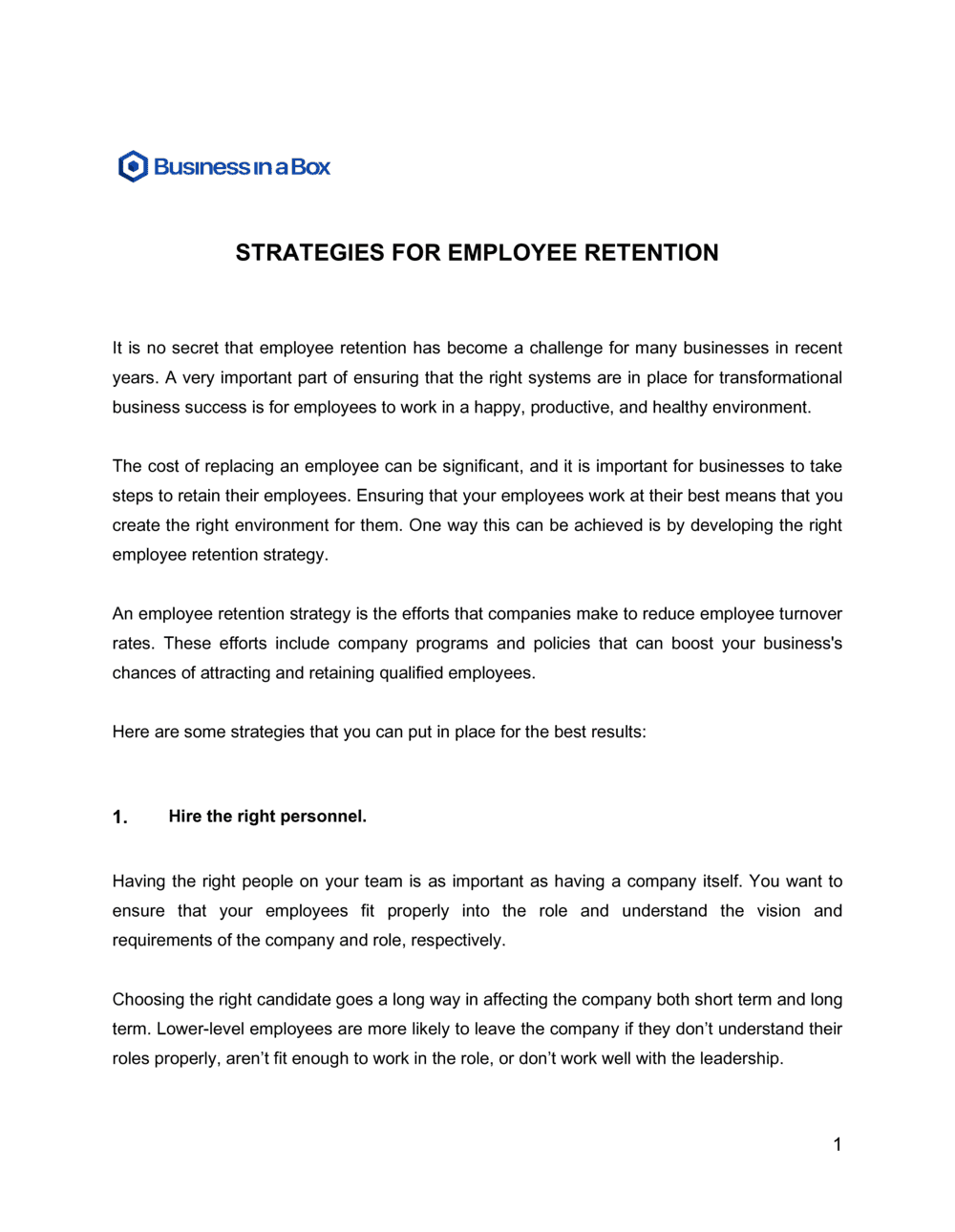
A Strategies for Employee Retention document is a formal, binding policy framework that commits the employer to specific compensation, development, recognition, and workplace conditions designed to reduce voluntary turnover. This free Word download covers retention bonuses, career advancement pathways, benefit commitments, and the obligations of both employer and employee β€” and can be exported as PDF for signature and HR filing.
When you need it
Use it when turnover is rising, key talent is at risk of departure, or you are scaling quickly and need a documented, enforceable retention commitment to present to employees during onboarding or annual reviews. It is also appropriate when integrating an acquired company's workforce or responding to a competitor poaching campaign.
What's inside
Retention bonus structures with vesting conditions, career development commitments, flexible work and benefit provisions, recognition program parameters, performance review cadence, non-solicitation obligations, and termination and repayment clauses that protect the company's investment in each retained employee.

What is a Strategies for Employee Retention Document?

A Strategies for Employee Retention document is a formal, binding framework that records the specific commitments an employer makes β€” retention bonuses with vesting schedules, career development timelines, compensation review benchmarks, benefit provisions, and recognition program obligations β€” to reduce voluntary turnover among targeted employees. Unlike a general HR policy, it is a signed agreement that creates enforceable obligations on both sides: the employer commits to defined incentives, and the employee acknowledges clawback and non-solicitation terms that protect the company's investment in retaining them. It functions as a supplement to the underlying employment contract and is most effective when tailored to the employee segments where departure would cause the greatest operational or financial disruption.

Why You Need This Document

Voluntary turnover costs organizations between 50% and 200% of an employee's annual salary in recruiting, onboarding, and lost productivity β€” and that figure rises sharply for technical, client-facing, or senior roles. Without a written retention framework, verbal commitments made during career conversations are unenforceable, retention bonuses paid without clawback provisions become unconditioned gifts, and competitors can poach your trained staff with no contractual obstacle. A documented, signed retention strategy closes all three gaps simultaneously: it binds the employer to specific career and compensation commitments that build genuine loyalty, while the clawback and non-solicitation clauses protect the company if the employee leaves early. This template gives you a structured starting point that covers every material retention lever β€” financial, developmental, and cultural β€” in a single document you can customize, sign, and file in each retained employee's HR record.

Which variant fits your situation?

If your situation is…Use this template
Retaining a single high-value employee with a cash bonus tied to tenureEmployee Retention Bonus Agreement
Retaining the full workforce during a merger or acquisitionM&A Employee Retention Plan
Documenting career development commitments for a key employeeEmployee Development Plan
Outlining performance expectations tied to retention incentivesPerformance Improvement Plan
Providing a structured onboarding experience to reduce early attritionEmployee Onboarding Plan
Formalizing flexible work arrangements as a retention toolRemote Work Agreement
Capturing why employees leave to improve future retentionExit Interview Form

Common mistakes to avoid

❌ Covering all employees identically regardless of role criticality

Why it matters: Spreading retention spend uniformly dilutes impact β€” resources are wasted on employees who would have stayed anyway, while the highest-flight-risk talent receives insufficient incentive to remain.

Fix: Segment employees by retention risk and business impact. Concentrate bonus amounts and development commitments on the 15–20% of roles where a departure would cause the most operational or financial damage.

❌ Using aspirational rather than enforceable language

Why it matters: Clauses that say 'the company will endeavor to' or 'aims to provide' create no legal obligation β€” employees who rely on them and are disappointed have no recourse, eroding trust faster than no commitment at all.

Fix: Replace aspirational language with specific, measurable commitments: a dollar amount, a date, a named program, or a minimum frequency. If you cannot commit to a specific outcome, do not put it in the document.

❌ No clawback provision on retention bonuses

Why it matters: Without a clawback, an employee can collect a 12-month retention bonus on day one and resign on day two with no financial consequence β€” turning the company's investment into a farewell gift.

Fix: Include a clawback clause requiring full or pro-rated repayment if the employee leaves voluntarily or is terminated for cause within a defined window, typically equal to the vesting period.

❌ Executing the document after delivering the retention bonus

Why it matters: In common-law jurisdictions, a contract requires fresh consideration. An employee who has already received the bonus has given nothing new in exchange for signing β€” the clawback and non-solicitation clauses may be unenforceable.

Fix: Always obtain a signed, countersigned copy before releasing any retention payment. If circumstances delay signing, provide a documented additional benefit as fresh consideration at the time of execution.

❌ Specifying benefit plan details inside the retention document

Why it matters: Benefits plans change annually. Hard-coding specific plan terms creates amendment obligations or unmet expectations every time the plan is updated.

Fix: Reference benefits by category and point to a separately maintained plan document: 'eligible for the Company's standard benefits program as amended from time to time.'

❌ Choosing a governing law based on the employer's headquarters rather than the employee's work location

Why it matters: Several jurisdictions β€” including California, France, and Germany β€” apply local employment law regardless of what a contract specifies. A mismatched choice-of-law clause can void key provisions including non-solicitation and clawback.

Fix: Set the governing law to the jurisdiction where the employee physically performs their work. For remote workers straddling multiple jurisdictions, seek legal advice on the applicable law before finalizing.

The 10 key clauses, explained

Purpose and Scope

In plain language: States the employer's intent to reduce voluntary turnover and identifies which employees, roles, or departments the strategy applies to.

Sample language
This Employee Retention Strategy ('Strategy') is adopted by [COMPANY NAME] to promote workforce stability, reduce voluntary turnover among [ELIGIBLE EMPLOYEE CLASSES], and document the Company's commitments to those employees.

Common mistake: Defining scope so broadly that every employee is covered with no differentiation β€” undermining the strategic focus and making the commitments too costly to honor consistently.

Retention Bonus Structure and Vesting

In plain language: Sets out the bonus amount or formula, the vesting date or milestone that triggers payment, and the conditions that must be met to receive it.

Sample language
Employee shall be eligible for a retention bonus of $[AMOUNT] payable on [DATE / MILESTONE], provided Employee remains actively employed in good standing through that date and has not given or received notice of termination.

Common mistake: Not defining 'actively employed in good standing' β€” leaving disputes open as to whether employees on leave, performance plans, or reduced hours qualify.

Clawback and Repayment Obligations

In plain language: Requires the employee to repay all or part of a retention bonus if they resign voluntarily or are terminated for cause within a defined period after receiving it.

Sample language
If Employee voluntarily resigns or is terminated for Cause within [X] months following receipt of the Retention Bonus, Employee agrees to repay [100% / pro-rated amount] of the gross bonus amount within [30] days of separation.

Common mistake: Setting the clawback on gross rather than net pay without specifying who bears the tax adjustment β€” creating an unintended windfall or shortfall depending on jurisdiction.

Career Development and Advancement Commitments

In plain language: Documents specific training, mentorship, promotion-review timelines, or role-expansion opportunities the employer commits to providing.

Sample language
The Company commits to conducting a formal career-path review with Employee no less than [annually / semi-annually], providing access to [TRAINING PROGRAM / BUDGET OF $X], and considering Employee for [ROLE / LEVEL] no later than [DATE].

Common mistake: Using aspirational language ('the Company will endeavor to') instead of specific, measurable commitments β€” making the clause unenforceable and eroding employee trust.

Compensation Review and Adjustment

In plain language: Establishes the frequency, criteria, and minimum parameters for salary reviews tied to retention β€” preventing market drift that drives departures.

Sample language
Employee's base compensation shall be reviewed no less than [annually], benchmarked against [SALARY SURVEY / MARKET DATA], and adjusted to remain within [X]% of the [PERCENTILE] of comparable roles in [MARKET / REGION].

Common mistake: Committing to market benchmarking without specifying the data source β€” leading to disputes over which salary survey applies when adjustment is due.

Benefits and Flexible Work Provisions

In plain language: Lists specific benefits, flexible-work arrangements, or wellness commitments the employer offers as retention incentives, with the conditions under which they apply.

Sample language
In addition to the Company's standard benefits program, Employee is eligible for [SPECIFIC BENEFIT β€” e.g., remote work up to [X] days per week, annual professional development budget of $[X], or [WELLNESS BENEFIT]] subject to the terms of the applicable policy.

Common mistake: Embedding specific benefit plan terms in the contract β€” benefits change annually, creating amendment obligations or unmet expectations when plans are updated.

Recognition and Engagement Program

In plain language: Describes the performance-recognition mechanisms the company commits to β€” formal awards, peer recognition platforms, or milestone acknowledgments β€” and the cadence for engagement surveys.

Sample language
The Company shall conduct an employee engagement survey no less than [annually], share results within [60] days, and publish an action plan addressing the top [3] identified improvement areas within [90] days of results.

Common mistake: Including recognition programs without any accountability mechanism β€” if the company skips surveys or ignores results, the clause becomes an empty promise that accelerates cynicism.

Non-Solicitation of Colleagues

In plain language: Prevents a departing employee from recruiting or encouraging current employees to leave the company for a defined period after separation.

Sample language
For a period of [12] months following separation, Employee shall not directly or indirectly solicit, recruit, or encourage any employee of the Company to terminate their employment or accept employment with a competing organization.

Common mistake: Combining non-solicitation of employees with non-solicitation of clients in a single clause β€” courts in some jurisdictions treat them differently, and a drafting error in one can void both.

Term, Review, and Amendment

In plain language: States how long the strategy or agreement is in effect, when it will be formally reviewed, and how amendments must be made and communicated.

Sample language
This Strategy is effective as of [DATE] and shall remain in force for [12 / 24] months, subject to annual review. Any material amendments require [30] days' written notice to affected employees and mutual written consent.

Common mistake: No amendment clause at all β€” when market conditions change and the company needs to adjust retention terms, the absence of a defined amendment process creates legal uncertainty.

Governing Law and Dispute Resolution

In plain language: Specifies the jurisdiction whose employment law governs the document and how disputes about retention obligations will be resolved.

Sample language
This Strategy is governed by the laws of [STATE / PROVINCE / COUNTRY]. Disputes arising under this Strategy shall be resolved by [binding arbitration / mediation / courts of competent jurisdiction] in [CITY / JURISDICTION].

Common mistake: Choosing a governing law with no connection to where the employee actually works β€” several jurisdictions, including California, apply local employment law regardless of what the contract specifies.

How to fill it out

  1. 1

    Identify the employee groups this strategy covers

    Define whether the document applies company-wide, to specific departments, to employees above a certain tenure or seniority level, or to roles identified as critical to operations. Document the selection criteria in the Purpose and Scope clause.

    πŸ’‘ Limiting scope to your highest-turnover or highest-impact roles makes retention investments easier to justify financially and easier to administer consistently.

  2. 2

    Set the retention bonus amount and vesting date

    Enter a specific dollar amount or a formula (e.g., X% of base salary), the exact calendar date or milestone that triggers payment, and the employment conditions that must be met β€” including a clear definition of 'in good standing.'

    πŸ’‘ A two-stage vesting schedule (50% at 12 months, 50% at 24 months) retains employees longer than a single lump-sum payment at year one.

  3. 3

    Draft the clawback terms with pro-ration language

    Decide whether clawback applies to 100% of the bonus or a declining percentage over time. Specify the repayment window (typically 30 days from separation) and whether the repayment is calculated on gross or net amounts.

    πŸ’‘ A pro-rated clawback β€” reducing the repayment obligation by 1/12 for each month served after the bonus payment β€” is more defensible in court than a flat full-repayment demand.

  4. 4

    Specify career development commitments with dates

    Replace aspirational language with specific, measurable commitments: a dollar amount for training, a promotion-review date, or a named program the employee will be enrolled in. Set a timeline for each commitment.

    πŸ’‘ Measurable commitments reduce turnover more than vague promises β€” and they hold managers accountable to follow through.

  5. 5

    Define the compensation review frequency and benchmark

    State how often salary will be reviewed, which salary survey or benchmark data will be used, and the target percentile range. Include a minimum adjustment trigger (e.g., 'salary will not fall below the 50th percentile of the applicable benchmark').

    πŸ’‘ Name the specific salary survey (e.g., Mercer, Radford, or a published industry report) to prevent disputes about which data applies.

  6. 6

    Add non-solicitation terms calibrated to role seniority

    Set the non-solicitation duration (typically 12 months for most employees, up to 18 months for senior leaders with wide internal networks) and confirm it covers direct and indirect solicitation of colleagues.

    πŸ’‘ Check jurisdiction-specific enforceability before finalizing β€” courts in some EU member states require financial compensation for post-employment restrictions to be enforceable.

  7. 7

    Set the term, review schedule, and governing law

    Enter the effective date, the duration of the agreement (12 or 24 months is standard), the scheduled review date, and the governing law based on the employee's actual work location β€” not the employer's headquarters.

    πŸ’‘ Schedule the annual review of this document at the same time as your compensation benchmarking cycle so both are updated together.

  8. 8

    Execute before delivering any retention bonus

    Both the employer representative and the employee must sign before any retention payment is made or career commitments are acted upon. Retain a countersigned copy in the employee's HR file.

    πŸ’‘ In common-law jurisdictions, obtaining a signature after a retention bonus has already been paid raises a consideration problem β€” the employee gave nothing new in exchange. Sign first, pay after.

Frequently asked questions

What is an employee retention strategy document?

An employee retention strategy document is a formal, written framework that records the employer's specific commitments β€” bonuses, career development, compensation reviews, benefits, and recognition programs β€” designed to reduce voluntary turnover. When signed by both parties, it creates enforceable obligations, including clawback provisions if the employee leaves before a defined retention milestone. It differs from a general HR policy in that it is tailored to individual employees or defined employee segments and carries legal weight.

What should be included in an employee retention strategy?

A complete retention strategy covers retention bonus structure and vesting conditions, clawback and repayment obligations, career development and promotion-review commitments, compensation benchmarking and review frequency, benefits and flexible-work provisions, recognition and engagement program commitments, non-solicitation of colleagues, and a governing law clause. Missing the clawback or the governing law clause are the two most common gaps that create legal exposure.

Is an employee retention agreement legally binding?

Yes, when properly executed. A retention agreement is generally enforceable when it is supported by consideration (typically the retention bonus or career commitment), signed by both parties before any benefit is delivered, and compliant with the employment law of the jurisdiction where the employee works. Aspirational language β€” such as 'the company aims to' β€” does not create enforceable obligations, which is why specific, measurable commitments are essential.

Can a company require repayment of a retention bonus?

Yes, provided a clawback clause was included in a signed agreement and the employee received the agreement before the bonus was paid. The clawback can require full repayment or a pro-rated amount declining over the retention period. In most US states and Canadian provinces, a properly drafted clawback is enforceable through the employer's payroll system or as a civil debt. In the UK and EU, wage deduction rules may require advance written consent before any recovery from final pay.

How much should a retention bonus be?

Common benchmarks range from 10–25% of annual base salary for general employee retention, rising to 25–50% for senior leaders or during merger and acquisition transitions. The amount should be large enough to make departure financially painful during the vesting window but calibrated against the replacement cost β€” typically 50–200% of annual salary depending on role seniority and specialization. Consult current compensation survey data for your industry before setting the figure.

What is the difference between a retention bonus agreement and a retention strategy document?

A retention bonus agreement is a narrow, bilateral contract focused solely on the payment of a cash bonus tied to continued service. A retention strategy document is a broader framework covering bonuses, career development, compensation reviews, benefits, recognition, and non-solicitation β€” addressing the full range of drivers that influence an employee's decision to stay. The strategy document is appropriate when retention risk is multifaceted and a single cash payment is unlikely to be sufficient.

Do retention strategies need to be documented in writing?

Yes, for any commitment that creates a financial obligation β€” such as a retention bonus, clawback, or non-solicitation restriction. Verbal retention promises are difficult to enforce and are interpreted differently by employer and employee, leading to disputes. A written, signed document protects both parties: the employer can enforce clawback and non-solicitation; the employee has documented proof of career and compensation commitments.

What employment laws affect employee retention agreements?

Key considerations include wage deduction laws (which restrict how clawbacks can be recovered), non-solicitation enforceability rules (which vary significantly by jurisdiction), FLSA overtime classification implications for bonus payments, and pay equity laws requiring consistent application of retention incentives across similarly situated employees. In the EU, the Transparent and Predictable Working Conditions Directive may require disclosure of retention terms before or on day one of employment.

How often should an employee retention strategy be reviewed?

Annually, at minimum β€” aligned with your compensation benchmarking cycle and benefits renewal period. Additionally, trigger an immediate review whenever voluntary turnover exceeds 15% in a 12-month period, a competitor launches an active recruiting campaign targeting your staff, or the company undergoes a structural change such as a merger, acquisition, or significant leadership transition.

How this compares to alternatives

vs Employee Retention Bonus Agreement

A retention bonus agreement is a bilateral contract covering only the payment of a cash bonus in exchange for continued service to a specified date. The retention strategy document is a broader framework covering bonuses, career development, compensation benchmarking, benefits, recognition, and non-solicitation together. Use the bonus agreement for a single targeted payment; use the strategy document when retention risk is driven by multiple factors beyond cash alone.

vs Employment Contract

An employment contract establishes the foundational terms of the working relationship at hire β€” salary, duties, IP, and termination. A retention strategy document is a supplemental agreement layered on top of an existing employment contract to address ongoing retention risk. The two documents coexist; the retention strategy does not replace the employment contract.

vs Employee Development Plan

An employee development plan is a performance and growth roadmap focused on skills, training, and career milestones β€” it does not include financial incentives or legal obligations such as clawbacks. A retention strategy document encompasses development commitments but adds compensation, bonus, and non-solicitation provisions that make retention legally enforceable, not merely aspirational.

vs Performance Improvement Plan

A performance improvement plan is triggered by underperformance and documents the corrective steps required to avoid termination. A retention strategy document is triggered by flight risk and documents incentives designed to keep a valued, performing employee. The two documents address opposite ends of the employee-management spectrum and should never be confused or combined.

Industry-specific considerations

Technology / SaaS

Engineers and product managers are primary targets for competitor poaching; retention bonuses tied to product launch milestones and equity vesting cliffs are standard practice.

Healthcare

Nurse and clinical staff shortages make retention critical; agreements often include tuition reimbursement, shift-preference commitments, and loan-forgiveness provisions alongside cash bonuses.

Financial Services

Regulatory knowledge concentration in compliance and risk roles creates acute retention risk; deferred compensation structures and bonus clawback provisions require coordination with FINRA or FCA rules.

Manufacturing

Skilled tradespeople and technicians are costly to replace; retention strategies emphasize training investment, apprenticeship pathways, and shift-schedule flexibility alongside cash incentives.

Professional Services

Client relationship concentration in key account managers creates departure-triggered revenue risk; non-solicitation of clients is often paired with non-solicitation of employees in the same agreement.

Retail / Hospitality

High baseline turnover makes cost-effective retention incentives critical; tenure-based bonuses, scheduling flexibility, and advancement-to-management pathways are the most effective documented commitments.

Jurisdictional notes

United States

Clawback enforceability varies by state β€” some states restrict wage deductions and require a separate written authorization before any bonus recovery from final pay. California limits post-employment non-solicitation of employees and prohibits most non-competes. FLSA classification affects how retention bonuses interact with overtime calculations for non-exempt employees. The FTC's 2024 proposed rule on non-competes (blocked as of 2025) may affect related restrictions β€” verify current status before finalizing.

Canada

Retention bonuses paid to employees in Ontario and most other provinces are subject to Employment Standards Act minimums for termination and severance β€” a clawback clause cannot reduce the employee's statutory entitlements on termination without Cause. Quebec employers must provide documents in French for provincially regulated employees. Non-solicitation clauses are enforceable if reasonable in scope and duration; courts assess reasonableness strictly.

United Kingdom

Wage deduction for clawback requires advance written consent under the Employment Rights Act 1996 β€” without it, recovery from final pay is unlawful. Post-employment restrictions, including non-solicitation of colleagues, must be reasonable and protect a legitimate business interest to be enforceable. Garden leave provisions are a common UK alternative to retention bonuses for senior employees. IR35 rules may affect retention arrangements involving personal service companies.

European Union

The EU Transparent and Predictable Working Conditions Directive requires employers to disclose material terms β€” including retention incentives β€” at or before the start of employment in many member states. Post-employment non-solicitation restrictions in Germany, France, and the Netherlands typically require financial compensation to the employee to be enforceable, ranging from 25–50% of salary during the restriction period. GDPR governs how engagement survey data and employee records related to the retention program are stored and processed.

Template vs lawyer β€” what fits your deal?

PathBest forCostTime
Use the templateSmall and mid-size employers retaining employees in a single domestic jurisdiction without complex equity or deferred compensationFree1–2 hours
Template + legal reviewEmployers adding clawback provisions, cross-state or cross-provincial arrangements, or retention terms tied to equity vesting$300–$7002–5 days
Custom draftedM&A retention plans, executive retention with deferred compensation, or multi-jurisdiction workforces where local employment law varies significantly$1,500–$5,000+1–3 weeks

Glossary

Retention Bonus
A cash payment made to an employee contingent on remaining employed through a specified date or milestone.
Vesting Schedule
A timeline defining when retention incentives β€” bonuses, equity, or benefits β€” are earned and payable, typically tied to continued service.
Clawback Provision
A contractual clause requiring an employee to repay retention bonuses or incentives if they resign or are terminated for cause before the vesting date.
Voluntary Turnover Rate
The percentage of employees who leave an organization by their own choice in a given period, calculated as departures divided by average headcount.
Stay Interview
A structured conversation between a manager and a current employee to identify what motivates them to stay and what might cause them to leave.
Total Compensation Package
The full monetary and non-monetary value an employer provides to an employee, including base salary, bonuses, benefits, equity, and perks.
Non-Solicitation Clause
A contractual restriction preventing a departing employee from recruiting the employer's remaining staff to follow them to a new employer.
Engagement Survey
A periodic, typically anonymous questionnaire measuring employee satisfaction, motivation, and likelihood to remain with the organization.
Career Pathing
A documented progression of roles, skills, and milestones an employee can pursue within the organization over a defined timeframe.
Constructive Dismissal
When an employer's unilateral changes to working conditions are so significant that the employee is effectively forced to resign, treated legally as termination.
Succession Planning
A process for identifying and developing internal candidates to fill key roles as they become vacant, reducing dependence on external hiring.

Part of your Business Operating System

This document is one of 3,000+ business & legal templates included in Business in a Box.

  • Fill-in-the-blanks β€” ready in minutes
  • 100% customizable Word document
  • Compatible with all office suites
  • Export to PDF and share electronically

Create your document in 3 simple steps.

From template to signed document β€” all inside one Business Operating System.
1
Download or open template

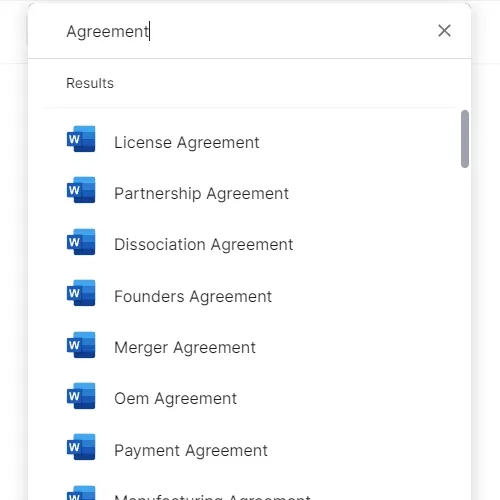
Access over 3,000+ business and legal templates for any business task, project or initiative.

2
Edit and fill in the blanks with AI

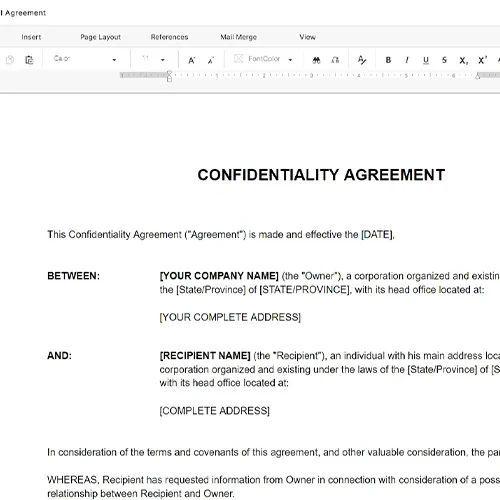
Customize your ready-made business document template and save it in the cloud.

3
Save, Share, Send, Sign

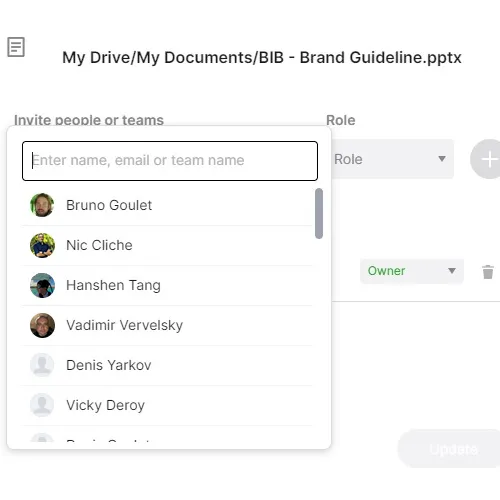
Share your files and folders with your team. Create a space of seamless collaboration.

Save time, save money, and create top-quality documents.

β˜…β˜…β˜…β˜…β˜…

"Fantastic value! I'm not sure how I'd do without it. It's worth its weight in gold and paid back for itself many times."

Managing Director Β· Mall Farm
Robert Whalley
Managing Director, Mall Farm Proprietary Limited
β˜…β˜…β˜…β˜…β˜…

"I have been using Business in a Box for years. It has been the most useful source of templates I have encountered. I recommend it to anyone."

Business Owner Β· 4+ years
Dr Michael John Freestone
Business Owner
β˜…β˜…β˜…β˜…β˜…

"It has been a life saver so many times I have lost count. Business in a Box has saved me so much time and as you know, time is money."

Owner Β· Upstate Web
David G. Moore Jr.
Owner, Upstate Web

Run your business with a system β€” not scattered tools

Stop downloading documents. Start operating with clarity. Business in a Box gives you the Business Operating System used by over 250,000 companies worldwide to structure, run, and grow their business.

Start freeΒ Β·Β No credit card required