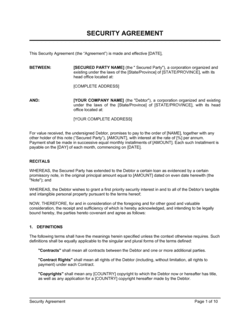
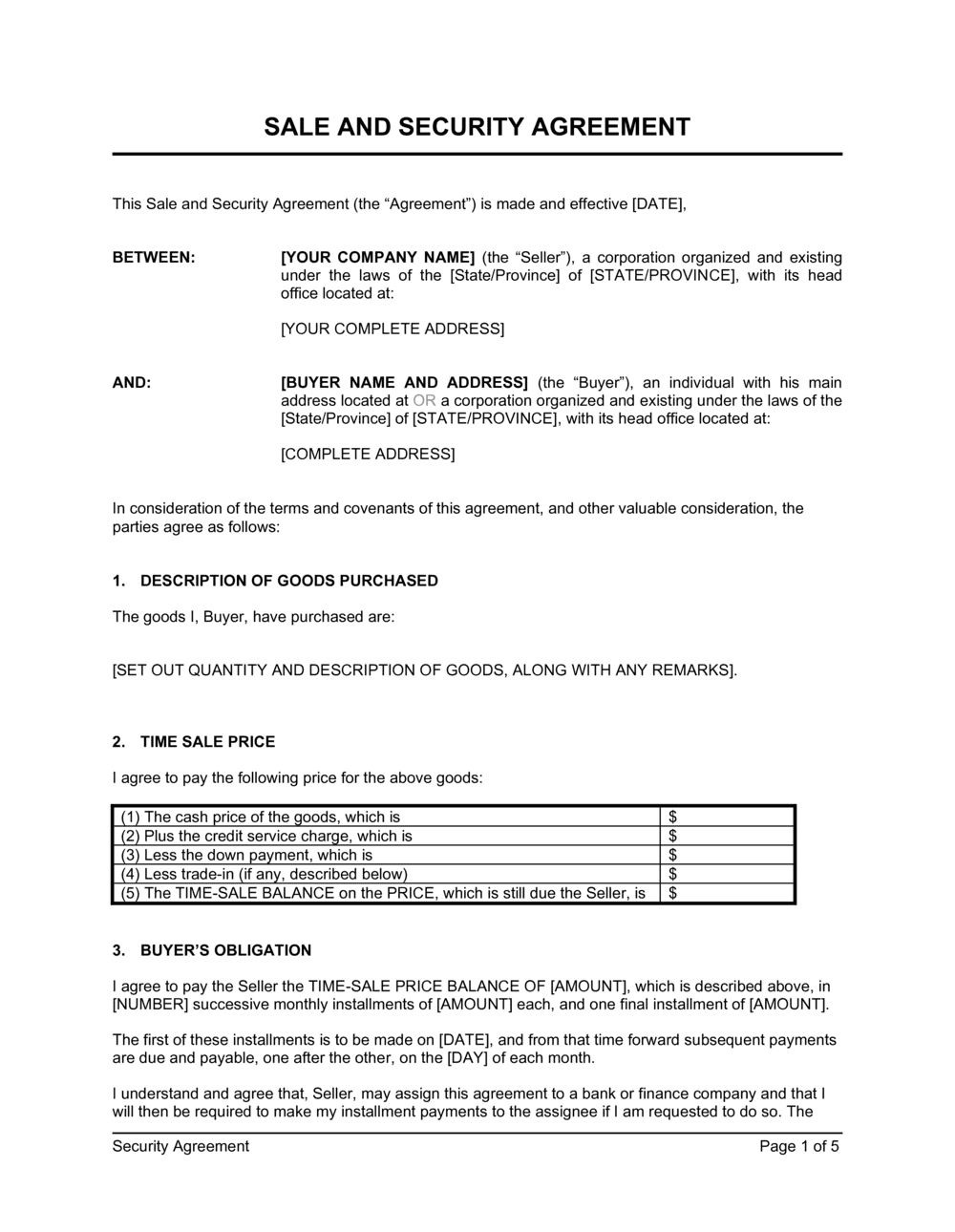
Security Agreement Covering Consumer Goods Template

Free Word download • Edit online • Save & share with Drive • Export to PDF

5 pages25–35 min to fillDifficulty: ComplexSignature requiredLegal review recommended
Learn more ↓
FreeSecurity Agreement Covering Consumer Goods Template

At a glance

What it is
A Security Agreement Covering Consumer Goods is a legally binding contract in which a debtor grants a creditor a security interest in specific consumer goods — such as furniture, appliances, electronics, or vehicles purchased for personal use — as collateral for a loan or credit obligation. This free Word download gives you a structured, UCC-compliant starting point you can edit online and export as PDF for execution between lender and borrower.
When you need it
Use it when extending credit to an individual whose repayment obligation will be secured by tangible personal property they own for personal, family, or household use. It is typically executed at the time of the credit transaction or purchase financing arrangement.
What's inside
Identification of the parties and collateral, grant of security interest, debtor representations and obligations, creditor rights on default, perfection and financing statement authorization, and governing law — covering the full lifecycle of the secured transaction from origination through enforcement.

What is a Security Agreement Covering Consumer Goods?

A Security Agreement Covering Consumer Goods is a legally binding contract in which an individual debtor grants a creditor a security interest in specific tangible personal property — furniture, appliances, electronics, vehicles, or other goods used primarily for personal, family, or household purposes — as collateral for a loan or deferred payment obligation. Governed in the United States by UCC Article 9, the agreement creates an enforceable lien that attaches to the named property, giving the creditor the right to repossess and sell it if the debtor fails to pay. Unlike real estate mortgages, which are recorded with a county register of deeds, consumer goods security interests are either automatically perfected (for purchase-money transactions) or perfected by filing a UCC-1 financing statement in the debtor's home state.

Why You Need This Document

Extending credit to a consumer without a signed security agreement means you are an unsecured creditor — last in line behind every other claimant if the debtor stops paying or files for bankruptcy. A properly executed and perfected security agreement changes your legal position materially: you have an enforceable right to specific property, priority over later creditors, and a path to recovery that does not depend entirely on suing and collecting a judgment. Without it, a debtor who defaults can sell or encumber the collateral freely, and you have no recourse against the goods themselves. For retailers offering installment sales, lenders financing personal property, and private individuals making secured loans, this agreement is the foundational document that separates a secured obligation from an unsecured one — and in a default scenario, that distinction is the difference between recovering your principal and writing it off entirely.

Which variant fits your situation?

If your situation is…Use this template
Securing a loan against business equipment or inventory instead of consumer goodsSecurity Agreement Covering Equipment
Financing a consumer vehicle purchase with a dedicated auto security interestMotor Vehicle Security Agreement
Securing a revolving line of credit against all personal property of the debtorGeneral Security Agreement
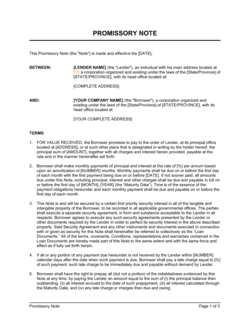
Documenting the underlying loan obligation that the security agreement securesPromissory Note
Providing notice of the security interest to third parties through public filingUCC-1 Financing Statement
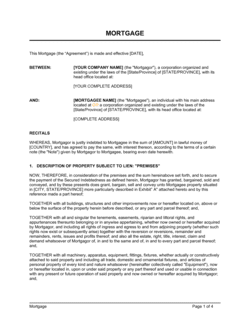
Extending credit secured by real property rather than personal propertyMortgage Agreement
Securing a purchase with both a promissory note and collateral in a single instrumentInstallment Sale Agreement

Common mistakes to avoid

❌ Relying solely on automatic perfection for all consumer goods

Why it matters: Automatic perfection under UCC Article 9 applies only to purchase-money security interests in consumer goods. Non-PMSI creditors — including lenders whose funds were not used to buy the specific collateral — must file a UCC-1 or their interest may be subordinate to a later-filed creditor or a bankruptcy trustee.

Fix: File a UCC-1 financing statement in the debtor's home state for every consumer goods security interest unless you are certain the PMSI automatic-perfection rule applies. The filing fee is minimal; the protection is material.

❌ Describing collateral as 'all household goods and personal property'

Why it matters: Courts have found blanket after-acquired collateral descriptions in consumer transactions unenforceable, and vague descriptions fail the UCC requirement that collateral be 'reasonably identified.' A creditor with an unenforceable description has an unperfected interest.

Fix: List specific items with make, model, and serial number, or at minimum a category description specific enough to distinguish the collateral from the debtor's other property.

❌ Skipping the required pre-sale notice to the debtor before disposing of repossessed collateral

Why it matters: UCC Article 9 requires that a secured party give the debtor at least 10 days' written notice before a private disposition and reasonable notice before a public sale. Failure voids the right to collect a deficiency judgment in many states.

Fix: Build a checklist into your default procedures: send written notice of disposition with the date, time, and location of any sale, retain proof of delivery, and wait the required notice period before proceeding.

❌ Not naming the secured party as loss payee on the debtor's insurance

Why it matters: If the collateral is destroyed — by fire, theft, or accident — and the insurance proceeds go directly to the debtor, the creditor loses its only security and must sue on the unsecured debt alone.

Fix: Require the debtor to deliver a certificate of insurance naming the secured party as loss payee before or at the time of signing. Follow up at each renewal date.

❌ Executing the agreement after the loan is funded or the goods are delivered

Why it matters: A security interest cannot attach until value is given, the debtor has rights in the collateral, and the debtor has signed the security agreement. Post-funding signatures raise attachment timing disputes and, in bankruptcy, may be challenged as preferential transfers.

Fix: Make execution of the security agreement a condition precedent to funding or delivery. Timestamp signatures and advance funds only after both parties have signed.

❌ Choosing a governing law with no connection to the debtor or collateral location

Why it matters: Many states have consumer protection statutes — covering repossession procedures, deficiency rights, and mandatory disclosures — that apply regardless of contractual choice of law. A mismatch can render key enforcement clauses void.

Fix: Use the law of the state where the individual debtor resides and the collateral is located. Confirm that the chosen state's consumer protection rules are compatible with the agreement's enforcement provisions.

The 10 key clauses, explained

Parties and recitals

In plain language: Identifies the secured party (creditor) and the debtor by full legal name and address, and states the purpose of the agreement — the underlying debt or obligation being secured.

Sample language
This Security Agreement ('Agreement') is entered into as of [DATE] between [SECURED PARTY FULL NAME], located at [ADDRESS] ('Secured Party'), and [DEBTOR FULL NAME], located at [ADDRESS] ('Debtor'), in connection with that certain [PROMISSORY NOTE / LOAN AGREEMENT] dated [DATE] in the original principal amount of $[AMOUNT].

Common mistake: Using a trade name or nickname for either party instead of the full legal name as it appears on government-issued ID or corporate registration. A mismatch can invalidate the security interest against third parties.

Grant of security interest

In plain language: The core operative clause in which the debtor formally grants the creditor a security interest in the described collateral as security for the stated obligation.

Sample language
To secure payment and performance of all obligations under the [LOAN AGREEMENT], Debtor hereby grants to Secured Party a continuing security interest in all of Debtor's right, title, and interest in and to the Collateral described in Schedule A attached hereto.

Common mistake: Writing 'assigns' or 'transfers' the collateral instead of 'grants a security interest.' An outright transfer is not a security interest and defeats the entire structure of the agreement.

Description of collateral

In plain language: Precisely identifies the consumer goods that serve as collateral — by make, model, serial number, or category — so there is no ambiguity about what is covered.

Sample language
The Collateral consists of the following consumer goods owned by Debtor: [ITEM DESCRIPTION, e.g., Samsung 65' QLED Television, Model QN65Q80C, Serial No. XXXXXXXX], located at [DEBTOR'S ADDRESS], and all proceeds, replacements, and accessions thereto.

Common mistake: Using a vague category description such as 'household goods' without specific identification. Courts and competing creditors require enough detail to distinguish the collateral from other property — and a vague description may be held insufficient to perfect a security interest.

Debtor's representations and warranties

In plain language: The debtor's written assurances that they own the collateral free and clear of other liens, that the goods are used for personal or household purposes, and that all information provided is accurate.

Sample language
Debtor represents and warrants that: (a) Debtor is the sole legal and beneficial owner of the Collateral, free and clear of all liens and encumbrances except as disclosed herein; (b) the Collateral is used primarily for personal, family, or household purposes; and (c) Debtor has full authority to grant the security interest herein.

Common mistake: Omitting the consumer-use warranty. Without it, classification of the goods as 'consumer goods' under UCC Article 9 — and the automatic perfection benefit — may be disputed.

Debtor's obligations and covenants

In plain language: Ongoing duties the debtor must fulfill during the term — maintaining and insuring the collateral, keeping it at a specified address, not selling or encumbering it, and notifying the creditor of any loss or change in location.

Sample language
Debtor covenants that Debtor shall: (a) maintain the Collateral in good condition and repair; (b) keep the Collateral insured against loss, naming Secured Party as loss payee; (c) not sell, transfer, or further encumber the Collateral without Secured Party's prior written consent; and (d) promptly notify Secured Party of any loss, damage, or change in the Collateral's location.

Common mistake: Not requiring the debtor to name the secured party as loss payee on the insurance policy. If the collateral is destroyed and proceeds go directly to the debtor, the creditor loses its only security.

Events of default

In plain language: Defines the specific acts or omissions that constitute a default triggering the creditor's enforcement rights — primarily non-payment, but also breach of covenants, insolvency, or destruction of collateral.

Sample language
Each of the following constitutes an Event of Default: (a) Debtor fails to pay any amount due under the [LOAN AGREEMENT] within [10] days of its due date; (b) Debtor breaches any covenant in this Agreement and fails to cure within [15] days of written notice; (c) Debtor becomes insolvent or files for bankruptcy; or (d) the Collateral is lost, destroyed, or materially damaged.

Common mistake: Defining default only as failure to pay. Omitting covenant breaches and insolvency events leaves the creditor unable to act when the debtor is clearly unable to perform, even before a payment is missed.

Creditor's remedies on default

In plain language: States what the creditor can do upon default — repossess, sell, or retain the collateral — and confirms that all UCC Article 9 remedies are available, including commercially reasonable disposition of the collateral.

Sample language
Upon an Event of Default, Secured Party may exercise all rights and remedies of a secured party under applicable law, including UCC Article 9, including the right to repossess the Collateral without judicial process (to the extent permitted by law) and to sell the Collateral at a public or private sale in a commercially reasonable manner. Net proceeds shall be applied first to Secured Party's costs of collection, then to the outstanding obligation. Debtor shall remain liable for any deficiency.

Common mistake: Claiming the right to retain the collateral in full satisfaction of the debt (strict foreclosure) without following the UCC's notice requirements. Skipping mandatory notice procedures can expose the creditor to damages and bar recovery of a deficiency.

Authorization to file financing statement

In plain language: The debtor's written authorization for the creditor to file a UCC-1 financing statement in the appropriate jurisdiction to perfect the security interest against third parties.

Sample language
Debtor hereby authorizes Secured Party to file, at Secured Party's discretion, one or more UCC financing statements and amendments describing the Collateral in the filing offices of [STATE / JURISDICTION] to perfect the security interest granted herein.

Common mistake: Omitting the authorization entirely and relying on automatic perfection for all consumer goods collateral. Automatic perfection under the PMSI rule is limited — for non-purchase-money security interests, a UCC-1 filing is required and without authorization language in the agreement, a separate signed authorization is needed.

Governing law and jurisdiction

In plain language: Specifies which state or province's law governs the agreement and where disputes will be resolved, ensuring predictability for both parties.

Sample language
This Agreement shall be governed by and construed in accordance with the laws of the State of [STATE], without regard to its conflict-of-laws rules. Any dispute arising hereunder shall be resolved exclusively in the courts of [COUNTY], [STATE].

Common mistake: Selecting a governing law with no connection to the debtor's location or the collateral's location. Several states — including California — apply consumer protection rules regardless of contractual choice of law, undermining clauses that conflict with local mandatory protections.

Entire agreement and amendment

In plain language: Confirms that the written agreement is the complete and final expression of the parties' deal, and that modifications must be in writing signed by both parties.

Sample language
This Agreement, together with any schedules attached hereto, constitutes the entire agreement of the parties with respect to the subject matter hereof and supersedes all prior discussions and understandings. No amendment shall be effective unless in writing and signed by both parties.

Common mistake: Not including this clause when the transaction was preceded by informal communications or a term sheet. Without it, a debtor can introduce emails or verbal side agreements to contest the agreed collateral scope or default terms.

How to fill it out

  1. 1

    Identify both parties with full legal names

    Enter the secured party's and debtor's full legal names exactly as they appear on government-issued ID or corporate registration. Include current mailing addresses for both.

    💡 For individual debtors, confirm the name matches the debtor's driver's license — this is the name used in any UCC filing and inconsistencies can impair perfection.

  2. 2

    Reference the underlying debt obligation

    In the recitals, cite the specific promissory note, loan agreement, or installment contract being secured — include its date and the original principal amount or credit limit.

    💡 If there is no separate written loan document, consider creating a promissory note first; a security agreement without a clear underlying obligation can be challenged as unenforceable.

  3. 3

    Describe the collateral with precision

    List each consumer good by make, model, and serial number if available, and state the address where the goods are located. Add 'and all proceeds, replacements, and accessions' to capture insurance payouts and substitutions.

    💡 Photograph the collateral at the time of signing and attach the images as an exhibit — this resolves condition disputes and confirms the goods existed at origination.

  4. 4

    Confirm consumer-use classification

    Include the debtor's representation that the goods are used primarily for personal, family, or household purposes. This classification triggers automatic perfection under UCC Article 9 PMSI rules if applicable.

    💡 If there is any chance the goods could be used for business purposes, do not rely on automatic perfection — file a UCC-1 financing statement to be safe.

  5. 5

    Set the debtor covenant obligations

    Specify where the collateral must be kept, insurance requirements including the secured party as loss payee, restrictions on sale or transfer, and notice obligations for any change in location or condition.

    💡 State a specific insurance coverage minimum (e.g., replacement value) rather than just 'adequate insurance' — vague standards are hard to enforce.

  6. 6

    Define events of default clearly

    List payment default (with any grace period), covenant breach default (with a cure period), insolvency, and collateral destruction as separate, numbered events. Include any cross-default provisions if the debtor has other obligations with the same creditor.

    💡 A 10-day grace period on payment default and a 15-day cure period on covenant default are standard — shorter periods are more protective but may be challenged as unreasonable in consumer transactions.

  7. 7

    Include the UCC-1 filing authorization

    Confirm the debtor authorizes the secured party to file a financing statement in the correct state — typically where the individual debtor resides. Even for consumer goods with automatic perfection, include this clause to cover non-PMSI situations.

    💡 File the UCC-1 within 20 days of the transaction if you are relying on PMSI priority — this is the window for purchase-money super-priority status in most states.

  8. 8

    Execute before funds are advanced or goods are delivered

    Both parties must sign the agreement before any money changes hands or goods are transferred. A security interest cannot attach — and is not enforceable — until value is given, the debtor has rights in the collateral, and the debtor has authenticated the security agreement.

    💡 Use a witnessed or notarized execution where the debtor is an individual and the collateral value is substantial — this strengthens enforceability and deters later disputes about authenticity of signature.

Frequently asked questions

What is a security agreement covering consumer goods?

A security agreement covering consumer goods is a contract in which an individual debtor grants a creditor a security interest in personal property used for household, family, or personal purposes — such as furniture, appliances, or electronics — as collateral for a loan or deferred payment obligation. Under UCC Article 9, it creates an enforceable lien that allows the creditor to repossess and sell the collateral if the debtor defaults. It is one of the most common forms of secured consumer lending outside of real estate.

What is the difference between a security agreement and a promissory note?

A promissory note documents the debtor's unconditional promise to repay a specific sum under defined terms — it is the debt instrument. A security agreement grants the creditor a lien on specific collateral to secure repayment of that debt. The two documents work together: the note creates the obligation; the security agreement provides the collateral backstop. Many consumer transactions use both, executed simultaneously.

Does a security agreement covering consumer goods need to be filed with the state?

In many cases, no — under UCC Article 9, a purchase-money security interest in consumer goods is automatically perfected at the moment it attaches, without a UCC-1 financing statement filing. However, automatic perfection does not apply to non-purchase-money interests, motor vehicles with certificate-of-title systems, or fixtures. Filing a UCC-1 is generally recommended as a belt-and-suspenders measure, particularly when the collateral is valuable or the debtor may have existing creditors.

What happens if a debtor defaults on a security agreement?

Upon default, the secured party typically has the right to repossess the collateral without court process, provided it can be done without breaching the peace — meaning no forced entry, confrontation, or threat of violence. After repossession, the creditor must give the debtor written notice of the intended disposition, conduct a commercially reasonable sale, and apply proceeds to the debt. If proceeds are insufficient, the creditor may sue for the deficiency in most U.S. jurisdictions.

Can a creditor keep the collateral instead of selling it?

Yes, but only under specific conditions. UCC Article 9 permits strict foreclosure — retaining the collateral in full satisfaction of the debt — but the secured party must send written notice of its intent to retain the collateral and allow the debtor a period (typically 20 days) to object. In consumer transactions, many states restrict or prohibit strict foreclosure entirely, requiring a sale. A lawyer familiar with the applicable state law should be consulted before pursuing this remedy.

What counts as 'consumer goods' under UCC Article 9?

Consumer goods are goods used or bought primarily for personal, family, or household purposes. Common examples include furniture, major appliances, televisions, personal computers, clothing, and household vehicles. The classification depends on the debtor's primary intended use at the time the security interest attaches — the same item (a laptop, for example) could be consumer goods for one debtor and equipment for another depending on how it is used.

Is a security agreement the same as a lien?

A security agreement is the contract that creates a consensual lien — both parties agree to the arrangement. A lien is the legal interest in the property that results from the agreement. Non-consensual liens (like tax liens or mechanic's liens) arise by operation of law without a contract. In secured lending, the security agreement is the source document; the lien is the legal consequence of executing and perfecting it.

Do I need a lawyer to use a security agreement template?

For straightforward consumer loans with clearly identified personal property collateral in a single jurisdiction, a well-drafted template is generally a sound starting point. Legal review is recommended when the collateral value is significant, the debtor has existing creditors who may hold prior interests, the transaction crosses state lines, or the goods are borderline between consumer and commercial use. The cost of a 1-hour attorney review is typically $150–$400 and is worthwhile for any secured transaction above $2,000.

What is a purchase-money security interest and why does it matter?

A purchase-money security interest (PMSI) arises when the creditor either sells the goods to the debtor on credit or lends money that the debtor uses specifically to buy those goods. A PMSI in consumer goods is automatically perfected under UCC Article 9 — no UCC-1 filing is required. It also enjoys super-priority over most earlier-filed security interests covering after-acquired consumer goods, making it the strongest form of consumer goods security interest available to retailers and consumer lenders.

How this compares to alternatives

vs General Security Agreement

A general security agreement covers all present and after-acquired personal property of the debtor — including inventory, equipment, and receivables — making it suitable for business lending. A consumer goods security agreement is narrower, covering only specific items used for personal or household purposes. Consumer agreements carry additional statutory protections for the debtor that do not apply to commercial general security agreements.

vs Promissory Note

A promissory note is the debt instrument — it records the amount borrowed, interest rate, repayment schedule, and the debtor's unconditional promise to pay. A security agreement is the collateral instrument — it grants the creditor a lien on specific property to secure the note. A fully documented consumer loan typically uses both documents together, executed simultaneously.

vs Mortgage Agreement

A mortgage agreement creates a security interest in real property — land and buildings. A consumer goods security agreement covers tangible personal property used for household purposes. Mortgages are governed by real property law and require recording with a county register of deeds; consumer goods security interests are governed by UCC Article 9 and perfected by filing or automatic operation.

vs Installment Sale Agreement

An installment sale agreement combines the purchase contract and the security interest in a single document — the buyer agrees to pay in installments and the seller retains title or a security interest until paid. A standalone security agreement is executed separately from the sale contract and assumes the purchase transaction is already documented elsewhere. Retailers often prefer the combined form; institutional lenders typically use separate instruments.

Industry-specific considerations

Retail and consumer finance

Retailers offering point-of-sale financing use security agreements to retain a PMSI in merchandise until installment payments are complete, enabling repossession on default without a court order.

Banking and credit unions

Community banks and credit unions document personal loans secured by household goods or appliances with a security agreement, often paired with a promissory note and automatic-payment authorization.

Automotive sales

Buy-here-pay-here dealers and private vehicle sellers use security agreements alongside the certificate of title to secure unpaid purchase price, though motor vehicle title laws in most states control perfection rather than UCC filing.

Professional services and private lending

Private lenders and individuals extending secured personal loans rely on security agreements to formalize collateral arrangements, creating an enforceable interest that survives the debtor's insolvency if properly perfected.

Jurisdictional notes

United States

UCC Article 9, adopted in all 50 states, governs security interests in consumer goods. A purchase-money security interest in consumer goods is automatically perfected without a UCC-1 filing, but non-PMSI interests require filing in the state where the individual debtor resides. Motor vehicles in most states are governed by certificate-of-title law rather than UCC filing. State-level consumer protection statutes — including California's Rees-Levering Act and similar laws in other states — impose additional notice and deficiency requirements that override contractual terms.

Canada

Each province has its own Personal Property Security Act (PPSA), modeled on UCC Article 9 but with provincial variations. Security interests in consumer goods must generally be registered in the province where the debtor resides. Ontario, British Columbia, and Alberta PPSA rules on consumer goods are broadly similar but differ on notice periods, deficiency rights, and the ability to sue for a shortfall after repossession. Quebec is governed by the Civil Code rather than the PPSA, and security interests are created through hypothecs rather than security agreements.

United Kingdom

England and Wales govern consumer credit security through the Consumer Credit Act 1974 (CCA), which imposes strict form, content, and cooling-off requirements on regulated consumer credit agreements — non-compliance renders the agreement unenforceable without a court order. Regulated agreements must be executed in prescribed form and contain specific statutory notices. The Financial Conduct Authority (FCA) also regulates lenders extending consumer credit, requiring authorization. Scotland has separate rules under Scots law regarding moveable property security.

European Union

EU member states implement the Consumer Credit Directive (2008/48/EC), which harmonizes disclosure and right-of-withdrawal requirements for consumer credit agreements, but security interest creation and enforcement remain governed by national law. Germany uses a Sicherungsübereignung (security transfer of title) structure rather than a lien-based system. France and other civil-law jurisdictions require specific formalities for taking security in personal property. GDPR applies to any personal data processed in connection with the agreement.

Template vs lawyer — what fits your deal?

PathBest forCostTime
Use the templateRetailers, small lenders, and private individuals documenting standard consumer goods collateral in a single stateFree15–30 minutes
Template + legal reviewTransactions with collateral value above $2,000, multi-state debtors, or any borrower with existing creditors on public record$150–$400 for a 1-hour attorney review1–3 business days
Custom draftedInstitutional consumer lenders, high-volume retail finance programs, or any program requiring regulatory compliance review under state lending or consumer protection law$800–$3,000+ depending on program complexity1–3 weeks

Glossary

Security Interest
A creditor's legal right in a debtor's property (the collateral) that allows the creditor to repossess or sell it if the debtor fails to repay the debt.
Consumer Goods
Under Article 9 of the UCC, goods used or bought primarily for personal, family, or household purposes — such as furniture, appliances, or personal electronics.
Collateral
The specific property a debtor pledges to a creditor as security for a loan or obligation; the creditor can claim it if the debtor defaults.
Perfection
The process by which a creditor makes its security interest enforceable against third parties — typically by filing a UCC-1 financing statement or, for consumer goods, through automatic perfection under purchase-money rules.
Purchase-Money Security Interest (PMSI)
A security interest taken by the seller or a lender whose funds were used to acquire the collateral — giving the creditor priority over other secured parties for that specific item.
Default
The debtor's failure to meet an obligation under the agreement — most commonly non-payment — that triggers the creditor's enforcement rights.
Repossession
A creditor's right, upon default, to take physical possession of the collateral; under UCC Article 9, this may be done without judicial process if it can be accomplished without breaching the peace.
UCC Article 9
The uniform commercial law framework adopted in all U.S. states governing secured transactions in personal property, including consumer goods.
Financing Statement (UCC-1)
A publicly filed document that gives notice of a creditor's security interest in named collateral; filing is the standard method of perfection for most personal property.
Deficiency
The amount still owed by the debtor after the creditor sells the repossessed collateral and applies the proceeds — the creditor may sue for this balance in most jurisdictions.
Automatic Perfection
A rule under UCC Article 9 by which a purchase-money security interest in consumer goods is perfected at the moment it attaches, without the need to file a financing statement.

Part of your Business Operating System

This document is one of 3,000+ business & legal templates included in Business in a Box.

  • Fill-in-the-blanks — ready in minutes
  • 100% customizable Word document
  • Compatible with all office suites
  • Export to PDF and share electronically

Create your document in 3 simple steps.

From template to signed document — all inside one Business Operating System.
1
Download or open template

Access over 3,000+ business and legal templates for any business task, project or initiative.

2
Edit and fill in the blanks with AI

Customize your ready-made business document template and save it in the cloud.

3
Save, Share, Send, Sign

Share your files and folders with your team. Create a space of seamless collaboration.

Save time, save money, and create top-quality documents.

★★★★★

"Fantastic value! I'm not sure how I'd do without it. It's worth its weight in gold and paid back for itself many times."

Managing Director · Mall Farm
Robert Whalley
Managing Director, Mall Farm Proprietary Limited
★★★★★

"I have been using Business in a Box for years. It has been the most useful source of templates I have encountered. I recommend it to anyone."

Business Owner · 4+ years
Dr Michael John Freestone
Business Owner
★★★★★

"It has been a life saver so many times I have lost count. Business in a Box has saved me so much time and as you know, time is money."

Owner · Upstate Web
David G. Moore Jr.
Owner, Upstate Web

Run your business with a system — not scattered tools

Stop downloading documents. Start operating with clarity. Business in a Box gives you the Business Operating System used by over 250,000 companies worldwide to structure, run, and grow their business.

Free Forever Plan · No credit card required