Request to Bank for Copy of Credit Report Template

Free Word download • Edit online • Save & share with Drive • Export to PDF

1 page15–20 min to fillDifficulty: Standard
Learn more ↓
FreeRequest to Bank for Copy of Credit Report Template

At a glance

What it is
A Request to Bank for Copy of Credit Report is a formal letter sent by an individual or business to their bank asking it to provide a copy of the credit report it holds or has obtained in connection with their account or financing relationship. This free Word download gives you a ready-to-edit template you can complete in minutes and send by email, post, or in-branch delivery.
When you need it
Use it when you need to verify the credit information your bank is working from before applying for a loan, disputing an adverse action, or auditing your financial records. It is also useful when a bank has denied credit and you want to review the underlying report that informed the decision.
What's inside
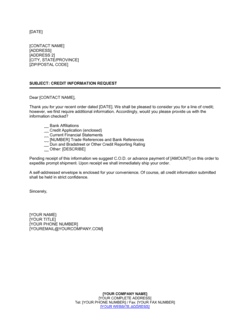
Sender and bank contact details, a clear statement of the request and its purpose, account or reference identification, supporting identity verification language, a response deadline, and a professional closing.

What is a Request to Bank for Copy of Credit Report?

A Request to Bank for Copy of Credit Report is a formal written letter sent by an individual or business to their bank asking it to provide the credit report it holds or has obtained in connection with a specific account or lending relationship. The letter identifies the account holder, supplies the identity verification details the bank requires, states the purpose of the request, defines the exact scope of information needed, and sets a clear response deadline. Unlike requesting a report directly from a national credit bureau, this letter targets the specific credit data your bank is actually working from — which may include bureau information pulled at a specific point in time or internal credit-scoring records that are not visible through standard bureau access channels.

Why You Need This Document

Relying on assumptions about what your bank sees when it evaluates your creditworthiness is a common and costly mistake. If your bank is working from a credit file that contains errors, outdated balances, or unauthorized inquiries, any loan, line of credit, or financing application you submit will be assessed against inaccurate data — and you will have no basis to challenge the outcome without first obtaining the report. Sending a formal written request creates a paper trail, establishes a response deadline the bank is expected to meet, and positions you to identify discrepancies before they affect a credit decision. For businesses preparing for growth financing, or individuals who have recently been denied credit, this letter is the first and most important step in taking control of the information driving lending decisions. This template gives you a professionally structured, ready-to-send letter that covers every element banks require to process the request without delay.

Which variant fits your situation?

If your situation is…Use this template
Requesting a personal credit report from a bank you hold an account withRequest to Bank for Copy of Credit Report
Formally disputing incorrect information on a credit reportCredit Report Dispute Letter
Requesting your full credit file from a national credit bureauCredit Bureau Report Request Letter
Following up after a bank has denied a credit applicationAdverse Action Notice Response Letter
Requesting a business credit report from a commercial lenderBusiness Credit Report Request Letter
Asking a bank to correct or update account informationBank Account Correction Request Letter

Common mistakes to avoid

❌ Sending to the wrong bank department

Why it matters: A letter routed to a general branch or customer service queue can sit unprocessed for weeks while statutory response windows tick down.

Fix: Confirm the correct mailing address or email for the bank's credit department or data-access team before sending, and name that department explicitly in the address block.

❌ Omitting identity verification details

Why it matters: Banks are legally required to verify the requester's identity before releasing credit data. An incomplete letter triggers a follow-up request and resets the response clock.

Fix: Include full legal name, date of birth, address on record, and account number in a clearly labeled verification block within the body of the letter.

❌ Using vague scope language

Why it matters: Asking for 'any credit information' gives the bank discretion to provide a one-page summary rather than the complete report, leaving you without the detail you need.

Fix: Specify exactly what you want — the full credit report including all inquiries, adverse entries, and account history — and the date range it should cover.

❌ Setting an unrealistic response deadline

Why it matters: Demanding a response within three to five days is outside standard processing windows and gives the bank grounds to decline or deprioritize the request without formal consequence.

Fix: Set a 14-to-30-day deadline, which aligns with typical regulatory timeframes and is accepted as standard by most banks.

The 8 key clauses, explained

Sender and recipient header

In plain language: Identifies the sender by full name or business name, address, and contact details, followed by the bank's name, branch or department, and address — establishing exactly who is writing and to whom.

Sample language
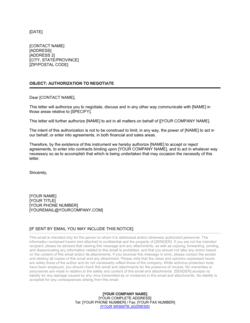
[YOUR FULL NAME / BUSINESS NAME] [ADDRESS LINE 1] [CITY, STATE, ZIP] [DATE] [BANK NAME] [BRANCH / CREDIT DEPARTMENT] [BANK ADDRESS]

Common mistake: Addressing the letter to a generic branch address rather than the specific credit or data-access department. Letters routed through general teller queues frequently go unanswered for weeks.

Subject line

In plain language: A brief reference line naming the purpose of the letter and the relevant account or reference number so bank staff can route and retrieve the file immediately.

Sample language
Re: Request for Copy of Credit Report — Account No. [ACCOUNT NUMBER]

Common mistake: Omitting the account number from the subject line, forcing the bank to ask a follow-up question before processing — adding days to the response time.

Opening statement of purpose

In plain language: States clearly and without preamble that the sender is requesting a copy of the credit report the bank holds or obtained in relation to the named account.

Sample language
I am writing to formally request a copy of the credit report held or obtained by [BANK NAME] in connection with my [personal / business] account referenced above.

Common mistake: Starting with several lines of background context before stating the actual request. Bank credit teams process dozens of letters daily — the ask should appear in the first two sentences.

Purpose and basis for the request

In plain language: Explains briefly why the report is needed — loan preparation, dispute investigation, adverse-action review — and references any applicable right of access under data protection or consumer credit law.

Sample language
I am requesting this report in preparation for a forthcoming credit application and to exercise my right of access to personal financial data held about me under applicable law.

Common mistake: Leaving the purpose unstated entirely. Banks may treat a purposeless request as lower priority or route it through a longer compliance review.

Identity verification details

In plain language: Provides the information the bank needs to confirm the sender's identity and locate the correct account — full legal name, date of birth, address on record, and account or customer reference number.

Sample language
For verification purposes, my details are as follows: Full Name: [FULL LEGAL NAME] | Date of Birth: [DD/MM/YYYY] | Address on Record: [ADDRESS] | Account Number: [ACCOUNT NUMBER].

Common mistake: Providing only a name without supporting identifiers. Banks cannot release credit information without matching at least two or three identity data points.

Scope of the request

In plain language: Specifies exactly what is being requested — the full credit report, the most recent credit inquiry, or the credit file used in a specific decision — to avoid receiving an incomplete or tangential document.

Sample language
Please provide the complete credit report currently held on file for my account, including all entries, inquiries, and any adverse information recorded as of [DATE OF REQUEST].

Common mistake: Requesting 'any credit information' without defining scope. Vague requests give the bank discretion to provide a summary rather than the full report.

Requested response deadline

In plain language: States the date by which the sender needs the report, giving the bank a reasonable window — typically 14 to 30 days — while creating a reference point for follow-up.

Sample language
I kindly request that you provide the requested report within [14 / 30] days of receiving this letter. Should you require additional information to process this request, please contact me at [PHONE / EMAIL].

Common mistake: Setting an unrealistically short deadline — such as 3 to 5 business days — which causes the bank to decline or deprioritize the request rather than expedite it.

Professional closing and signature block

In plain language: Closes the letter with a courteous sign-off, the sender's full name, and contact details — creating a clean paper trail and making follow-up straightforward for the bank.

Sample language
Thank you for your prompt attention to this matter. Yours sincerely, [YOUR FULL NAME] [PHONE NUMBER] [EMAIL ADDRESS]

Common mistake: Using an informal closing such as 'Thanks' or 'Best' on a formal bank correspondence. An informal tone can undermine the letter's credibility as a formal data-access request.

How to fill it out

  1. 1

    Enter your full name or business name and contact details

    Add your legal name (or registered business name), current mailing address, phone number, and email to the sender block at the top of the template.

    💡 Use exactly the same name that appears on your bank account to avoid verification delays.

  2. 2

    Address the letter to the correct bank department

    Call your bank's main number or check its website to find the name and address of the credit department or data-access team. Avoid sending to a general branch address.

    💡 Some banks have a dedicated data-subject access request (DSAR) team — using that address can cut response time by up to a week.

  3. 3

    Add your account reference number to the subject line

    Include your account number or customer reference number in the Re: line. This lets bank staff pull your file without sending a follow-up query.

    💡 If you have multiple accounts with the bank, list all relevant account numbers to avoid receiving a partial response.

  4. 4

    State the purpose of your request

    In one or two sentences, explain why you need the report — loan preparation, adverse-action review, or a data audit. Reference your right of access if applicable in your jurisdiction.

    💡 Citing a specific reason signals to the bank that you know your rights, which typically speeds up processing.

  5. 5

    Fill in the identity verification block

    Enter your full legal name, date of birth, address on record with the bank, and account number. If requesting for a business, include the registered business name and company registration number.

    💡 Match every field exactly to your bank records — a single mismatch can trigger a manual review that adds 5 to 10 business days.

  6. 6

    Set a specific response deadline

    Enter a date 14 to 30 days from the date you send the letter. Include your preferred contact method so the bank can reach you if it needs clarification.

    💡 30 days aligns with statutory data-access windows in many jurisdictions, making the request harder to deprioritize.

  7. 7

    Send by a trackable method and keep a copy

    Send by email with a read receipt, or by tracked post. Save a copy of the sent letter and note the date it was dispatched for follow-up reference.

    💡 If you send by post, photograph or scan the completed letter before mailing — you will need it if the bank claims not to have received it.

Frequently asked questions

What is a request to bank for copy of credit report?

It is a formal written letter sent to a bank asking it to provide a copy of the credit report it holds or has obtained in relation to a specific account or financing relationship. The letter identifies the account holder, provides verification details, states the purpose of the request, and sets a response deadline. It creates a documented paper trail that is useful for follow-up or dispute purposes.

Why would I need to request my credit report from a bank specifically?

Banks sometimes pull credit reports from internal files or bureau partners that differ from the reports you access directly through national credit bureaus. Requesting the bank's copy lets you see exactly what information informed a lending decision, identify discrepancies between the bank's data and your bureau file, and prepare for an upcoming loan application with full knowledge of how the bank is likely to assess your creditworthiness.

How long does a bank typically take to respond?

Most banks respond within 14 to 30 days for routine credit report requests. In jurisdictions with statutory data-access windows — such as 30 days under GDPR in the EU and UK — banks are legally required to respond within that period. Setting a 30-day deadline in your letter aligns with these windows and gives the bank clear expectations without being unreasonable.

Can a business use this letter to request its business credit report?

Yes. The same template structure applies for business credit report requests, with the sender details updated to reflect the registered business name, company registration or tax ID number, and the name of an authorized signatory. Some banks have separate processes for commercial and personal credit data requests, so confirm the correct department when addressing a business request.

What should I do if the bank does not respond within my stated deadline?

Send a follow-up letter referencing the original request date and your account number, and escalate to the bank's compliance or data-protection officer if a second request goes unanswered. If the bank is subject to a statutory response window and has missed it, you may be able to file a complaint with the relevant financial regulator or data-protection authority in your jurisdiction.

Does sending this letter affect my credit score?

No. A letter requesting a copy of your own credit report does not constitute a credit inquiry and does not affect your credit score. Hard inquiries — which can impact scores — occur only when a lender pulls your report as part of evaluating a new credit application. Accessing your own report for review purposes is classified as a soft inquiry in most jurisdictions.

Should I send this letter by email or post?

Either method works, provided you use a trackable channel. Email with a read receipt creates an immediate timestamp; tracked or recorded post provides physical proof of delivery. Whichever you choose, keep a copy of the sent letter and note the dispatch date so you have a reference point if the bank claims non-receipt or the deadline passes without a response.

How this compares to alternatives

vs Credit Bureau Report Request Letter

A credit bureau request goes directly to agencies like Equifax, Experian, or TransUnion to obtain your centralized consumer credit file. A bank credit report request targets the specific file or bureau data your bank holds in connection with your account. Both documents can reveal different information — the bank's copy may include internal notes or a bureau pull not reflected in your standard bureau file.

vs Credit Report Dispute Letter

A dispute letter challenges specific inaccurate or incomplete entries already identified on a credit report. A request letter precedes the dispute — you need to obtain the report before you can identify what to dispute. Use the request letter first, then follow up with a dispute letter if errors are found.

vs Adverse Action Notice Response Letter

An adverse action response is sent after a bank has formally denied a credit application, asking the bank to explain the basis of its decision. A credit report request is a proactive step taken before or after any decision to review the underlying data. The two letters often work in sequence: request the report, review it, then respond to an adverse action if necessary.

vs Bank Account Information Request Letter

A bank account information request asks for transaction history, account statements, or balance records. A credit report request asks for the external bureau data or internal credit file the bank has compiled. They target different categories of information and are routed to different bank departments.

Industry-specific considerations

Financial Services

Brokers and advisors routinely request client credit reports from banking partners to assess refinancing options and verify data before structuring deals.

Real Estate

Property buyers and developers request bank credit reports ahead of mortgage applications to identify and resolve discrepancies before formal underwriting begins.

Professional Services

Accountants and financial consultants request credit reports on behalf of clients to support loan applications, dispute preparation, and financial health audits.

Retail and E-commerce

Small retail businesses request bank credit reports before applying for trade credit lines or supplier financing to ensure their file accurately reflects current standing.

Template vs pro — what fits your needs?

PathBest forCostTime
Use the templateIndividuals and small businesses making a routine request to review their bank's credit fileFree10 minutes
Template + professional reviewBusiness owners requesting credit data in advance of a significant financing round or after a formal credit denial$50–$150 (brief accountant or financial advisor review)1–2 hours
Custom draftedComplex multi-entity credit disputes, regulated industry borrowers, or cases involving potential legal escalation$200–$600 (solicitor or credit specialist)1–3 days

Glossary

Credit Report
A detailed record of an individual's or company's borrowing history, outstanding balances, payment behavior, and public financial records compiled by a credit bureau.
Adverse Action
A decision by a lender to deny credit, reduce a credit limit, or change loan terms unfavorably, typically triggered by information in a credit report.
Credit Bureau
An agency that collects and maintains consumer or business credit data and provides it to lenders as credit reports — major examples include Equifax, Experian, and TransUnion.
Account Reference Number
A unique identifier assigned by the bank to a specific account, used to ensure the correct file is retrieved when processing a request.
Identity Verification
The process a bank uses to confirm that the person requesting information is the account holder — typically by matching name, date of birth, address, and account number.
Data Subject
The individual or entity whose personal or financial information is held and processed by an institution such as a bank.
Right of Access
A legal right in many jurisdictions that allows individuals to obtain a copy of personal data held about them by an organization, including financial institutions.
Credit Inquiry
A record showing that a lender or other authorized party has accessed a credit report — hard inquiries can affect credit scores; soft inquiries do not.
Response Deadline
The date by which the sender requests the bank to respond; in many jurisdictions, statutory data-access response windows run 30 to 45 days.

Part of your Business Operating System

This document is one of 3,000+ business & legal templates included in Business in a Box.

  • Fill-in-the-blanks — ready in minutes
  • 100% customizable Word document
  • Compatible with all office suites
  • Export to PDF and share electronically

Create your document in 3 simple steps.

From template to signed document — all inside one Business Operating System.
1
Download or open template

Access over 3,000+ business and legal templates for any business task, project or initiative.

2
Edit and fill in the blanks with AI

Customize your ready-made business document template and save it in the cloud.

3
Save, Share, Send, Sign

Share your files and folders with your team. Create a space of seamless collaboration.

Save time, save money, and create top-quality documents.

★★★★★

"Fantastic value! I'm not sure how I'd do without it. It's worth its weight in gold and paid back for itself many times."

Managing Director · Mall Farm
Robert Whalley
Managing Director, Mall Farm Proprietary Limited
★★★★★

"I have been using Business in a Box for years. It has been the most useful source of templates I have encountered. I recommend it to anyone."

Business Owner · 4+ years
Dr Michael John Freestone
Business Owner
★★★★★

"It has been a life saver so many times I have lost count. Business in a Box has saved me so much time and as you know, time is money."

Owner · Upstate Web
David G. Moore Jr.
Owner, Upstate Web

Run your business with a system — not scattered tools

Stop downloading documents. Start operating with clarity. Business in a Box gives you the Business Operating System used by over 250,000 companies worldwide to structure, run, and grow their business.

Free Forever Plan · No credit card required