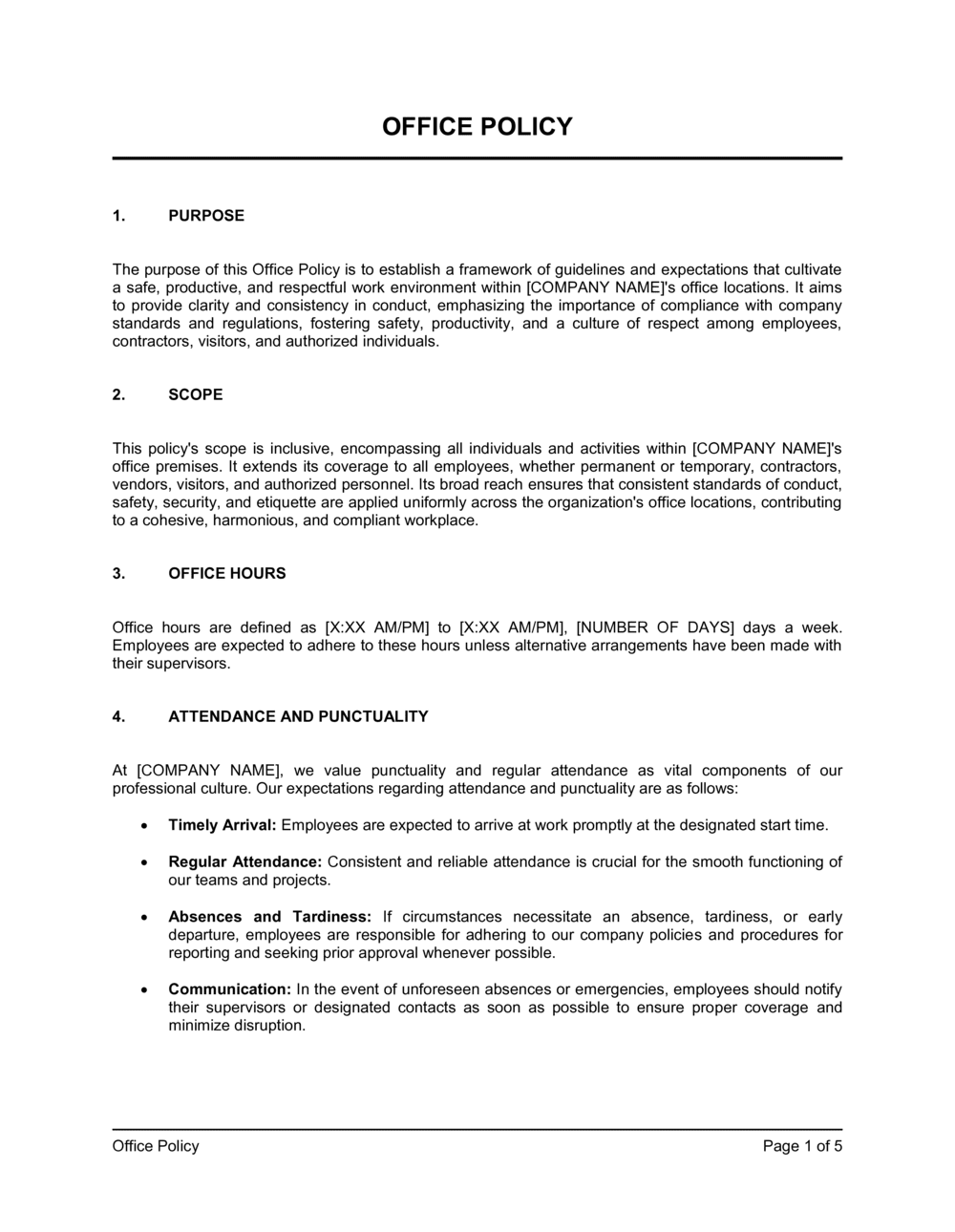
Office Policy Template

Free Word download β€’ Edit online β€’ Save & share with Drive β€’ Export to PDF

5 pagesβ€’20–30 min to fillβ€’Difficulty: Standard
Learn more ↓
FreeOffice Policy Template

At a glance

What it is
An Office Policy is a formal written document that defines the rules, expectations, and procedures governing day-to-day employee conduct and workplace operations. This free Word download gives you a structured, ready-to-customize starting point you can edit online and export as PDF to share with your team during onboarding or policy updates.
When you need it
Use it when onboarding new employees, standardizing workplace behavior after a period of growth, or responding to recurring conduct issues that need a documented resolution framework. It is also essential when preparing for audits, HR reviews, or staff expansions that require consistent written expectations across the organization.
What's inside
Purpose and scope, workplace conduct standards, attendance and punctuality rules, communication and technology use guidelines, dress code, health and safety expectations, disciplinary procedures, and acknowledgment and sign-off instructions.

What is an Office Policy?

An Office Policy is a formal written document that establishes the rules, expectations, and procedures governing employee conduct and day-to-day workplace operations. It defines what professional behavior looks like in your organization, how attendance and communication are managed, what constitutes a violation, and how violations are addressed β€” giving both employees and managers a consistent, documented reference point. Unlike an employment contract, which governs the legal terms of the working relationship, an office policy governs how people are expected to behave once they are in the workplace. A properly written policy eliminates the ambiguity that leads to inconsistent management decisions, employee grievances, and costly disputes.

Why You Need This Document

Without a written office policy, workplace expectations exist only in managers' heads β€” applied inconsistently, interpreted differently by each employee, and nearly impossible to enforce fairly when a conduct issue arises. When an attendance problem escalates to termination, or a technology misuse incident leads to a disciplinary hearing, the first question asked is whether the employee knew the rule and the consequence. Without a signed, documented policy, the answer is almost always contested. A clear office policy removes that ambiguity: it sets expectations before any incident occurs, creates a defensible record that the employee was informed, and gives managers a structured procedure to follow rather than improvising under pressure. This template gives you a complete, customizable starting point that covers every core operational area β€” ready to distribute to your team in under two hours.

Which variant fits your situation?

If your situation is…Use this template
Documenting all HR policies in a single comprehensive referenceEmployee Handbook
Setting rules specifically for remote and hybrid workersRemote Work Policy
Establishing a formal disciplinary process with escalation stepsEmployee Disciplinary Policy
Defining acceptable use of company devices and the internetIT and Acceptable Use Policy
Communicating standards of conduct and ethics to all staffCode of Conduct
Regulating leave, vacation, and absence requests formallyEmployee Leave Policy
Addressing workplace safety obligations and incident reportingHealth and Safety Policy

Common mistakes to avoid

❌ Undefined scope excluding contractors and interns

Why it matters: If the policy only references 'employees,' contractors and interns may argue it does not apply to them β€” removing your basis for disciplinary action against those workers.

Fix: Explicitly list every worker category the policy covers in the scope section, including part-time staff, temporary workers, and independent contractors.

❌ No monitoring notice in the technology use section

Why it matters: In several US states and most EU member countries, monitoring employee communications without prior notice is unlawful and exposes the company to significant fines.

Fix: Include a clear statement that company-issued devices, email, and network activity may be monitored, and have employees acknowledge this in the sign-off section.

❌ Disciplinary procedure with no gross-misconduct carve-out

Why it matters: A policy that mandates three warnings before termination can be read as contractually requiring those steps even for serious offenses like theft or harassment, creating legal exposure.

Fix: Add a paragraph naming specific behaviors β€” fraud, physical violence, harassment, theft β€” that constitute gross misconduct and justify immediate termination without prior warnings.

❌ Collecting acknowledgment signatures but not version-controlling the document

Why it matters: If the policy is updated after signatures are collected but files are not clearly versioned, it becomes impossible to confirm which version an employee agreed to during a dispute or employment tribunal.

Fix: Add a version number and effective date to every page footer, store signed copies linked to that version, and collect new signatures when any material change is made.

❌ Using vague attendance language like 'excessive absence'

Why it matters: Terms like 'excessive' or 'frequent' are subjective β€” two managers will apply them differently, creating inconsistency claims and discrimination exposure.

Fix: Replace vague terms with exact numbers: 'More than three unplanned absences within any rolling 90-day period will trigger a formal attendance review.'

❌ Single grievance contact who is also a potential subject of complaints

Why it matters: When the only named grievance contact is the employee's direct manager, complaints about that manager have no procedural outlet β€” exposing the company to constructive dismissal or harassment claims.

Fix: Name at least two grievance contacts β€” typically the direct manager and HR β€” and explicitly state that the employee may bypass their manager when the complaint involves them.

The 10 key sections, explained

Purpose and scope

Workplace conduct standards

Attendance, punctuality, and hours

Communication and technology use

Dress code and personal presentation

Health, safety, and workplace cleanliness

Confidentiality and information security

Disciplinary procedures

Grievance and complaint procedure

Policy acknowledgment

How to fill it out

  1. 1

    Define scope and effective date

    Specify which employees, roles, and locations the policy covers, and set the date it takes effect. Be explicit about whether it applies to contractors, interns, and part-time staff.

    πŸ’‘ Add a version number (e.g., v1.0) and effective date to the header β€” it makes tracking updates and confirming which version an employee signed straightforward.

  2. 2

    Set workplace conduct standards with concrete examples

    List the behaviors that are expected and those that are prohibited. Include at least two to three specific examples of unacceptable conduct so the standard is clear to both employees and managers enforcing it.

    πŸ’‘ Pair each prohibited behavior with the consequence β€” vague policies without stated consequences are harder to enforce consistently.

  3. 3

    Specify attendance rules with exact timelines

    Enter your core working hours, the deadline for reporting unplanned absences, and the threshold at which repeated absences trigger a formal review. Use specific numbers, not relative terms like 'frequently' or 'repeatedly.'

    πŸ’‘ State the notification method explicitly β€” text, phone call, or email β€” and name the person to notify, not just a job title that may change.

  4. 4

    Draft the technology use section with a monitoring notice

    Describe which systems are covered, what personal use is permitted (if any), and include a clear statement that company systems may be monitored. This notice is legally required in several jurisdictions before monitoring can take place.

    πŸ’‘ Check whether your jurisdiction requires employees to affirmatively consent to monitoring versus simple notice β€” the distinction matters for enforceability.

  5. 5

    Customize dress code by situation type

    Write separate standards for standard office days, client-facing days, and any designated casual days. Avoid one-size-fits-all language that leaves ambiguity for roles with different public-facing requirements.

    πŸ’‘ Include one concrete example of compliant attire and one example of non-compliant attire β€” it eliminates the most common interpretation disputes.

  6. 6

    Write the disciplinary procedure with a gross-misconduct carve-out

    List the progressive discipline steps in order. Add a separate paragraph that explicitly names behaviors constituting gross misconduct β€” theft, harassment, fraud, violence β€” which bypass the standard steps and allow immediate termination.

    πŸ’‘ Use the phrase 'up to and including termination' at each escalation step to preserve managerial discretion without overpromising a fixed outcome.

  7. 7

    Add acknowledgment signatures and collect them before the effective date

    Include a signature block at the end of the document for the employee's name, signature, and date. Collect all signed copies before the policy goes live and file them with employment records.

    πŸ’‘ For remote teams, use an e-signature tool and store timestamped acknowledgment records linked to the specific version of the document.

  8. 8

    Schedule an annual review date

    Add a footer or internal note identifying the next scheduled review date β€” typically 12 months from the effective date. Assign a named owner responsible for initiating the review.

    πŸ’‘ Announce policy updates to staff at least 2 weeks before the new version takes effect, and collect fresh acknowledgment signatures for any material changes.

Frequently asked questions

What is an office policy?

An office policy is a formal written document that defines the rules, expectations, and procedures governing employee behavior and daily workplace operations. It covers areas including conduct, attendance, technology use, dress code, health and safety, and disciplinary procedures. A well-drafted office policy gives both employees and managers a clear, consistent reference point for what is expected and what happens when expectations are not met.

Is an office policy legally required?

No federal or state law in the US mandates a standalone office policy document for most private employers, but specific policies β€” such as harassment prevention, safety, and technology monitoring notices β€” are legally required in many jurisdictions. Beyond legal minimums, a written office policy protects employers in disciplinary disputes by demonstrating that expectations were clearly communicated and consistently enforced.

What is the difference between an office policy and an employee handbook?

An office policy is a focused document covering day-to-day workplace conduct rules. An employee handbook is a comprehensive reference document that incorporates multiple policies β€” including compensation, benefits, leave, conduct, and termination β€” into a single authoritative guide. For small businesses, a standalone office policy is a practical starting point; larger organizations typically consolidate policies into a full handbook.

Do employees need to sign the office policy?

Employees are not legally required to sign an office policy in most jurisdictions, but collecting a signed acknowledgment is strongly recommended. A signed acknowledgment creates a documented record that the employee received, read, and understood the policy β€” which is critical evidence if a disciplinary action or termination is later challenged. For remote teams, a timestamped e-signature serves the same purpose.

How often should an office policy be updated?

Review the office policy at least once per year and whenever significant changes occur β€” new legislation, a shift to hybrid or remote work, a change in company size, or a recurring conduct issue that the current policy does not adequately address. Each update should carry a new version number and effective date, and all employees should be asked to acknowledge the updated version in writing.

Can an office policy override an employment contract?

Generally, no. An employment contract takes precedence over a standalone policy document where there is a direct conflict. Office policies are typically framed as operational guidelines and supplementary rules rather than contractual terms. However, if the policy is expressly incorporated into the employment contract, its terms may become contractually binding β€” which is one reason disciplinary procedures should include managerial discretion language rather than guaranteeing a fixed number of warnings.

What should a disciplinary section in an office policy include?

The disciplinary section should describe the progressive discipline steps β€” verbal warning, written warning, final written warning or suspension, and termination β€” along with a clear carve-out for gross misconduct behaviors that allow immediate termination. It should name who is responsible for initiating each step, confirm that records will be kept, and use language such as 'up to and including termination' to preserve managerial discretion at each stage.

How do I make an office policy enforceable?

Enforceability depends on four things: the policy is written and distributed to all covered employees; employees sign an acknowledgment confirming receipt; the policy is applied consistently across comparable situations; and any updates are communicated and re-acknowledged. Policies that are applied selectively or that managers are unaware of are routinely challenged in employment disputes on the grounds of inconsistent enforcement.

Should a small business have an office policy?

Yes β€” even a business with five employees benefits from a written office policy. Without written expectations, disagreements about attendance, conduct, or technology use are resolved informally, inconsistently, and sometimes expensively. A concise office policy creates a shared reference point from day one, making onboarding faster, conduct disputes clearer, and disciplinary decisions easier to defend.

How this compares to alternatives

vs Employee Handbook

An employee handbook is a comprehensive single document that consolidates all HR policies β€” compensation, benefits, leave, conduct, and termination β€” into one authoritative reference. An office policy is a focused document covering day-to-day workplace conduct rules. Use the office policy as a standalone document for small teams, or as a constituent section within a full handbook for larger organizations.

vs Code of Conduct

A code of conduct defines an organization's ethical values and professional standards at a broad level β€” integrity, conflicts of interest, and organizational culture. An office policy is more operational, covering specific rules for attendance, dress, technology, and disciplinary procedures. The two documents complement each other and are often cross-referenced.

vs Remote Work Policy

A remote work policy addresses the specific operational rules that apply when employees work outside the office β€” home workspace standards, availability expectations, data security, and equipment provision. An office policy covers the in-office environment. Organizations with hybrid teams need both, or a combined policy with separate in-office and remote sections.

vs Employment Contract

An employment contract is a legally binding agreement that establishes the terms of the working relationship β€” compensation, IP assignment, non-compete, and termination. An office policy is an operational document setting conduct standards. The contract governs the legal relationship; the policy governs daily behavior. The two should be cross-referenced but kept as separate documents.

Industry-specific considerations

Professional services

Client confidentiality obligations and dress code for client-facing roles receive extra weight; billing-time and non-disclosure provisions are typically integrated directly.

Technology / SaaS

Technology use and data security sections are expanded to cover BYOD policies, code repository access, and acceptable use of AI tools on company systems.

Retail / Hospitality

High staff turnover makes a brief, clearly written policy critical; dress code, attendance, and customer interaction standards are the most heavily used sections.

Healthcare

HIPAA-aligned confidentiality language and strict infection-control and personal presentation standards are embedded alongside standard conduct rules.

Template vs pro β€” what fits your needs?

PathBest forCostTime
Use the templateSmall businesses and startups establishing their first written workplace conduct standardsFree1–2 hours
Template + professional reviewGrowing teams adding monitoring, confidentiality, or disciplinary procedures that touch employment law$200–$500 for an HR consultant or employment lawyer review1–3 days
Custom draftedOrganizations in regulated industries, multi-location businesses, or companies with a history of employment disputes$500–$2,000 for a professionally drafted and jurisdiction-reviewed policy1–2 weeks

Glossary

Scope
The defined group of employees, locations, or activities to which a policy applies.
Progressive Discipline
A structured escalation process for addressing policy violations, typically moving from verbal warning to written warning to suspension to termination.
At-Will Employment
An employment arrangement in which either party may end the relationship at any time for any lawful reason β€” relevant context for how disciplinary policies are framed in US workplaces.
Policy Acknowledgment
A signed or electronically confirmed record that an employee has received, read, and understood the policy β€” used as evidence in disputes.
Workplace Conduct
The standards of behavior expected from employees in their interactions with colleagues, clients, and company property.
Grievance Procedure
A formal process employees follow to raise a complaint about workplace treatment, policy application, or a colleague's behavior.
Code of Conduct
A broader ethical framework document that sets organizational values and acceptable professional behavior, often referenced by or incorporated into an office policy.
Insubordination
Refusal to follow a reasonable, lawful directive from a supervisor β€” a commonly cited ground for disciplinary action in office policy frameworks.
Confidentiality Obligation
A policy requirement that employees protect sensitive business, client, or personnel information from unauthorized disclosure.
Probationary Period
An initial employment phase β€” typically 30 to 90 days β€” during which conduct and performance expectations under the policy are assessed with reduced formality.

Part of your Business Operating System

This document is one of 3,000+ business & legal templates included in Business in a Box.

  • Fill-in-the-blanks β€” ready in minutes
  • 100% customizable Word document
  • Compatible with all office suites
  • Export to PDF and share electronically

Create your document in 3 simple steps.

From template to signed document β€” all inside one Business Operating System.
1
Download or open template

Access over 3,000+ business and legal templates for any business task, project or initiative.

2
Edit and fill in the blanks with AI

Customize your ready-made business document template and save it in the cloud.

3
Save, Share, Send, Sign

Share your files and folders with your team. Create a space of seamless collaboration.

Save time, save money, and create top-quality documents.

β˜…β˜…β˜…β˜…β˜…

"Fantastic value! I'm not sure how I'd do without it. It's worth its weight in gold and paid back for itself many times."

Managing Director Β· Mall Farm
Robert Whalley
Managing Director, Mall Farm Proprietary Limited
β˜…β˜…β˜…β˜…β˜…

"I have been using Business in a Box for years. It has been the most useful source of templates I have encountered. I recommend it to anyone."

Business Owner Β· 4+ years
Dr Michael John Freestone
Business Owner
β˜…β˜…β˜…β˜…β˜…

"It has been a life saver so many times I have lost count. Business in a Box has saved me so much time and as you know, time is money."

Owner Β· Upstate Web
David G. Moore Jr.
Owner, Upstate Web

Run your business with a system β€” not scattered tools

Stop downloading documents. Start operating with clarity. Business in a Box gives you the Business Operating System used by over 250,000 companies worldwide to structure, run, and grow their business.

Free Forever PlanΒ Β·Β No credit card required