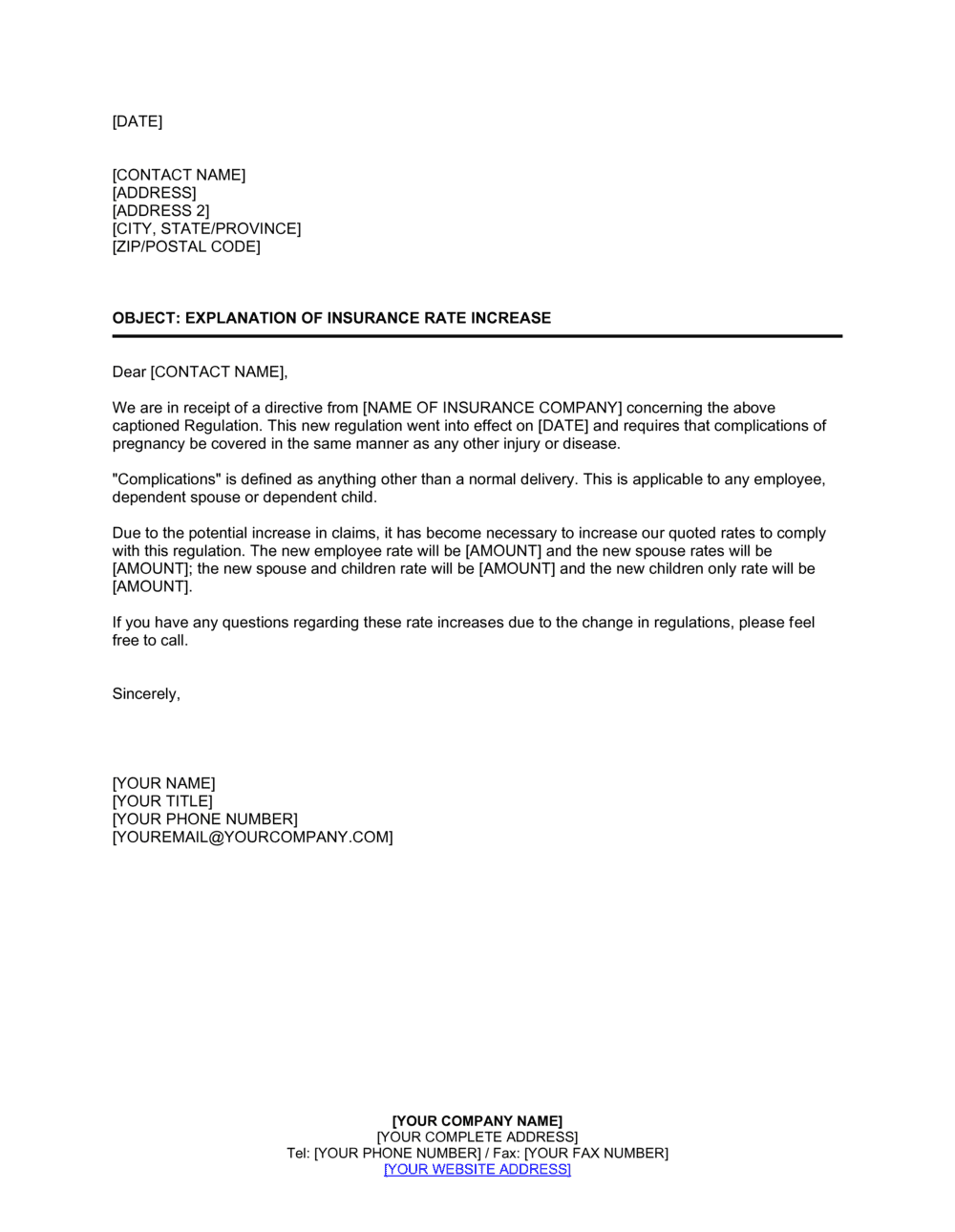
Explanation of Insurance Rate Increase Template

Free Word download • Edit online • Save & share with Drive • Export to PDF

1 page20–30 min to fillDifficulty: StandardSignature requiredLegal review recommended
Learn more ↓
FreeExplanation of Insurance Rate Increase Template

At a glance

What it is
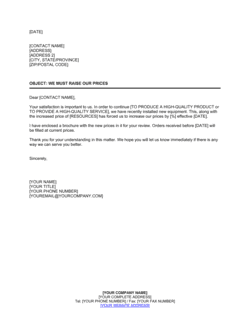
An Explanation of Insurance Rate Increase is a formal written document issued by an insurer or insurance broker to a policyholder that discloses and justifies a change in premium rates. This free Word download gives you a compliant, editable template you can export as PDF and send to policyholders or submit to a state or provincial regulator to satisfy mandatory rate-change disclosure obligations.
When you need it
Use it any time a renewal quote reflects a material premium increase — typically defined as 10% or more above the prior period — or when a regulator, employer group, or policyholder demands a written explanation of the actuarial, loss-experience, or market factors driving higher rates.
What's inside
The template covers the policyholder and policy identification block, the rate change summary with percentage and effective date, the detailed actuarial and loss-experience rationale, a comparison of prior and revised premium calculations, a statement of the policyholder's rights (including appeal and cancellation options), and the authorized insurer signature block.

What is an Explanation of Insurance Rate Increase?

An Explanation of Insurance Rate Increase is a formal written document issued by an insurer or licensed insurance broker to a policyholder that discloses, justifies, and documents an upward adjustment in the premium charged for a renewing insurance policy. The document identifies the policyholder and policy, states the expiring and renewal premium amounts with a precise percentage change, provides the actuarial and loss-experience data supporting the increase, and informs the policyholder of their legal rights to appeal the decision, request an independent review, or decline renewal. Unlike a routine renewal quote, this document satisfies specific statutory and regulatory disclosure obligations that attach once a premium increase crosses the materiality threshold defined by the applicable insurance code — typically 10% or more above the prior period's premium.

Why You Need This Document

Issuing a rate increase without a properly prepared written explanation exposes an insurer or broker to regulatory enforcement, policyholder disputes, and — in the most serious cases — the legal inability to collect the higher premium for the renewal period. State insurance departments and provincial regulators treat inadequate or late rate-increase notices as unfair trade practices, which can result in fines, mandatory refunds, and license action. Policyholders who receive no explanation have stronger grounds to challenge the increase with the department of insurance and to claim the prior rate as the contractually binding premium. For commercial accounts, a finance team that cannot explain a significant insurance-line increase to its CFO will push back hard at renewal — a clear, professional explanation of the actuarial rationale resolves that friction before it becomes a lost account. This template gives insurers, underwriters, and brokers a compliant, structured starting point that satisfies the core disclosure requirements across major jurisdictions while leaving room to insert the policyholder-specific data that transforms a generic notice into a defensible rate justification.

Which variant fits your situation?

If your situation is…Use this template
Explaining a rate increase on a personal auto or home policyPersonal Lines Insurance Rate Increase Notice
Notifying a group employer of a health insurance premium increaseGroup Health Insurance Rate Increase Letter
Providing actuarial rate filing documentation to a state regulatorActuarial Rate Filing Memorandum
Issuing a non-renewal notice rather than a rate increaseInsurance Non-Renewal Notice
Documenting a mid-term endorsement that increases premiumPolicy Endorsement and Premium Adjustment Notice
Communicating a workers' compensation experience-modification increaseWorkers Compensation Experience Modification Explanation
Sending a rate increase notice for a professional liability (E&O) policyProfessional Liability Premium Increase Explanation

Common mistakes to avoid

❌ Sending the notice late

Why it matters: Most US states and Canadian provinces require 30–60 days' written notice of a material premium increase before the renewal date. A notice delivered inside that window may be legally ineffective, preventing the insurer from collecting the higher rate for that renewal term.

Fix: Build the notice-delivery date into your renewal workflow as a hard deadline triggered by the renewal date — not by when the underwriter finishes the quote.

❌ Omitting the premium calculation breakdown

Why it matters: Without a line-by-line comparison of expiring versus renewal components, policyholders cannot distinguish a rate-driven increase from a coverage-driven one and are far more likely to file regulator complaints.

Fix: Always include the premium calculation comparison table, and confirm that the component totals tie exactly to the rate change summary figures.

❌ Using generic market-conditions language for a material increase

Why it matters: For increases above the materiality threshold (typically 10–25% depending on jurisdiction), regulators require policyholder-specific loss-experience data. A boilerplate market-hardening statement is not sufficient and will be rejected in a rate filing review.

Fix: Pull the policyholder's actual loss ratio and claims history for the applicable experience period and include the specific figures in the actuarial rationale clause.

❌ Signing the notice with an unlicensed staff member

Why it matters: Several jurisdictions require the signature of a licensed insurance professional on a rate-increase notice. A notice signed by unlicensed administrative staff can be challenged as invalid, exposing the insurer to regulatory sanctions and the inability to enforce the new rate.

Fix: Route all rate-increase notices through a licensed underwriter or the agent of record for execution before delivery.

❌ Stating regulatory approval before it is granted

Why it matters: In prior-approval states, including a filing reference that implies approval when only a filing has been submitted constitutes a misrepresentation to the policyholder and a regulatory violation that can trigger fines and license action.

Fix: In prior-approval jurisdictions, hold the notice until written approval is received. In file-and-use states, clearly state the filing date rather than implying approval.

❌ Setting an appeal deadline shorter than statutory minimums

Why it matters: Insurance codes in most US states and Canadian provinces set minimum appeal or review periods — commonly 30 days — after receipt of a rate-increase notice. A shorter contractual deadline is void and does not shorten the policyholder's statutory rights.

Fix: Check the governing jurisdiction's insurance code for the minimum review period and use that number or longer — never less.

The 9 key clauses, explained

Policyholder and Policy Identification

In plain language: Identifies the named insured, policy number, line of business, policy period, and the insurer issuing the notice — establishing the precise contract being amended.

Sample language
This notice is issued to [NAMED INSURED], holder of Policy No. [POLICY NUMBER] for [LINE OF BUSINESS] coverage issued by [INSURER LEGAL NAME], effective [EXPIRING POLICY PERIOD START DATE] to [EXPIRING POLICY PERIOD END DATE].

Common mistake: Using a trade name instead of the insurer's full licensed legal name. Regulators and courts look for the entity name exactly as it appears on the certificate of authority — a mismatch can invalidate the notice.

Rate Change Summary

In plain language: States the prior premium, the revised premium, the percentage change, and the effective date of the new rate — the single most important block for the policyholder.

Sample language
Expiring Annual Premium: $[PRIOR AMOUNT]. Renewal Annual Premium: $[NEW AMOUNT]. Rate Change: +[X]%. New rate is effective [EFFECTIVE DATE] upon policy renewal.

Common mistake: Expressing the increase only in percentage terms without the dollar amounts. Policyholders and regulators need both figures to verify the calculation and assess affordability.

Actuarial and Loss-Experience Rationale

In plain language: Explains the data-driven reasons for the rate change — claims history, loss ratio, trend factors, reinsurance costs, and market conditions — in language the policyholder can understand.

Sample language
The rate adjustment reflects a loss ratio of [X]% for the [DATE]–[DATE] experience period, compared to a target loss ratio of [X]%. Contributing factors include [FACTOR 1], [FACTOR 2], and a [X]% increase in reinsurance costs effective [DATE].

Common mistake: Providing only a generic market-conditions statement without policyholder-specific loss data. In many jurisdictions, a rate increase above the materiality threshold requires policyholder-specific claims experience, not just industry-wide trends.

Premium Calculation Comparison

In plain language: Side-by-side table showing the expiring and renewal premium components — base rate, coverage limits, deductibles, credits, surcharges, taxes, and total — so the policyholder can trace exactly where the increase originates.

Sample language
Coverage Component | Expiring Premium | Renewal Premium | Change Base Rate per $[UNIT] | $[X] | $[X] | +[X]% Liability Limit ($[X]M) | $[X] | $[X] | +[X]% Deductible Credit ([X]%) | -$[X] | -$[X] | [X]% Total Premium | $[X] | $[X] | +[X]%

Common mistake: Omitting the comparison table and substituting a narrative summary. Without the line-by-line breakdown, policyholders cannot identify whether the increase stems from rate changes, coverage changes, or both — leading to disputes and regulator complaints.

Regulatory Compliance Statement

In plain language: Confirms that the rate has been filed with and, where required, approved by the applicable insurance regulator — protecting the insurer from claims that the increase was unauthorized.

Sample language
The revised rate has been filed with the [STATE/PROVINCE] Department of Insurance [and approved under Filing No. [FILING NUMBER]] in accordance with [APPLICABLE STATUTE OR REGULATION].

Common mistake: Including this clause when approval has not yet been granted. In prior-approval states, charging a rate before regulatory approval is a regulatory violation regardless of what the notice says.

Policyholder Rights — Appeal and Review

In plain language: Informs the policyholder of their right to request a written review of the rate increase, including the process, deadline, and contact information.

Sample language
You may request a written review of this rate determination by contacting [INSURER CONTACT NAME/DEPARTMENT] at [ADDRESS/EMAIL] within [X] days of receipt of this notice. Your request must include [REQUIRED INFORMATION].

Common mistake: Setting the appeal deadline shorter than the minimum required by the governing jurisdiction's insurance code. State and provincial statutes commonly require at least 30 days — a shorter deadline makes the clause unenforceable and exposes the insurer to regulatory sanction.

Cancellation and Non-Renewal Rights

In plain language: Reminds the policyholder of their right to cancel or decline renewal if they do not accept the revised premium, and states the refund or pro-rata return-premium calculation that applies.

Sample language
If you choose not to renew your policy at the revised premium, you may decline renewal by providing written notice to [INSURER/AGENT] no later than [DATE]. Any unearned premium will be returned on a [PRO-RATA / SHORT-RATE] basis.

Common mistake: Omitting the refund basis entirely. A policyholder who cancels and receives a short-rate refund without prior notice of the short-rate calculation can successfully claim the insurer misrepresented the cancellation terms.

Effective Date and Notice Period

In plain language: States the date the new rate takes effect and confirms that the required advance-notice period mandated by law and the policy has been satisfied.

Sample language
This notice is issued [X] days prior to the renewal date of [RENEWAL DATE], satisfying the [X]-day advance notice requirement under [POLICY PROVISION / APPLICABLE STATUTE].

Common mistake: Sending the notice fewer days in advance than required by the policy or statute. Most US states and Canadian provinces require 30–60 days' advance written notice of a material rate increase — late delivery can render the increase unenforceable for that renewal period.

Authorized Insurer Signature Block

In plain language: Provides the name, title, license number (where required), and signature of the authorized insurer or agent representative issuing the notice — establishing accountability and satisfying execution requirements.

Sample language
Issued by: [AUTHORIZED REPRESENTATIVE NAME], [TITLE], [INSURER LEGAL NAME] License No.: [LICENSE NUMBER] | Date: [DATE] | Signature: _______________

Common mistake: Having the notice signed by an unlicensed support staff member rather than a licensed underwriter or agent of record. Several jurisdictions require the signature of a licensed individual for a rate-increase notice to be valid.

How to fill it out

  1. 1

    Enter the policyholder and policy details

    Complete the identification block with the named insured's full legal name, policy number, line of business, and exact expiring policy period dates. Use the insurer's full licensed legal name as it appears on the certificate of authority.

    💡 Copy the policy number and named insured directly from the declarations page to prevent transcription errors that can invalidate the notice.

  2. 2

    Calculate and enter the rate change figures

    Enter the expiring annual premium, the renewal annual premium, the exact percentage change rounded to two decimal places, and the effective date of the new rate.

    💡 Express the percentage increase to two decimal places — rounding to a whole number can cause a mismatch with the premium calculation worksheet and trigger policyholder disputes.

  3. 3

    Complete the actuarial rationale section

    Fill in the policyholder's loss ratio for the applicable experience period, the target loss ratio, the key contributing factors (claims frequency, severity trend, reinsurance cost changes), and any market-wide conditions that compound the increase.

    💡 Use at least two to three years of loss experience data where available. Single-year experience is more vulnerable to challenge as statistically non-credible.

  4. 4

    Build the premium calculation comparison table

    Complete the side-by-side table for each coverage component, showing expiring and renewal amounts and the line-level percentage change. Confirm that the component totals reconcile to the summary figures in the rate change block.

    💡 Have the underwriter reconcile the table against the rating system output before issuance — a $1 discrepancy in the total is enough to trigger a formal complaint.

  5. 5

    Insert the regulatory filing reference

    Add the state or provincial department of insurance filing number and approval status. If the jurisdiction is file-and-use, note the filing date. If prior approval is required, confirm approval has been granted before completing this field.

    💡 Keep a copy of the regulator's approval letter on file with this notice — it is the first document regulators request in a rate-complaint investigation.

  6. 6

    Set the appeal deadline and cancellation terms

    Enter the appeal deadline in calendar days from the date of receipt, verify it meets the minimum required by the governing insurance code, and specify whether the cancellation refund basis is pro-rata or short-rate.

    💡 Default to pro-rata refund language unless your filed policy form specifies short-rate — courts have found undisclosed short-rate calculations to constitute an unfair trade practice.

  7. 7

    Confirm the notice period and execute

    Verify the notice is being issued at least the minimum number of days before the renewal date required by the applicable statute and policy. Have a licensed underwriter or agent of record sign the notice and date it.

    💡 Send by certified mail or documented electronic delivery so you have proof of the delivery date — the notice period runs from the date of receipt, not the date of mailing.

  8. 8

    Retain a copy and log in the policy file

    File a copy of the executed notice in the policy record with the delivery confirmation. Note the delivery date, method, and recipient name in the underwriting log.

    💡 Set a calendar reminder for the appeal deadline — if the policyholder submits a timely review request you are obligated to respond within the period set by your filed complaint-handling procedures.

Frequently asked questions

What is an explanation of insurance rate increase?

An explanation of insurance rate increase is a formal written notice an insurer or broker sends to a policyholder to disclose that the premium for a renewing policy is higher than the expiring premium. It explains the actuarial, loss-experience, and market factors driving the change, provides a comparison of expiring and renewal premium components, and informs the policyholder of their rights to appeal the increase, cancel the policy, or seek alternative coverage.

When is an insurer required to provide a written rate increase explanation?

Most US states and Canadian provinces require written notice of a material premium increase — typically defined as 10% or more above the prior period — at least 30 to 60 days before the renewal effective date. Exact thresholds and notice periods vary by jurisdiction and line of business. Group health and workers' compensation lines often carry separate, more stringent disclosure rules. Failing to provide timely notice can make the rate increase unenforceable for that renewal term.

What information must be included in a rate increase notice?

A compliant notice typically includes the policyholder's name and policy number, the expiring and renewal premium amounts and the percentage change, the effective date of the new rate, the actuarial or loss-experience rationale, a premium calculation comparison, a regulatory compliance statement, the policyholder's appeal and cancellation rights, and the signature of a licensed authorized representative. Some jurisdictions require additional disclosures specific to the line of business.

Can a policyholder dispute or appeal an insurance rate increase?

Yes. Most insurance codes give policyholders the right to request a written review of a rate increase directly from the insurer and to file a formal complaint with the state or provincial department of insurance. The review-request deadline is typically 30 days from receipt of the notice. Policyholders may also decline renewal without penalty if they do not accept the revised premium, subject to the policy's cancellation provisions and any applicable short-rate or pro-rata return-premium terms.

What is the difference between a rate increase notice and a non-renewal notice?

A rate increase notice communicates a higher premium for a renewing policy — the coverage continues, but at a different cost. A non-renewal notice informs the policyholder that the insurer will not offer renewal at all, ending the coverage relationship at the expiration date. Both require advance written notice under most insurance codes, but they trigger different policyholder rights and carry different regulatory filing obligations.

Does a rate increase explanation need to be filed with the insurance regulator?

The underlying rate that supports the increase must generally be filed with the applicable insurance department under a rate filing. The policyholder-facing explanation letter itself is typically not filed separately, but it must reference the filed rate and comply with any approved rate-change disclosure requirements. In prior-approval states, the rate must be approved before the notice is sent. In file-and-use states, the rate may be charged upon filing, subject to subsequent review.

How far in advance does a rate increase notice need to be sent?

The minimum advance-notice period depends on the jurisdiction and line of business. In the United States, 30 days is the most common statutory minimum for commercial lines, with some states requiring 45 or 60 days. In Canada, provincial insurance acts typically require 30 days. In the UK, the FCA requires insurers to give consumers sufficient notice before renewal to make an informed decision, which in practice means 30 days for most personal lines. Sending the notice as early as possible reduces regulatory exposure and gives policyholders time to shop alternatives.

Is this document the same as a premium audit notice?

No. A premium audit notice adjusts the final premium after a policy period ends based on actual payroll, revenue, or other auditable exposure — it is a retroactive adjustment. An explanation of insurance rate increase is a prospective notice sent before the renewal period begins, disclosing that the rate for the upcoming term will be higher than the expiring rate. The two documents serve different functions and arise at different points in the policy lifecycle.

Do I need a lawyer to issue an insurance rate increase explanation?

For most standard commercial or personal lines renewals with modest increases, a properly completed template reviewed against the governing state or provincial insurance code is sufficient. Engage a lawyer when the increase exceeds the materiality threshold by a significant margin, when the policyholder has indicated they may dispute the increase, when a regulator has requested a rate justification as part of a complaint investigation, or when the policy involves complex multistate or international coverage. A 1–2 hour compliance review typically costs $300–$600 and is worthwhile for high-exposure commercial accounts.

How this compares to alternatives

vs Insurance Non-Renewal Notice

A non-renewal notice terminates the insurer-policyholder relationship at the end of the current policy term with no offer of continuation. An explanation of insurance rate increase offers continuation of coverage at a revised premium. Both require advance written notice, but the policyholder's rights, the regulatory thresholds, and the insurer's obligations differ materially between the two documents.

vs Insurance Cancellation Notice

A cancellation notice ends coverage mid-term, typically for non-payment, material misrepresentation, or substantial change in risk — and carries the most restrictive statutory notice and grounds requirements. An explanation of rate increase is a renewal-period document that does not interrupt coverage. Cancellation for cause is substantially harder to accomplish legally than issuing a higher renewal premium.

vs Premium Audit Notice

A premium audit notice adjusts the final premium retroactively after a policy period ends, based on audited actual exposure (payroll, revenue, or square footage). An explanation of rate increase is prospective — it discloses the higher rate that will apply to the upcoming renewal term before it begins. They operate at opposite ends of the policy lifecycle and serve entirely different regulatory and accounting functions.

vs Policy Endorsement and Premium Adjustment Notice

A policy endorsement notice documents a mid-term change to coverage terms that results in an additional premium charge — it modifies the existing contract. An explanation of rate increase applies at renewal and changes the rate for the new policy period without altering the underlying coverage terms. Endorsements require policyholder consent; rate increases at renewal are typically effective automatically if the policyholder does not decline.

Industry-specific considerations

Healthcare and Employee Benefits

Group health and dental renewal increases must include claims utilization data, stop-loss reinsurance cost changes, and pharmacy trend factors, with separate notices to the employer and, in some plans, individual covered members.

Construction and Contracting

Workers' compensation experience-modification increases require a detailed mod worksheet alongside the rate notice, and the explanation must address payroll classification changes separately from pure rate movement.

Financial Services and Professional Liability

E&O and D&O rate increases in hardening markets require market-wide trend data alongside firm-specific claims history, and notices must be delivered well before renewal to give risk managers time to negotiate terms or access the surplus lines market.

Retail and Commercial Property

Commercial property rate increases driven by catastrophe reinsurance costs must distinguish between location-specific risk factors and market-wide CAT load adjustments to satisfy regulatory scrutiny in coastal and wildfire-exposed states.

Jurisdictional notes

United States

Rate regulation varies significantly by state. Prior-approval states (e.g., California, New York) require department-of-insurance approval before a rate can be charged; file-and-use and use-and-file states permit immediate or near-immediate use. Advance notice requirements range from 30 to 60 days depending on state and line of business. The NAIC Model Act provides a baseline, but individual state insurance codes control. California Proposition 103 imposes particularly stringent rate-increase justification requirements for personal auto and homeowners lines.

Canada

Insurance regulation is primarily provincial. Each province's insurance act sets the minimum advance notice period — typically 30 days — for premium increases. In Ontario, the Financial Services Regulatory Authority (FSRA) reviews auto insurance rate filings; in British Columbia, ICBC operates as the mandatory auto insurer with its own rate-change procedures. Quebec-regulated employers must issue notices in French for Francophone policyholders. Group benefit rate increases may also trigger notice obligations under provincial employment standards legislation.

United Kingdom

The Financial Conduct Authority (FCA) requires insurers to provide renewal notices to personal-lines consumers at least 30 days before the renewal date, including the previous year's premium for comparison and a prompt to shop the market. Since January 2022, the FCA's pricing practices rules prohibit charging renewing personal-lines customers more than an equivalent new customer would pay, limiting certain premium increases. Commercial lines are less prescriptive but must comply with the Consumer Duty and treating-customers-fairly principles.

European Union

The EU Insurance Distribution Directive (IDD) requires that policyholders receive adequate, clear, and timely information before renewal. GDPR applies to any personal data included in the notice, including loss history. Member state implementations vary — Germany, France, and the Netherlands each have national insurance supervisors with specific rate-filing and notice requirements. Cross-border EU policies must comply with both the insurer's home-state regulator and, in some cases, the host-state regulator where the risk is located.

Template vs lawyer — what fits your deal?

PathBest forCostTime
Use the templateStandard commercial or personal lines renewals with a rate increase below the regulatory materiality threshold in a single jurisdictionFree30–45 minutes per notice
Template + legal reviewIncreases above 15%, multistate policies, group health renewals, or any renewal where the policyholder has signaled a potential dispute$300–$600 for a 1–2 hour compliance review by an insurance attorney or licensed consultant1–3 days
Custom draftedRegulator-requested rate justifications, active department-of-insurance complaint investigations, or large commercial accounts with material coverage modifications accompanying the rate change$1,500–$5,000+1–2 weeks

Glossary

Loss Ratio
Claims paid by the insurer divided by premiums collected over the same period, expressed as a percentage — a ratio above 100% means the insurer paid out more than it received.
Experience Rating
A premium-adjustment method that bases rates on the policyholder's own historical claims data rather than industry averages alone.
Rate Filing
A submission to a state or provincial insurance regulator that documents and justifies proposed premium rates before they can be charged to policyholders.
Actuarial Justification
A statistically grounded explanation, prepared or reviewed by a credentialed actuary, of why a rate change is necessary given projected claims costs and expenses.
Renewal Premium
The premium amount an insurer charges when an existing policy is extended for a new term, which may differ from the expiring premium.
Combined Ratio
Loss ratio plus expense ratio — a combined ratio below 100% indicates underwriting profitability; above 100% indicates an underwriting loss.
Trend Factor
An actuarial adjustment that accounts for the expected change in claims frequency or severity over time due to inflation, litigation trends, or medical cost increases.
Reinsurance Cost
The premium an insurer pays to transfer a portion of its risk to another insurer, which directly affects the rates charged to policyholders.
Prior Approval State
A US jurisdiction that requires an insurer to receive regulatory approval before implementing a new rate, as opposed to a file-and-use or use-and-file state.
Material Rate Increase
A premium change above a defined regulatory threshold — commonly 10%–25% depending on jurisdiction and line of business — that triggers additional disclosure or filing requirements.
Premium Calculation Worksheet
A line-by-line breakdown showing how the base rate, coverage limits, deductibles, credits, surcharges, and taxes combine to produce the final premium.

Part of your Business Operating System

This document is one of 3,000+ business & legal templates included in Business in a Box.

  • Fill-in-the-blanks — ready in minutes
  • 100% customizable Word document
  • Compatible with all office suites
  • Export to PDF and share electronically

Create your document in 3 simple steps.

From template to signed document — all inside one Business Operating System.
1
Download or open template

Access over 3,000+ business and legal templates for any business task, project or initiative.

2
Edit and fill in the blanks with AI

Customize your ready-made business document template and save it in the cloud.

3
Save, Share, Send, Sign

Share your files and folders with your team. Create a space of seamless collaboration.

Save time, save money, and create top-quality documents.

★★★★★

"Fantastic value! I'm not sure how I'd do without it. It's worth its weight in gold and paid back for itself many times."

Managing Director · Mall Farm
Robert Whalley
Managing Director, Mall Farm Proprietary Limited
★★★★★

"I have been using Business in a Box for years. It has been the most useful source of templates I have encountered. I recommend it to anyone."

Business Owner · 4+ years
Dr Michael John Freestone
Business Owner
★★★★★

"It has been a life saver so many times I have lost count. Business in a Box has saved me so much time and as you know, time is money."

Owner · Upstate Web
David G. Moore Jr.
Owner, Upstate Web

Run your business with a system — not scattered tools

Stop downloading documents. Start operating with clarity. Business in a Box gives you the Business Operating System used by over 250,000 companies worldwide to structure, run, and grow their business.

Free Forever Plan · No credit card required