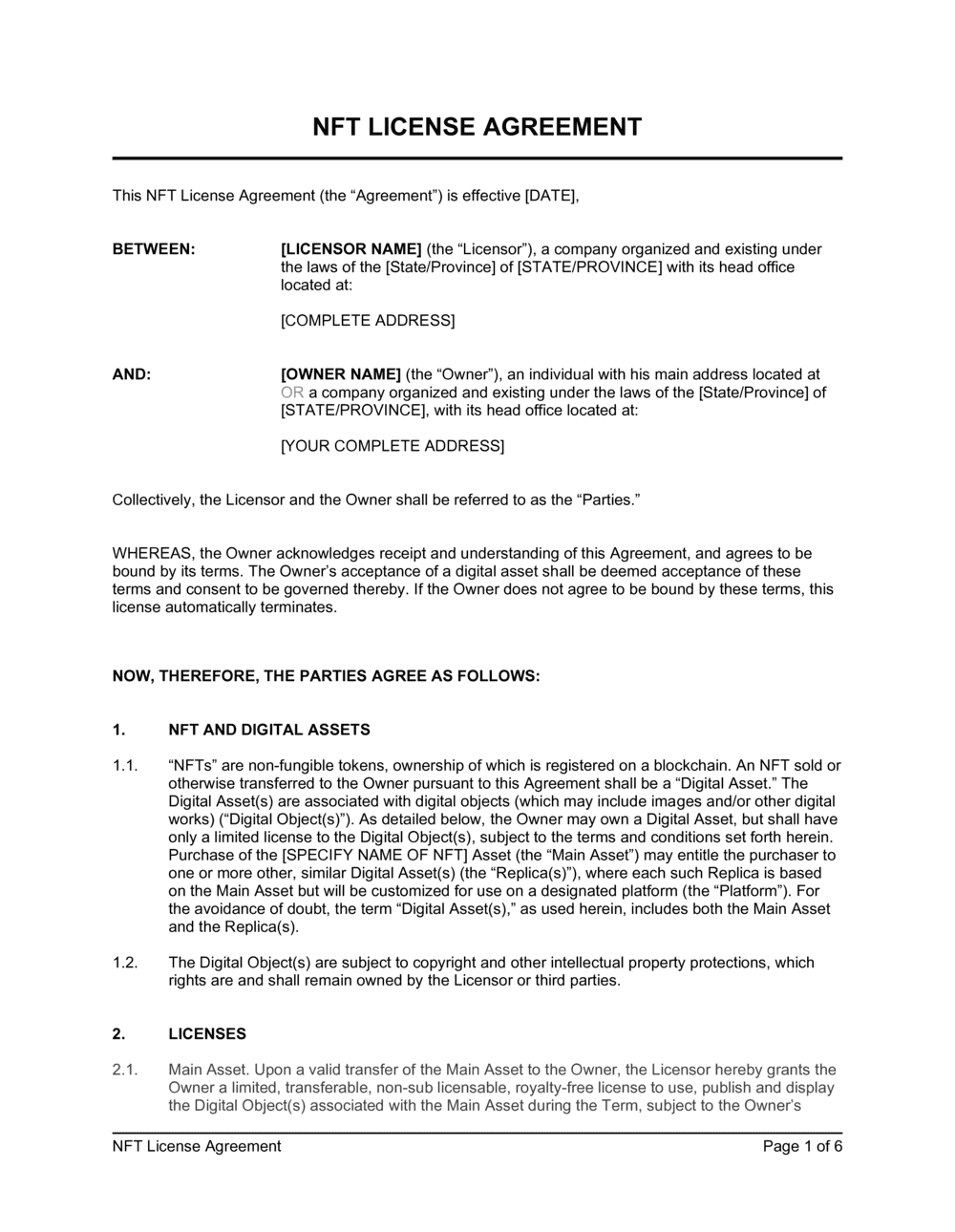
This nft license agreement template has 6 pages and is a MS Word file type listed under our legal agreements documents.
Nft license agreement template
NFT LICENSE AGREEMENT This NFT License Agreement (the "Agreement") is effective [DATE], BETWEEN: [LICENSOR NAME] (the "Licensor"), a company organized and existing under the laws of the [State/Province] of [STATE/PROVINCE] with its head office located at: [COMPLETE ADDRESS] AND: [OWNER NAME] (the "Owner"), an individual with his main address located at OR a company organized and existing under the laws of the [State/Province] of [STATE/PROVINCE], with its head office located at: [YOUR COMPLETE ADDRESS] Collectively, the Licensor and the Owner shall be referred to as the "Parties." WHEREAS, the Owner acknowledges receipt and understanding of this Agreement, and agrees to be bound by its terms. The Owner's acceptance of a digital asset shall be deemed acceptance of these terms and consent to be governed thereby. If the Owner does not agree to be bound by these terms, this license automatically terminates. NOW, THEREFORE, THE PARTIES AGREE AS FOLLOWS: NFT AND DIGITAL ASSETS "NFTs" are non-fungible tokens, ownership of which is registered on a blockchain. An NFT sold or otherwise transferred to the Owner pursuant to this Agreement shall be a "Digital Asset." The Digital Asset(s) are associated with digital objects (which may include images and/or other digital works) ("Digital Object(s)"). As detailed below, the Owner may own a Digital Asset, but shall have only a limited license to the Digital Object(s), subject to the terms and conditions set forth herein. Purchase of the [SPECIFY NAME OF NFT] Asset (the "Main Asset") may entitle the purchaser to one or more other, similar Digital Asset(s) (the "Replica(s)"), where each such Replica is based on the Main Asset but will be customized for use on a designated platform (the "Platform"). For the avoidance of doubt, the term "Digital Asset(s)," as used herein, includes both the Main Asset and the Replica(s). The Digital Object(s) are subject to copyright and other intellectual property protections, which rights are and shall remain owned by the Licensor or third parties. LICENSES Main Asset. Upon a valid transfer of the Main Asset to the Owner, the Licensor hereby grants the Owner a limited, transferable, non-sub licensable, royalty-free license to use, publish and display the Digital Object(s) associated with the Main Asset during the Term, subject to the Owner's compliance with the terms and conditions set forth herein, including without limitation, the restrictions in this Agreement, solely for the following purposes: (a) for their own personal, non-commercial use; or (ii) to display the Main Asset for resale. Upon expiration of the Term or breach of any conditions of this NFT License Agreement by the Owner, all license rights shall immediately terminate. Replica(s). Upon a valid transfer of a Replica to the Owner, the Licensor hereby grants the Owner a limited, transferable, non-sub licensable, royalty-free license to use, publish and display the Digital Object(s) associated with such Replica on the Platform for which the Replica is designed, during the Term, subject to the Owner's compliance with the terms and conditions set forth herein, including without limitation, the restrictions in this Agreement, solely for the following purposes: for their own personal, non-commercial use; or to display the Replica for purposes of resale. Upon expiration of the Term or breach of any conditions of this NFT License Agreement by the Owner, all license rights shall immediately terminate. RESTRICTIONS The Digital Object(s) provided pursuant to this NFT License Agreement are licensed, not sold, and the Owner receives no title to or ownership of the Digital Object(s) or the intellectual property rights therein. Except for the license expressly set forth herein, no other rights (express or implied) to the Digital Object(s) are granted. The Licensor reserves all rights not expressly granted. Without limiting the generality of the foregoing, the Owner shall not: copy, modify, create derivative works from, or distribute the Digital Object(s); display the Digital Object(s) other than as expressly licensed in this Agreement; use the Digital Asset(s) or Digital Object(s) to advertise, market or sell a product and/or service; incorporate the Digital Asset(s) or Digital Object(s) in videos or other media; or sell merchandise incorporating the Digital Asset(s) or Digital Object(s). The Owner shall not sell or otherwise transfer the Digital Asset(s) if the license granted in this Agreement is expired or terminated for any reason. Upon a permitted transfer of ownership of the Digital Asset(s) by the Owner to a third party, the license to the Digital Object(s) associated therewith shall be transferable solely subject to the terms and conditions set forth in this Agreement, and the Owner's license to such Digital Object(s) terminates immediately upon transfer to such third party. Upon a non-permitted transfer of ownership of the Digital Asset(s) by the Owner to a third party, the Owner's license to the Digital Object(s) associated therewith terminates immediately, and any purported transfer of the license to such Digital Object(s) to such third party shall be void. The Owner agrees not to: remove any copyright or other legal notices associated with the Digital Asset(s) or Digital Object(s); or remove or alter any metadata of the Digital Asset(s), including without limitation, any link or other reference to license information. Failure to comply with the conditions set forth in Sections 2 and 3 constitutes a material breach. INTELLECTUAL PROPERTY RIGHTS The Owner acknowledges and agrees that the Licensor owns all legal right, title and interest in and to all elements of the Digital Asset(s). The Owner acknowledges that the Digital Asset(s) are protected by, as applicable, copyright, patent, or trademark laws or other relevant intellectual property and proprietary rights. Except as expressly set forth in this Agreement, the Licensor retains all right, title, and interest in and to any intellectual property rights in the Digital Asset(s). The Owner does not have a right to use any trademarks or logos owned by the Licensor. REPLICAS The Owner understands and agrees that the Licensor has no control over, and shall have no liability for, the Replicas. The Owner understands and agrees that the Platforms and/or the Replica(s) may be unavailable or cease to exist at any time. DISCLAIMER The Licensor makes no warranties, either express or implied, including without limitation any implied warranty of merchantability, non-infringement or fitness for a particular purpose. The Owner understands and accepts the risks of blockchain technology. Without limiting the generality of the foregoing, the Licensor does not warrant that the Digital Asset(s) or Digital Object(s) will perform without error. Further, the Licensor provides no warranty regarding, and will have no responsibility for, any claim arising out of: (i) a modification of the Digital Asset(s) or Digital Object(s) made by anyone other than the Licensor, unless the Licensor approves such modification in writing; (ii) the Owner's misuse of or misrepresentation regarding the Digital Asset(s) or Digital Object(s); or (iii) any technology, including without limitation, any Replica or Platform, that fails to perform or ceases to exist. The Licensor shall not be obligated to provide any support to the Owner or any subsequent owner of the Digital Asset(s). LIMITATION OF LIABILITY The Licensor's cumulative liability for all claims arising out of or related to this NFT License Agreement will not exceed the amount the Owner paid to the Licensor for the Digital Asset(s). In no event will the Licensor be liable for lost profits or loss of business or for any consequential, indirect, special, incidental, or punitive damages arising out of or related to this NFT License Agreement.
 Dashboard
 HR Management
 Links
Links Chat
Chat Connect
 Contacts
 Inbox
Inbox Business Al
 Project Management
 Notes
Notes Business Templates
 Cloud Drive
 Docs
Docs Sheets