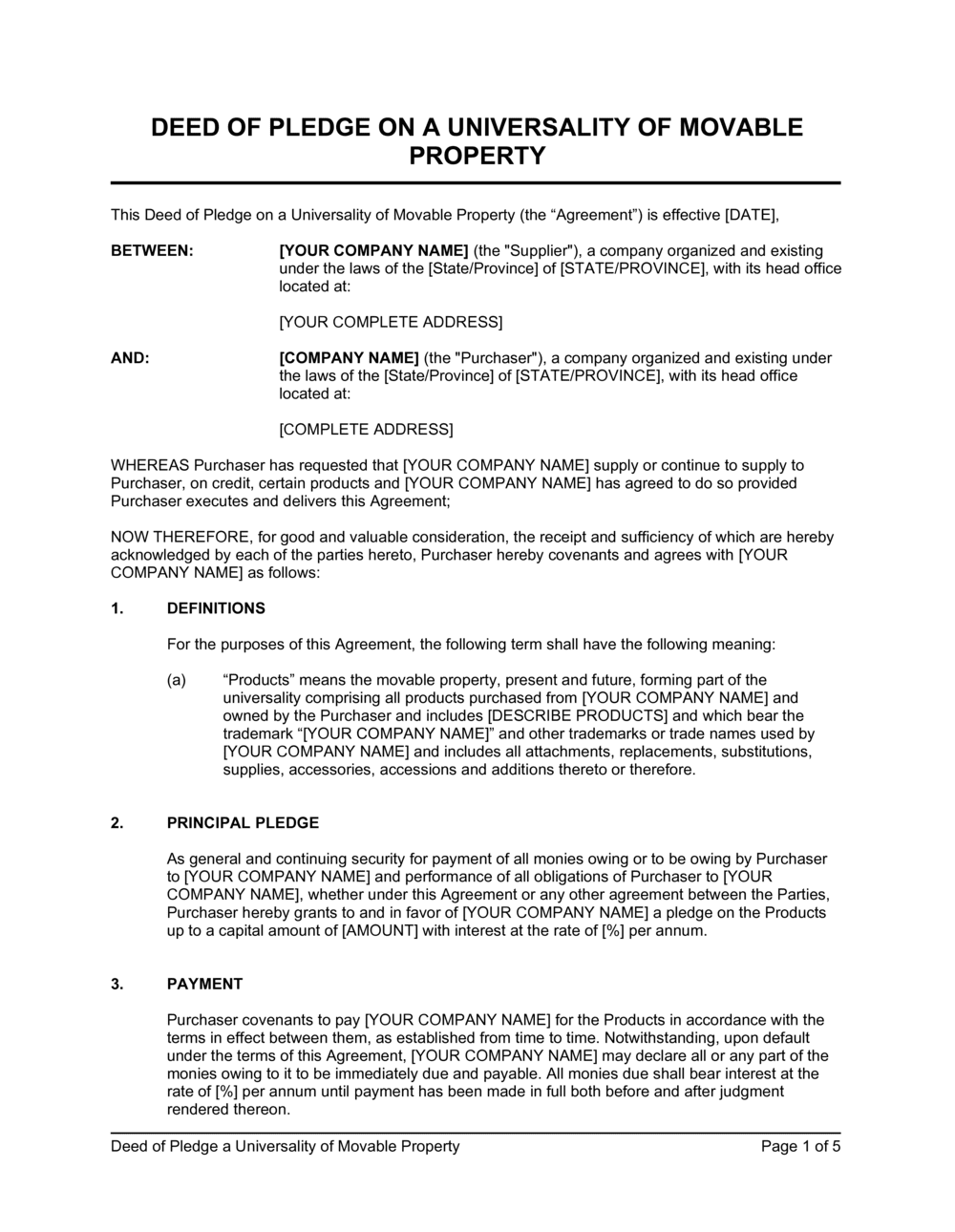
Deed of Pledge Universality of Movable Property Template

Free Word download • Edit online • Save & share with Drive • Export to PDF

5 pages25–35 min to fillDifficulty: ComplexSignature requiredLegal review recommended
Learn more ↓
FreeDeed of Pledge Universality of Movable Property Template

At a glance

What it is
A Deed of Pledge Universality of Movable Property is a legally binding security agreement in which a debtor (pledgor) grants a creditor (pledgee) a security interest over a defined collection — or universality — of movable assets, such as inventory, receivables, equipment, or intellectual property, as collateral for a debt or obligation. This free Word download gives you a structured, professionally drafted starting point you can edit online and export as PDF for execution by both parties.
When you need it
Use it when a lender requires a blanket charge over a business's movable asset pool as security for a loan, line of credit, or other financial obligation — or when a borrower needs to formalize collateral arrangements before funds are advanced. It is also used in restructuring transactions where existing creditors require enhanced security.
What's inside
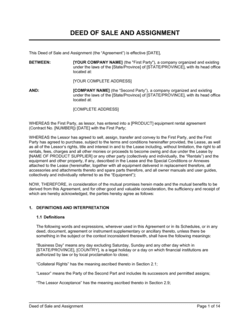
Identification of the parties and the secured obligation, a precise description of the pledged universality of assets, representations and warranties, pledgor covenants and restrictions, enforcement rights, priority and ranking provisions, events of default, and governing law.

What is a Deed of Pledge Universality of Movable Property?

A Deed of Pledge Universality of Movable Property is a legally binding security agreement in which a debtor — the pledgor — grants a creditor — the pledgee — a security interest over a defined collection of movable assets treated as a single pledged object, known as a universality. Rather than pledging one specific item, this deed captures an entire asset pool: inventory, trade receivables, machinery, equipment, intellectual property, or any combination thereof, including assets acquired by the pledgor after the deed is signed. When the underlying obligation is repaid in full, the pledge is released; if the pledgor defaults, the pledgee has the right to take possession of the pledged assets, appoint a receiver, and apply the proceeds of sale to the outstanding debt.

Why You Need This Document

Without a formal deed of pledge, a lender advancing credit against a borrower's asset base has no enforceable proprietary right to those assets if the borrower becomes insolvent — ranking instead as an unsecured creditor alongside all other claimants, with little prospect of full recovery. A properly executed and registered deed of pledge gives the creditor priority over the pledged asset pool ahead of unsecured creditors and, in most jurisdictions, ahead of later-registered claimants. For borrowers, a signed deed is typically a condition precedent to drawdown — without it, funds are not advanced. Beyond the capital-raising context, this document protects both parties by defining covenants, events of default, enforcement procedures, and release conditions in unambiguous terms — eliminating the disputes that arise when security arrangements are left to informal agreements or side letters. This template provides the complete clause framework required to create an enforceable security interest, ready for legal review and registry filing in the applicable jurisdiction.

Which variant fits your situation?

If your situation is…Use this template
Pledging a specific identified asset rather than a universalityPledge Agreement (Specific Asset)
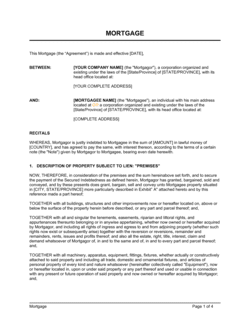
Securing a real property or immovable asset as collateralMortgage Agreement
Granting security over shares or equity interestsShare Pledge Agreement
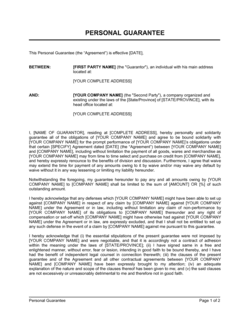
Providing a personal guarantee alongside the pledgePersonal Guarantee Agreement
Securing a floating charge over all business assets under common lawDebenture Agreement
Pledging receivables or accounts as securityAssignment of Receivables Agreement
Documenting the underlying loan the pledge securesBusiness Loan Agreement

Common mistakes to avoid

❌ Failing to register the pledge before funds are advanced

Why it matters: An unregistered pledge is not perfected and cannot be enforced against third parties — including competing creditors or a liquidator. A pledgee who advances funds before registering may find its security interest subordinated to a later-registered creditor.

Fix: Complete the registry filing before disbursing funds. In most jurisdictions, registration is a condition precedent to enforceability against third parties and takes priority from the date of filing, not the date of execution.

❌ Describing the pledged universality in vague terms

Why it matters: Courts and insolvency practitioners require a sufficiently precise description to identify what is pledged. A generic reference to 'all business assets' without a schedule is routinely challenged in priority disputes and may be held unenforceable.

Fix: Attach a detailed Schedule A categorizing each asset type included in the pledge, and a Schedule B listing individually identified high-value items with serial numbers or other identifiers.

❌ Limiting the secured obligation to initial principal only

Why it matters: Interest, default interest, fees, and enforcement costs are not automatically covered unless expressly included in the definition of the secured obligation. The pledgee becomes an unsecured creditor for these amounts on enforcement.

Fix: Draft the secured obligation clause to cover all present and future amounts owed — principal, interest, default interest, fees, costs, and any future advances — under the underlying facility.

❌ Omitting a prohibition on further encumbrances

Why it matters: Without an express covenant against further charges, the pledgor can grant a second pledge over the same assets to another creditor without breaching the deed — directly eroding the first pledgee's recovery position.

Fix: Include a negative pledge covenant prohibiting the pledgor from creating any additional security interest over the pledged assets without the pledgee's prior written consent.

❌ Choosing a governing law inconsistent with the asset location

Why it matters: Security interests over movable property are generally subject to the law of the jurisdiction where the assets are located (lex situs). A governing law clause that conflicts with the situs can render the pledge unenforceable against third parties in the jurisdiction where the assets sit.

Fix: Select the governing law of the jurisdiction where the pledged assets are principally located, or take separate legal advice on the conflict-of-laws analysis if assets span multiple jurisdictions.

❌ No cure period for remediable events of default

Why it matters: Accelerating and enforcing immediately upon a minor or technical breach — without giving the pledgor an opportunity to remedy — can expose the pledgee to claims for wrongful enforcement, damages, or injunction in jurisdictions that require good-faith enforcement.

Fix: Include a cure period of 5–20 business days for remediable breaches, reserving immediate enforcement only for non-remediable events such as insolvency or fraud.

The 10 key clauses, explained

Parties and Recitals

In plain language: Identifies the pledgor and pledgee by their full legal names and registered addresses, and sets out the background — the underlying loan or credit facility that the pledge secures.

Sample language
This Deed of Pledge is entered into on [DATE] between [PLEDGOR LEGAL NAME], a [ENTITY TYPE] incorporated under the laws of [JURISDICTION] with registered number [NUMBER], having its registered office at [ADDRESS] ('Pledgor'), and [PLEDGEE LEGAL NAME] ('Pledgee'). Whereas, the Pledgee has agreed to extend [CREDIT FACILITY / LOAN] of [AMOUNT] to the Pledgor pursuant to the Loan Agreement dated [DATE] ('Secured Obligation').

Common mistake: Using a trade name instead of the full registered legal entity name. Enforcement proceedings require exact identification of the pledgor as a legal person — a mismatch can void the registration.

Description of the Pledged Universality

In plain language: Defines precisely what movable assets are included in the pledged universality — inventory, equipment, receivables, IP, cash, or any combination — and the basis on which future assets are captured.

Sample language
The Pledgor hereby pledges in favour of the Pledgee, as security for the Secured Obligation, all present and future movable assets constituting the universality described in Schedule A, including but not limited to: (a) inventory and raw materials; (b) trade receivables; (c) machinery and equipment listed in Schedule B; and (d) intellectual property rights registered in the name of the Pledgor.

Common mistake: Describing the universality in vague terms such as 'all business assets' without a schedule. Courts and insolvency practitioners require a sufficiently precise description to identify what is and is not pledged — overly broad descriptions are challenged in priority disputes.

Secured Obligation

In plain language: States the exact debt or obligation secured by the pledge — principal amount, interest rate, fees, and any future advances — and confirms the pledge extends to all amounts owed, not just the principal.

Sample language
This Deed of Pledge secures all present and future amounts owed by the Pledgor to the Pledgee under the Loan Agreement dated [DATE], including principal of [AMOUNT], interest at [RATE]% per annum, default interest, costs, fees, and any other sums payable thereunder (together, the 'Secured Obligations').

Common mistake: Limiting the secured obligation to the initial principal only. If interest, fees, or future advances are not expressly captured, the pledgee may be an unsecured creditor for those amounts on enforcement.

Representations and Warranties

In plain language: The pledgor's factual statements at the date of execution — that it owns the assets free of prior charges, has authority to pledge them, and that no insolvency proceedings are pending.

Sample language
The Pledgor represents and warrants that: (a) it is the sole legal and beneficial owner of the Pledged Assets, free from all Encumbrances except as disclosed in Schedule C; (b) it has full power and authority to enter into and perform this Deed; (c) no insolvency, administration, or winding-up proceedings have been commenced or threatened against it.

Common mistake: Omitting a warranty that the assets are free of prior charges. If an earlier undisclosed pledge exists, the pledgee's priority may be subordinated to a prior creditor and the pledgee has no breach of warranty claim unless one is included.

Pledgor Covenants

In plain language: Ongoing obligations the pledgor agrees to during the life of the pledge — maintaining assets, keeping insurance, not creating further charges, notifying the pledgee of material changes, and providing periodic asset valuations.

Sample language
During the continuance of this Deed, the Pledgor shall: (a) maintain the Pledged Assets in good repair and condition; (b) keep the Pledged Assets insured for their full replacement value with [INSURER]; (c) not create or permit any Encumbrance over the Pledged Assets without the prior written consent of the Pledgee; (d) notify the Pledgee within [5] business days of any material change in the composition or value of the Pledged Assets.

Common mistake: Omitting a prohibition on further encumbrances. Without it, the pledgor can grant a second pledge to another creditor — eroding the first pledgee's priority without notice or breach.

Events of Default

In plain language: Defines the triggers that entitle the pledgee to enforce the security — typically non-payment, insolvency, breach of covenant, change of control, or material adverse change.

Sample language
Each of the following constitutes an Event of Default: (a) failure to pay any Secured Obligation within [5] business days of the due date; (b) any insolvency, liquidation, or administration of the Pledgor; (c) material breach of any covenant in this Deed not remedied within [20] business days of notice; (d) any attachment or execution levied against the Pledged Assets by a third party.

Common mistake: Drafting the material adverse change trigger too broadly with no materiality threshold. Courts have held that MAC clauses must be objectively material — an unlimited MAC clause may be unenforceable or result in the pledgee accelerating prematurely, triggering liability.

Enforcement Rights

In plain language: Sets out what the pledgee may do upon an event of default — take possession, appoint a receiver, sell assets, or apply proceeds to the secured obligation — and the process for doing so.

Sample language
Upon the occurrence of an Event of Default, the Pledgee may, without further notice: (a) take possession of the Pledged Assets; (b) appoint a receiver over the Pledged Assets; (c) sell or otherwise dispose of the Pledged Assets by public auction or private sale on such terms as the Pledgee reasonably determines; (d) apply the net proceeds of any sale to the Secured Obligations in such order as the Pledgee determines.

Common mistake: Omitting a clause granting the pledgee the right to sell by private sale as well as public auction. Restricting enforcement to public auction can significantly reduce recoverable value for certain asset classes such as receivables or IP.

Priority and Ranking

In plain language: Confirms the ranking of the pledge relative to other creditors and states whether it ranks ahead of unsecured claims and subordinate to any agreed prior charges.

Sample language
The pledge created under this Deed ranks as a [first / second] priority security interest over the Pledged Assets. The Pledgor confirms that, except as disclosed in Schedule C, no prior Encumbrances exist over the Pledged Assets. The Pledgee's rights under this Deed are subject only to the rights of [PRIOR CREDITOR NAME] under the [PRIOR SECURITY DOCUMENT].

Common mistake: Failing to confirm priority ranking in the deed itself and relying solely on registration date. Priority disputes are complex and a contractual subordination or priority agreement must be documented separately if multiple creditors share the same asset pool.

Release and Discharge

In plain language: States the conditions under which the pledge is released — typically full repayment of the secured obligation — and obligates the pledgee to issue a discharge and cancel any registration.

Sample language
Upon final and irrevocable payment of all Secured Obligations, the Pledgee shall, at the Pledgor's cost and within [10] business days, execute all documents and take all steps necessary to release the pledge and cancel any registration made in respect of it, including filing a discharge notice with [RELEVANT REGISTRY].

Common mistake: Not including a timeframe for the pledgee to execute a discharge after repayment. Delays in releasing security registrations can block refinancing or asset sales — a 10-business-day deadline is standard.

Governing Law and Jurisdiction

In plain language: Specifies which jurisdiction's law governs the deed and which courts or arbitral bodies have jurisdiction to resolve disputes arising from it.

Sample language
This Deed is governed by and construed in accordance with the laws of [JURISDICTION]. The parties submit to the exclusive jurisdiction of the courts of [JURISDICTION] in respect of any dispute arising out of or in connection with this Deed.

Common mistake: Choosing a governing law jurisdiction that has no meaningful connection to where the pledged assets are located. Security interests over movable property are generally governed by the lex situs — the law of the place where the assets are situated — and a conflict between governing law and situs law can render the pledge unenforceable against third parties.

How to fill it out

  1. 1

    Identify the parties with full legal details

    Enter the pledgor's and pledgee's complete registered legal names, entity types, registration numbers, and registered addresses. For individuals, use the full legal name as it appears on government-issued ID.

    💡 Cross-reference the pledgor's corporate registry entry to confirm the exact legal name — a mismatch between the deed and the registry filing can invalidate the security registration.

  2. 2

    Define the secured obligation precisely

    Specify the principal amount, interest rate, payment schedule, and any fees or charges under the underlying loan or credit facility. Confirm the pledge covers all amounts payable — not just principal — including future advances if applicable.

    💡 Reference the underlying loan agreement by date and title and attach it as an exhibit to the deed to eliminate ambiguity about what is secured.

  3. 3

    Draft a detailed Schedule A describing the pledged universality

    List each category of movable asset included in the pledge — inventory, equipment, receivables, IP, bank accounts — with enough specificity that a third party could identify what is pledged. Attach a Schedule B for individually identified high-value items such as machinery.

    💡 For revolving asset pools such as inventory or receivables, include language capturing 'all present and future' assets in the category so after-acquired assets are automatically captured.

  4. 4

    Complete the representations and warranties section

    Have the pledgor confirm in writing that it owns the assets free of prior charges, has authority to pledge them, and is not subject to pending insolvency proceedings. Attach a Schedule C disclosing any known prior encumbrances.

    💡 Request a current search of the relevant personal property or commercial security registry before execution to verify no undisclosed charges exist.

  5. 5

    Set the pledgor covenants and restrictions

    Specify the pledgor's ongoing obligations — maintaining and insuring the assets, providing periodic valuations, notifying the pledgee of material changes, and obtaining consent before disposing of or further encumbering the pledged assets.

    💡 Set a specific frequency for asset valuations — quarterly for inventory-heavy businesses — so the pledgee can monitor collateral value throughout the loan term.

  6. 6

    Define events of default with clear thresholds

    List each event of default with objective, measurable triggers. Include a cure period of at least 5–20 business days for remediable breaches, and state whether the pledgee must give notice before accelerating.

    💡 Avoid undefined terms like 'material adverse change' without a specific financial threshold — courts apply a high bar for MAC enforcement and a quantified threshold (e.g., 20% decline in asset value) is more defensible.

  7. 7

    Register the pledge with the applicable registry

    File the required notice or financing statement with the personal property security registry, commercial pledge registry, or equivalent in the governing jurisdiction to perfect the security interest and establish priority against third parties.

    💡 Register before funds are advanced — a pledge that is not registered before a competing creditor files may lose priority even if executed earlier.

  8. 8

    Execute and date the deed before funds are advanced

    Both parties must sign the deed — and any required witnesses or notary must attest — before the loan proceeds are disbursed. File executed copies with both parties and retain the original in secure storage.

    💡 Use Business in a Box eSign to timestamp execution and store the fully-executed deed with a complete audit trail.

Frequently asked questions

What is a deed of pledge universality of movable property?

A deed of pledge universality of movable property is a security agreement in which a debtor (pledgor) grants a creditor (pledgee) a security interest over a defined collection — or universality — of movable assets, such as inventory, receivables, equipment, or intellectual property. It differs from a specific asset pledge in that it covers an entire category or pool of assets, including future assets acquired after execution. The deed gives the creditor the right to take possession of and sell the pledged assets if the debtor defaults on the secured obligation.

What types of assets can be included in the pledged universality?

Any movable property can typically be included — inventory and raw materials, trade receivables, machinery and equipment, intellectual property rights, cash and bank accounts, and financial instruments. The key requirement is that the assets are movable (as opposed to land or fixed real property) and that the description of the universality is sufficiently precise to identify what is pledged. Including after-acquired assets — those purchased after execution — requires specific language capturing present and future assets in each category.

How does a deed of pledge differ from a mortgage?

A mortgage creates a security interest over immovable property — real estate and land — while a deed of pledge covers movable assets such as inventory, equipment, receivables, and IP. In most civil law jurisdictions, the two instruments are governed by separate statutory regimes with different registration requirements and enforcement procedures. Some common law jurisdictions use a debenture to create a floating charge over both movable and immovable assets in a single instrument.

Does a deed of pledge need to be registered?

In most jurisdictions, yes — registration in a personal property security registry, commercial pledge registry, or equivalent is required to perfect the security interest and make it enforceable against third parties. An unregistered pledge is typically valid between the parties but cannot be enforced against a liquidator or a competing creditor who registers first. The specific registry and filing requirements vary significantly by jurisdiction; always confirm local requirements before executing.

What happens when the pledgor defaults?

Upon an event of default, the pledgee is typically entitled to take possession of the pledged assets, appoint a receiver or administrator, sell the assets by public auction or private sale, and apply the net proceeds to the outstanding secured obligation. Any surplus after satisfying the secured debt must be returned to the pledgor. The specific enforcement procedure is governed by the applicable law of the jurisdiction where the assets are located and may require court approval in some circumstances.

Can a pledge be granted over assets the pledgor does not yet own?

Yes, provided the deed expressly captures after-acquired assets using language such as 'all present and future' movable assets in the described categories. A pledge over future assets typically attaches automatically when the pledgor acquires those assets, without the need for a new deed. However, the timing of attachment and perfection for after-acquired assets varies by jurisdiction — in some systems, a new registration or filing is required each time new assets are added to the universality.

What is the difference between a fixed charge and a floating charge?

A fixed charge attaches to specific, identified assets at the time of creation — the pledgor cannot dispose of those assets without the pledgee's consent. A floating charge covers a class of assets that changes in the ordinary course of business (such as inventory) and allows the pledgor to deal with those assets freely until a default event causes the charge to crystallize into a fixed charge. A deed of pledge over a universality of movable property typically combines elements of both — fixed over identified items and floating over revolving pools such as inventory and receivables.

How is priority determined between competing pledges over the same assets?

Priority is generally determined by the order of registration in the applicable security registry — a first-registered pledgee ranks ahead of a later-registered one regardless of the dates the deeds were executed. In some jurisdictions, the type of charge also affects priority, with fixed charges ranking ahead of floating charges over the same assets. Creditors who need first priority should complete registration before funds are advanced and conduct a registry search beforehand to identify any existing charges.

Do I need a lawyer to prepare a deed of pledge?

For most commercial lending transactions involving significant asset values, legal review is strongly recommended. The enforceability of a pledge depends on jurisdiction-specific statutory requirements — registration formalities, description standards, and enforcement procedures — that vary widely. A high-quality template provides the correct structure and clause framework, but a lawyer familiar with the applicable jurisdiction should review and adapt the document before execution, particularly for cross-border transactions or complex asset pools.

How this compares to alternatives

vs Share Pledge Agreement

A share pledge agreement creates a security interest specifically over the equity shares or ownership interests in a company, rather than its underlying movable assets. Lenders use share pledges to take control of a company indirectly by enforcing against its shares. A deed of pledge over movable property gives the pledgee direct rights over the physical and intangible assets — used when asset-level security is preferred or the shares have limited value.

vs Mortgage Agreement

A mortgage creates security over immovable property — real estate and land — while a deed of pledge covers movable assets such as inventory, equipment, receivables, and IP. The two instruments operate under separate statutory regimes in most jurisdictions, with different registration systems and enforcement procedures. Lenders requiring security over a complete asset base typically take both a mortgage and a pledge in parallel.

vs Personal Guarantee

A personal guarantee creates a personal obligation on an individual — typically a director or shareholder — to pay the borrower's debt if the borrower defaults. A deed of pledge creates a proprietary right over specific assets. Guarantees provide recourse against a person; pledges provide recourse against property. Most lenders take both to maximize recovery options.

vs Loan Agreement

A loan agreement documents the terms of the debt — principal, interest, repayment schedule, and borrower covenants — but does not itself create a security interest. A deed of pledge is the collateral document that secures that debt against specific assets. The two documents work together: the loan agreement creates the obligation and the deed of pledge secures it. Executing a loan agreement without a pledge leaves the lender unsecured.

Industry-specific considerations

Banking and Financial Services

Banks routinely require a deed of pledge over a borrower's entire movable asset universality as a condition of revolving credit facilities, term loans, and trade finance arrangements — with priority searches and registration completed before drawdown.

Manufacturing

Manufacturers pledge inventory, raw materials, machinery, and equipment as a universality to secure working capital facilities — requiring dynamic schedules that capture after-acquired stock and replacement equipment automatically.

Retail and Wholesale

Retailers pledge stock-in-trade and receivables under a floating-charge universality structure, allowing them to buy and sell inventory in the ordinary course while the pledge remains in place over the asset pool.

Technology and SaaS

Technology companies pledge IP portfolios, software licenses, and trade receivables as a universality to secure venture debt or growth financing — requiring careful IP assignment and registry filing in each jurisdiction where IP is registered.

Professional Services

Professional services firms pledge receivables and work-in-progress as a universality for invoice-financing or credit line security — with covenants requiring the pledgor to maintain minimum receivables coverage ratios.

Logistics and Transportation

Logistics operators pledge fleets of vehicles, equipment, and trade receivables as a universality — requiring individual asset schedules for titled vehicles alongside the broader floating universality description.

Jurisdictional notes

United States

In the US, security interests over movable personal property are governed by Article 9 of the Uniform Commercial Code (UCC), adopted in all 50 states with local variations. Perfection requires filing a UCC-1 financing statement with the Secretary of State in the debtor's state of organization. Priority is generally determined by the order of filing. California, Texas, and Delaware have specific nuances around fixture filings and IP security interests that require local counsel review.

Canada

Security interests over movable property in common-law provinces are governed by provincial Personal Property Security Acts (PPSAs), requiring registration in the applicable provincial PPSA registry to perfect. Quebec operates under a distinct civil law regime — the Civil Code of Quebec governs hypothecs over movable property, and registration in the Register of Personal and Movable Real Rights (RPMRR) is required. Cross-province transactions require analysis of which provincial regime applies based on asset location.

United Kingdom

In England and Wales, security over movable assets is typically taken by way of a fixed and floating charge under a debenture, registered at Companies House within 21 days of creation. Failure to register within this window voids the charge against a liquidator. Scotland operates under a distinct system — the law of assignation in security and the Moveable Transactions (Scotland) Act 2023 has modernized Scottish secured transactions law. IP security interests may require separate registration with the UK Intellectual Property Office.

European Union

There is no single EU-wide regime for pledges over movable property — each member state operates its own security interest law. Belgium, France, and Luxembourg have well-developed commercial pledge regimes widely used in structured finance. France's pledge over a fonds de commerce (business as a going concern) and Belgium's pledge on the enterprise are civil law equivalents of a universality pledge. The Financial Collateral Directive (2002/47/EC) provides a harmonized framework for financial collateral arrangements but does not cover general commercial asset pledges. Always engage local counsel in the member state where the assets are situated.

Template vs lawyer — what fits your deal?

PathBest forCostTime
Use the templateStraightforward domestic secured lending transactions where both parties understand the asset pool and governing jurisdictionFree1–2 hours to complete the template
Template + legal reviewCommercial loans above $50K, complex asset pools spanning multiple categories, or any transaction involving after-acquired assets or multiple creditors$500–$2,000 for a lawyer review and registry filing2–5 business days
Custom draftedCross-border transactions, multi-jurisdiction asset pools, leveraged buyouts, or structured finance arrangements with multiple tranches of security$3,000–$15,000+2–6 weeks

Glossary

Pledgor
The party that owns the movable assets and grants a security interest over them to the pledgee as collateral for an obligation.
Pledgee
The creditor or lender that receives the security interest in the pledged assets and holds the right to enforce against them upon default.
Universality of Movable Property
A legally recognized collection of movable assets — such as inventory, receivables, machinery, or IP — treated as a single pledge object rather than individually itemized assets.
Security Interest
A creditor's legal right to take possession of and sell pledged assets if the debtor fails to meet the secured obligation.
Secured Obligation
The specific debt, loan, or financial commitment that the pledge is created to secure, including principal, interest, fees, and associated costs.
Event of Default
A defined trigger — such as missed payment, insolvency, or breach of covenant — that entitles the pledgee to enforce the security and take possession of the pledged assets.
Floating Charge
A security interest that covers a class of assets that changes over time (e.g., inventory) and crystallizes into a fixed charge upon a default event.
Enforcement
The pledgee's exercise of its rights upon default — typically taking possession of pledged assets, appointing a receiver, or conducting a forced sale.
Priority
The ranking of a creditor's security interest relative to other creditors' claims against the same assets, generally determined by registration date and type of charge.
Perfection
The legal steps — typically registration in a public registry — required to make a security interest enforceable against third parties and establish priority.
Covenant
A contractual promise by the pledgor to do — or refrain from doing — specific things with the pledged assets during the life of the security arrangement.

Part of your Business Operating System

This document is one of 3,000+ business & legal templates included in Business in a Box.

  • Fill-in-the-blanks — ready in minutes
  • 100% customizable Word document
  • Compatible with all office suites
  • Export to PDF and share electronically

Create your document in 3 simple steps.

From template to signed document — all inside one Business Operating System.
1
Download or open template

Access over 3,000+ business and legal templates for any business task, project or initiative.

2
Edit and fill in the blanks with AI

Customize your ready-made business document template and save it in the cloud.

3
Save, Share, Send, Sign

Share your files and folders with your team. Create a space of seamless collaboration.

Save time, save money, and create top-quality documents.

★★★★★

"Fantastic value! I'm not sure how I'd do without it. It's worth its weight in gold and paid back for itself many times."

Managing Director · Mall Farm
Robert Whalley
Managing Director, Mall Farm Proprietary Limited
★★★★★

"I have been using Business in a Box for years. It has been the most useful source of templates I have encountered. I recommend it to anyone."

Business Owner · 4+ years
Dr Michael John Freestone
Business Owner
★★★★★

"It has been a life saver so many times I have lost count. Business in a Box has saved me so much time and as you know, time is money."

Owner · Upstate Web
David G. Moore Jr.
Owner, Upstate Web

Run your business with a system — not scattered tools

Stop downloading documents. Start operating with clarity. Business in a Box gives you the Business Operating System used by over 250,000 companies worldwide to structure, run, and grow their business.

Free Forever Plan · No credit card required