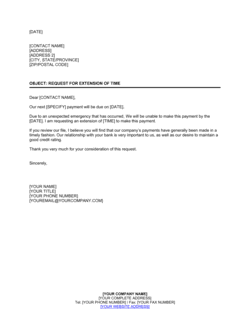
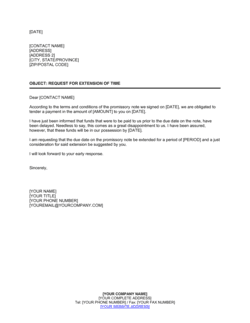
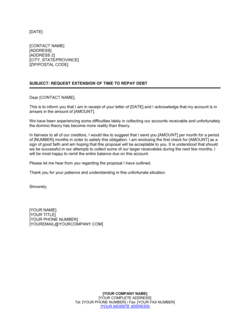
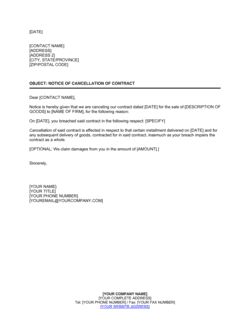
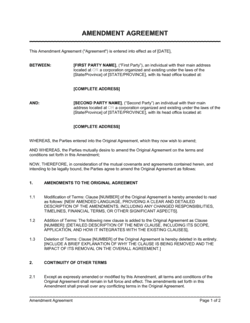
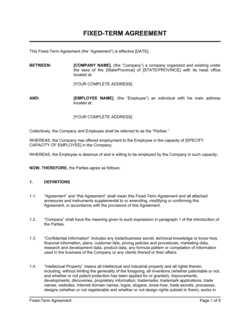
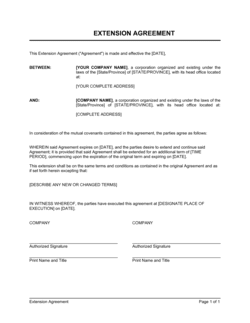
Decline Extension of Agreement Template

Free Word download • Edit online • Save & share with Drive • Export to PDF

1 page20–30 min to fillDifficulty: StandardSignature requiredLegal review recommended
Learn more ↓
FreeDecline Extension of Agreement Template

At a glance

What it is
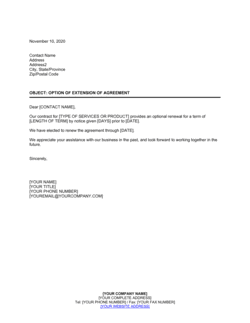
A Decline Extension of Agreement is a formal written notice one party sends to another to communicate that it will not renew or extend an existing contract when the current term expires. This free Word download gives you a professionally structured, legally clear letter you can edit online and export as PDF — protecting your position while maintaining a professional relationship with the other party.
When you need it
Use it when an existing contract is approaching its expiration date and you have decided not to continue the relationship beyond the current term. It is especially important when the original agreement requires advance written notice of non-renewal, or when you want a documented record of your decision to avoid any implied auto-renewal.
What's inside
Party identification, contract reference details, formal statement of non-renewal, the effective termination date, transition and wind-down instructions, outstanding obligations summary, and a closing that preserves the professional relationship where appropriate.

What is a Decline Extension of Agreement?

A Decline Extension of Agreement is a formal written notice one contracting party sends to the other to communicate, clearly and on the record, that it will not renew or extend the existing contract when the current term comes to an end. Unlike a contract termination letter — which ends an agreement before its scheduled expiry — a decline extension allows the contract to run its full course and simply confirms that the relationship will not continue beyond that point. The notice references the original agreement, states the effective termination date, and addresses key wind-down matters including outstanding obligations, the return of confidential materials, and any contractual provisions that survive expiry.

The document is most consequential when the original agreement contains an auto-renewal clause — a provision that silently extends the contract for another full term unless one party provides written notice of non-renewal before a specified deadline. Sending a properly worded, timely notice is the mechanism that prevents that automatic extension from taking effect, making it a protective document as much as an administrative one.

Why You Need This Document

Failing to send a formal non-renewal notice has one predictable consequence: the contract renews automatically, often for another 12 months, and you are bound to its terms whether or not the relationship still makes commercial sense. Courts routinely uphold auto-renewal clauses when they are clearly stated and the non-renewing party cannot prove timely, compliant notice was delivered. The downstream costs — continued payments, performance obligations, and the difficulty of exiting a renewed term mid-cycle — make a missed notice deadline one of the most avoidable contract risks in business operations.

Beyond preventing auto-renewal, a written non-renewal notice creates an unambiguous record of your decision, establishes the wind-down timeline both parties must respect, and confirms which obligations survive the contract's end. Without it, disputes over outstanding invoices, the return of proprietary data, and the scope of confidentiality obligations after expiry are far more likely. This template gives you a professionally structured, legally clear notice you can complete in under 30 minutes — protecting your position, preserving the professional relationship where appropriate, and ensuring the contract ends on your terms.

Which variant fits your situation?

If your situation is…Use this template
Declining to renew a vendor or supplier services contractDecline Extension of Agreement
Formally terminating an agreement before its natural expiry dateContract Termination Letter
Ending a fixed-term employment contract at its scheduled closeFixed-Term Contract Non-Renewal Notice
Notifying a tenant that a commercial lease will not be renewedCommercial Lease Non-Renewal Notice
Declining to extend a professional services or consulting agreementDecline Extension of Agreement
Accepting and extending a contract with modified termsContract Amendment Agreement
Requesting a contract extension from the other partyRequest for Extension of Agreement

Common mistakes to avoid

❌ Missing the contractual notice deadline

Why it matters: Most agreements with auto-renewal clauses treat a late or absent non-renewal notice as consent to renew — binding you to another full term, sometimes 12 months or more, with no right to exit without penalty.

Fix: Set a calendar reminder for the notice deadline at least two weeks before it falls due, and verify delivery confirmation the same day the notice is sent.

❌ Using informal or ambiguous language

Why it matters: Phrases like 'we may not continue' or 'we are reconsidering the relationship' do not constitute formal notice of non-renewal in most jurisdictions and can be used by the counterparty to argue the agreement was implicitly extended.

Fix: Use explicit, declarative language: 'The [PARTY NAME] hereby provides formal written notice that it will not renew the Agreement dated [DATE] beyond its current expiry on [DATE].'

❌ Delivering notice by a method not authorized in the contract

Why it matters: If the contract specifies certified mail and you send notice by email only, the notice may be legally ineffective — meaning the contract auto-renews despite your intent.

Fix: Check the original agreement's notice clause before sending, and use exactly the delivery method specified. When in doubt, use both the specified method and email to create a dual record.

❌ Failing to address surviving obligations

Why it matters: Without explicitly referencing surviving clauses, a counterparty may argue that all obligations — including confidentiality and IP ownership — terminated with the contract, creating significant exposure.

Fix: Include a surviving obligations clause in the notice listing the specific sections of the original agreement that remain in force after the Termination Date.

❌ Providing an overly detailed reason for non-renewal

Why it matters: In employment, franchise, or regulated-industry contexts, a detailed explanation of non-renewal can inadvertently create a discrimination, retaliation, or wrongful termination claim that would not otherwise exist.

Fix: Keep the reason brief and factual, or state that no reason is required and none is being provided. Consult counsel before explaining non-renewal in fixed-term employment or franchise contexts.

❌ Not retaining proof of delivery

Why it matters: If the counterparty later claims it never received the notice, and you lack delivery confirmation, a court may find the auto-renewal clause was triggered — leaving you obligated under a contract you believed had ended.

Fix: Always obtain and file written proof of delivery — a certified mail receipt, courier tracking number, or email read-receipt — and store it alongside the executed notice in your contract records.

The 10 key clauses, explained

Parties and Contract Identification

In plain language: Identifies both parties by their full legal names and references the original agreement being declined for renewal, including the contract date and title.

Sample language
This notice is provided by [DECLINING PARTY LEGAL NAME] ('Notifying Party') to [COUNTERPARTY LEGAL NAME] ('Counterparty') regarding the [AGREEMENT TITLE] dated [ORIGINAL AGREEMENT DATE] ('Agreement').

Common mistake: Referencing the agreement by informal name or date alone — if multiple contracts exist between the parties, ambiguity about which agreement is being declined can expose the notifying party to an unintended renewal.

Formal Statement of Non-Renewal

In plain language: Clearly and unambiguously states that the notifying party will not renew, extend, or continue the agreement beyond the current term.

Sample language
The Notifying Party hereby provides formal notice that it will not renew or extend the Agreement upon the expiration of the current term. This notice is provided pursuant to Section [X] of the Agreement, which requires [X] days' advance written notice of non-renewal.

Common mistake: Using hedged language such as 'does not currently intend to renew' — this can be interpreted as leaving the door open and may not satisfy a contractual notice requirement for non-renewal.

Effective Termination Date

In plain language: States the exact calendar date on which the agreement will end, confirming it aligns with the contract's scheduled expiry and satisfies any notice period requirement.

Sample language
The Agreement shall terminate and be of no further force or effect as of [TERMINATION DATE] (the 'Termination Date'). This notice is provided [X] days in advance, satisfying the [X]-day notice requirement under Section [X] of the Agreement.

Common mistake: Stating the termination date without confirming that the notice was delivered within the required notice window — if the window is missed, the contract may auto-renew regardless of the letter.

Reason for Non-Renewal (Optional)

In plain language: Briefly states the reason the notifying party is choosing not to renew, or explicitly notes that no reason is required by the agreement. Including a reason is optional but can reduce follow-up disputes.

Sample language
The Notifying Party's decision not to renew is based on [BUSINESS RESTRUCTURING / BUDGET CONSTRAINTS / CHANGE IN OPERATIONAL REQUIREMENTS / no reason is required under the Agreement and none is provided]. This decision is made without reflection on the Counterparty's performance.

Common mistake: Providing a detailed explanation that inadvertently creates grounds for a wrongful termination or discrimination claim — particularly in employment or franchise contexts. If you state a reason, keep it factual and brief.

Outstanding Obligations and Payments

In plain language: Confirms that all outstanding fees, invoices, or deliverables owed by either party through the Termination Date will be fulfilled in accordance with the original agreement.

Sample language
Both parties agree to fulfill all obligations accrued through the Termination Date. Any outstanding invoices or payments due as of the Termination Date shall be settled no later than [X] days following the Termination Date.

Common mistake: Omitting this clause entirely — leaving payment and deliverable obligations unaddressed creates disputes about whether partial work completed before termination is owed compensation.

Transition and Wind-Down Cooperation

In plain language: Outlines how both parties will cooperate during the wind-down period to transfer work, data, materials, or responsibilities smoothly before the Termination Date.

Sample language
During the period between the date of this notice and the Termination Date ('Wind-Down Period'), the parties shall cooperate in good faith to transition [MATERIALS / DATA / RESPONSIBILITIES / ACCESS] as set out in Schedule A. [COUNTERPARTY NAME] shall provide reasonable transition assistance at no additional charge.

Common mistake: Assuming the other party will cooperate voluntarily without written terms — without a wind-down clause, the counterparty has no contractual obligation to assist with transition, which can leave critical handover tasks incomplete.

Return or Destruction of Confidential Materials

In plain language: Requires both parties to return or destroy confidential information, proprietary data, access credentials, and physical or digital materials belonging to the other party by the Termination Date.

Sample language
Within [X] business days of the Termination Date, each party shall return or certifiably destroy all Confidential Information, proprietary materials, and access credentials provided by the other party under the Agreement and shall provide written confirmation of such return or destruction upon request.

Common mistake: Not specifying a deadline or confirmation requirement — without both, parties may retain sensitive information indefinitely, creating ongoing confidentiality and data-protection liability.

Surviving Obligations

In plain language: Identifies specific clauses from the original agreement that remain binding on both parties after the Termination Date — typically confidentiality, IP ownership, indemnification, and dispute resolution.

Sample language
Notwithstanding the termination of the Agreement, the following provisions shall survive and continue in full force: Section [X] (Confidentiality), Section [X] (Intellectual Property), Section [X] (Indemnification), and Section [X] (Governing Law and Dispute Resolution).

Common mistake: Failing to list surviving obligations explicitly — if the non-renewal letter does not reference them, a party may claim that termination extinguished all obligations, including confidentiality.

No Admission of Liability

In plain language: Confirms that the non-renewal is not an admission of fault, breach, or liability by either party for any matter arising from the original agreement.

Sample language
Nothing in this notice shall be construed as an admission of liability, fault, or breach by either party with respect to the Agreement or the parties' performance thereunder.

Common mistake: Omitting this clause when the relationship involved disputes or performance issues — without it, the act of declining renewal can be characterized as implicit acknowledgment of problems that the counterparty may later use in litigation.

Governing Law and Delivery Confirmation

In plain language: States the governing jurisdiction for the notice and confirms the method and date of delivery to ensure the notice is legally effective.

Sample language
This notice is governed by the laws of [STATE / PROVINCE / COUNTRY]. It has been delivered to [COUNTERPARTY NAME] at [ADDRESS / EMAIL] on [DELIVERY DATE] by [DELIVERY METHOD — certified mail / email with read receipt / hand delivery].

Common mistake: Sending the notice by regular email without delivery confirmation — if the counterparty disputes receipt and the contract auto-renews as a result, proving timely delivery becomes a factual dispute.

How to fill it out

  1. 1

    Locate and review the original agreement

    Pull up the existing contract and identify the notice period for non-renewal, the auto-renewal clause (if any), the required delivery method for notices, and the exact expiry date of the current term.

    💡 Calculate the notice deadline backward from the expiry date — if the contract requires 60 days' notice and expires October 31, the notice must be sent no later than September 1.

  2. 2

    Enter the parties' full legal names and contract reference

    Fill in both parties' registered legal entity names — not trade names — and reference the original agreement by its exact title and execution date to eliminate ambiguity about which contract is being declined.

    💡 If the parties have executed multiple agreements, include the contract number or a brief description of the subject matter to make the reference unambiguous.

  3. 3

    Draft the formal non-renewal statement

    Write a clear, unequivocal statement that the agreement will not be renewed. Reference the specific contract clause that governs non-renewal and confirm this notice satisfies that requirement.

    💡 Avoid softening language. 'We will not be renewing' is enforceable; 'we do not currently plan to renew' may not be.

  4. 4

    Confirm the effective termination date

    Enter the specific calendar date on which the agreement ends — typically the last day of the current term. Confirm the number of days between today and that date satisfies the contractual notice window.

    💡 If today's date falls within the notice period or after it, consult the original contract immediately — you may have triggered an auto-renewal that requires separate action to unwind.

  5. 5

    Address outstanding obligations and transition steps

    List any payments, deliverables, or work-in-progress that will be completed before the Termination Date. If a handover is required, attach or describe a transition schedule in Schedule A.

    💡 Sending a proposed transition schedule alongside the notice reduces back-and-forth and signals good faith — both of which matter if the relationship later becomes a dispute.

  6. 6

    Specify surviving obligations and confidentiality requirements

    List the clauses from the original agreement that survive termination by section number. Confirm the deadline and method for returning or destroying confidential materials and access credentials.

    💡 If the original agreement does not specify a return deadline, set one explicitly here — 10 to 30 business days is a common commercial standard.

  7. 7

    Sign, date, and deliver by the required method

    Have the authorized signatory execute the notice. Deliver it by the method specified in the original agreement's notice clause — typically certified mail, email with read receipt, or overnight courier. Retain proof of delivery.

    💡 Even if the contract permits email notice, follow up with a certified mail copy for any notice that starts the clock on a legal deadline — the dual delivery eliminates receipt disputes.

  8. 8

    File the executed notice and delivery confirmation

    Save the signed notice, proof of delivery, and the original agreement together in your contract management records. Note the Termination Date in your calendar with a 30-day prior reminder for wind-down tasks.

    💡 If you use contract management software, update the agreement record to 'Non-Renewal Notice Sent' status with the delivery date so the team does not inadvertently continue work past the Termination Date.

Frequently asked questions

What is a decline extension of agreement?

A decline extension of agreement is a formal written notice one contracting party sends to another to confirm it will not renew or extend the existing contract when the current term expires. It satisfies any contractual notice-of-non-renewal requirement, creates a documented record of the decision, prevents inadvertent auto-renewal, and establishes the terms for winding down the relationship through the Termination Date.

When do I need to send a non-renewal notice?

You need to send a non-renewal notice whenever the original contract contains an auto-renewal clause or a notice-period requirement for non-renewal — typically 30, 60, or 90 days before the contract's expiry date. Even where the contract does not require one, sending a formal notice is advisable practice because it documents your intent, avoids disputes about implied renewal, and gives both parties time to plan the wind-down.

Is a decline extension of agreement legally binding?

Yes, a properly executed and timely delivered non-renewal notice is generally binding in the sense that it triggers the contractual non-renewal mechanism and prevents automatic extension. It does not create new obligations — it ends the existing ones as of the Termination Date, subject to any surviving clauses. Courts in most jurisdictions treat a clearly worded, timely notice as sufficient to satisfy contractual notice requirements.

What happens if I miss the non-renewal notice deadline?

If the original agreement contains an auto-renewal clause and you miss the notice deadline, the contract will typically renew automatically for another full term. In most cases, you cannot exit the renewed term without triggering early-termination provisions — which often require notice, penalty payments, or both. If you have missed the deadline, review the contract immediately and consult counsel about whether equitable relief or a negotiated release is available.

Do I need to give a reason for not renewing a contract?

In most commercial contracts, no. Unless the agreement explicitly requires a reason for non-renewal — which is rare outside franchise and regulated-industry contexts — you are generally free to decline renewal without explanation. Providing a reason is optional and can sometimes create legal risk, particularly in employment or franchise relationships. When you do provide a reason, keep it factual, brief, and free of evaluative language about the counterparty's performance.

What is the difference between a non-renewal notice and a contract termination letter?

A non-renewal notice declines to extend an existing agreement at the end of its current term — the contract runs its full course and simply does not continue. A contract termination letter ends the agreement before its natural expiry, typically invoking a termination-for-cause or termination-for-convenience clause. The distinction matters because early termination often triggers penalties or notice obligations that non-renewal does not.

What delivery method should I use for a non-renewal notice?

Use exactly the delivery method specified in the original contract's notice clause — commonly certified mail, overnight courier, hand delivery, or email with written confirmation. If the contract does not specify, use at least two methods (email plus certified mail) to ensure a verifiable delivery record. Retain proof of delivery regardless of the method — a receipt, tracking number, or email read-receipt — as the date of delivery typically starts the notice clock.

What obligations survive after a contract is not renewed?

Typically, confidentiality obligations, IP assignment provisions, indemnification clauses, payment obligations for work completed before the Termination Date, and dispute-resolution provisions survive the end of a contract. The specific surviving clauses depend on what the original agreement designates. A well-drafted non-renewal notice lists these provisions explicitly to prevent either party from arguing that all obligations ended with the contract.

Can the other party refuse to accept a non-renewal notice?

The other party cannot legally refuse to accept a properly delivered, timely non-renewal notice that complies with the contract's terms. They may dispute the timeliness of delivery or the sufficiency of the notice, but refusing acceptance does not void the notice. If the counterparty objects, respond in writing documenting your position, retain all delivery evidence, and consult legal counsel if the dispute cannot be resolved directly.

How this compares to alternatives

vs Contract Termination Letter

A contract termination letter ends an agreement before its scheduled expiry date, typically by invoking a for-cause or for-convenience termination clause. A decline extension of agreement allows the contract to run its full term and simply confirms it will not continue afterward. Termination mid-term often triggers penalties or cure periods; non-renewal typically does not, provided notice is timely.

vs Contract Amendment Agreement

A contract amendment modifies the terms of an existing agreement — including extending its term, adjusting pricing, or changing scope — and requires both parties' consent. A decline extension of agreement is a unilateral notice requiring no counterparty agreement. Use an amendment when both sides want to continue with changes; use a non-renewal notice when one side has decided to end the relationship entirely.

vs Mutual Termination Agreement

A mutual termination agreement is a bilateral document where both parties consent to end the contract early and typically exchange mutual releases of claims. A decline extension of agreement is a unilateral notice sent by one party exercising its contractual right not to renew. Where the relationship has been contentious or where a clean release is desirable, a mutual termination agreement provides more comprehensive protection.

vs Cease and Desist Letter

A cease and desist letter demands that the recipient immediately stop a specific activity — often a breach, infringement, or tortious act. A decline extension of agreement is a contractual notice with no demand component; it simply informs the counterparty that the contract will not continue. The two documents address entirely different situations and should not be confused or combined.

Industry-specific considerations

Professional Services

Law firms, consultancies, and accounting practices regularly send non-renewal notices to end retainer or project-based service agreements, with close attention to outstanding billing and client-file return obligations.

Technology / SaaS

SaaS and software vendors commonly use non-renewal notices when enterprise subscription or licensing agreements expire, triggering data-export windows, access deactivation timelines, and IP license termination.

Real Estate and Property Management

Commercial landlords and tenants rely on non-renewal notices to end leases and license agreements, where statutory notice periods vary by jurisdiction and failure to comply can result in automatic holdover tenancy.

Retail and Supply Chain

Retailers and distributors use non-renewal notices to end supplier, distribution, or reseller agreements, with particular attention to inventory return terms, exclusivity wind-down, and final purchase-order cutoffs.

Healthcare

Healthcare organizations declining to renew service or staffing contracts must address patient continuity obligations, credentialing record transfer, and HIPAA-compliant data return or destruction in the wind-down terms.

Manufacturing

Manufacturers ending supply or licensing agreements must address tooling and mold ownership, proprietary specifications, remaining purchase commitments, and multi-year supply obligations that may survive the formal contract term.

Jurisdictional notes

United States

US contract law is primarily state-governed, so notice requirements and auto-renewal enforceability vary by state. Many states — including California, New York, and Illinois — have specific statutes regulating auto-renewal clauses in consumer and certain commercial contracts, requiring clear disclosure and compliant opt-out procedures. Employment contract non-renewals in California must avoid language that could be construed as a termination without cause triggering implied-contract protections.

Canada

Canadian contract non-renewal law is governed provincially. Auto-renewal clauses are enforceable but must comply with provincial consumer protection legislation in jurisdictions such as Ontario and British Columbia, which impose disclosure requirements. For fixed-term employment contracts, non-renewal without adequate notice may be treated as termination at common law, potentially triggering common-law reasonable-notice obligations regardless of the written term. Quebec requires French-language notices for consumer and certain commercial contracts.

United Kingdom

In the UK, commercial contracts may include auto-renewal clauses that courts will enforce if the terms are clear and the notice mechanism is reasonable. The Unfair Contract Terms Act 1977 and Consumer Rights Act 2015 restrict overly onerous auto-renewal terms in consumer contexts. For commercial leases, the Landlord and Tenant Act 1954 provides statutory security of tenure that must be specifically excluded — a non-renewal notice under a protected lease requires formal Section 25 procedure rather than a standard contract notice.

European Union

EU member states generally enforce written non-renewal notices in commercial contracts, but specific requirements vary significantly by country. The EU Directive on Unfair Terms in Consumer Contracts restricts auto-renewal clauses that disadvantage consumers. In Germany, automatic renewal clauses in commercial contracts are standard and enforceable, but consumer contracts must meet strict transparency requirements under the BGB. GDPR imposes obligations on the return or deletion of personal data processed under the contract, which should be addressed explicitly in the wind-down clause.

Template vs lawyer — what fits your deal?

PathBest forCostTime
Use the templateStandard commercial service, vendor, or subscription agreements with clear non-renewal clauses and no active disputesFree15–30 minutes
Template + legal reviewMulti-year agreements, contracts with complex surviving obligations, employment or franchise non-renewals, or relationships with a history of disputes$200–$500 for a 1-hour attorney review1–3 days
Custom draftedHigh-value contracts with significant penalty exposure, regulated industries, cross-border agreements, or situations where litigation risk is material$500–$2,500+3–7 days

Glossary

Non-Renewal Notice
A written communication informing the counterparty that the current contract will not be extended or renewed when its term expires.
Notice Period
The minimum amount of advance time — defined in the original contract — within which a party must communicate its intention not to renew, typically 30, 60, or 90 days before expiry.
Auto-Renewal Clause
A contract provision that automatically extends the agreement for another term unless one party provides written notice of non-renewal before a specified deadline.
Effective Termination Date
The specific calendar date on which the agreement ceases to be in force — usually the last day of the current contract term.
Surviving Obligations
Contractual duties — such as confidentiality, IP assignment, payment of outstanding invoices, or return of materials — that continue to bind the parties after the agreement ends.
Wind-Down Period
A transitional phase between the notice of non-renewal and the effective termination date, during which parties fulfill remaining obligations and transition work or responsibilities.
Evergreen Contract
An agreement with no fixed end date that continues indefinitely until one party provides notice of termination — distinct from a fixed-term contract subject to renewal.
Consideration
Something of value exchanged between parties to form a binding contract; in a decline-to-renew context, confirming no new consideration is being created distinguishes a non-renewal from a new agreement.
Breach of Contract
Failure by one party to fulfill a contractual obligation; failing to honor surviving obligations after a non-renewal notice can constitute breach even after the contract nominally ends.
Mutual Release
An agreement by both parties to relinquish claims against each other arising from the contract — sometimes included as part of a formal non-renewal process to achieve a clean break.
Without Cause
Non-renewal that is not based on any fault or misconduct by the other party — the most common form of contract non-renewal in commercial relationships.

Part of your Business Operating System

This document is one of 3,000+ business & legal templates included in Business in a Box.

  • Fill-in-the-blanks — ready in minutes
  • 100% customizable Word document
  • Compatible with all office suites
  • Export to PDF and share electronically

Create your document in 3 simple steps.

From template to signed document — all inside one Business Operating System.
1
Download or open template

Access over 3,000+ business and legal templates for any business task, project or initiative.

2
Edit and fill in the blanks with AI

Customize your ready-made business document template and save it in the cloud.

3
Save, Share, Send, Sign

Share your files and folders with your team. Create a space of seamless collaboration.

Save time, save money, and create top-quality documents.

★★★★★

"Fantastic value! I'm not sure how I'd do without it. It's worth its weight in gold and paid back for itself many times."

Managing Director · Mall Farm
Robert Whalley
Managing Director, Mall Farm Proprietary Limited
★★★★★

"I have been using Business in a Box for years. It has been the most useful source of templates I have encountered. I recommend it to anyone."

Business Owner · 4+ years
Dr Michael John Freestone
Business Owner
★★★★★

"It has been a life saver so many times I have lost count. Business in a Box has saved me so much time and as you know, time is money."

Owner · Upstate Web
David G. Moore Jr.
Owner, Upstate Web

Run your business with a system — not scattered tools

Stop downloading documents. Start operating with clarity. Business in a Box gives you the Business Operating System used by over 250,000 companies worldwide to structure, run, and grow their business.

Free Forever Plan · No credit card required