1
Identify all parties by full legal name
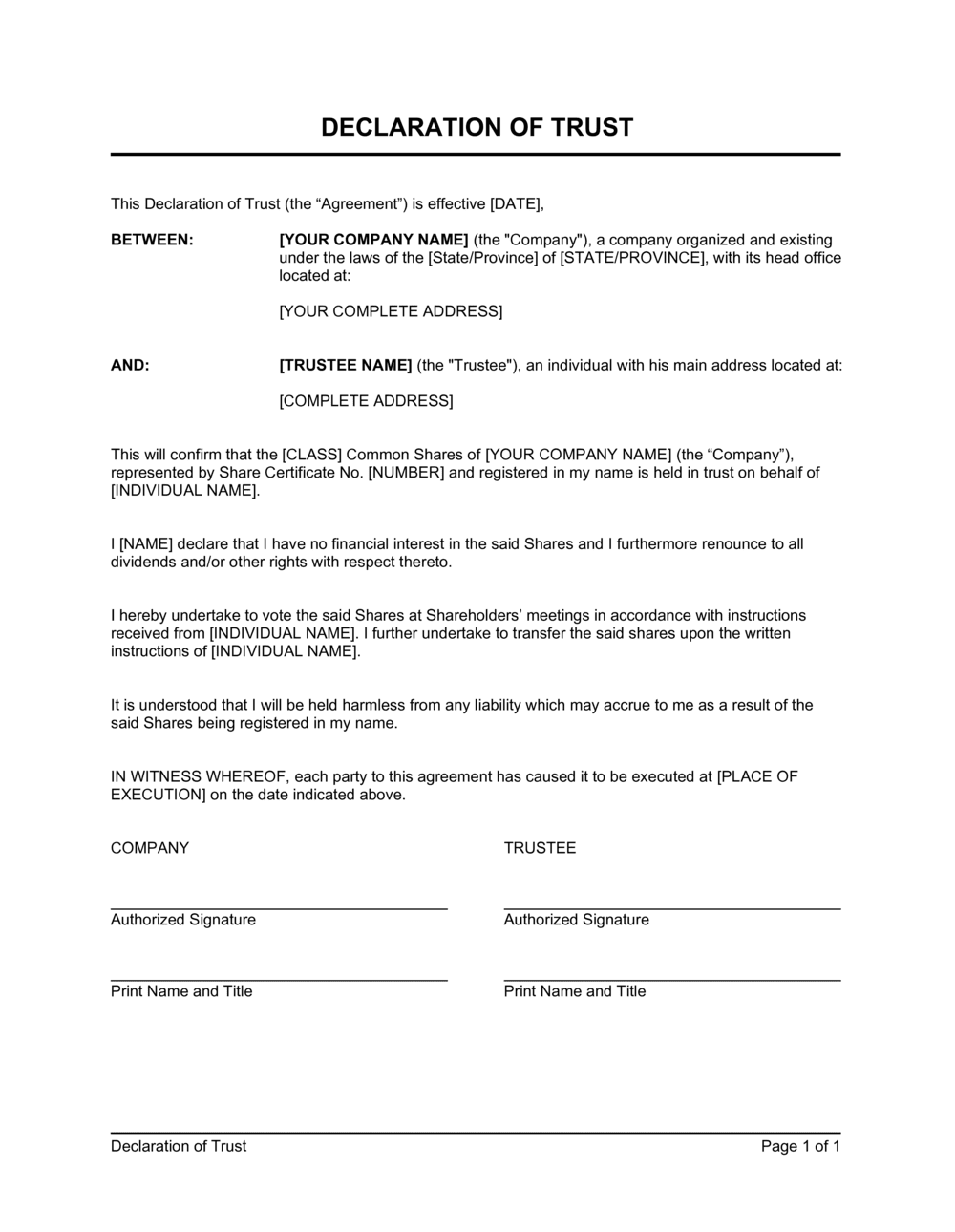
Enter the settlor's, trustee's, and each beneficiary's complete legal name exactly as it appears on government-issued ID or corporate registration documents. For corporate trustees or beneficiaries, include the registered company number and jurisdiction of incorporation.
💡 Cross-reference the beneficiary's name against any existing property title, share register, or bank account to ensure exact matching — discrepancies create costly correction procedures later.
2
Describe the trust property with legal precision
For real estate, include the full address, title number or land registry reference, and legal description. For shares, include company name, share class, number of shares, and certificate numbers. For cash or bank accounts, include the institution name, account number, and sort or routing code.
💡 Attach a Schedule A with the full property description rather than trying to fit it into the body clause — this makes future amendments to the property schedule cleaner.
3
State beneficial ownership proportions clearly
Where there is a single beneficiary, confirm 100% beneficial ownership. Where there are multiple beneficiaries, state each person's percentage or fractional share explicitly. If shares are to be unequal, record the agreed reasoning in a separate letter of wishes.
💡 Even where parties intend a 50/50 split, write '50% each' rather than 'equal shares' — equal-share language has been disputed in court when contributions to purchase price were unequal.
4
Define trustee powers appropriate to the trust type
For a bare trust, limit trustee powers to administrative acts — signing documents, collecting income, maintaining records — on the beneficiary's direction. For a discretionary trust, enumerate specific investment and distribution powers with any restrictions or guidelines.
💡 Avoid copying trustee powers from a discretionary trust template into a bare trust declaration. Broad discretionary powers in a bare trust can reclassify it for tax purposes and trigger unintended stamp duty or income tax consequences.
5
Draft the indemnity clause with real-world liabilities in mind
List the specific categories of liability the trustee may face — mortgage obligations, property taxes, insurance, maintenance, legal costs — and confirm the beneficiary's obligation to fund or reimburse each. Include a payment timeline, e.g., within 14 days of written demand.
💡 If the trust property carries a mortgage, confirm with the lender whether the trust structure affects the loan terms — some mortgage lenders require consent to a change in beneficial ownership.
6
Insert a termination date and succession plan
Set a long-stop termination date consistent with applicable perpetuity rules in the governing jurisdiction. If the beneficiary is a minor, set the vesting date at age 18 or 21. Include a successor trustee appointment mechanism in case the original trustee dies, becomes incapacitated, or resigns.
💡 Check the perpetuity period in your jurisdiction before setting the long-stop date — England and Wales apply a 125-year statutory period; other jurisdictions differ materially.
7
Execute as a deed with proper witnessing
Sign the declaration in the presence of an independent adult witness who is not a party to the trust and not a family member of any party. The witness must sign, print their name, and provide their address. Where required, have the document notarized before registration.
💡 A declaration of trust over real property must be executed as a deed in most common-law jurisdictions — signing as a simple contract leaves it unenforceable against third-party purchasers and mortgage lenders.
8
Register or file the document where required
In some jurisdictions, a declaration of trust over real property must be noted on the land title or filed with the relevant registry to bind third parties. For share trusts, update the company's register of members to note the nominee arrangement if required by local law.
💡 Even where registration is not legally required, keep a certified copy of the executed declaration with the title deeds or share certificates — losing the original creates significant complications if the trust is disputed.