1
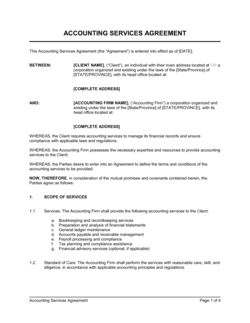
Identify the parties correctly
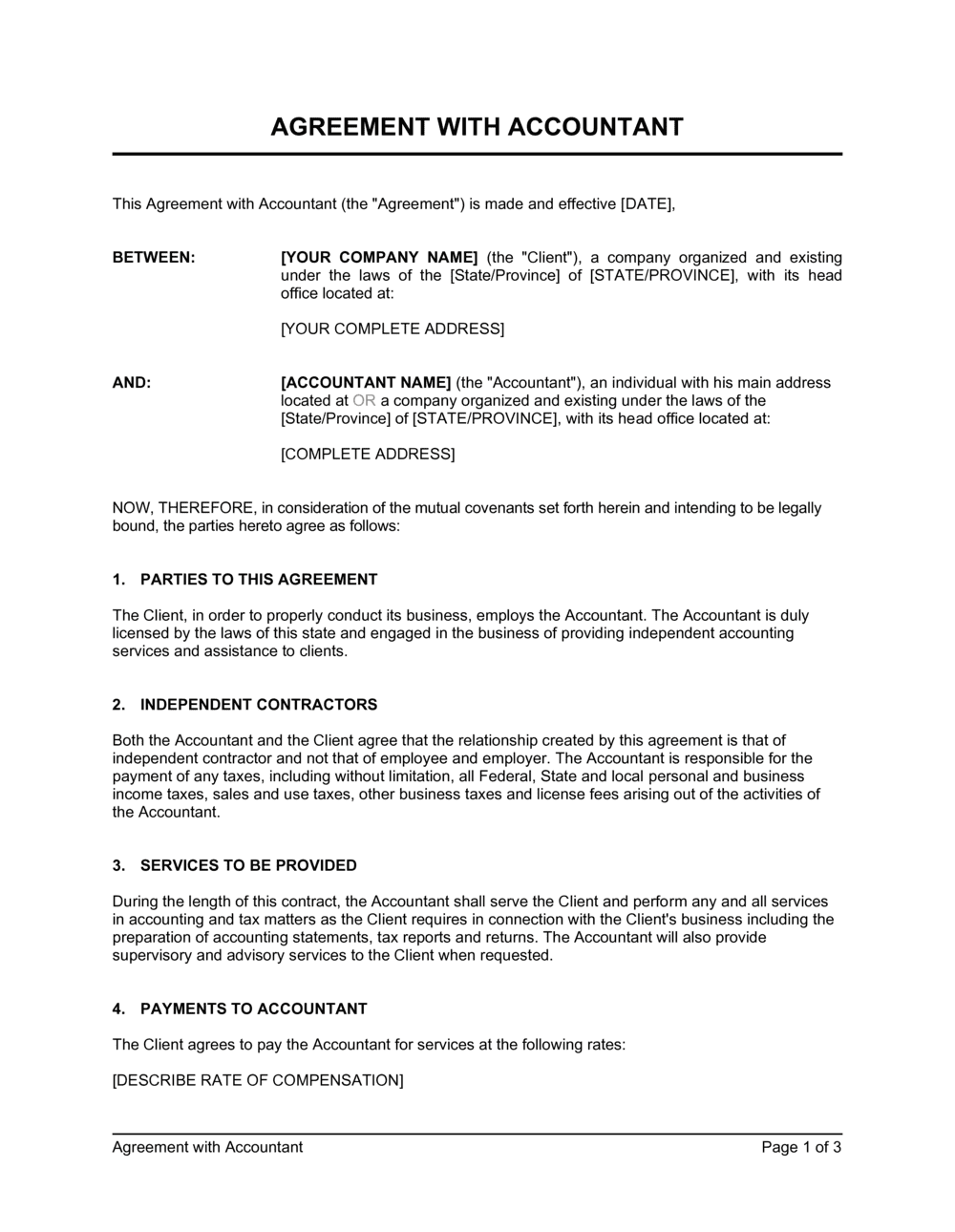
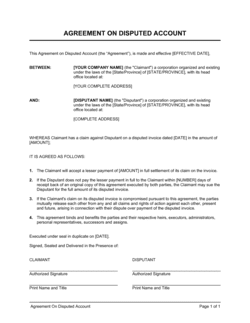
Enter the client's full legal entity name and the accountant's or firm's full registered legal name. Confirm whether the accountant is engaged as an individual or through a professional corporation, as this affects which entity holds the liability and insurance.
💡 Ask for the accountant's professional corporation number or CPA license number and include it in the parties block — it confirms you engaged a licensed professional, which matters in a dispute.
2
Define the scope of services in detail
List every specific task included in the engagement — for example, 'preparation of federal and state income tax returns for the fiscal year ending December 31, [YEAR]' — and explicitly list two or three common exclusions such as audit representation or payroll processing.
💡 A scope defined by deliverable (e.g., 'one set of reviewed financial statements') is more enforceable than a scope defined by task (e.g., 'general accounting support').
3
Set the fee structure and payment terms
Choose fixed fee, hourly rate, or monthly retainer and enter the agreed amount. Add the billing cycle, due date, accepted payment methods, and a late-payment interest rate. If expenses are reimbursable, state which categories and set a pre-approval threshold.
💡 For ongoing engagements, add an annual fee adjustment clause — for example, 'fees may be adjusted by up to [CPI + 2]% on each anniversary' — so you avoid renegotiating the contract every year.
4
Complete the client responsibilities clause
Specify the documents and records the client must deliver and the deadline for delivery — for example, 'all bank statements, receipts, and prior-year returns by [DATE].' This creates a documented record if a filing delay results from late client delivery.
💡 Add a missed-deadline provision: if the client fails to deliver records by the agreed date, the filing deadline shifts and the accountant is not liable for penalties arising from the delay.
5
Tailor the confidentiality and data-handling terms
Reference any specific data-security standards your firm uses (e.g., 256-bit encryption, SOC 2 compliant storage) and state the retention and destruction timeline for client records after the engagement ends.
💡 If the client is subject to HIPAA, GDPR, or state privacy laws, add a reference to those obligations and confirm the accountant's compliance — failure to do so can expose both parties to regulatory penalties.
6
Set the liability cap
Enter the maximum liability amount — typically 12 months of fees paid — and confirm that indirect and consequential damages are excluded. Review this cap against your professional-indemnity insurance policy limits for consistency.
💡 Set the cap at no more than one year of fees. Courts in most jurisdictions enforce reasonable caps in professional-services agreements; caps set too high offer no real protection.
7
State the term, notice period, and termination effects
Enter the engagement start date and either a fixed end date or an evergreen term with a renewal clause. Set the notice period for termination (30 days is standard) and add a clause confirming that fees through the termination date are payable regardless of who initiates termination.
💡 For tax-season engagements, add a blackout clause prohibiting termination between January 1 and April 30 — this prevents a client from switching accountants mid-filing and leaving the accountant with uncompensated in-progress work.
8
Sign before any work begins
Both parties must sign the agreement before the accountant starts any billable work. An unsigned agreement is unenforceable, and work performed without a signed contract relies entirely on implied terms — typically unfavorable to the service provider.
💡 Use an electronic signature platform to timestamp execution and send an executed copy to both parties automatically. Store the signed agreement with the engagement file for the full retention period.