75 Samples Goals For Coaching Template

Free Word download β€’ Edit online β€’ Save & share with Drive β€’ Export to PDF

3 pagesβ€’20–25 min to fillβ€’Difficulty: Standard
Learn more ↓
Free75 Samples Goals For Coaching Template

At a glance

What it is
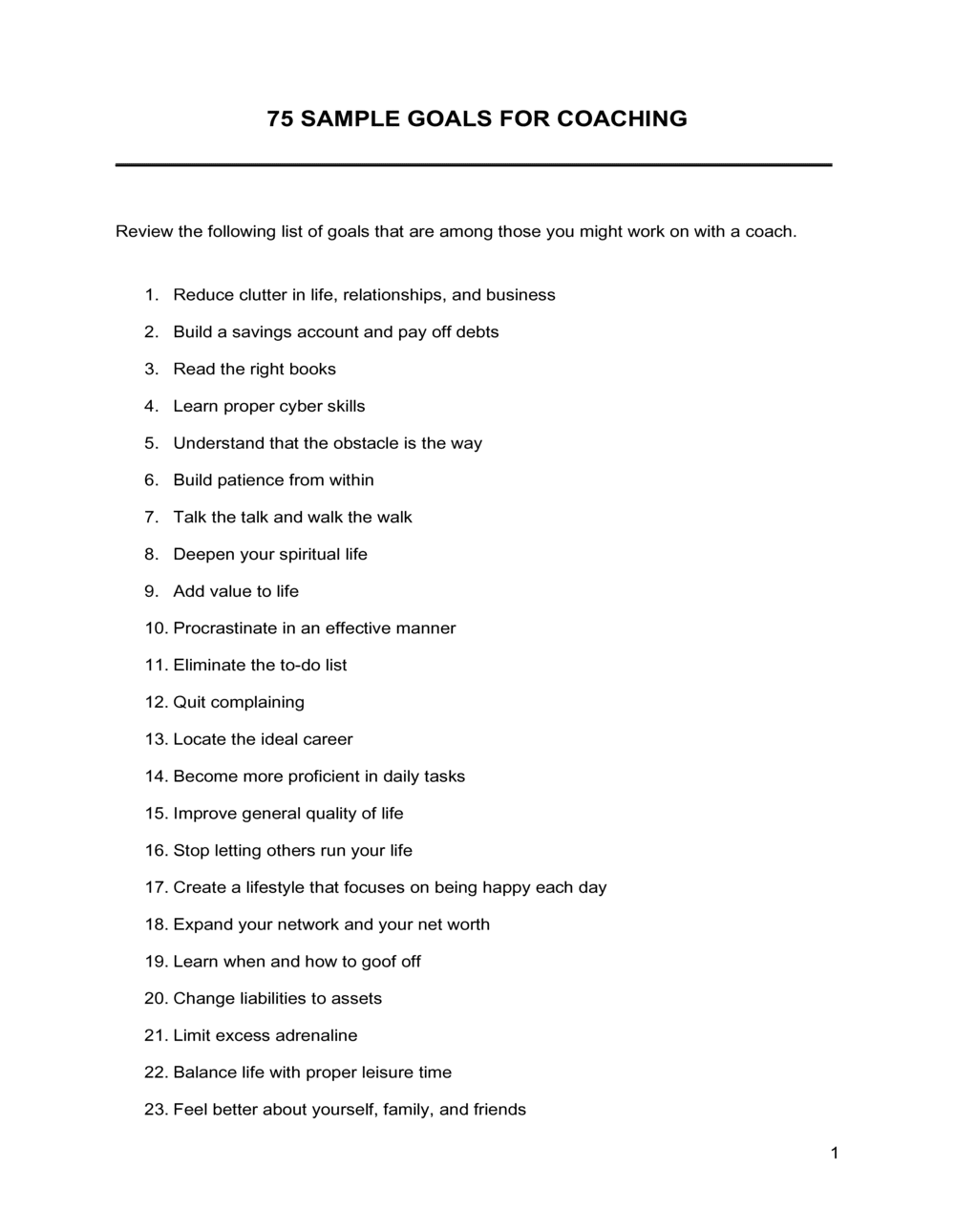
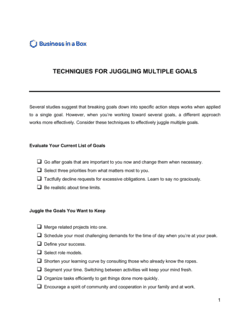
75 Samples Goals for Coaching is a ready-to-use Word template containing 75 pre-written, categorized coaching goal statements covering performance, communication, leadership, time management, and personal development. This free Word download gives coaches, managers, and HR professionals a structured starting point they can edit online and adapt to any individual coaching engagement or team development program.
When you need it
Use it when launching a new coaching engagement, completing a performance improvement plan, or building a structured development program for employees, direct reports, or clients. It is especially useful when a coach or manager needs to quickly identify relevant, well-phrased goals without starting from a blank page.
What's inside
Seventy-five categorized goal statements spanning performance improvement, leadership development, communication skills, time management, emotional intelligence, teamwork, strategic thinking, personal effectiveness, and career advancement. Each goal is written in actionable, measurable language that can be tailored to a specific individual or role.

What is a 75 Samples Goals for Coaching Template?

75 Samples Goals for Coaching is a ready-to-use reference document containing 75 pre-written, categorized coaching goal statements organized across nine development areas β€” from performance improvement and leadership to emotional intelligence and career advancement. Each goal is written in specific, behavioral language that can be selected, customized, and incorporated directly into a coaching engagement, a performance plan, or an employee development conversation. Rather than requiring a coach or manager to construct goal language from scratch, the template provides a structured library of professionally phrased starting points that can be adapted to any role, industry, or individual situation.

Why You Need This Document

Starting a coaching engagement without clear, well-written goals is one of the most common reasons coaching programs fail to produce measurable results. Vague goals like "be a better communicator" or "improve leadership" give neither the coach nor the coachee a concrete target to work toward, making progress impossible to assess and accountability difficult to maintain. This template eliminates that problem by providing 75 actionable, observable goal statements across all major development categories β€” so coaches and managers spend their time on the substance of the coaching conversation rather than the mechanics of goal construction. The result is a faster start, a more focused engagement, and a written record of agreed commitments that both parties can reference at every session.

Which variant fits your situation?

If your situation is…Use this template
Addressing a specific performance shortfall with a structured remediation planPerformance Improvement Plan (PIP)
Documenting a full coaching relationship with milestones and accountability checkpointsCoaching Plan Template
Setting annual development targets tied to the performance review cycleEmployee Development Plan
Tracking coaching goal progress session by sessionCoaching Session Notes Template
Onboarding a new hire with role-specific 30-60-90 day objectives30-60-90 Day Plan
Providing leadership-specific goals for a high-potential employee programLeadership Development Plan
Conducting a structured career conversation tied to promotion readinessCareer Development Plan

Common mistakes to avoid

❌ Setting too many goals at once

Why it matters: Coachees who carry more than five active goals at a time consistently under-deliver on all of them. Attention and effort dilute across too many priorities.

Fix: Limit the active goal set to three to five, and stage additional goals for later phases of the engagement once early goals show measurable progress.

❌ Using goal language that is not observable

Why it matters: Goals like 'be more confident' or 'improve attitude' cannot be measured, which makes progress invisible and coaching conversations vague.

Fix: Rewrite every goal to include at least one observable behavior and a measurable indicator β€” frequency, completion rate, score, or documented output.

❌ Skipping the coachee's input on goal selection

Why it matters: Goals imposed without coachee buy-in produce compliance at best. Without genuine ownership, the coachee will disengage as soon as the coaching relationship loses momentum.

Fix: Use the sample goals as a menu presented to the coachee, not a prescription. Let the coachee identify which statements resonate and why before customizing.

❌ No accountability structure attached to the goals

Why it matters: A goal with no review date, no check-in owner, and no milestone is an intention β€” not a commitment. Most untracked goals are forgotten within three weeks.

Fix: Assign a review date, a responsible party for each check-in, and at least one interim milestone for any goal with a timeline longer than 30 days.

❌ Failing to update goals when circumstances change

Why it matters: A coaching plan built on a goal that is no longer relevant to the coachee's role or situation becomes a source of frustration rather than motivation.

Fix: Schedule a formal goal review at the midpoint of every coaching engagement and document any adjustments with the reason for the change.

❌ Treating all goal categories as equally relevant for every coachee

Why it matters: Using the full 75 goals as a checklist rather than a curated selection produces an unfocused plan that lacks strategic coherence.

Fix: Anchor goal selection to a specific development need, performance gap, or career objective identified in the discovery phase β€” use only the categories that directly address that need.

The 9 key sections, explained

Performance improvement goals

Leadership development goals

Communication skills goals

Time management and productivity goals

Emotional intelligence and self-awareness goals

Teamwork and collaboration goals

Strategic thinking and problem-solving goals

Career advancement and professional growth goals

Personal effectiveness and well-being goals

How to fill it out

  1. 1

    Identify the coaching focus areas

    Review the nine goal categories in the template and select the two or three areas most relevant to the coachee's development needs or performance gaps. Use assessment data, 360 feedback, or a discovery conversation to guide selection.

    πŸ’‘ Limit active coaching goals to three to five at a time. More than five goals in simultaneous focus consistently reduces completion rates.

  2. 2

    Select and shortlist relevant sample goals

    Within each chosen category, review the sample goals and highlight the statements that most closely match the coachee's specific situation. Aim for three to five candidate statements per category before narrowing down.

    πŸ’‘ Read each sample goal aloud with the coachee β€” goals they find resonant from the start produce stronger commitment than goals assigned without input.

  3. 3

    Customize placeholders with specific details

    Replace all [PLACEHOLDERS] with the coachee's actual role context, measurable targets, and realistic timeframes. The sample language provides structure β€” the specific numbers and contexts make it actionable.

    πŸ’‘ Ask the coachee to propose the target metric before you suggest one. Self-set targets generate stronger accountability than manager-assigned numbers.

  4. 4

    Add a behavioral indicator for each goal

    For every finalized goal, write one sentence describing the observable behavior that will confirm the goal is being met. This bridges the gap between the goal statement and day-to-day evidence of progress.

    πŸ’‘ Behavioral indicators work best when they describe something a third party could observe β€” not just self-reported feelings or intentions.

  5. 5

    Set a review cadence and milestone checkpoints

    Assign a review date to each goal β€” typically aligned with coaching session frequency β€” and note at least one interim milestone for goals with timelines longer than 60 days.

    πŸ’‘ Goals with no review date are forgotten by the second session. Build the review schedule into the coaching contract or calendar at the outset.

  6. 6

    Share the finalized goals with all relevant stakeholders

    If the coaching engagement involves a manager or sponsor, share the finalized goal list with their input and acknowledgment. Alignment between coach, coachee, and manager significantly increases completion rates.

    πŸ’‘ A brief written summary of the agreed goals β€” even a single page β€” is more effective than a verbal handoff. It creates a reference point for all parties.

  7. 7

    Revisit and adjust goals at the midpoint

    At the midpoint of the coaching engagement, formally review each goal. Mark completed goals, adjust timelines or targets where circumstances have changed, and retire goals that are no longer relevant.

    πŸ’‘ Adjusting a goal is not failure β€” it is evidence that the coaching is responsive to real conditions. Document the rationale for any change.

Frequently asked questions

What are coaching goals?

Coaching goals are specific, time-bound outcomes that a coaching engagement is designed to help an individual achieve. They define the measurable change in behavior, skill, or performance expected by the end of the coaching relationship. Effective coaching goals are written in concrete, observable language rather than vague aspirations, and they are agreed upon by both the coach and the coachee at the start of the engagement.

How many coaching goals should a person have at one time?

Three to five active goals is the range that most coaching practitioners recommend for a standard engagement. More than five goals dilutes focus and reduces completion rates. If a coachee has more developmental needs, prioritize the highest-impact goals for the current phase and stage the remaining goals for later in the engagement or a subsequent program.

What is the difference between a coaching goal and a performance goal?

A performance goal measures work output β€” sales numbers, error rates, project deadlines. A coaching goal focuses on the behaviors, skills, or habits that drive that output. In practice, most coaching engagements include both types: developmental goals that build capability and performance goals that link that capability to measurable business results.

How do I write a SMART coaching goal?

A SMART coaching goal is Specific (names the exact behavior or outcome), Measurable (has a metric or observable indicator), Achievable (realistic within the coachee's context), Relevant (tied to a genuine development need or role requirement), and Time-bound (has a deadline or review date). For example, "improve communication" becomes "deliver a structured written project update to the leadership team every Friday for the next 8 weeks, using the situation-complication-resolution format."

Can I use these sample goals for both individual and group coaching?

Yes. The sample goals in this template are written at the individual level but can be adapted for team or group coaching by adjusting the subject and scope. For group coaching, select goals relevant to shared development themes β€” such as collaboration or communication β€” and modify the language to reflect collective rather than individual targets.

How often should coaching goals be reviewed?

Goals should be reviewed at every coaching session to track incremental progress, and formally assessed at the midpoint and end of the engagement. For coaching programs lasting more than three months, a monthly written progress summary keeps goals visible between sessions. Goals that are reviewed less than once per month are typically forgotten or deprioritized by the coachee.

What should I do if a coachee is not making progress toward their goals?

First, investigate whether the goal itself is still relevant and realistic given the coachee's current context. If it is, explore whether the obstacle is skill-based (the coachee doesn't know how), motivation-based (the coachee doesn't want to), or structural (the coachee lacks time, authority, or resources). Each cause requires a different coaching intervention. Document the diagnosis and any goal adjustment in writing.

Are these coaching goals suitable for executive-level coaching?

Yes, particularly the leadership development, strategic thinking, and emotional intelligence categories. Executive coaching goals typically require more customization to reflect the individual's specific organizational context, stakeholder landscape, and strategic responsibilities. Use the sample goals as a starting point, then refine the language to match the scope and complexity of the executive role.

How is this template different from a performance improvement plan?

A performance improvement plan (PIP) is a formal HR document used to address specific performance deficiencies with documented consequences for non-completion. This coaching goals template is a developmental tool used in both corrective and growth contexts β€” it focuses on building capability rather than documenting compliance. The two documents can be used together, with coaching goals forming the developmental component of a broader PIP.

How this compares to alternatives

vs Performance Improvement Plan (PIP)

A PIP is a formal HR document used to address documented performance deficiencies with defined consequences for non-completion. This coaching goals template is a developmental resource used proactively or alongside a PIP to build the skills that address the performance gap. The PIP sets the compliance framework; the coaching goals provide the behavioral roadmap. Both can be used together.

vs Employee Development Plan

An employee development plan is a broader career-oriented document covering training, skills gaps, and long-term role progression. This template focuses specifically on coaching goals β€” observable, time-bound behavioral targets used within a structured coaching engagement. The development plan defines the destination; the coaching goals describe the specific next steps to get there.

vs 30-60-90 Day Plan

A 30-60-90 day plan sets role-specific objectives for a new hire or role transition across three structured phases. Coaching goals are used throughout an ongoing relationship to develop behaviors and skills that may span beyond the initial onboarding period. The 30-60-90 plan is time-boxed to the first quarter; coaching goals extend across the full arc of a coaching engagement.

vs Career Development Plan

A career development plan maps an individual's long-term professional trajectory β€” aspirations, skill gaps, and advancement milestones. Coaching goals are the tactical, session-level commitments that operationalize that plan in the near term. The career plan answers 'where are you going?'; the coaching goals answer 'what are you working on this month to get there?'

Industry-specific considerations

Professional Services

Leadership presence, client communication quality, and billable productivity goals are the most frequently selected categories for coaching in consulting, law, and accounting firms.

Technology / SaaS

Strategic thinking, cross-functional collaboration, and time management goals are commonly used in fast-scaling tech companies where individual contributors are promoted into management roles without formal leadership training.

Healthcare

Emotional intelligence, communication, and personal effectiveness goals are particularly relevant in clinical and administrative coaching contexts where burnout and interpersonal dynamics directly affect patient outcomes.

Retail / Hospitality

Teamwork, communication, and performance improvement goals support front-line manager development and high-turnover team coaching programs common in retail and hospitality operations.

Template vs pro β€” what fits your needs?

PathBest forCostTime
Use the templateManagers, HR professionals, and independent coaches running structured coaching engagements without a custom goal bankFree30–60 minutes to select and customize goals per coachee
Template + professional reviewOrganizations building a formal coaching program that requires goal language aligned to competency frameworks or job levels$500–$2,000 for an OD consultant or ICF-certified coach to calibrate goal language to internal frameworks1–2 weeks
Custom draftedEnterprise talent programs requiring bespoke coaching goal libraries tied to leadership competency models, 360 instruments, or succession planning criteria$3,000–$15,000 for a full coaching framework design engagement4–10 weeks

Glossary

Coaching Goal
A specific, time-bound outcome that a coaching engagement is designed to help the individual achieve, stated in measurable behavioral or performance terms.
SMART Goal
A goal that is Specific, Measurable, Achievable, Relevant, and Time-bound β€” the standard framework for writing actionable objectives in coaching and management contexts.
Developmental Goal
A goal focused on building new skills, knowledge, or behaviors rather than correcting underperformance.
Performance Goal
A goal tied directly to measurable work outputs β€” such as sales targets, error rates, or project completion timelines.
Stretch Goal
An aspirational objective set beyond current demonstrated capability, intended to motivate and accelerate growth rather than represent a minimum standard.
Coaching Contract
A written agreement between coach and coachee that defines the purpose, duration, confidentiality, and goals of the coaching engagement.
Accountability Partner
A person β€” often the coach or manager β€” who regularly checks in on goal progress and holds the individual to their stated commitments.
Behavioral Indicator
A specific, observable action or pattern that signals whether a goal is being met β€” used to make abstract goals like 'improve communication' concretely measurable.
Coachee
The individual receiving coaching β€” the person whose development, performance, or behavior the coaching engagement is designed to improve.
360-Degree Feedback
A structured input process where an individual receives performance and behavior feedback from their manager, peers, direct reports, and sometimes clients β€” commonly used to identify coaching goal areas.

Part of your Business Operating System

This document is one of 3,000+ business & legal templates included in Business in a Box.

  • Fill-in-the-blanks β€” ready in minutes
  • 100% customizable Word document
  • Compatible with all office suites
  • Export to PDF and share electronically

Create your document in 3 simple steps.

From template to signed document β€” all inside one Business Operating System.
1
Download or open template

Access over 3,000+ business and legal templates for any business task, project or initiative.

2
Edit and fill in the blanks with AI

Customize your ready-made business document template and save it in the cloud.

3
Save, Share, Send, Sign

Share your files and folders with your team. Create a space of seamless collaboration.

Save time, save money, and create top-quality documents.

β˜…β˜…β˜…β˜…β˜…

"Fantastic value! I'm not sure how I'd do without it. It's worth its weight in gold and paid back for itself many times."

Managing Director Β· Mall Farm
Robert Whalley
Managing Director, Mall Farm Proprietary Limited
β˜…β˜…β˜…β˜…β˜…

"I have been using Business in a Box for years. It has been the most useful source of templates I have encountered. I recommend it to anyone."

Business Owner Β· 4+ years
Dr Michael John Freestone
Business Owner
β˜…β˜…β˜…β˜…β˜…

"It has been a life saver so many times I have lost count. Business in a Box has saved me so much time and as you know, time is money."

Owner Β· Upstate Web
David G. Moore Jr.
Owner, Upstate Web

Run your business with a system β€” not scattered tools

Stop downloading documents. Start operating with clarity. Business in a Box gives you the Business Operating System used by over 250,000 companies worldwide to structure, run, and grow their business.

Free Forever PlanΒ Β·Β No credit card required