15 Ways To Strengthen Your Finances

Free to read β€’ Save or share with one click

Free15 Ways To Strengthen Your Finances Template

At a glance

What it is
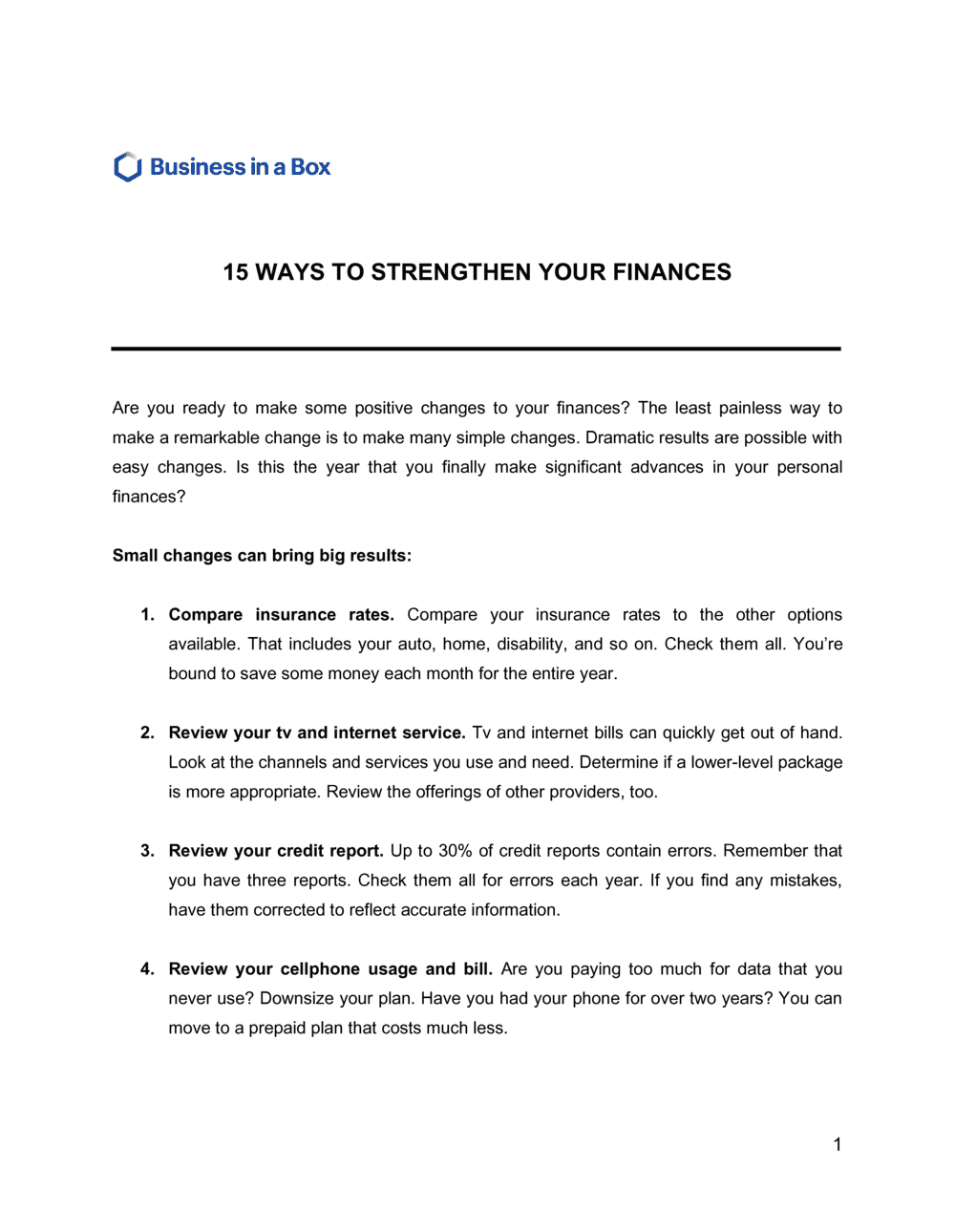
15 Ways To Strengthen Your Finances is a structured Word document that walks business owners and financial advisors through fifteen proven strategies for improving financial health β€” covering cash flow, debt management, cost control, revenue diversification, and long-term planning. This free download is fully editable and can be exported as PDF for client handouts, internal workshops, or self-guided planning sessions.
When you need it
Use it when conducting a business financial review, onboarding a new advisory client, or preparing for a planning cycle where cash flow, profitability, or debt load needs to be addressed systematically.
What's inside
A sequenced set of fifteen strategies organized into thematic areas including cash flow optimization, expense reduction, debt repayment prioritization, revenue diversification, emergency fund building, and investment planning β€” each with clear action steps and implementation guidance.

What is 15 Ways To Strengthen Your Finances?

15 Ways To Strengthen Your Finances is a structured operational guide that walks business owners, financial coaches, and advisors through fifteen concrete strategies for improving financial health across the areas that matter most: cash flow timing, budgeting discipline, expense reduction, debt repayment, emergency reserves, revenue diversification, pricing integrity, and long-term investment planning. Unlike a single-purpose spreadsheet, this free Word download provides a holistic framework β€” with action steps, numeric targets, and a review cadence β€” that turns a financial audit into a prioritized improvement plan.

Why You Need This Document

Most businesses that struggle financially do so not from a single catastrophic event but from the slow accumulation of unaddressed habits: budgets that are built but never reviewed, pricing that hasn't moved in two years while costs have, and emergency reserves that were always "next quarter's project." Without a structured framework, owners address whichever financial problem is loudest this week rather than the one with the highest long-term impact. This template provides the structure to diagnose all fifteen dimensions at once, rank them by urgency and impact, and assign specific targets with deadlines. The result is a financial improvement plan that can be acted on immediately β€” and revisited monthly to hold the business accountable to real progress.

Which variant fits your situation?

If your situation is…Use this template
Conducting a formal annual financial review for a businessAnnual Financial Report
Tracking monthly income and expenses in one placeMonthly Budget Template
Planning cash flow for the next 12 monthsCash Flow Forecast
Setting and monitoring business financial goalsFinancial Plan
Presenting financial strategy to a board or investorsFinancial Projections Template
Reducing and restructuring existing business debtDebt Repayment Plan
Identifying and cutting unnecessary operating expensesBusiness Expense Report

Common mistakes to avoid

❌ Treating the document as a one-time exercise

Why it matters: Financial conditions change month to month. A plan completed once and never revisited fails to respond to rising costs, new debt, or shifts in revenue mix.

Fix: Schedule a monthly 30-minute review to update actuals, reassess priorities, and adjust targets. Treat the document as a living plan, not a one-off report.

❌ Setting vague financial targets

Why it matters: Goals like 'improve cash flow' or 'spend less' provide no measurable benchmark and no trigger for corrective action when things drift.

Fix: Replace every goal with a specific dollar amount and deadline β€” 'increase monthly cash reserve to $15,000 by September 30' is actionable; 'save more money' is not.

❌ Skipping the expense audit before cutting

Why it matters: Cutting costs without a full audit leads to eliminating low-impact line items while high-cost inefficiencies β€” unused vendor contracts, over-insured policies β€” remain untouched.

Fix: Pull a complete list of every recurring charge from bank statements and card statements for the past 90 days before deciding what to cut.

❌ Ignoring the revenue concentration risk section

Why it matters: A business where one client represents more than 30% of revenue faces existential risk if that client churns, delays payment, or renegotiates terms.

Fix: Calculate revenue concentration by client and channel. If any single source exceeds 25–30%, treat diversification as a priority strategy, not an optional one.

The 9 key sections, explained

Cash flow assessment

Budget creation and adherence

Expense reduction tactics

Debt prioritization and repayment

Emergency fund building

Revenue diversification strategy

Pricing and margin review

Investment and savings planning

Financial reporting and review cadence

How to fill it out

  1. 1

    Complete the cash flow and budget baseline

    Before applying any strategy, document your current monthly inflows, outflows, and the net balance for each of the last three months. This gives every subsequent recommendation a factual foundation.

    πŸ’‘ Pull data directly from your accounting software export rather than estimating from memory β€” estimates routinely undercount variable expenses by 15–25%.

  2. 2

    Rank your highest-impact strategies first

    Review all fifteen strategies and mark the three to five with the largest potential impact on your specific situation. Address those first rather than working through the list sequentially.

    πŸ’‘ For most businesses, cash flow timing, expense reduction, and debt prioritization deliver faster results than long-term investment strategies β€” sequence accordingly.

  3. 3

    Set specific targets for each selected strategy

    Replace every placeholder with a real number, date, or account name. Vague intentions ('spend less') don't drive behavior; specific targets ('reduce software subscriptions to under $400/month by June 1') do.

    πŸ’‘ Targets with a deadline and a dollar amount are acted on three times more often than open-ended goals, according to standard behavioral finance research.

  4. 4

    Assign accountability for each action item

    If more than one person is involved in financial management, note who owns each strategy β€” owner, bookkeeper, advisor, or a specific manager β€” to avoid shared accountability becoming no accountability.

    πŸ’‘ For solo operators, schedule a recurring 30-minute calendar block each week labeled 'financial review' to serve as the accountability mechanism.

  5. 5

    Build a 90-day implementation timeline

    Map each priority strategy to a specific 30-, 60-, or 90-day milestone so progress is measurable and the plan doesn't stall after the first week.

    πŸ’‘ Put the three most uncomfortable actions (usually debt repayment, price increases, and expense cuts) in the first 30 days β€” momentum from early wins carries the rest of the plan.

  6. 6

    Schedule a monthly review against the plan

    Set a fixed monthly review date to compare actuals against your targets and update the document. Note what changed, why, and what the revised action is.

    πŸ’‘ Keep version history by saving each month's reviewed copy with a date suffix β€” this creates an audit trail of decisions and a record of progress that is useful for advisor meetings.

Frequently asked questions

What is the '15 Ways To Strengthen Your Finances' template?

It is a structured Word document outlining fifteen concrete strategies for improving business financial health β€” covering cash flow, budgeting, debt management, expense reduction, revenue diversification, and long-term savings planning. It is designed for business owners, financial advisors, and coaches who need a ready-made framework they can customize and act on immediately.

Who should use this financial strengthening guide?

Small business owners conducting a self-assessment, financial coaches delivering structured client programs, accountants supplementing quarterly reviews, and startup founders building sound financial habits before scaling all benefit from this template. It works equally well as a self-guided checklist or a facilitated advisory tool.

How is this different from a budget template?

A budget template tracks planned versus actual spending in a specific period. This document is a strategic guide covering fifteen distinct financial improvement areas β€” including debt prioritization, pricing review, emergency fund building, and investment planning β€” that a budget alone does not address. Think of the budget as one of the fifteen tools, not as a substitute for the full framework.

How long does it take to work through all fifteen strategies?

Completing the baseline assessment and selecting priority strategies takes 2–4 hours in a focused session. Fully implementing all fifteen strategies is a 90-day process for most businesses, with the highest- impact items β€” cash flow review, expense audit, and debt prioritization β€” actionable within the first two weeks.

Can I use this template with clients as a financial coach or advisor?

Yes. The template is designed to function as a client-facing deliverable. You can white-label it, add your branding, and walk clients through each section in a structured session. Many advisors use it as a discovery and onboarding tool at the start of a new engagement to establish a financial baseline and identify priority areas.

Which of the fifteen strategies has the fastest impact on cash flow?

Accounts receivable acceleration β€” reducing the time between invoice issuance and payment receipt β€” typically produces the fastest cash flow improvement. Moving from Net 30 to Net 15 terms, or implementing an automated follow-up sequence for overdue invoices, can improve available cash within 30 days without requiring any cost cuts or new revenue.

Do I need an accountant to use this template?

No. The template is written for non-accountants and uses plain-language explanations throughout. That said, an accountant or bookkeeper can add significant value when reviewing the financial reporting section, stress- testing your projections, or helping you interpret P&L and cash flow data for the baseline assessment.

How often should I revisit the plan?

Monthly reviews against your targets are the minimum recommended cadence. A full reset of priorities β€” where you re-score each of the fifteen strategies β€” is worth doing quarterly or whenever a major financial event occurs, such as taking on new debt, losing a significant client, or entering a new market.

How this compares to alternatives

vs Financial Plan

A financial plan is a forward-looking projection document covering revenue, expenses, and capital requirements over a multi-year horizon. This template is an action-oriented guide focused on improving current financial health through fifteen discrete strategies. Use the financial plan for fundraising and long-term modeling; use this template for diagnosing and fixing present-day financial weaknesses.

vs Cash Flow Projection

A cash flow projection forecasts future inflows and outflows on a monthly basis to identify upcoming shortfalls. This template addresses the underlying behaviors and decisions β€” expense patterns, pricing, debt structure β€” that determine whether cash flow improves or worsens. The projection shows you the problem; this guide shows you how to fix it.

vs Business Budget Template

A budget template allocates revenue to spending categories and tracks actuals against plan. Budgeting is one of the fifteen strategies covered in this document, but this guide goes further β€” addressing debt management, revenue diversification, emergency reserves, and investment planning that a budget spreadsheet does not cover.

vs Small Business Expense Report

An expense report captures and categorizes historical spending for reimbursement or accounting purposes. This template uses that spending data as an input for strategic decisions β€” identifying where to cut, renegotiate, or reallocate β€” rather than simply recording what was spent.

Industry-specific considerations

Professional Services

Billing cycle optimization and receivables aging are the highest-impact strategies, given that revenue is often tied to slow-paying corporate clients.

Retail / E-commerce

Inventory cost management and supplier payment terms negotiation are central, alongside seasonal cash flow planning to avoid stockout or overstock situations.

Construction and Trades

Progress billing alignment, materials cost forecasting, and emergency fund sizing for project delays are the most business-critical strategies in this sector.

SaaS / Technology

Churn-adjusted revenue forecasting, infrastructure cost optimization, and CAC-to-LTV ratio improvement are the strategies with the greatest financial leverage.

Template vs pro β€” what fits your needs?

PathBest forCostTime
Use the templateBusiness owners, coaches, and advisors who need a ready-made financial improvement framework they can customize and use immediatelyFree2–4 hours for initial completion; 30 minutes per monthly review
Template + professional reviewBusinesses with complex debt structures, multi-entity finances, or significant revenue concentration risk$200–$600 for a session with an accountant or financial advisor1–2 days including advisor review and revised action plan
Custom draftedOrganizations requiring a fully customized financial improvement program integrated with existing reporting systems or delivered as part of a formal advisory engagement$1,000–$5,000 depending on scope and advisor seniority1–3 weeks

Glossary

Cash Flow
The net movement of money into and out of a business over a given period, distinct from profit or revenue on paper.
Working Capital
Current assets minus current liabilities β€” the funds available to cover day-to-day operating costs.
Debt-to-Income Ratio
Total monthly debt payments divided by gross monthly income, used to assess how much of revenue is consumed by debt service.
Emergency Fund
A reserve of liquid cash set aside to cover unexpected expenses or revenue shortfalls, typically 3–6 months of operating costs.
Revenue Diversification
The practice of generating income from multiple sources so that the loss of any single revenue stream does not threaten the business.
Net Profit Margin
Net income divided by total revenue, expressed as a percentage β€” a measure of how much profit is retained per dollar of sales.
Fixed vs. Variable Costs
Fixed costs remain constant regardless of output (rent, salaries); variable costs scale with activity (materials, commissions).
Accounts Receivable Aging
A report grouping outstanding invoices by how long they have been unpaid, used to identify overdue payments and collection priorities.
Liquidity
How quickly and easily assets can be converted to cash to meet short-term obligations without significant loss of value.
ROI (Return on Investment)
Net gain from an investment divided by its cost, expressed as a percentage β€” used to evaluate whether spending generates proportionate value.

Part of your Business Operating System

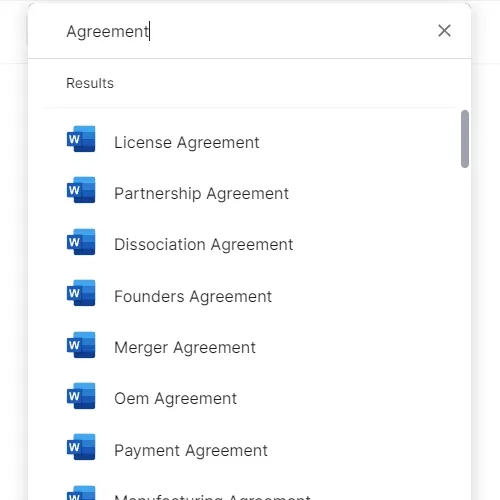
This document is one of 3,000+ business & legal templates included in Business in a Box.

  • Fill-in-the-blanks β€” ready in minutes
  • Compatible with all office suites
  • Export to PDF and share electronically

Create your document in 3 simple steps.

From template to signed document β€” all inside one Business Operating System.
1
Download or open template

Access over 3,000+ business and legal templates for any business task, project or initiative.

2
Edit and fill in the blanks with AI

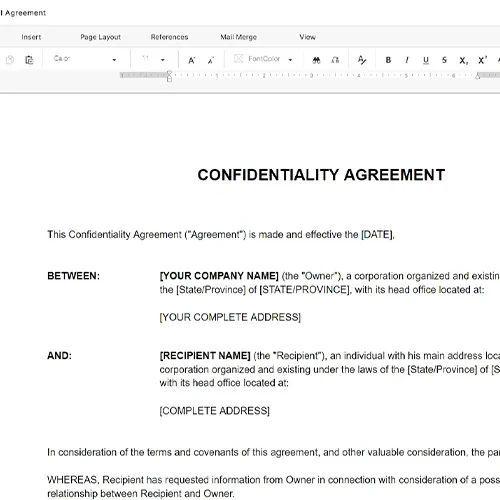
Customize your ready-made business document template and save it in the cloud.

3
Save, Share, Send, Sign

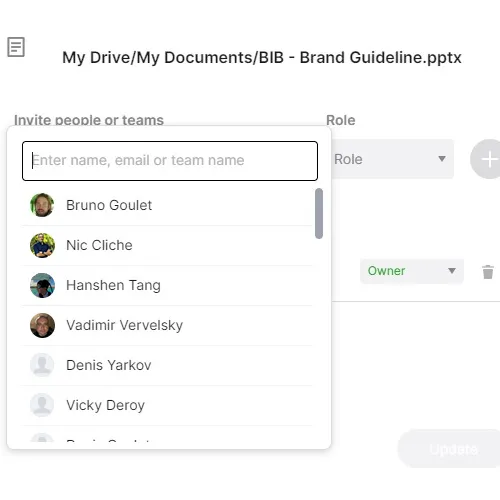
Share your files and folders with your team. Create a space of seamless collaboration.

Save time, save money, and create top-quality documents.

β˜…β˜…β˜…β˜…β˜…

"Fantastic value! I'm not sure how I'd do without it. It's worth its weight in gold and paid back for itself many times."

Managing Director Β· Mall Farm
Robert Whalley
Managing Director, Mall Farm Proprietary Limited
β˜…β˜…β˜…β˜…β˜…

"I have been using Business in a Box for years. It has been the most useful source of templates I have encountered. I recommend it to anyone."

Business Owner Β· 4+ years
Dr Michael John Freestone
Business Owner
β˜…β˜…β˜…β˜…β˜…

"It has been a life saver so many times I have lost count. Business in a Box has saved me so much time and as you know, time is money."

Owner Β· Upstate Web
David G. Moore Jr.
Owner, Upstate Web

Run your business with a system β€” not scattered tools

Stop downloading documents. Start operating with clarity. Business in a Box gives you the Business Operating System used by over 250,000 companies worldwide to structure, run, and grow their business.

Free Forever PlanΒ Β·Β No credit card required