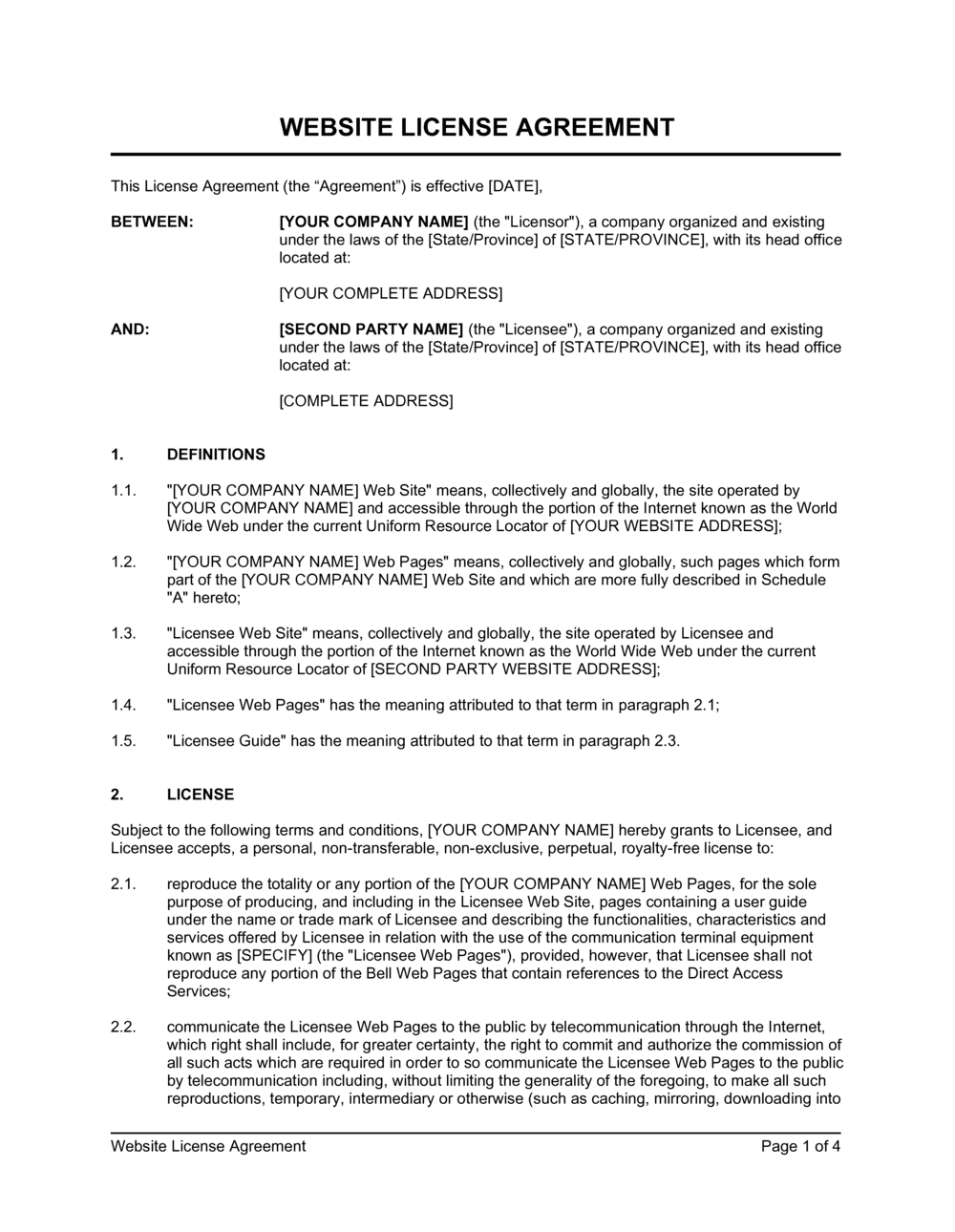
Website License Agreement Template

Free Word download • Edit online • Save & share with Drive • Export to PDF

4 pages25–35 min to fillDifficulty: ComplexSignature requiredLegal review recommended
Learn more ↓
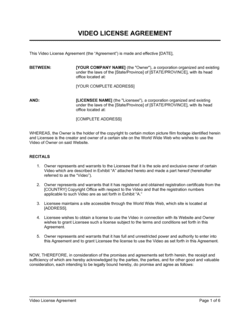
FreeWebsite License Agreement Template

At a glance

What it is
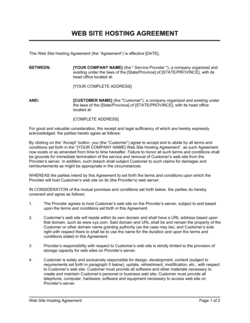
A Website License Agreement is a legally binding contract between a website owner or software licensor and a licensee that grants specific, limited rights to access, use, or integrate a website, web application, or digital content. This free Word download gives you a structured, enforceable starting point you can edit online and export as PDF to protect your intellectual property and define the exact scope of permitted use.
When you need it
Use it when granting a business partner, client, or third party the right to use your website platform, embed your content, or access your web-based software under defined conditions — rather than transferring ownership outright. It is also appropriate when white-labeling a web application or providing API-based access to website functionality.
What's inside
License grant and scope, permitted and prohibited uses, intellectual property ownership, fees and payment terms, confidentiality, representations and warranties, indemnification, limitation of liability, term and termination, and governing law. Together these clauses define exactly what the licensee may do, what the licensor retains, and what happens if either party breaches the agreement.

What is a Website License Agreement?

A Website License Agreement is a legally binding contract between a website or platform owner (the licensor) and a named third party (the licensee) that grants specific, limited rights to access, use, or integrate a website, web application, or digital content under defined conditions. Unlike a sale or intellectual property assignment, a website license agreement does not transfer ownership — the licensor retains all copyright, trademark, and other intellectual property rights throughout the agreement's term. The document defines the exact scope of permitted use, the fees owed, confidentiality obligations, what the licensee may not do, and the consequences of breach or termination. It is the foundational instrument for any commercial arrangement where a web platform is monetized through controlled access rather than outright sale.

Why You Need This Document

Operating without a signed website license agreement exposes a licensor to four concrete risks simultaneously. Without an IP ownership clause, a licensee who customizes or builds on the platform can argue partial ownership under joint-authorship principles — a dispute that can tie up a valuable asset in litigation for years. Without a defined scope of use, a licensee is free to argue that any use not explicitly prohibited is permitted, extending access far beyond what the licensor intended or priced. Without a termination and post-termination obligations clause, a former licensee may continue using cached content, embedded code, or user data long after the relationship ends. And without a limitation of liability clause, a single downtime event or security incident can expose the licensor to consequential damages that dwarf the license fees received. A properly executed website license agreement closes all four gaps before access is granted, making it the essential first document for any web platform with commercial licensing potential.

Which variant fits your situation?

If your situation is…Use this template
Granting end users the right to install and use a downloadable software productEnd User License Agreement (EULA)
Setting general rules for all visitors accessing a public websiteWebsite Terms of Use
Licensing proprietary software to a business client for internal useSoftware License Agreement
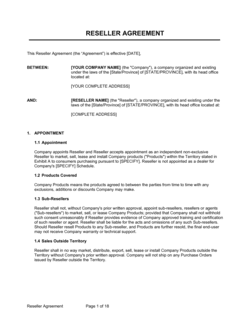
Allowing a reseller or partner to distribute your web-based productReseller Agreement
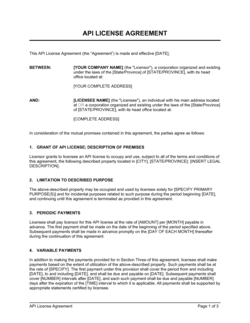
Governing access to proprietary data or API endpointsAPI License Agreement
White-labeling a web application for a client to brand as their ownWhite Label Agreement
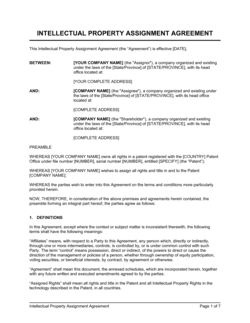
Transferring full ownership of website IP rather than licensing itIntellectual Property Assignment Agreement

Common mistakes to avoid

❌ Omitting an IP ownership clause

Why it matters: Without an explicit statement that the licensor retains ownership, a licensee who has customized or contributed to the website may assert joint-authorship or ownership rights under copyright law.

Fix: Include a standalone IP ownership clause confirming that all website IP — including any derivative works or customizations — belongs exclusively to the licensor, and have the licensee assign any such contributions at signing.

❌ Granting an undefined or overly broad license scope

Why it matters: A license grant that does not specify territory, user count, or permitted purpose is interpreted as broadly as the licensee argues in court — potentially far exceeding the licensor's commercial intent.

Fix: Specify every limiting dimension of the license in the grant clause: exclusive or non-exclusive, the specific URL or platform, the territory, the number of seats, and the precise permitted business purpose.

❌ No auto-renewal notice period or termination procedure

Why it matters: Agreements that renew automatically without a clear notice deadline and form of notice lock parties into renewed terms they no longer want, creating fee disputes and access-continuation arguments.

Fix: State the renewal notice period (30–60 days is standard), the form of valid notice (written email to a named contact), and the exact effect of a missed deadline.

❌ Unlimited or asymmetric indemnification

Why it matters: An uncapped indemnity clause can expose the indemnifying party to liability orders of magnitude larger than the license fees involved, making the deal economically irrational in hindsight.

Fix: Cap indemnity obligations at a multiple of the fees paid — typically 2–3× the annual license fee — and carve out willful misconduct or fraud, which courts often exclude from caps anyway.

❌ Leaving out a warranty disclaimer

Why it matters: Without an express disclaimer, implied warranties of merchantability and fitness for a particular purpose apply in many jurisdictions, exposing the licensor to claims for any downtime, bugs, or incompatibility.

Fix: Add an express warranty disclaimer in ALL CAPS as required by the UCC in the US, stating the website is provided 'as is' without warranties of uninterrupted availability or fitness for any specific purpose.

❌ Not specifying what happens to data and content on termination

Why it matters: Failing to address post-termination obligations leaves the licensee holding cached content, user data, or embedded code that may violate the licensor's IP rights or applicable data protection law.

Fix: Include a termination clause requiring the licensee to immediately cease all use, delete or return all licensed materials, and provide written certification of deletion within a defined number of days.

The 10 key clauses, explained

Parties and recitals

In plain language: Identifies the licensor and licensee by their full legal names and entity types, and summarizes the purpose of the agreement in one or two background statements.

Sample language
This Website License Agreement ('Agreement') is entered into as of [DATE] between [LICENSOR LEGAL NAME], a [STATE] [ENTITY TYPE] ('Licensor'), and [LICENSEE LEGAL NAME], a [STATE] [ENTITY TYPE] ('Licensee').

Common mistake: Using a trade name or DBA instead of the registered legal entity name — if enforcement becomes necessary, the agreement may not bind the correct legal party.

License grant and scope

In plain language: States the precise rights being granted — whether the license is exclusive or non-exclusive, the permitted territory, the number of authorized users or installations, and whether sublicensing is allowed.

Sample language
Licensor hereby grants Licensee a non-exclusive, non-transferable, revocable license to access and use the Website located at [URL] solely for [PERMITTED PURPOSE] within [TERRITORY], for up to [NUMBER] authorized users.

Common mistake: Failing to specify whether the license is exclusive. An unspecified grant is interpreted by courts as non-exclusive by default, but the ambiguity invites disputes that a single word prevents.

Permitted and prohibited uses

In plain language: Lists exactly what the licensee may do with the website or content and explicitly prohibits actions such as reverse engineering, scraping, redistribution, or modification.

Sample language
Licensee may use the Website solely for [INTERNAL BUSINESS PURPOSES]. Licensee shall not: (a) copy, modify, or create derivative works; (b) reverse engineer or decompile the Website; (c) sublicense, sell, or transfer access to any third party; or (d) use the Website for any unlawful purpose.

Common mistake: Listing only prohibited uses without defining permitted uses — courts may interpret anything not prohibited as implicitly allowed, expanding the license far beyond the licensor's intent.

Intellectual property ownership

In plain language: Confirms that the licensor retains all ownership of the website, software, code, and content and that no ownership rights are transferred to the licensee by virtue of the license.

Sample language
All right, title, and interest in and to the Website, including all intellectual property rights, remain exclusively with Licensor. This Agreement does not convey to Licensee any ownership interest in the Website or any related IP.

Common mistake: Omitting this clause entirely on the assumption ownership is obvious. Without it, a licensee who has customized or contributed to the site may argue partial ownership under joint-authorship doctrines.

Fees, payment terms, and license fees

In plain language: States the license fee amount, payment schedule, accepted payment methods, and consequences of late or non-payment — including suspension or termination of access.

Sample language
Licensee shall pay Licensor a license fee of $[AMOUNT] per [month/year], due on the [DAY] of each [period]. Payments not received within [10] days of the due date accrue interest at [1.5]% per month. Non-payment for more than [30] days constitutes a material breach.

Common mistake: Setting fees without specifying when the obligation begins — particularly for SaaS-style agreements where access activates before invoicing, creating a gap in when fees are owed.

Confidentiality

In plain language: Requires both parties to protect non-public information disclosed during the agreement — such as source code, user data, and business terms — from disclosure to third parties.

Sample language
Each party agrees to hold in strict confidence all Confidential Information of the other party and not to disclose such information to any third party without prior written consent. 'Confidential Information' means any non-public information relating to the Website, its architecture, data, or business terms.

Common mistake: Using a confidentiality clause with no carve-outs for legally required disclosures. A party served with a court order to produce documents needs room to comply without breaching the agreement.

Representations and warranties

In plain language: Each party makes factual promises: the licensor warrants it owns and has the right to license the website; the licensee warrants it has authority to enter the agreement and will use the site lawfully.

Sample language
Licensor represents and warrants that it owns or has the right to license the Website and that, to its knowledge, the Website does not infringe any third-party intellectual property rights. Licensee represents and warrants that it has full authority to enter into this Agreement.

Common mistake: Including a warranty that the website will be 'uninterrupted or error-free' — this creates an absolute obligation the licensor cannot realistically meet; replace it with a commercially reasonable uptime commitment.

Indemnification

In plain language: Allocates responsibility for third-party claims: the licensor typically indemnifies for IP infringement claims; the licensee indemnifies for misuse or unauthorized access.

Sample language
Licensor shall defend and indemnify Licensee against third-party claims alleging that the Website infringes any patent, copyright, or trademark. Licensee shall defend and indemnify Licensor against claims arising from Licensee's use of the Website in violation of this Agreement.

Common mistake: Writing a mutual indemnity without a cap. Uncapped indemnity clauses can expose either party to liability far exceeding the economic value of the license itself.

Limitation of liability

In plain language: Caps the licensor's total financial exposure — typically at the fees paid in the prior 12 months — and excludes indirect, consequential, and punitive damages.

Sample language
In no event shall Licensor's total liability exceed the fees paid by Licensee in the [12] months preceding the claim. Neither party shall be liable for indirect, incidental, consequential, or punitive damages, even if advised of their possibility.

Common mistake: Applying the liability cap only to the licensor but not the licensee. Courts sometimes construe asymmetric caps as unenforceable where consumer protection statutes apply.

Term, termination, and effect of termination

In plain language: States the initial term, renewal conditions, notice periods for no-fault termination, grounds for immediate termination for cause, and what happens upon expiry — particularly the obligation to delete or return licensed materials.

Sample language
This Agreement commences on [START DATE] and continues for [1] year, renewing automatically unless either party provides [30] days' written notice. Licensor may terminate immediately for cause upon written notice. Upon termination, Licensee shall immediately cease all use of the Website and certify in writing the deletion of any cached or downloaded content.

Common mistake: Auto-renewal language that does not specify the notice period or the form of notice required, leaving the licensor unable to stop a renewal it no longer wants.

How to fill it out

  1. 1

    Identify both parties with their full legal names

    Enter the licensor's and licensee's complete registered legal names, entity types, and states or countries of incorporation. Do not use trade names or abbreviated names in the parties block.

    💡 Pull the exact entity name from a current certificate of good standing — variations of even one word can complicate enforcement.

  2. 2

    Define the website or platform being licensed

    Describe the website by its URL, the scope of the platform (e.g., the full application versus specific modules), and the version or release being licensed if versioning is relevant.

    💡 If licensing a web application that will be updated over time, specify whether future versions are included or require a separate amendment.

  3. 3

    Set the license scope precisely

    Choose exclusive or non-exclusive, specify the territory, set the number of authorized users or seats, and state whether sublicensing is permitted. All four of these parameters should be explicit — courts do not infer them in the licensor's favor.

    💡 If the client is part of a corporate group, clarify upfront whether affiliated subsidiaries are included in 'Licensee' or require separate licenses.

  4. 4

    List permitted uses and prohibited actions

    Write out the specific business purpose the licensee may use the website for, then enumerate prohibited actions — reverse engineering, scraping, redistribution, modification, and use for competing products.

    💡 Be specific about the permitted purpose: 'internal business operations' is far stronger than 'any lawful purpose,' which grants more latitude than most licensors intend.

  5. 5

    Enter the fee schedule and payment mechanics

    State the license fee amount, currency, billing cycle, payment due date, accepted methods, and the late-payment interest rate. Include a suspension-of-access right for non-payment of more than 30 days.

    💡 State the currency explicitly — USD versus CAD or EUR creates disputes on international deals; a sentence costs nothing.

  6. 6

    Tailor the confidentiality and IP ownership clauses

    Confirm the licensor retains all IP and insert a confidentiality clause with a reasonable duration — typically 2–5 years post-termination. Include standard carve-outs for disclosures required by law or court order.

    💡 If the licensee will access source code or backend systems, consider a separate NDA with a longer confidentiality tail than the standard agreement term.

  7. 7

    Set the liability cap at a commercially realistic level

    Cap total liability at 12 months of fees paid and exclude indirect and consequential damages for both parties. Confirm that the indemnity for IP infringement claims has its own sublimit if the deal value is large.

    💡 Match the liability cap to the fees actually paid, not the contract value — if Year 1 fees are $5,000 but the contract value is $50,000, a 12-month-fees cap limits exposure to $5,000.

  8. 8

    Confirm the governing law and dispute resolution mechanism

    Choose the jurisdiction whose courts or arbitration body will handle disputes. For cross-border licenses, arbitration under AAA or ICC rules is typically more practical than court litigation.

    💡 Avoid choosing a governing law with no connection to either party's location — some courts refuse to honor such a choice as having no legitimate basis.

Frequently asked questions

What is a website license agreement?

A website license agreement is a legally binding contract between a website or platform owner and a licensee that grants specific, limited rights to access, use, or integrate the website or its content. Unlike a sale or assignment, it does not transfer ownership — the licensor retains all intellectual property rights. It defines the permitted scope of use, fees, confidentiality obligations, and what happens if either party terminates the arrangement.

What is the difference between a website license agreement and website terms of use?

Website terms of use govern the relationship between a site owner and all general visitors — they are typically non-negotiated, click-wrap agreements that apply to anonymous public access. A website license agreement is a negotiated, signed contract with a specific named party — such as a business client, partner, or reseller — that grants defined rights beyond what public visitors have, such as white-labeling, API access, or platform integration. Both documents can coexist for the same website.

When do I need a website license agreement instead of a simple terms of use?

Use a website license agreement any time a specific party receives rights that go beyond standard visitor access — including API access, the right to embed or redistribute content, white-label use, platform resale, or access to proprietary back-end tools. Terms of use are sufficient for public visitors browsing and interacting with a site in ordinary ways. The moment commercial value or IP transfer is involved, a signed license agreement is the appropriate instrument.

Does a website license agreement need to be signed?

Yes. Unlike click-wrap terms of use, a website license agreement is a negotiated bilateral contract that should be signed by authorized representatives of both parties before access is granted. An unsigned agreement may be enforceable in some jurisdictions based on conduct, but a signed copy eliminates any question about whether both parties agreed to the terms and when the agreement took effect.

Can a licensee sublicense the website to third parties?

Only if the agreement expressly permits it. In most standard website license agreements, sublicensing is prohibited without prior written consent from the licensor. If the licensee's business model requires sublicensing — for example, a reseller who deploys the platform to end clients — this must be explicitly addressed in a separate sublicense provision or a reseller agreement that defines the permitted scope and the licensor's approval rights.

What happens to the license if the licensee's business is acquired?

Most website license agreements are non-transferable, meaning the license does not automatically pass to an acquirer. A change-of-control clause typically treats an acquisition as a triggering event requiring licensor consent or giving the licensor the right to terminate. If continuity of access is important to the licensee, negotiate a change-of-control carve-out permitting assignment to an acquirer who agrees in writing to be bound by the agreement's terms.

What governing law should I choose for a website license agreement?

Choose the jurisdiction where your business is incorporated or where your primary operations are located — this makes dispute resolution practically accessible and ensures your counsel is familiar with the applicable law. For cross-border agreements, Delaware law (US) and English law (UK) are commonly chosen as neutral, commercially sophisticated frameworks. Avoid choosing a jurisdiction with no connection to either party, as some courts will refuse to honor that choice.

How should I handle data privacy in a website license agreement?

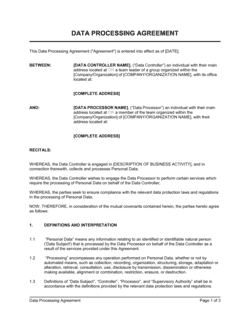
If the licensee will access, process, or store personal data through the website, the agreement must address data protection obligations — particularly GDPR compliance for EU users and applicable US state privacy laws. This typically requires a separate Data Processing Agreement (DPA) incorporated by reference, specifying the categories of data processed, the legal basis, security standards, and breach notification timelines. A confidentiality clause alone is insufficient for regulated personal data.

Do I need a lawyer to draft or review a website license agreement?

For straightforward domestic licensing arrangements at modest deal values, a high-quality template is a solid starting point. Engage a lawyer when the deal involves material IP, exclusive rights, significant license fees, cross-border parties, personal data processing, or when the licensee is a large enterprise that will redline the agreement substantially. A 1–2 hour template review typically costs $400–$800 and is worthwhile any time the license has meaningful commercial or IP exposure.

How this compares to alternatives

vs End User License Agreement (EULA)

An EULA governs the relationship between a software publisher and an individual end user installing or activating a downloadable product. A website license agreement covers browser-based or API-based access to a hosted platform between two businesses. EULAs are typically click-wrap and non-negotiated; website license agreements are negotiated and signed. Use an EULA for consumer software distribution and a website license agreement for B2B platform access.

vs Website Terms of Use

Website terms of use are a non-negotiated, publicly posted policy governing all visitors' general access to a site — browsing, account creation, and content interaction. A website license agreement is a signed bilateral contract granting specific commercial rights to a named party. Terms of use protect the site owner against misuse by the general public; a website license agreement formalizes a commercial relationship with a specific partner or client.

vs Software License Agreement

A software license agreement typically governs on-premise or locally installed software — covering installation rights, version upgrades, and maintenance. A website license agreement covers access to a remotely hosted web application or online platform. The key distinction is delivery model: installed software versus browser-based or API access. Choose the software license agreement for on-premise deployments and the website license agreement for SaaS or hosted platform arrangements.

vs Intellectual Property Assignment Agreement

An IP assignment agreement permanently transfers ownership of intellectual property from one party to another. A website license agreement grants a right to use IP while the licensor retains ownership. If the goal is to sell or permanently transfer the website, its code, or its content, an assignment is the correct instrument. If the goal is to monetize the website while retaining control and ownership, use a license agreement.

Industry-specific considerations

SaaS / Technology

Multi-tenant platform access, API rate limits, uptime SLA references, and data processing addenda for GDPR and CCPA compliance.

Media and Publishing

Content syndication rights, attribution requirements, territorial restrictions on republication, and takedown obligations for removed content.

E-commerce

Storefront platform licensing, marketplace seller terms, payment processing integration rights, and prohibited product category restrictions.

Professional Services

Client portal access licensing, confidentiality of client-specific data processed through the platform, and multi-user seat allocations per engagement.

Education and E-learning

Seat-based licensing for student populations, FERPA compliance for student data, and restrictions on resale or redistribution of course content.

Financial Services

Regulatory compliance obligations incorporated by reference, data residency requirements, enhanced audit rights, and financial data confidentiality protections.

Jurisdictional notes

United States

Website license agreements in the US are primarily governed by state contract law and federal copyright law under the Copyright Act. Warranty disclaimers must comply with UCC Article 2 requirements — typically written in ALL CAPS to be effective. California's CCPA imposes additional data handling obligations if the platform processes personal information of California residents. Non-compete clauses embedded in license agreements are unenforceable in California regardless of the governing law chosen.

Canada

Canadian website license agreements must account for PIPEDA (federal) or provincial equivalents — particularly Quebec's Law 25, which imposes strict privacy impact assessments and explicit consent requirements for commercial data processing. Quebec contracts must be available in French for provincially regulated entities. IP ownership clauses should explicitly address moral rights under the Copyright Act, which Canadian authors retain separately from economic rights and cannot be assigned — only waived.

United Kingdom

In the UK, website license agreements are subject to the Contracts (Rights of Third Parties) Act 1999, which may give third-party beneficiaries enforcement rights unless expressly excluded. The Unfair Contract Terms Act 1977 and Consumer Rights Act 2015 restrict the enforceability of liability exclusions in B2C contexts. Post-Brexit UK GDPR applies to personal data processing and requires a UK-specific Data Processing Agreement if the platform handles user data.

European Union

GDPR applies to any website license agreement where personal data of EU residents is processed, requiring a compliant Data Processing Agreement (Article 28 DPA) to be incorporated by reference or executed separately. The EU's Copyright in the Digital Single Market Directive (Article 17) imposes upload filter obligations on large platforms. Software Database Directive protections apply to databases incorporated in the website. Member state contract law governs enforceability, with significant variation between civil-law countries such as Germany and France.

Template vs lawyer — what fits your deal?

PathBest forCostTime
Use the templateDomestic B2B licensing arrangements with defined scope, standard fees, and no exclusive or cross-border termsFree30–60 minutes
Template + legal reviewCross-border licenses, significant IP value, personal data processing, or deals where the licensee will redline the agreement$400–$800 for a 1–2 hour attorney review2–5 days
Custom draftedExclusive licenses, enterprise SaaS deals above $50K, regulated industries, or complex multi-party platform arrangements$1,500–$5,000+1–3 weeks

Glossary

License Grant
The specific permission given by the licensor to the licensee to use the website, software, or content under the terms stated in the agreement.
Licensor
The party that owns the website, software, or intellectual property and grants permission for another party to use it.
Licensee
The party that receives the limited right to use the website, software, or content under the conditions set out in the agreement.
Scope of License
The defined boundaries of the permitted use — including whether it is exclusive or non-exclusive, transferable or non-transferable, and limited by territory or user count.
Intellectual Property (IP)
Creations protected by law — including source code, website design, content, trademarks, and databases — that remain owned by the licensor unless explicitly transferred.
Sublicense
A secondary license granted by the licensee to a third party; typically prohibited without the licensor's prior written consent.
Indemnification
A contractual obligation by one party to compensate the other for losses or legal costs arising from specific breaches or third-party claims.
Limitation of Liability
A clause capping the maximum financial exposure of one or both parties, typically excluding consequential, indirect, or punitive damages.
Termination for Cause
The right to end the agreement immediately upon a material breach — such as unauthorized sublicensing or non-payment — without the notice period that would apply to a no-fault termination.
Governing Law
The jurisdiction whose laws apply to interpret and enforce the agreement, regardless of where either party is located.
Warranty Disclaimer
A clause in which the licensor expressly states the website or software is provided 'as is' without guarantees of fitness for a particular purpose or uninterrupted availability.

Part of your Business Operating System

This document is one of 3,000+ business & legal templates included in Business in a Box.

  • Fill-in-the-blanks — ready in minutes
  • 100% customizable Word document
  • Compatible with all office suites
  • Export to PDF and share electronically

Create your document in 3 simple steps.

From template to signed document — all inside one Business Operating System.
1
Download or open template

Access over 3,000+ business and legal templates for any business task, project or initiative.

2
Edit and fill in the blanks with AI

Customize your ready-made business document template and save it in the cloud.

3
Save, Share, Send, Sign

Share your files and folders with your team. Create a space of seamless collaboration.

Save time, save money, and create top-quality documents.

★★★★★

"Fantastic value! I'm not sure how I'd do without it. It's worth its weight in gold and paid back for itself many times."

Managing Director · Mall Farm
Robert Whalley
Managing Director, Mall Farm Proprietary Limited
★★★★★

"I have been using Business in a Box for years. It has been the most useful source of templates I have encountered. I recommend it to anyone."

Business Owner · 4+ years
Dr Michael John Freestone
Business Owner
★★★★★

"It has been a life saver so many times I have lost count. Business in a Box has saved me so much time and as you know, time is money."

Owner · Upstate Web
David G. Moore Jr.
Owner, Upstate Web

Run your business with a system — not scattered tools

Stop downloading documents. Start operating with clarity. Business in a Box gives you the Business Operating System used by over 250,000 companies worldwide to structure, run, and grow their business.

Free Forever Plan · No credit card required