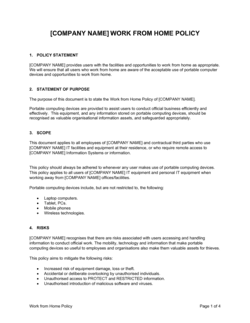
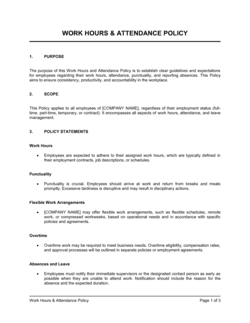
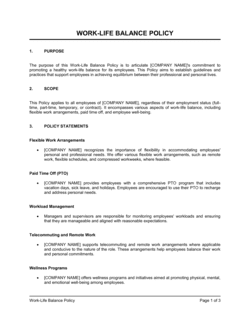
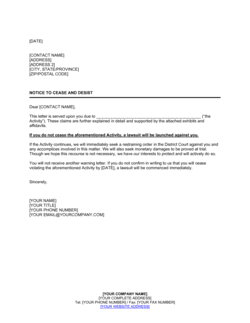
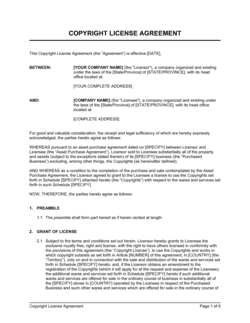
Notice of Infringement of Copyrighted Work Template

Free Word download β€’ Edit online β€’ Save & share with Drive β€’ Export to PDF

1 pageβ€’15–25 min to fillβ€’Difficulty: Standard
Learn more ↓
FreeNotice of Infringement of Copyrighted Work Template

At a glance

What it is
A Notice of Infringement of Copyrighted Work is a formal written letter sent by a copyright owner β€” or their authorized representative β€” to a party that has used, reproduced, or distributed protected material without permission. This free Word download gives you a structured, professional starting point you can edit online and export as PDF to send by email or certified mail.
When you need it
Use it when you discover that someone has copied, published, or distributed your original work β€” images, text, software, music, or video β€” without your authorization and without a valid license. It is typically the first formal step before escalating to a DMCA takedown, cease-and-desist demand, or litigation.
What's inside
Identification of the copyright owner and the infringing party, a description of the original protected work and its registration details, a specific description of the infringing use, a demand to cease and remove the infringing content, a deadline for compliance, and a statement of the sender's rights and intent to pursue further action if ignored.

What is a Notice of Infringement of Copyrighted Work?

A Notice of Infringement of Copyrighted Work is a formal written letter sent by a copyright owner β€” or their authorized representative β€” to a party that has reproduced, distributed, or publicly displayed a protected original work without permission. It identifies both parties, describes the original work and the specific infringing use, demands that the unauthorized activity stop, and sets a deadline for compliance. Unlike a cease-and-desist letter, which covers a broad range of legal disputes, this notice is scoped specifically to copyright claims and functions as the first documented step in a structured enforcement process.

Why You Need This Document

Discovering that your original work β€” a photograph, article, software component, or creative asset β€” has been used without authorization is both a legal problem and a business one. Without a formal written notice, you have no documented record that the infringing party was informed of your rights, which weakens any follow-up claim for damages. In the United States, willful infringement β€” where the infringer knew about your rights and continued anyway β€” can support statutory damages of up to $150,000 per work. Sending a properly structured notice creates that knowledge on the record. It also gives the recipient a clear path to compliance, resolving many disputes without the cost of litigation or a formal DMCA proceeding. This template gives you a complete, professional notice you can complete in under 30 minutes, attach your evidence to, and send the same day.

Which variant fits your situation?

If your situation is…Use this template
Infringing content hosted on a US-based online platformDMCA Takedown Notice
Ongoing or repeated infringement requiring an immediate stopCease and Desist Letter (Copyright)
Infringement by a former employee or contractorNotice of Infringement of Copyrighted Work
Trademark rather than copyright violationTrademark Infringement Notice
Licensing dispute over a previously authorized workLicense Agreement (Copyright)
Infringement leading to a formal legal claim for damagesCopyright Assignment Agreement

Common mistakes to avoid

❌ Sending the notice without evidence attached

Why it matters: Recipients routinely deny or ignore notices that contain no supporting documentation. Without evidence, you cannot demonstrate the infringement occurred on a specific date.

Fix: Attach timestamped screenshots, cached URLs, or archived copies as a labeled exhibit before sending the notice.

❌ Misidentifying the copyright owner

Why it matters: A notice sent by someone who does not actually own the copyright is legally ineffective and can expose the sender to liability for a fraudulent DMCA claim.

Fix: Confirm ownership through original creation records, a copyright registration certificate, or a signed copyright assignment agreement before drafting the notice.

❌ Using vague descriptions of the infringing work

Why it matters: If the recipient cannot identify the specific content you are referring to, they have plausible grounds to claim they complied by removing something unrelated.

Fix: Include the exact URL, page title, file name, and the date you observed the infringement β€” specific enough that a third party could verify it independently.

❌ Setting an unreasonably short compliance deadline

Why it matters: A 24-hour deadline for a website operator who must coordinate with a developer or hosting provider is routinely ignored and can make the sender appear unreasonable if the matter escalates.

Fix: Use a 10–14 calendar day deadline as the standard. Reserve shorter timelines for urgent situations where commercial harm is demonstrably ongoing.

The 9 key clauses, explained

Header and date

In plain language: Identifies the sender, the recipient, and the date the notice is issued β€” establishing the formal record of when the complaint was made.

Sample language
[SENDER FULL NAME / COMPANY NAME] | [ADDRESS] | [CITY, STATE, ZIP] | [DATE] | To: [RECIPIENT NAME / COMPANY] | [RECIPIENT ADDRESS]

Common mistake: Using only an email address in the header without a physical address. A complete postal address strengthens the evidentiary record and is required for formal DMCA submissions.

Subject line

In plain language: A single line identifying the letter as a copyright infringement notice and referencing the specific work at issue.

Sample language
RE: Notice of Infringement of Copyrighted Work β€” [TITLE OF WORK]

Common mistake: Omitting the subject line or writing it vaguely as 'Copyright Issue.' A specific subject line makes the notice harder to ignore and easier to cite in follow-up correspondence.

Identification of the copyright owner

In plain language: States clearly who owns the copyright β€” the individual creator or the company β€” and the basis for that ownership (original creation, work for hire, or assignment).

Sample language
I, [OWNER NAME], am the copyright owner of the work described below. The work was created by me on or about [DATE] and has not been transferred or licensed to [INFRINGING PARTY].

Common mistake: Naming the wrong owner β€” for example, listing the individual creator when the copyright was assigned to a company through a work-for-hire clause. Verify ownership before sending.

Description of the original work

In plain language: Identifies the protected work by title, type (photograph, article, software, etc.), creation or publication date, and registration number if applicable.

Sample language
The original copyrighted work is a [TYPE OF WORK] titled '[TITLE]', created on [DATE] and registered with the US Copyright Office under Registration No. [NUMBER] on [DATE].

Common mistake: Describing the work so vaguely that the recipient cannot locate it. Include the URL, file name, publication name, or registration number to remove any ambiguity.

Description of the infringing use

In plain language: Identifies precisely where, how, and when the infringing party used the protected work without authorization.

Sample language
Your website located at [URL] displays a reproduction of my work titled '[TITLE]' without my authorization. A screenshot of the infringing use dated [DATE] is attached as Exhibit A.

Common mistake: Failing to attach or link to evidence of the infringement. Unsubstantiated claims are easy to dispute β€” always include a screenshot, URL, or other documentation.

Statement of no authorization

In plain language: Explicitly states that the infringing party never received a license or permission to use the work, closing the 'I didn't know' defense.

Sample language
You have not been granted a license, permission, or any other authorization to reproduce, distribute, display, or otherwise use the above-described work.

Common mistake: Skipping this statement because it seems obvious. Without it, the recipient may claim they believed the use was permitted β€” this clause closes that gap.

Demand and compliance deadline

In plain language: States the specific action required β€” typically removing the infringing content β€” and the deadline by which it must be completed.

Sample language
You are hereby demanded to immediately cease all use of the infringing work and remove it from all platforms, websites, and publications no later than [DATE β€” typically 10–14 days from the notice date].

Common mistake: Setting an unrealistically short deadline β€” 24 to 48 hours β€” for content that requires platform coordination to remove. 10–14 calendar days is standard and more likely to result in compliance.

Reservation of rights and consequences

In plain language: Notifies the recipient that the sender reserves all legal rights and will pursue further action β€” DMCA takedown, litigation, or damages claims β€” if the demand is not met.

Sample language
I reserve all rights and remedies available under the Copyright Act and applicable law. Failure to comply by [DATE] may result in further legal action, including a claim for statutory damages of up to $[AMOUNT] per infringed work.

Common mistake: Threatening litigation in absolute terms ('we will sue you on [DATE]') rather than reserving the right to do so. Absolute threats can create procedural complications if you later choose a different remedy.

Sender signature and contact details

In plain language: The sender's printed name, title if applicable, signature, and contact information for the recipient to respond or request further information.

Sample language
Sincerely, [NAME] | [TITLE, if applicable] | [EMAIL] | [PHONE] | [DATE]

Common mistake: Not including a direct email or phone number. Recipients who want to comply quickly β€” or negotiate a license β€” need a way to reach you immediately.

How to fill it out

  1. 1

    Confirm you own the copyright

    Verify that you are the original creator or that copyright was formally assigned to you β€” for example, through a work-for-hire agreement or a copyright assignment. If you are acting on behalf of a rights holder, confirm you have written authorization.

    πŸ’‘ Check any freelance or contractor agreements β€” if the work was created by a hired party without a work-for-hire clause, the creator may retain the copyright.

  2. 2

    Document the infringing use before sending

    Take timestamped screenshots of the infringing content, note the URL, and save any cached or archived versions. Evidence can disappear once the recipient knows a notice is coming.

    πŸ’‘ Use a tool like the Wayback Machine or a browser screenshot extension that embeds the date and URL in the image file metadata.

  3. 3

    Complete the owner identification and work description

    Enter your full legal name or company name, the title and type of the original work, its creation or publication date, and your copyright registration number if you have one.

    πŸ’‘ Registration is not required to send a notice, but including a registration number signals seriousness and preserves your right to seek statutory damages in the US.

  4. 4

    Describe the infringement precisely

    State the exact URL or location, the form of the infringement (reproduction, display, distribution), and attach your evidence as Exhibit A. Be specific β€” 'your homepage' is less useful than 'https://example.com/blog/post-title, accessed April 30, 2026.'

    πŸ’‘ If the infringement appears in multiple locations, list each one separately rather than using a general description.

  5. 5

    Set a reasonable compliance deadline

    Enter a deadline 10–14 calendar days from the date of the notice. State the specific date rather than a relative period so the recipient cannot claim confusion.

    πŸ’‘ For social media platforms, 7 days is acceptable since removal is typically a one-click action β€” but 10–14 days is the safer standard for website operators.

  6. 6

    Review, sign, and send by tracked delivery

    Review the completed notice for accuracy, add your signature block, and send by both email (with read receipt requested) and certified mail or a tracked courier to the recipient's registered business address.

    πŸ’‘ Sending to both the registered agent's address and the general business address simultaneously maximizes the chance of documented delivery.

Frequently asked questions

What is a notice of infringement of copyrighted work?

A notice of infringement of copyrighted work is a formal written letter from a copyright owner β€” or their authorized representative β€” to a party that has used, reproduced, or distributed protected material without permission. It identifies the original work, describes the infringing use, demands that the infringement stop, and sets a deadline for compliance. It is typically the first formal step in resolving a copyright dispute before escalating to a DMCA takedown or litigation.

What should I do if the infringing party does not respond?

If the compliance deadline passes without a response or removal, your next steps depend on where the content appears. For online content, file a DMCA takedown with the hosting platform or search engine. For ongoing commercial infringement, consult an intellectual property attorney about sending a formal cease-and-desist letter or filing a lawsuit. Keep copies of the original notice, delivery confirmation, and all follow-up correspondence as evidence.

Can I send this notice myself, or do I need a lawyer?

You can send this notice yourself without a lawyer for straightforward situations β€” a photograph used on a website without a license, for example. A lawyer is advisable when the infringement is large-scale or commercial, when significant damages are at stake, when the infringing party is likely to dispute ownership, or when you are acting on behalf of a company rather than as an individual creator.

Should I send the notice by email or certified mail?

Send by both. Email creates an immediate timestamped record and gives the recipient the fastest path to compliance. Certified mail or a tracked courier to the recipient's registered business address creates a formal delivery record that is harder to dispute in court. For DMCA purposes, the notice must be sent to the platform's designated copyright agent β€” check the platform's terms of service for the correct address.

Does this notice apply to international infringement?

Copyright infringement notices can be sent to parties in any country, and most jurisdictions are members of the Berne Convention, which provides reciprocal copyright protection. However, enforcement varies significantly by country. For infringement hosted outside the US or EU, the practical remedy is often a platform-level DMCA or equivalent takedown rather than direct legal action. Consult a lawyer with international IP experience for cross-border enforcement.

How this compares to alternatives

vs Cease and Desist Letter

A cease and desist letter is a broader legal demand to stop any unlawful activity β€” it can cover trademark, defamation, harassment, and other claims beyond copyright. A notice of infringement of copyrighted work is specifically scoped to copyright violations. The cease-and-desist carries a stronger legal tone and is typically the escalation step when an infringement notice goes unanswered.

vs DMCA Takedown Notice

A DMCA takedown notice is addressed to a platform's designated copyright agent and triggers a statutory removal obligation under US law. A copyright infringement notice is addressed directly to the infringing party and relies on their voluntary compliance. Use the DMCA notice when the content is hosted on a US-based platform; use the infringement notice to create a direct record with the party responsible.

vs Copyright Assignment Agreement

A copyright assignment agreement transfers ownership of a work from one party to another β€” it is a transactional document, not a dispute document. A notice of infringement is used after unauthorized use has already occurred. If the infringer wants to legitimize their use going forward, the resolution may involve negotiating a license or assignment agreement after the notice is sent.

vs Trademark Infringement Notice

A trademark infringement notice addresses unauthorized use of a brand name, logo, or slogan β€” rights that arise from use or registration in commerce. A copyright infringement notice addresses unauthorized copying of an original creative work. The two claims often arise together (e.g., a logo is both a trademark and a copyrighted artistic work) but require separate notices grounded in separate legal rights.

Industry-specific considerations

Media and publishing

Articles, photographs, and illustrations reproduced without a syndication license are the most common trigger for infringement notices in this sector.

Technology and software

Unauthorized copying of source code, APIs, or documentation is addressed through infringement notices before escalating to DMCA or litigation.

Creative and marketing agencies

Agencies regularly send notices on behalf of clients whose campaign assets, photography, or brand content have been reproduced by third parties without authorization.

Music and entertainment

Unlicensed use of recordings, lyrics, or audiovisual content on social platforms and streaming services is typically addressed with a notice followed by a platform takedown.

Template vs pro β€” what fits your needs?

PathBest forCostTime
Use the templateIndividual creators and small businesses addressing a single, clear-cut unauthorized use by an identifiable partyFree15–30 minutes
Template + professional reviewCompanies with recurring infringement issues or notices sent on behalf of a business entity rather than an individual$150–$400 for a one-hour attorney review1–2 days
Custom draftedLarge-scale commercial infringement, high-value works, international parties, or situations where litigation is likely$500–$2,000+ depending on complexity3–7 days

Glossary

Copyright
An automatic legal right granted to the creator of an original work β€” text, image, audio, video, or software β€” giving them exclusive control over reproduction, distribution, and display.
Infringement
Using, copying, distributing, or displaying a copyrighted work without the owner's permission or a valid statutory exception such as fair use.
DMCA (Digital Millennium Copyright Act)
A US law that provides a formal takedown procedure allowing copyright owners to request that online platforms remove infringing content hosted by their users.
Takedown Notice
A formal request sent under the DMCA or similar laws to a platform's designated agent demanding removal of specific infringing content.
Fair Use
A statutory exception in US copyright law allowing limited use of copyrighted material for purposes such as commentary, criticism, education, or parody β€” without the owner's permission.
Copyright Registration
Optional registration of a work with a national copyright office (e.g., the US Copyright Office) that creates a public record and is required in the US before filing a lawsuit for infringement.
Cease and Desist
A formal demand letter instructing the recipient to immediately stop an allegedly unlawful activity and refrain from repeating it.
Authorized Representative
A person β€” typically an attorney or agent β€” who sends a copyright notice on behalf of the rights holder, with express written authority to act in their name.
Infringing Work
The specific reproduction, adaptation, or distribution of a protected original that the notice identifies as unauthorized.
Statutory Damages
A fixed range of monetary damages ($750–$30,000 per work in the US, up to $150,000 for willful infringement) available to registered copyright holders without needing to prove actual financial loss.

Part of your Business Operating System

This document is one of 3,000+ business & legal templates included in Business in a Box.

  • Fill-in-the-blanks β€” ready in minutes
  • 100% customizable Word document
  • Compatible with all office suites
  • Export to PDF and share electronically

Create your document in 3 simple steps.

From template to signed document β€” all inside one Business Operating System.
1
Download or open template

Access over 3,000+ business and legal templates for any business task, project or initiative.

2
Edit and fill in the blanks with AI

Customize your ready-made business document template and save it in the cloud.

3
Save, Share, Send, Sign

Share your files and folders with your team. Create a space of seamless collaboration.

Save time, save money, and create top-quality documents.

β˜…β˜…β˜…β˜…β˜…

"Fantastic value! I'm not sure how I'd do without it. It's worth its weight in gold and paid back for itself many times."

Managing Director Β· Mall Farm
Robert Whalley
Managing Director, Mall Farm Proprietary Limited
β˜…β˜…β˜…β˜…β˜…

"I have been using Business in a Box for years. It has been the most useful source of templates I have encountered. I recommend it to anyone."

Business Owner Β· 4+ years
Dr Michael John Freestone
Business Owner
β˜…β˜…β˜…β˜…β˜…

"It has been a life saver so many times I have lost count. Business in a Box has saved me so much time and as you know, time is money."

Owner Β· Upstate Web
David G. Moore Jr.
Owner, Upstate Web

Run your business with a system β€” not scattered tools

Stop downloading documents. Start operating with clarity. Business in a Box gives you the Business Operating System used by over 250,000 companies worldwide to structure, run, and grow their business.

Free Forever PlanΒ Β·Β No credit card required