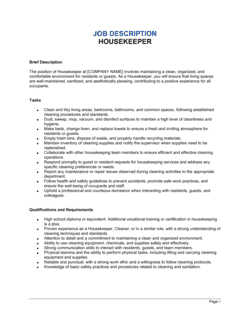
Maid and Housekeeping Cleaner Job Description Template

Free Word download β€’ Edit online β€’ Save & share with Drive β€’ Export to PDF

2 pagesβ€’20–30 min to fillβ€’Difficulty: Standardβ€’Signature requiredβ€’Legal review recommended
Learn more ↓
FreeMaid and Housekeeping Cleaner Job Description Template

At a glance

What it is
A Maid and Housekeeping Cleaner Job Description is a formal binding document that defines the role, responsibilities, standards of conduct, compensation, and terms of engagement for a residential or commercial cleaning employee. This free Word download gives you a structured, legally grounded starting point you can edit online and export as PDF to present to candidates or attach to an employment contract.
When you need it
Use it when hiring a full-time, part-time, or agency-placed cleaner for a private home, vacation rental, hotel, or commercial facility β€” and whenever you need a written record of agreed duties to support performance management or termination.
What's inside
Job title and reporting structure, detailed cleaning duties and room-by-room responsibilities, schedule and hours, compensation and benefits, conduct and appearance standards, equipment and chemical handling requirements, and termination conditions.

What is a Maid and Housekeeping Cleaner Job Description?

A Maid and Housekeeping Cleaner Job Description is a formal written document that defines the role title, cleaning duties, work schedule, compensation, conduct standards, equipment and chemical-handling requirements, and termination conditions for a residential or commercial cleaning employee. When signed by both the employer and the employee before the first day of work, it creates a binding record of agreed expectations that supports performance management, disciplinary action, and lawful termination. It is used by private households, hotels, vacation rental operators, cleaning companies, and care facilities to replace informal verbal arrangements with a clear, enforceable framework.

Why You Need This Document

Without a signed job description, every performance conversation and disciplinary decision rests on what was said rather than what was written β€” and verbal arrangements almost always favor the employee in an employment dispute. A cleaner who is dismissed for failing to meet standards the employer cannot document in writing has a strong basis for a wrongful dismissal or unfair dismissal claim in every major jurisdiction. Beyond performance management, the confidentiality and conduct clauses in a formal job description are the only reliable mechanism for holding a cleaner accountable for privacy breaches, theft, or unauthorized access to restricted areas of a property. Statutory leave entitlements omitted from the document do not disappear β€” they accrue silently and surface as underpayment liability at the point of termination. This template gives you a legally grounded, role-specific document you can complete in under 30 minutes, sign at onboarding, and rely on throughout the employment relationship.

Which variant fits your situation?

If your situation is…Use this template
Hiring a full-time live-in housekeeper for a private homeLive-In Housekeeper Employment Contract
Engaging a self-employed cleaner on a per-visit basisIndependent Contractor Agreement
Staffing hotel room attendants across multiple floorsHotel Housekeeping Job Description
Documenting a cleaning company's standard employee roleCleaning Technician Job Description
Hiring a part-time or casual cleaner for an officePart-Time Employment Contract
Onboarding a cleaner who handles hazardous or industrial chemicalsHealth and Safety Policy
Replacing an existing cleaner after performance issuesEmployee Termination Letter

Common mistakes to avoid

❌ Using vague duty language like 'general cleaning'

Why it matters: Courts and employment tribunals require specific documented standards to sustain performance-based termination. 'General cleaning' gives an employee room to argue any level of effort meets the description.

Fix: Break duties into room-by-room or zone-by-zone lists with task frequency. Attach a signed cleaning checklist as Schedule A to the job description.

❌ Omitting statutory leave entitlements for part-time staff

Why it matters: Part-time and casual cleaners accrue pro-rated annual leave, sick leave, and public holiday entitlements from day one in most jurisdictions. Omitting these creates underpayment liability.

Fix: Reference the applicable Employment Standards Act or Working Time Regulations in the compensation clause and state the pro-rated accrual formula for the employee's contracted hours.

❌ No signed acknowledgment of the job description

Why it matters: An unsigned job description is an unsigned document. In a wrongful dismissal, wage dispute, or confidentiality breach, the employer cannot prove the employee was bound by the terms.

Fix: Include a signature and date block at the bottom of the document and execute it before or on the first day of employment.

❌ Listing no grounds for immediate dismissal

Why it matters: Without a specific list of gross misconduct offenses, an employer who dismisses a cleaner for theft or a privacy breach may still owe full statutory notice or severance because 'gross misconduct' is disputed.

Fix: Enumerate at least four specific acts that constitute gross misconduct β€” theft, falsifying hours, unauthorized access to restricted areas, and confidentiality breach are standard inclusions for this role.

❌ Ignoring chemical and PPE safety requirements

Why it matters: If a cleaner is injured by a cleaning product and the job description contains no reference to MSDS, PPE, or safety training, the employer faces enhanced liability for failing to inform the worker of known hazards.

Fix: Add a dedicated equipment and chemical-handling clause, require the employee to sign an MSDS acknowledgment, and keep both documents on file separately.

❌ Setting overtime terms that conflict with statutory minimums

Why it matters: A clause requiring prior written approval for overtime does not eliminate the obligation to pay statutory overtime rates. If the employee works extra hours regardless, the employer owes the statutory rate.

Fix: Pair the approval requirement with a clear statement of the statutory overtime rate and the consequences of working unauthorized hours β€” discipline, not non-payment.

The 10 key clauses, explained

Job Title, Reporting Structure, and Work Location

In plain language: States the formal job title, who the cleaner reports to, and the specific property or properties where work will be performed.

Sample language
The Employee is engaged as [JOB TITLE] and shall report directly to [SUPERVISOR NAME / TITLE] at [PROPERTY ADDRESS / FACILITY NAME]. Work may be required at additional locations as directed by [EMPLOYER NAME] with reasonable notice.

Common mistake: Listing only a property address without naming a reporting supervisor. If the supervisor changes and no amendment is issued, the clause becomes unenforceable for direction-of-work disputes.

Scope of Cleaning Duties

In plain language: Defines the specific cleaning tasks the employee is required to perform, organized by area or frequency β€” daily, weekly, or on demand.

Sample language
Employee's duties include, but are not limited to: [DAILY TASKS β€” vacuuming, mopping, sanitizing bathrooms]; [WEEKLY TASKS β€” laundering linens, cleaning appliances]; and any additional tasks reasonably assigned by [SUPERVISOR TITLE].

Common mistake: Using 'general cleaning duties' as the entire description. Vague duty language makes performance management and termination for poor performance legally difficult to substantiate.

Work Schedule and Hours

In plain language: Specifies the days, start and end times, and total weekly hours the employee is engaged to work, including whether overtime is available or restricted.

Sample language
Employee shall work [X] hours per week on [DAYS OF THE WEEK], from [START TIME] to [END TIME]. Overtime beyond [X] hours per week requires prior written approval from [SUPERVISOR TITLE] and will be compensated at [OVERTIME RATE].

Common mistake: Not specifying whether the schedule is fixed or variable. A schedule listed as 'flexible' without parameters triggers disputes about minimum guaranteed hours in jurisdictions with zero-hours protections.

Compensation, Pay Frequency, and Benefits

In plain language: States the hourly rate or salary, how often payment is made, and any benefits β€” paid leave, sick pay, or uniform allowances β€” the employee is entitled to.

Sample language
Employee shall be paid at the rate of $[X] per hour / $[X] per week, payable [weekly / bi-weekly] by [METHOD]. Employee is entitled to [X] days paid leave per year accruing from the start date, in accordance with [APPLICABLE EMPLOYMENT STANDARDS ACT].

Common mistake: Omitting statutory leave entitlements because the employer considers the role 'part-time.' Part-time employees in most jurisdictions accrue pro-rated statutory leave from their first day of work.

Conduct, Appearance, and Personal Standards

In plain language: Sets expectations for professional behavior, uniform or dress code, punctuality, use of mobile devices during work hours, and treatment of the employer's property and personal items.

Sample language
Employee shall maintain a professional appearance in accordance with [EMPLOYER]'s uniform policy. Mobile device use is restricted to scheduled breaks. Employee shall treat all personal items, valuables, and confidential materials at [PROPERTY] with the utmost care and discretion.

Common mistake: Publishing a conduct standard without having the employee sign an acknowledgment. Courts require evidence that the employee was made aware of specific behavioral standards before disciplinary action can be taken.

Equipment, Supplies, and Chemical Handling

In plain language: Defines who provides cleaning equipment and supplies, the employee's responsibility for their care and storage, and mandatory safety protocols for handling cleaning chemicals.

Sample language
Employer shall provide all cleaning equipment and approved supplies. Employee shall use chemicals only as directed on the MSDS and shall wear provided PPE at all times when handling [SPECIFIED CHEMICALS]. Unauthorized substitution of cleaning products is prohibited.

Common mistake: Not referencing MSDS documents or PPE requirements in the job description. In the event of a chemical injury, an employer who cannot show the employee was informed of hazards faces significant liability exposure.

Confidentiality and Privacy Obligations

In plain language: Prohibits the employee from disclosing information about the employer, household members, guests, or business operations observed during the course of employment.

Sample language
Employee shall not disclose, discuss, or share any information concerning [EMPLOYER NAME], household members, guests, or visitors β€” including but not limited to financial matters, personal relationships, or property contents β€” during or after employment.

Common mistake: Skipping a confidentiality clause for domestic roles on the assumption it is 'obvious.' Courts require express written obligations; implied duties of discretion are difficult to enforce in most jurisdictions.

Probationary Period and Performance Review

In plain language: Sets an initial evaluation period, explains the reduced notice required for termination during probation, and describes when and how formal performance reviews occur.

Sample language
The first [30 / 60 / 90] days of employment constitute a probationary period during which either party may terminate this arrangement with [X] days' written notice. A formal performance review will be conducted at the end of the probationary period and annually thereafter.

Common mistake: Setting a probationary period but omitting a reduced-notice provision. Without it, statutory notice minimums apply from day one, negating the practical benefit of the probationary clause.

Termination, Notice, and Grounds for Immediate Dismissal

In plain language: States the notice period for voluntary or employer-initiated termination, and lists specific acts of gross misconduct that justify immediate dismissal without notice or pay in lieu.

Sample language
Either party may terminate employment with [X] weeks' written notice. Employer may terminate immediately without notice or pay in lieu for gross misconduct, including but not limited to: theft, falsifying time records, unauthorized entry to restricted areas, or breach of the confidentiality clause.

Common mistake: Listing a termination clause but failing to enumerate grounds for summary dismissal. Without a specific list, 'gross misconduct' is open to challenge and employers may be required to pay notice regardless of the severity of the incident.

Governing Law and Acknowledgment

In plain language: Identifies the jurisdiction whose employment law governs the agreement and includes an acknowledgment block confirming the employee has read, understood, and agreed to the terms.

Sample language
This Job Description and any associated Employment Agreement are governed by the laws of [STATE / PROVINCE / COUNTRY]. Employee acknowledges receipt, understanding, and acceptance of these terms by signing below. Signed: _________________ Date: _________________

Common mistake: Treating the job description as a standalone informational document without obtaining a signed acknowledgment. An unsigned job description provides no evidentiary value in a wrongful dismissal or performance dispute.

How to fill it out

  1. 1

    Enter the employer and property details

    Fill in the employer's full legal name (not a trade name), the specific property address where work will be performed, and the name and title of the direct supervisor. For multi-property roles, list all locations or attach a schedule.

    πŸ’‘ Use the same legal entity name that appears on your payroll records. Discrepancies between the job description and pay stubs complicate wage dispute defenses.

  2. 2

    Define the scope of duties by area and frequency

    List cleaning tasks organized by room or zone and frequency β€” daily, weekly, monthly, and on-demand. Be specific: 'sanitize bathroom fixtures' is enforceable; 'clean bathrooms' is not.

    πŸ’‘ Attach a separate cleaning checklist as Schedule A. This lets you update task specifics without amending the main document, and it doubles as a daily performance tool.

  3. 3

    Set the schedule, hours, and overtime policy

    Enter the days of the week, start and end times, total weekly hours, and whether the schedule is fixed or variable. State the overtime threshold and approval process explicitly.

    πŸ’‘ If the schedule varies week to week, include minimum guaranteed hours to avoid zero-hours contract disputes in jurisdictions that restrict them.

  4. 4

    Complete the compensation and benefits block

    Enter the hourly rate or weekly salary, pay frequency, payment method, and all statutory entitlements β€” paid leave, sick pay, and any employer-provided benefits such as uniforms or transportation allowances.

    πŸ’‘ Check the applicable minimum wage for the employee's work location on the date of hire β€” minimum wage rates are updated annually in most US states, Canadian provinces, and UK pay cycles.

  5. 5

    Specify conduct, appearance, and device-use standards

    Describe the uniform or dress code, punctuality expectations, rules for mobile phone use during work hours, and the standard of care expected for the employer's property and personal items.

    πŸ’‘ Have the employee initial the conduct section separately at signing to create clear evidence they acknowledged the specific behavioral standards.

  6. 6

    Document equipment, supplies, and chemical safety protocols

    State who provides equipment and supplies, what PPE is required, and that all chemicals must be used in accordance with their MSDS. Reference any site-specific safety induction the employee must complete.

    πŸ’‘ Keep a signed copy of the MSDS acknowledgment on file separately from the job description β€” this is the key document in a workplace chemical injury claim.

  7. 7

    Set the probationary period and notice terms

    Enter the probationary period duration (typically 30–90 days), the reduced notice applicable during probation, and the standard notice period after confirmation of employment.

    πŸ’‘ In Canadian provinces and the UK, probationary-period notice terms must still meet or exceed statutory minimums β€” confirm the applicable floor before entering a shorter period.

  8. 8

    Obtain signatures before the first day of work

    Have both the employer and the employee sign and date the document before or on the employee's first day. File the original and provide the employee with a copy.

    πŸ’‘ Post-start-date signatures risk voiding restrictive covenants β€” particularly confidentiality clauses β€” in common-law jurisdictions without fresh consideration.

Frequently asked questions

What is a maid and housekeeping cleaner job description?

A maid and housekeeping cleaner job description is a formal document that defines the role title, cleaning duties, work schedule, compensation, conduct standards, equipment requirements, and termination conditions for a residential or commercial cleaning employee. It functions both as an onboarding document and as the written record that supports performance management and, if necessary, lawful termination.

Is a job description a legally binding document?

A job description becomes legally binding when it is signed by both the employer and the employee and incorporated by reference into an employment contract or letter of engagement. An unsigned job description is informational only. To be enforceable β€” particularly for confidentiality obligations and conduct standards β€” it must be acknowledged in writing before the employee's first day of work.

What duties should be included in a housekeeping cleaner job description?

At minimum: vacuuming, mopping, dusting, and surface sanitization; bathroom and kitchen cleaning with specific task frequency; linen and laundry handling; waste removal; equipment care and storage; and any specialized tasks such as window cleaning, oven cleaning, or biohazard protocols. Duties should be organized by room or zone and frequency β€” daily, weekly, monthly β€” to give the employee a clear performance standard.

Can I use this job description for both residential and hotel housekeeping staff?

Yes, with targeted adjustments. Residential roles typically include household-specific tasks such as laundry, dishwashing, and care of personal items. Hotel and commercial roles focus on room turnovers, productivity benchmarks (rooms per shift), trolley stocking, and lost property procedures. The core structure β€” duties, schedule, compensation, conduct, and termination β€” applies to both contexts.

Do I need a separate employment contract if I use this job description?

For formal employment relationships, yes. A job description defines the role and its requirements; an employment contract governs the legal relationship β€” IP assignment, governing law, dispute resolution, and severance. For simple domestic arrangements, a signed job description with a compensation clause and termination terms can serve as a combined document in many jurisdictions, but a standalone employment contract provides stronger legal protection.

What is the difference between a maid and an independent cleaning contractor?

A maid or housekeeping cleaner employed under a job description is an employee β€” the employer withholds taxes, provides statutory benefits, and directs when and how the work is performed. An independent cleaning contractor sets their own hours, uses their own equipment, and invoices per visit. Misclassifying an employee as a contractor triggers back taxes, penalty contributions, and benefit liability in every major jurisdiction. The degree of control the employer exercises over the work is the primary classification test.

What conduct standards should a housekeeping job description include?

Standard conduct expectations for a cleaner include: punctuality and reliable attendance, wearing the required uniform, restricting mobile phone use to scheduled breaks, treating the employer's property and personal items with care and discretion, not admitting unauthorized visitors to the property, and maintaining confidentiality about household members, guests, and financial matters. These should be documented in the job description and acknowledged with a signature.

How do probationary periods work for housekeeping staff?

A probationary period β€” typically 30 to 90 days β€” allows the employer to evaluate performance before confirming full employment status. During probation, a shorter notice period (typically 1–2 weeks rather than the standard period) is contractually valid, provided it meets or exceeds the statutory minimum in the applicable jurisdiction. At the end of probation, a formal performance review should determine whether employment is confirmed, extended, or ended.

How this compares to alternatives

vs Employment Contract

An employment contract governs the full legal relationship β€” compensation, IP, governing law, and severance. A job description defines role-specific duties, conduct standards, and scheduling. Both documents are typically used together: the job description is attached as a schedule to the employment contract and signed at the same time. Using only one leaves either the legal obligations or the operational expectations undocumented.

vs Independent Contractor Agreement

An independent contractor agreement engages a self-employed cleaner who sets their own hours, uses their own equipment, and invoices per job. A job description creates an employment relationship with tax withholding, statutory leave, and direct supervision. Misclassifying a cleaner who works regular scheduled hours as a contractor exposes the employer to back taxes, benefits liability, and regulatory penalties.

vs Job Offer Letter

A job offer letter confirms the role title and salary to secure the candidate's acceptance. It is not a performance management tool and typically lacks duty schedules, conduct standards, and termination grounds. A signed job description supplements the offer letter with the operational and behavioral detail needed to manage the role day-to-day and support lawful disciplinary action.

vs Employee Handbook

An employee handbook sets company-wide policies β€” anti-harassment, expense reimbursement, PTO β€” that apply to all staff. A job description is role-specific, covering the particular duties, schedule, equipment, and standards for a single position. Both should be signed at onboarding; the handbook governs conduct across the organization while the job description governs the individual role.

Industry-specific considerations

Hospitality and Hotels

Room turnover targets (rooms per shift), lost-property logging procedures, trolley stocking checklists, and guest privacy obligations under hotel data protection policies.

Vacation Rental and Short-Term Let

Tight turnaround windows between guest check-out and check-in, linen laundering and restocking protocols, and property damage reporting obligations to the operator.

Senior Care and Assisted Living

Infection control and clinical-grade disinfection requirements, resident dignity and privacy obligations, and mandatory reporting of hazards or safeguarding concerns.

Residential Property Management

Cleaning standards across multiple units, key-holding and access-control responsibilities, and coordination with maintenance and repair teams between tenancy changeovers.

Jurisdictional notes

United States

At-will employment is the default in 49 states, but domestic workers in states such as New York, California, and Hawaii are covered by Domestic Worker Bills of Rights that mandate minimum rest periods, overtime pay, and advance termination notice. The FLSA requires overtime at 1.5Γ— for hours over 40 per week for non-exempt cleaners. Several states require written pay-rate notice at hire β€” a signed job description with a compensation clause satisfies this requirement in most cases.

Canada

Each province sets its own Employment Standards Act minimums for minimum wage, overtime thresholds, statutory holidays, and termination notice β€” contracts that provide less are void to the extent they fall below the floor. Ontario requires written notice of termination of at least 1 week per year of service for employees with more than 3 months of service. Live-in caregivers and domestic workers have additional protections under provincial regulations. Quebec job descriptions must be provided in French for provincially regulated employers.

United Kingdom

Employers must provide a written statement of employment particulars on or before the first day of work under the Employment Rights Act 1996 β€” a signed job description with compensation and notice terms satisfies much of this requirement. The National Living Wage applies to all workers aged 21 and over and is updated each April. Cleaners are entitled to 5.6 weeks of paid annual leave per year pro-rated by contracted hours. Zero-hours contracts must comply with the Workers (Predictable Terms and Conditions) Act 2023 provisions on minimum notice of shift patterns.

European Union

The EU Transparent and Predictable Working Conditions Directive requires employers to provide written terms within 7 days of hire, including working hours, rest periods, and pay. Several member states β€” France, Germany, and the Netherlands β€” impose sector-specific minimum wages and collective agreement requirements that apply to cleaning and domestic workers. GDPR obligations apply where the cleaner has access to household or guest personal data; a confidentiality clause in the job description is necessary but may need supplementing with a formal data processing notice.

Template vs lawyer β€” what fits your deal?

PathBest forCostTime
Use the templatePrivate household employers, small cleaning companies, and vacation rental operators hiring a single cleaner in a standard domestic roleFree20–30 minutes
Template + legal reviewEmployers in Canada, the UK, or EU where statutory minimum entitlements are complex, or where the role involves significant access to valuables or sensitive personal information$200–$500 for a 1-hour employment lawyer review1–3 days
Custom draftedHotel chains, care facilities, or cleaning companies hiring across multiple jurisdictions with specialized chemical, biohazard, or clinical hygiene requirements$800–$2,500+1–2 weeks

Glossary

Job Description
A written document outlining the title, duties, reporting structure, qualifications, and conditions of a specific employment role.
Scope of Duties
The defined set of tasks and responsibilities an employee is expected to perform as part of their role.
Room Turnover
The process of cleaning, restocking, and preparing a room or unit for the next occupant β€” a key productivity metric in hotel and vacation rental contexts.
Personal Protective Equipment (PPE)
Gloves, masks, goggles, or other gear the employer provides and requires the cleaner to wear when handling chemicals or biohazardous materials.
Material Safety Data Sheet (MSDS)
A standardized document detailing the hazards, safe handling, and emergency procedures for a specific cleaning chemical or substance.
At-Will Employment
Employment that either party may end at any time for any lawful reason β€” the default standard in most US states, but absent in Canada, the UK, and the EU.
Probationary Period
An initial period β€” typically 30 to 90 days β€” during which the employer evaluates the cleaner's performance before confirming full employment status.
Non-Disclosure Obligation
A duty placed on the employee not to share confidential information about the employer, household members, guests, or business operations.
Gross Misconduct
Serious breaches of conduct β€” such as theft, falsifying time records, or exposing a household to harm β€” that justify immediate termination without notice or severance.
Casual Worker
A worker engaged on an as-needed basis with no guaranteed hours, who may not have the same statutory entitlements as a regular part-time or full-time employee.

Part of your Business Operating System

This document is one of 3,000+ business & legal templates included in Business in a Box.

  • Fill-in-the-blanks β€” ready in minutes
  • 100% customizable Word document
  • Compatible with all office suites
  • Export to PDF and share electronically

Create your document in 3 simple steps.

From template to signed document β€” all inside one Business Operating System.
1
Download or open template

Access over 3,000+ business and legal templates for any business task, project or initiative.

2
Edit and fill in the blanks with AI

Customize your ready-made business document template and save it in the cloud.

3
Save, Share, Send, Sign

Share your files and folders with your team. Create a space of seamless collaboration.

Save time, save money, and create top-quality documents.

β˜…β˜…β˜…β˜…β˜…

"Fantastic value! I'm not sure how I'd do without it. It's worth its weight in gold and paid back for itself many times."

Managing Director Β· Mall Farm
Robert Whalley
Managing Director, Mall Farm Proprietary Limited
β˜…β˜…β˜…β˜…β˜…

"I have been using Business in a Box for years. It has been the most useful source of templates I have encountered. I recommend it to anyone."

Business Owner Β· 4+ years
Dr Michael John Freestone
Business Owner
β˜…β˜…β˜…β˜…β˜…

"It has been a life saver so many times I have lost count. Business in a Box has saved me so much time and as you know, time is money."

Owner Β· Upstate Web
David G. Moore Jr.
Owner, Upstate Web

Run your business with a system β€” not scattered tools

Stop downloading documents. Start operating with clarity. Business in a Box gives you the Business Operating System used by over 250,000 companies worldwide to structure, run, and grow their business.

Start freeΒ Β·Β No credit card required