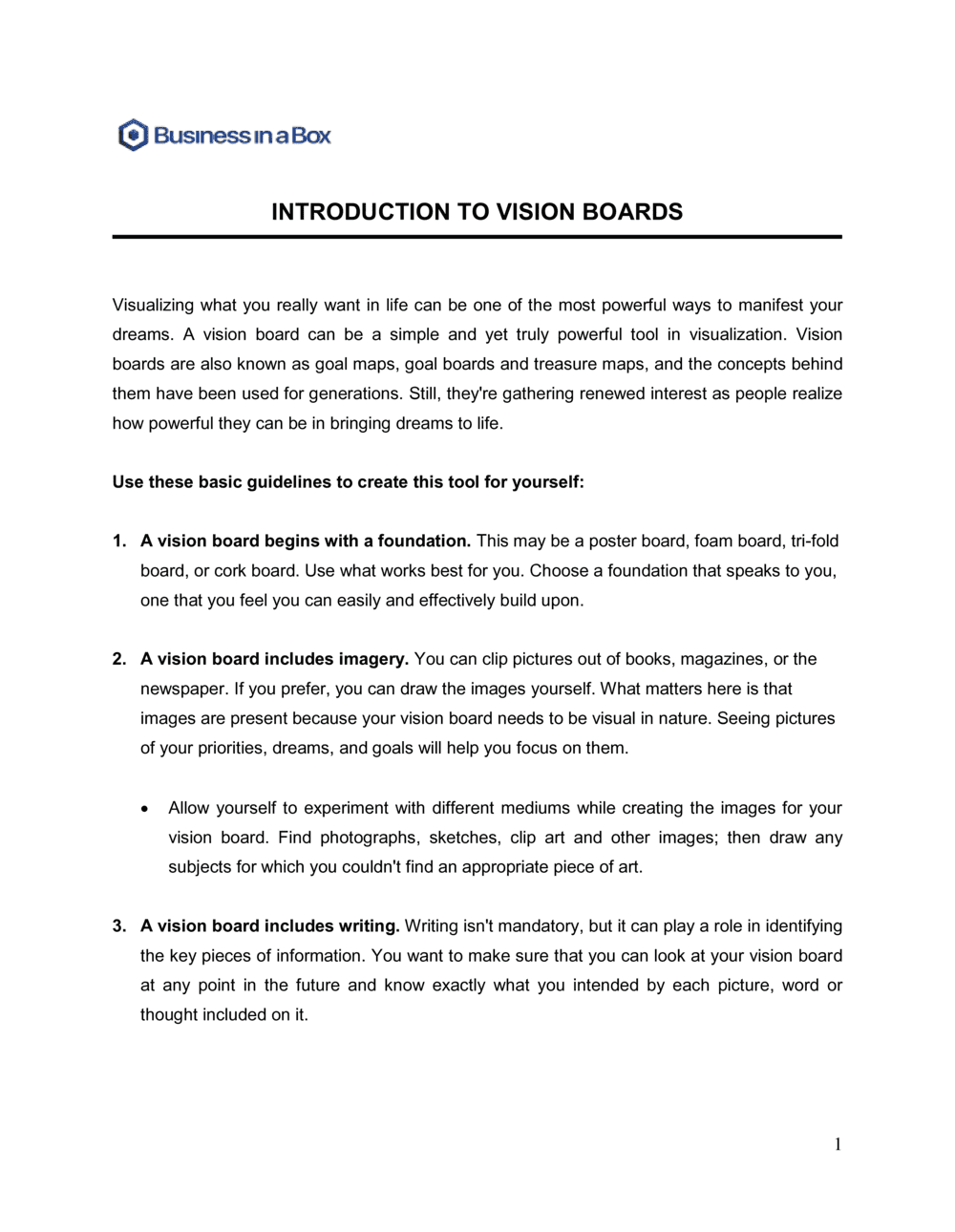
Introduction To Vision Boards Template

Free to read • Save or share with one click

FreeIntroduction To Vision Boards Template

At a glance

What it is
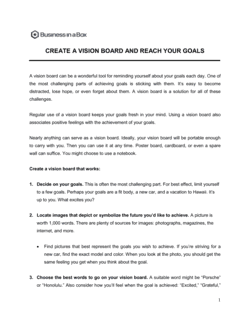
An Introduction to Vision Boards is a formal letter or guide that explains the concept, purpose, and process of vision boarding to a team, group, or individual recipient. This free Word download gives you a structured starting point you can edit online and distribute as a printed handout or PDF ahead of a workshop, coaching session, or strategic planning event.
When you need it
Use it when preparing employees, students, coaching clients, or workshop participants for a vision board activity — giving them context and instructions before the session begins so the time together is productive.
What's inside
A warm opening that frames the purpose, a plain-language explanation of what a vision board is, guidance on gathering materials and selecting imagery, instructions for the creation process, and a closing that encourages commitment and next steps.

What is an Introduction to Vision Boards?

An Introduction to Vision Boards is a formal letter or preparatory handout that explains the concept, purpose, and process of vision boarding to participants ahead of a structured activity or workshop. It defines what a vision board is — a curated collection of images, words, and symbols representing a person's goals and aspirations — outlines the materials needed, provides reflection prompts to prime intentional participation, and walks recipients through the creation process step by step. The document bridges the gap between an invitation to a session and meaningful participation in it, ensuring participants arrive prepared, focused, and ready to engage.

Why You Need This Document

Without a clear introduction, vision board sessions frequently stall on logistics — participants arrive without materials, spend the first 20 minutes asking what a vision board is, or produce shallow boards because they haven't reflected on their goals in advance. The result is a session that feels like a craft activity rather than a strategic goal-setting exercise. A well-written introduction letter eliminates all three problems by setting expectations, supplying a materials list, and delivering reflection prompts before the room fills. It also establishes your credibility as a facilitator or coach by signaling that the session has been thoughtfully designed. This template gives you a ready-to-customize document you can personalize in 15 minutes and distribute to any audience — corporate teams, coaching clients, or students — without starting from a blank page.

Which variant fits your situation?

If your situation is…Use this template
Running a vision board workshop for a corporate teamTeam Vision Board Workshop Agenda
Introducing vision boards in a one-on-one coaching contextCoaching Session Introduction Letter
Using vision boards as part of an annual strategic planning retreatStrategic Planning Template
Distributing a goal-setting framework alongside the vision board introPersonal Development Plan
Following up after the vision board session with action stepsAction Plan Template
Introducing vision boards to students in a school or university settingStudent Goal-Setting Letter

Common mistakes to avoid

❌ Skipping the purpose statement

Why it matters: Participants who don't understand why they are doing a vision board exercise treat it as arts and crafts rather than a serious goal-setting tool, limiting its long-term impact.

Fix: Include two sentences explaining the specific outcome the facilitator intends — clarity of purpose directly increases participant engagement and follow-through.
❌ Omitting the materials list

Why it matters: Participants who arrive without supplies either borrow from others, disrupting the session, or cannot participate fully — reducing the quality of output for the whole group.

Fix: Distribute the introduction letter at least five days before the session with a clear, itemized materials list and any digital setup instructions.

❌ Over-prescribing the layout

Why it matters: Vision boards derive their effectiveness from personal ownership — when participants feel they are following a template rather than expressing genuine goals, the boards lack meaning and are rarely revisited.

Fix: Provide the step-by-step process as a suggested framework, not a mandatory structure, and explicitly tell participants that personal variation is encouraged.

❌ No follow-up or display guidance

Why it matters: Without instructions to display and regularly review the board, most participants file it away within a week — turning a powerful exercise into a one-time event with no lasting behavioral impact.

Fix: Include specific display guidance (location, frequency of review) and schedule at least one follow-up touchpoint — a 30-day check-in email or group share-out session.

The 9 key clauses, explained

Opening salutation and context

In plain language: Greets the recipient and briefly explains why they are receiving this document — setting the tone for the session or activity ahead.

Sample language
Dear [RECIPIENT NAME / TEAM NAME], I am delighted to share this introduction as we prepare for our upcoming [WORKSHOP / SESSION / RETREAT] on [DATE].

Common mistake: Using a generic 'To Whom It May Concern' salutation — an impersonal opener reduces engagement and signals the letter was not tailored to the audience.

Purpose statement

In plain language: Explains in one or two sentences why vision boarding is being introduced and what outcome the facilitator or sender hopes it will achieve.

Sample language
This session is designed to help you clarify your goals for the coming [TIMEFRAME] and create a tangible visual reference that keeps your priorities front of mind every day.

Common mistake: Skipping the purpose statement entirely and jumping into instructions — participants who don't understand the 'why' engage less seriously with the exercise.

Definition of a vision board

In plain language: Provides a plain-language explanation of what a vision board is, how it works, and the principle behind visualization as a goal-setting tool.

Sample language
A vision board is a curated collection of images, words, and phrases that represent your goals and the life or career you are working toward. By seeing these images daily, you keep your intentions active and your decisions aligned with your deeper aspirations.

Common mistake: Overloading this section with citations or scientific debate — participants need clarity and motivation, not a literature review.

Materials list

In plain language: Lists everything the participant needs to bring or prepare before the session — magazines, scissors, adhesives, a board or digital tool.

Sample language
Please bring: a foam board or poster (approx. [SIZE]), old magazines or printed images, scissors, glue or tape, markers, and any personal photos that inspire you. If participating digitally, download [TOOL NAME] in advance.

Common mistake: Omitting the materials list and assuming participants will figure it out — missing materials stall the session and frustrate participants.

Pre-session reflection prompts

In plain language: Provides two to four questions for participants to consider before the session to prime intentional, focused imagery selection.

Sample language
Before the session, take 10 minutes to reflect: What do I want to achieve in the next [TIMEFRAME]? What does my ideal [CAREER / LIFE / YEAR] look and feel like? What values do I want to honour?

Common mistake: Providing too many prompts (more than five) — participants feel overwhelmed and arrive without clear focus rather than with sharper clarity.

Step-by-step creation instructions

In plain language: Walks participants through the process of building their board — setting an intent, selecting images, arranging and adhering them, and adding written affirmations.

Sample language
Step 1: Write your intent statement at the top of your board. Step 2: Select images that resonate with each goal area. Step 3: Arrange before gluing. Step 4: Add affirmations or key words. Step 5: Place your anchor image at the centre.

Common mistake: Prescribing a rigid layout — vision boards are personal; over-instructing inhibits creative ownership and reduces participant buy-in.

Guidance on goal areas

In plain language: Suggests categories to consider — career, relationships, health, finances, personal growth, travel — without mandating that every area be covered.

Sample language
Consider including images that represent different areas of your life: [CAREER / PURPOSE], [HEALTH / WELLNESS], [RELATIONSHIPS / COMMUNITY], [FINANCES / ABUNDANCE], and [PERSONAL GROWTH / LEARNING]. Choose the areas most meaningful to you.

Common mistake: Listing goal areas as mandatory sections rather than optional prompts — participants with a narrow, focused vision feel pressured to fill categories that don't apply.

Post-session commitment and display guidance

In plain language: Encourages participants to display their finished board somewhere visible and to review it regularly — turning the one-time exercise into an ongoing practice.

Sample language
Place your completed board somewhere you will see it every day — your desk, bathroom mirror, or digital home screen. Spend 2–3 minutes each morning reviewing your intentions before starting your day.

Common mistake: Ending the letter without any follow-through guidance — the board becomes a craft project rather than an active goal-setting tool.

Closing and sender sign-off

In plain language: Closes with encouragement, states any follow-up actions (e.g., sharing photos, scheduling a debrief), and includes the sender's name and role.

Sample language
I look forward to creating with you on [DATE]. If you have any questions beforehand, please reach me at [EMAIL / PHONE]. Warmly, [SENDER NAME], [TITLE / ROLE], [ORGANISATION].

Common mistake: Closing without a follow-up action or contact detail — participants are left unsure what happens next and engagement drops before the session begins.

How to fill it out

  1. 1

    Personalize the salutation and opening context

    Replace [RECIPIENT NAME / TEAM NAME] with the specific person, group, or department receiving the letter. Add the session date and your organization's name so the document feels purposeful.

    💡 Named recipients open and read introductory letters at a measurably higher rate than those addressed generically.

  2. 2

    Set the goal horizon

    Decide whether the vision board exercise covers 1 year, 3 years, or a specific life chapter, and use that timeframe consistently throughout the letter. Inconsistent timeframes confuse participants.

    💡 One year is the most actionable horizon for first-time participants; reserve 3–5 year boards for experienced practitioners.

  3. 3

    Tailor the materials list to the format

    If running a physical workshop, list the physical supplies. If running a digital session, name the specific tool (Canva, Miro, Pinterest) and include a setup link.

    💡 Send the materials list at least five days before the session so participants have time to gather supplies.

  4. 4

    Select two to three pre-session reflection prompts

    From the suggested prompts in the template, keep two or three that best match your audience — employees focusing on career growth need different prompts than coaching clients working on life balance.

    💡 Prompts framed as 'What does success look like?' outperform prompts framed as 'What do you want?' — the former encourages sensory, visual thinking.

  5. 5

    Adjust the goal area categories to your audience

    For a corporate audience, lead with career, professional development, and team contribution. For a life coaching audience, lead with health, relationships, and personal growth.

    💡 Limit suggested goal areas to five — more than five fragments attention and dilutes the board's visual focus.

  6. 6

    Add your contact information and follow-up action

    Include your email or phone number and state the next step — whether that's a debrief meeting, a group share-out, or a check-in at 30 days.

    💡 Scheduling the follow-up at the time of the workshop, not after, doubles the likelihood participants actually review their boards.

Frequently asked questions

What is an Introduction to Vision Boards document?

An Introduction to Vision Boards is a formal letter or handout that explains the concept and process of vision boarding to participants before a workshop, coaching session, or team event. It covers what a vision board is, why the exercise is valuable, what materials are needed, and how to approach the creation process — so the session itself can focus on doing rather than explaining.

Who should receive this letter?

Anyone participating in a vision board activity benefits from receiving this introduction in advance. Common recipients include employees ahead of a company goal-setting workshop, coaching clients starting a new engagement, students in a personal development program, or leadership teams preparing for a strategic planning retreat. The letter can be distributed by HR, a facilitator, a coach, or a team leader.

How far in advance should I send this letter?

Send it at least five to seven days before the session. This gives participants time to gather physical materials, download any digital tools, and complete the pre-session reflection prompts thoughtfully. Sending it the day before reduces preparation quality and leads to rushed or shallow boards.

Can this letter be used for a digital vision board session?

Yes. Replace the physical materials list with the name of the digital platform you are using — Canva, Miro, or Pinterest are common choices — and include a setup link or login instructions. The reflection prompts, goal area categories, and creation steps apply equally to digital formats.

How long should the Introduction to Vision Boards letter be?

One to two pages is the right length. Long enough to give participants genuine context and clear instructions, short enough that they actually read it in full. If your letter exceeds two pages, the materials list or instructions have become too detailed — move excess content to a separate workshop agenda or facilitator guide.

What goal areas should I suggest in the letter?

For corporate or professional audiences, focus on career development, team contribution, skills growth, and work-life integration. For life coaching or personal development contexts, include health, relationships, finances, personal growth, and travel. Limit suggestions to four or five areas and frame them as optional prompts rather than mandatory sections.

Does a vision board letter need to be formally signed?

No formal signature is required. A warm, professional sign-off with the sender's name, title, and contact details is sufficient. The letter is informational and motivational, not a binding document — the tone should be encouraging and personal rather than formal or legalistic.

How do I make the letter feel relevant to a corporate audience?

Anchor the purpose statement to business outcomes — team alignment, goal clarity, or performance in the coming year — rather than personal life aspirations. Use the company name and team name throughout, replace personal goal categories with professional ones, and frame follow-up actions around existing team rituals like quarterly reviews or one-on-ones.

How this compares to alternatives

vs Personal Development Plan

A personal development plan is a structured written document that maps specific skills, milestones, and timelines for professional growth. An Introduction to Vision Boards letter is a preparatory guide for a visual, intuition-led goal-setting exercise. The two complement each other — use the vision board letter to surface aspirations, then capture actionable steps in the development plan.

vs Action Plan Template

An action plan translates defined goals into specific tasks, owners, deadlines, and success metrics. A vision board introduction focuses on clarifying and visualizing goals before any tactical planning begins. Vision boarding typically precedes action planning — it generates the 'what and why' that the action plan then operationalizes.

vs Strategic Planning Template

A strategic plan is a formal multi-section document covering market analysis, objectives, initiatives, and financial targets for an organization. A vision board introduction is a lightweight, personal facilitation tool used at the individual or small-team level. Strategic planning operates at the organizational level with quantitative rigor; vision boarding operates at the aspirational level with visual and emotional resonance.

vs Workshop Agenda Template

A workshop agenda sequences the activities, timings, and facilitator instructions for the session itself. An Introduction to Vision Boards letter is a pre-session document sent to participants to prepare them before they arrive. The two work in tandem — the introduction primes participants; the agenda guides the facilitator through delivery.

Industry-specific considerations

Human Resources and L&D

Used to prime employees before annual goal-setting workshops, onboarding retreats, or leadership development programs where vision alignment is a core objective.

Coaching and Consulting

Distributed to new coaching clients at the start of an engagement to establish vision boarding as a foundational tool for the entire coaching relationship.

Education

Used by teachers, university advisors, and student affairs staff to introduce goal-setting and visualization exercises in personal development or orientation programs.

Health and Wellness

Incorporated into wellness programs, mental health initiatives, and therapeutic group settings where goal clarity and positive visualization support participant outcomes.

Template vs pro — what fits your needs?

PathBest forCostTime
Use the templateHR managers, coaches, educators, and team leads running their own vision board sessionsFree15–30 minutes to customize and send
Template + professional reviewOrganizations embedding vision boarding in a formal L&D program or coaching curriculum$100–$300 for a facilitator or coach to review and tailor the content1–2 hours
Custom draftedExecutive coaching firms or corporate L&D teams building a proprietary vision board methodology at scale$500–$1,500 for a professional facilitator or instructional designer3–5 days

Glossary

Vision Board
A physical or digital collage of images, words, and symbols that represent a person's or team's goals and aspirations for a defined future period.
Visualization
A goal-setting technique in which a person mentally pictures achieving a desired outcome in order to clarify intention and build motivation.
Affirmation
A short, positive statement written or displayed on a vision board to reinforce a desired belief, habit, or goal.
Facilitation
The process of guiding a group through a structured activity or discussion to reach a defined outcome.
Intent Statement
A brief written declaration of the specific outcome or transformation a participant wants the vision board to represent.
Core Values
The fundamental beliefs or principles — such as integrity, creativity, or family — that guide a person's decisions and priorities.
Goal Horizon
The timeframe over which a vision board's goals are set — commonly 1 year, 3 years, or a specific life chapter.
Anchor Image
A single central image on a vision board that captures the overarching theme or most important aspiration of the creator.

Part of your Business Operating System

This document is one of 3,000+ business & legal templates included in Business in a Box.

  • Fill-in-the-blanks — ready in minutes
  • Compatible with all office suites
  • Export to PDF and share electronically

Create your document in 3 simple steps.

From template to signed document — all inside one Business Operating System.
1
Download or open template

Access over 3,000+ business and legal templates for any business task, project or initiative.

2
Edit and fill in the blanks with AI

Customize your ready-made business document template and save it in the cloud.

3
Save, Share, Send, Sign

Share your files and folders with your team. Create a space of seamless collaboration.

Save time, save money, and create top-quality documents.

★★★★★

"Fantastic value! I'm not sure how I'd do without it. It's worth its weight in gold and paid back for itself many times."

Managing Director · Mall Farm
Robert Whalley
Managing Director, Mall Farm Proprietary Limited
★★★★★

"I have been using Business in a Box for years. It has been the most useful source of templates I have encountered. I recommend it to anyone."

Business Owner · 4+ years
Dr Michael John Freestone
Business Owner
★★★★★

"It has been a life saver so many times I have lost count. Business in a Box has saved me so much time and as you know, time is money."

Owner · Upstate Web
David G. Moore Jr.
Owner, Upstate Web

Run your business with a system — not scattered tools

Stop downloading documents. Start operating with clarity. Business in a Box gives you the Business Operating System used by over 250,000 companies worldwide to structure, run, and grow their business.

Free Forever Plan · No credit card required